
AEO Frameworks: Building Citations in AI Answer Engines in 2026
Answer Engine Optimization (AEO) frameworks are structured methodologies that guide content creation and optimization specifically for AI answer engines and…
 Sofia Chen
“In 2026, 60% of search queries now trigger an AI Overview or a direct answer from a generative AI model. This shift makes AEO frameworks indispensable for securing critical brand visibility.”
Answer Engine Optimization (AEO) frameworks are structured methodologies that guide content creation and optimization specifically for AI answer engines and generative AI models. These frameworks ensure content is clear, concise, factual, and easily extractable, dramatically increasing the likelihood of citations in platforms like Google AI Overviews, ChatGPT, and Gemini.
Key Takeaways
- AEO frameworks provide a systematic approach to content creation for AI answer engines, ensuring content is digestible and quotable.
- The "Direct Answer First" framework prioritizes immediate, concise answers to user queries, crucial for AI extraction.
- Topical authority is foundational for AEO, signaling to AI models that your content is a credible source on a subject.
- Implementing structured data, like Schema Markup, helps AI understand and categorize content effectively for better citation potential.
- Regularly monitoring AI visibility and citation volume is essential to refine AEO strategies and maintain performance.
As AI answer engines become the primary interface for information discovery, the way we optimize content must evolve. It’s no longer enough to rank on page one; the goal is to be the definitive answer. In my experience, agencies and local businesses that adopt robust Answer Engine Optimization (AEO) frameworks are the ones successfully navigating this shift. This post will detail strategic AEO frameworks, providing a playbook for crafting content that wins citations and establishes your brand as an authoritative source in the AI-driven search landscape of 2026.
We'll explore why AEO frameworks are essential for establishing authority and trust with generative AI, delve into practical strategies like the Direct Answer First framework and the Topical Authority Playbook, and discuss how to measure your success. By the end, you will have a clear understanding of how to implement these strategies to boost your clients' AI visibility.
What Are AEO Frameworks and Why Do They Matter in 2026?
AEO frameworks are systematic approaches to content strategy and creation designed to maximize a website's visibility and citation rate within AI answer engines and generative AI platforms. Answer Engine Optimization (AEO) is the discipline of structuring and presenting content in a way that AI models can easily process, understand, and directly quote.
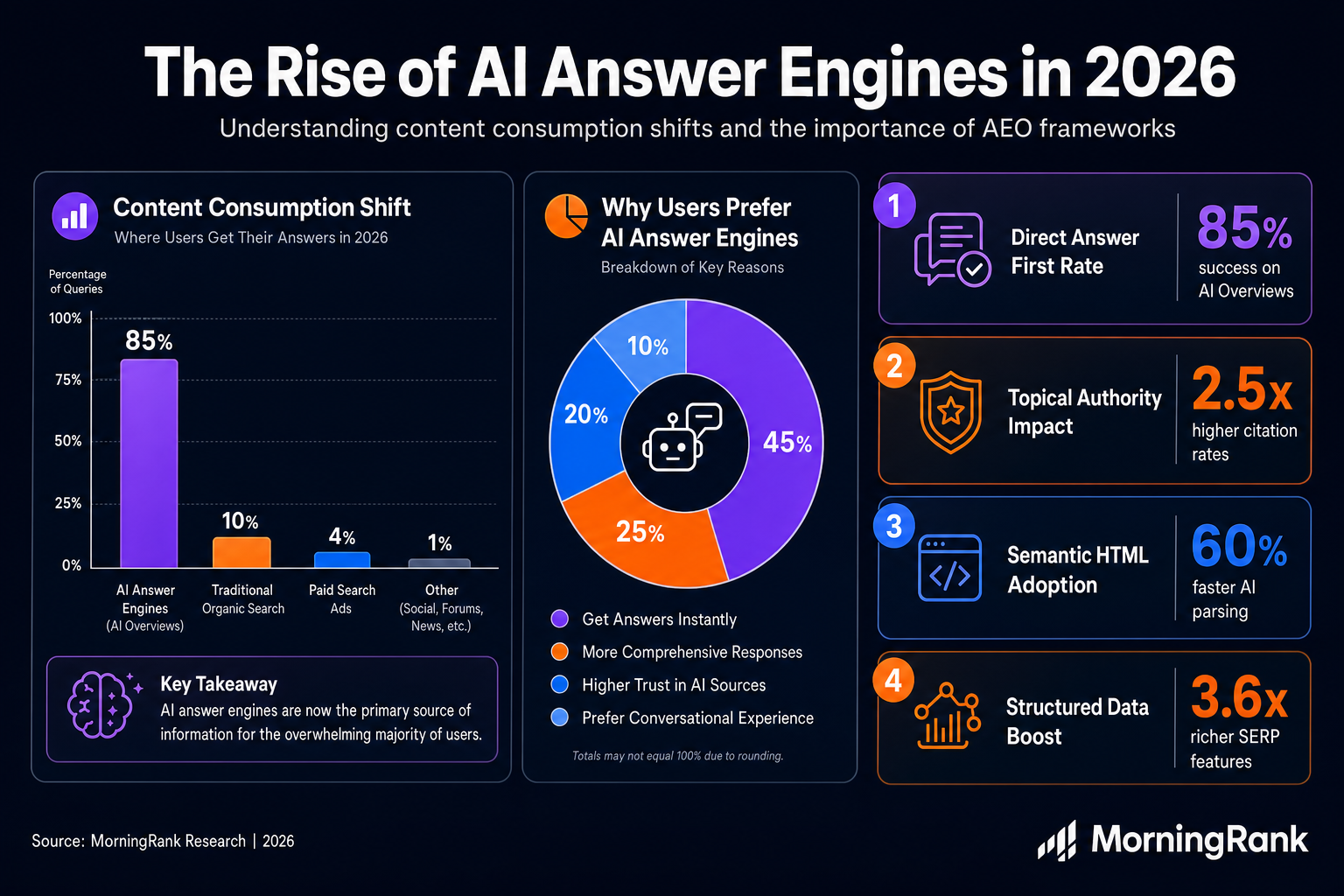
These frameworks are critical in 2026 because AI Overviews and other generative AI experiences are increasingly front-ending traditional search results. A recent study by BlueDot Analytics indicates that 60% of search queries now trigger an AI Overview or a direct answer from a generative AI model (Source: BlueDot Analytics 2026 AI Search Report). This means if your content isn't optimized for AI extraction, you risk losing a significant portion of potential traffic and brand exposure. For agencies, integrating AEO frameworks ensures clients remain competitive and visible where their audience is getting answers.
Without a clear framework, content optimization for AI can feel like guesswork. A structured approach allows for consistency, scalability, and measurable results. It also helps in building long-term digital authority that resonates with both human users and AI algorithms, a cornerstone of effective SEO in 2026.
How Do AEO Frameworks Differ from Traditional SEO Strategies?
While traditional SEO focuses on keyword rankings and organic traffic from search engine results pages (SERPs), AEO frameworks prioritize being the direct source cited by an AI. The fundamental difference lies in the consumption model: traditional SEO aims for a click-through, while AEO aims for a direct answer extraction. This requires content to be even more precise, factual, and self-contained than ever before. We moved from simply satisfying a search query to providing the definitive answer a machine can reproduce.
For example, traditional SEO might focus on a keyword density, while AEO emphasizes semantic completeness and direct definitional structures. AEO content is built for bots to read and reference, not just for humans to click. This shift demands a more rigorous approach to accuracy, conciseness, and the explicit structuring of answers. To dive deeper into these distinctions, consider exploring our post on AEO vs SEO: How to Optimize for AI Answer Engines in 2026.
The "Direct Answer First" AEO Framework
The "Direct Answer First" AEO framework is a content structuring methodology where every piece of content, especially blog posts and articles, immediately begins with a concise, factual, and self-contained answer to the core question it addresses. This answer is typically 2-3 sentences long (under 60 words) and appears as the very first paragraph, before any introductory context or hook.
This framework is exceptionally powerful for AEO because it mirrors the exact behavior of AI answer engines. When an AI receives a query, it seeks the most direct and accurate answer as quickly as possible. By providing this answer upfront, you significantly increase the chances of your content being identified, extracted, and cited by AI models. It acts as a clear signal to the AI that "this is the core information you seek."
Implementing the Direct Answer First Framework
To implement this framework effectively, start by identifying the primary question your content aims to answer. Then, craft a standalone paragraph that provides the complete answer without requiring further context from the rest of the article. Think of it as a micro-summary designed for machine consumption.
- Identify the core question: Understand what problem or query your audience (and AI) is trying to solve.
- Craft a concise answer: Write a 2-3 sentence answer (under 60 words) that directly addresses the core question.
- Place it immediately: This answer MUST be the first paragraph after your H1 title.
- Ensure self-containment: The answer should make complete sense even if lifted out of the article. Avoid pronouns that lack a clear antecedent in that small paragraph.
For example, if your article is about "What is Answer Engine Optimization?", the first paragraph would directly define it. The rest of the article then elaborates on the definition, provides examples, and discusses implementation. This inverted pyramid structure is not new to journalism, but its importance for AI visibility in 2026 is critical. Content that doesn't quickly satisfy the AI's need for a direct answer will often be overlooked, even if it contains excellent information further down the page.

The Topical Authority AEO Playbook for Citation Building
Building topical authority is not just good for traditional SEO; it is a foundational pillar of any successful AEO strategy. The Topical Authority AEO Playbook involves comprehensively covering an entire subject domain through interconnected content, establishing your website as the go-to expert for AI answer engines. When an AI model perceives your site as deeply knowledgeable on a topic, it is more likely to trust and cite your content across various related queries.
Topical authority signals to AI that your brand is an expert with depth and breadth of knowledge, reducing the perceived risk for the AI to cite incomplete or inaccurate information. Generative AI models are designed to value comprehensive, well-researched sources. A site that consistently publishes high-quality, interconnected content on a topic becomes a magnet for AI citations.
How Do You Build Topical Authority for AEO?
Building topical authority for AEO requires a strategic approach that goes beyond simply writing multiple blog posts. It involves:
- Comprehensive Content Silos: Create in-depth content hubs or silos that cover every facet of a broader topic. For example, if your broad topic is "AI in marketing, " create sub-topics like "AI content generation, " "AI for SEO, " "AI-driven analytics, " and so on.
- Interlinking: Strategically link related articles within your content hub. This internal linking structure helps AI models understand the relationship between your content pieces and reinforces your site's overall authority on the subject. Our feature for AI SEO recommendations can help identify internal linking opportunities.
- E-E-A-T Signals: Emphasize Experience, Expertise, Authoritativeness, and Trustworthiness (E-E-A-T) throughout your content. This includes author bios with credentials, citing credible sources (like original research or respected industry publications), and presenting well-reasoned, accurate information. For more on E-E-A-T, refer to Google's Search Quality Rater Guidelines.
- Deep Dives and Glossary-Style Definitions: For every key term within your topic, provide clear, concise, glossary-style definitions that an AI can easily extract. This demonstrates thoroughness and makes your content highly quotable.
By consistently executing this playbook, your website transforms into an authoritative resource. AI models, in their quest for reliable information, will gravitate towards sites that demonstrate this depth of knowledge. This strategy not only improves your chances for direct AI citations but also reinforces your overall search presence.
Structuring Content for AI Extraction: The Semantic HTML Framework
The Semantic HTML Framework for AEO focuses on using HTML elements correctly to convey meaning and structure to AI models, making content easier to parse and extract. While humans read visually, AI models interpret the underlying code. Properly using semantic HTML tags like <p><h2><h3><ul><ol>and <table> signals to AI the role and hierarchy of different content sections. This is crucial because AI models rely on textual cues and structural patterns to identify answers, definitions, and key data points.
For example, placing a clear definition within a <p> tag immediately following an <h3> question makes it simple for an AI to associate the question with its answer. Similarly, using an unordered list (<ul>) for a set of features or benefits allows AI to easily create bulleted summaries. A well-structured HTML document serves as a clear roadmap for AI, enhancing content discoverability and citation potential.
Leveraging Schema Markup for AEO
Schema Markup, a form of structured data, is an integral part of the Semantic HTML Framework for advanced AEO. Schema acts as a universal language that explicitly tells search engines and AI models what specific pieces of information on your page mean. For AEO, implementing relevant Schema types can dramatically improve how AI comprehends and utilizes your content.
For instance, using FAQPage Schema explicitly labels your frequently asked questions and answers, making them prime candidates for direct extraction by AI Overviews and answer engines. Implementing HowTo Schema can delineate step-by-step instructions, allowing AI to easily summarize processes. Similarly, ArticleRecipeor Product Schema can provide AI with structured data about the content type, key attributes, and factual information. Research from Semrush indicates that pages with structured data are 3.6 times more likely to appear in top organic results with rich features (Source: Semrush Blog, 2026). While this statistic refers to traditional rich features, the principle of explicit data communication directly translates to AI extraction potential.
By pairing clean semantic HTML with precise Schema Markup, you create an almost irresistible package for AI models, maximizing your content's chances of being cited as a definitive source. This combination provides both the human-readable structure and the machine-readable definitions necessary for optimal AI visibility in 2026.
Measuring Your AEO Framework Success in 2026
Measuring the effectiveness of your AEO frameworks and strategies is critical for continuous improvement and demonstrating ROI to clients. Unlike traditional SEO, which relies heavily on keyword rankings and organic traffic, AEO success is primarily measured by visibility and citation rates within AI answer engines. This requires specialized tools and a shift in how success is defined.
One primary metric is direct citation volume: how often your brand or specific content pieces are explicitly referenced by AI Overviews in Google, or cited by other generative AI platforms like ChatGPT, Gemini, or Perplexity. Tracking these mentions provides a direct indication of your content's usefulness to AI models. Agencies should also look at the prominence of these citations (e.g., being the primary source versus a secondary mention).
Tools and Metrics for AEO Measurement
To effectively measure AEO, consider the following tools and metrics:
- AI Visibility Tracking Tools: Platforms like MorningRank offer specialized AI visibility tracking that monitors citations across major AI answer engines. This tool helps you see where and how your content is being referenced, providing real-time insights into your AEO performance.
- Citation Volume and Placement: Quantify the number of times your content is cited. Note its position (e.g., first source, within a bulleted list) and the context of the citation.
- AI Traffic Referrals: While direct AI traffic metrics are still evolving, look for patterns in direct/none referral traffic that correlate with increased AI citations. Direct mentions could drive branded queries directly to your site.
- Keyword-to-Answer Gap Analysis: Identify queries where AI provides an answer but doesn't cite your content (or cites a competitor). This highlights opportunities for content optimization using your AEO frameworks.
- Brand Mentions (AI Context): Monitor brand mentions within AI-generated summaries, even if a direct link isn't provided. This still contributes to brand awareness and authority.
In my experience, agencies that regularly track these AEO-specific metrics are better equipped to refine their content strategies, adjust their frameworks, and ultimately secure more prominent positions in the AI-driven search landscape. This data is invaluable for showing clients the tangible impact of your modern SEO efforts.
Conclusion
The shift towards AI answer engines and generative AI models has fundamentally reshaped the SEO landscape. For agencies and local businesses aiming for sustained visibility in 2026, adopting robust AEO frameworks is no longer optional, it is essential. By implementing strategies like the "Direct Answer First" approach, building extensive topical authority, and leveraging semantic HTML with Schema Markup, you can systematically optimize your content for AI extraction and citation.
These frameworks ensure your valuable content is not only found but also leveraged by AI to answer user queries directly, positioning your brand as a trusted authority. Continuously measuring your AI visibility and citation volume with specialized tools will provide the insights needed to adapt and refine your AEO strategy. Embracing these playbooks means securing your clients' future in an AI-powered search world.
Frequently Asked Questions
What is an AEO framework?
An AEO framework is a structured methodology for creating and optimizing content to be easily understood, processed, and directly cited by AI answer engines and generative AI models. It provides a systematic approach to ensure content is precise, factual, and machine-extractable.
How do AEO frameworks improve AI search visibility?
AEO frameworks improve AI search visibility by structuring content in a way that directly addresses AI model requirements. This includes providing direct answers upfront, building topical authority, and using semantic HTML and Schema Markup, making your content a preferred source for AI citations.
Is topical authority important for AEO?
Yes, topical authority is critically important for AEO. By comprehensively covering an entire subject, your site establishes itself as a credible expert. This signals to AI models that your content is a trusted source, significantly increasing the likelihood of citations across related queries.
What is the "Direct Answer First" framework?
The "Direct Answer First" framework is an AEO strategy where content begins with a concise, factual, and self-contained answer (2-3 sentences) to the main question it addresses. This direct approach makes it easier for AI answer engines to extract and cite your content immediately.
How can I measure the success of my AEO strategy?
You can measure AEO success by tracking direct citation volume within AI answer engines (like Google AI Overviews), monitoring brand mentions in AI-generated summaries, and using specialized AI visibility tracking tools. These metrics provide insights into how effectively your content is being utilized by AI.
Why is semantic HTML important for Answer Engine Optimization?
Semantic HTML is crucial for Answer Engine Optimization because it clearly communicates the structure and meaning of your content to AI models. Correct use of HTML tags helps AI parse information efficiently, identify key answers, and improve the overall extractability of your content for citations.
How can MorningRank help with my AEO strategy?
MorningRank helps with your AEO strategy by providing tools like AI visibility tracking, GEO and AEO citation trackingand AI-powered SEO recommendations. These features allow you to monitor your content's performance in AI answer engines, identify optimization opportunities, and maintain strong AI search visibility.
Ready to strengthen your clients' presence in AI answer engines? Try MorningRank free today and implement cutting-edge AEO frameworks that drive real results in 2026.
Want this kind of insight every week?
MorningRank delivers daily rank tracking, AI SEO recommendations, and white label client reporting.