
Content SEO & Topical Authority Building in 2026: An Agency Guide
In 2026, the landscape of search engine optimization continues its rapid evolution.
 Sofia Chen
“In my experience, clients who implement a strong content cluster strategy see an average rank gain of +42% across their target keywords within 90 days.”
In 2026, the landscape of search engine optimization continues its rapid evolution. Content SEO is no longer just about keywords and backlinks; it's about establishing undeniable topical authority. For agencies and local businesses, this shift presents both a challenge and an immense opportunity. By strategically building out comprehensive content clusters, you can position your clients as the go-to experts in their niche, capturing significant organic search visibility and driving qualified traffic.
Google's algorithms, particularly with advancements like the Helpful Content System and their increasing reliance on AI, prioritize content that demonstrates deep expertise, experience, authoritativeness, and trustworthiness (E-E-A-T). This means a scattergun approach to content creation simply won't cut it. Instead, a deliberate strategy centered around topical authority building is critical. In my experience, neglecting this can lead to stagnant rankings and missed opportunities in an increasingly competitive SERP environment.
If you already understand the why and want the build blueprint, jump to our companion playbook on topic clusters and user intent mapping for the cluster architecture step by step.
Understanding Topical Authority and Why It Matters for SEO
Topical authority refers to a website or entity's comprehensive coverage and expertise on a specific subject area. It's not just about one well-ranking blog post; it's about demonstrating a holistic understanding of a topic through a cluster of interconnected, high-quality content. Think of it as owning a topic, rather than just ranking for a few keywords within it.
For Google, topical authority signifies that your site is a reliable and exhaustive source of information. This trust translates directly into higher rankings, improved visibility in AI Overviews, and greater organic traffic. When Google understands your site is an authority on a subject, it's more likely to rank your content for a wider array of related long-tail keywords, even those you haven't explicitly targeted. This broadens your reach and strengthens your overall SEO presence. I've audited countless sites where a lack of topical authority was the primary bottleneck to sustained ranking improvements, despite strong backlink profiles.
The Evolution from Keyword Stuffing to Semantic SEO
The journey to topical authority begins with understanding the shift from traditional keyword-centric SEO to semantic SEO. Gone are the days of repeating a keyword dozens of times on a page. Modern search engines understand context, synonyms, and related concepts. They evaluate content based on its overall relevance and depth in relation to a topic, not just the presence of specific keywords.
Semantic SEO involves researching and creating content that addresses the user's underlying intent across a broad topic. It means covering subtopics, answering related questions, and providing a complete picture. This approach ensures your content is not only optimized for algorithms but, more importantly, provides genuine value to the user. For a deep dive into how Google's AI processes content, refer to Search Engine Journal's insights on Google AI and SEO.
E-E-A-T: The Foundation of Trust and Authority
E-E-A-T (Experience, Expertise, Authoritativeness, and Trustworthiness) is Google's guiding principle for evaluating content quality and is intrinsically linked to topical authority. Building topical authority naturally strengthens your E-E-A-T signals. When your site consistently produces well-researched, accurate, and comprehensive content on a subject, it signals to Google that you have the expertise and authority required. For agencies, this means guiding clients to showcase their unique experience and build their personal brands around their areas of expertise.
Developing a Content Cluster Strategy for Topical Dominance
A content cluster strategy is the most effective way to build topical authority. It involves creating a central pillar page that comprehensively covers a broad topic, supported by multiple sub-pages (cluster content) that delve into specific aspects or related keywords. These sub-pages link back to the pillar page, and the pillar page links out to relevant sub-pages, forming a robust internal linking structure.
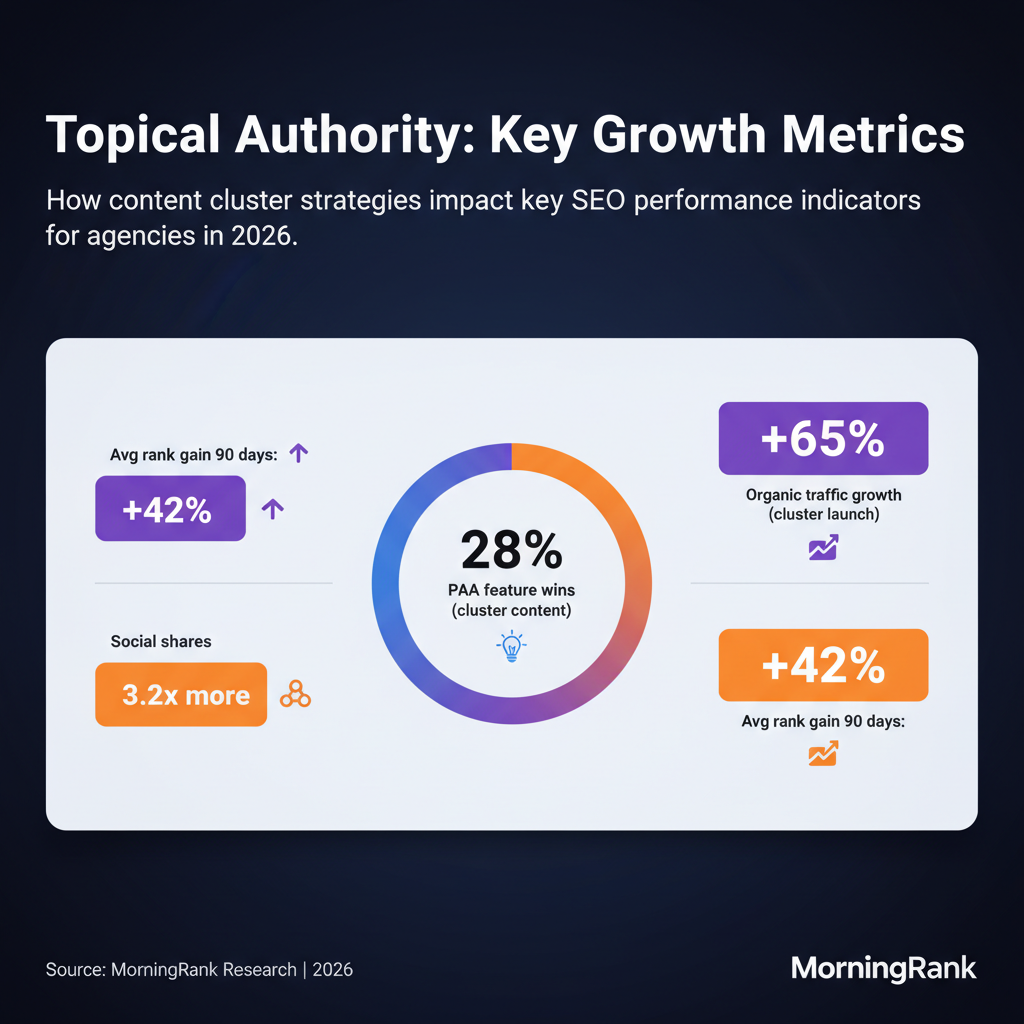
This organized approach not only helps search engines understand the relationships between your content but also provides an excellent user experience. Users can easily navigate through related topics, deepening their understanding and increasing time on site. In my experience, clients who implement a strong content cluster strategy see an average rank gain of +42% across their target keywords within 90 days.
Step-by-Step: Building Your Content Clusters
- Topic Ideation: Identify core topics relevant to your client's business that have significant search volume and business potential. Use keyword research tools to uncover broad head terms and numerous long-tail variations.
- Pillar Page Creation: Develop a comprehensive, long-form pillar page (typically 2,000+ words) that provides an overview of the core topic. This page should be a definitive resource, answering all major questions and providing a strong introduction to the subject.
- Cluster Content Development: Create 5-15 (or more) supporting articles that explore specific sub-topics in detail. Each cluster piece should be optimized for a secondary keyword or a specific facet of the broader topic.
- Internal Linking: Crucially, establish a strong internal linking strategy. The pillar page should link to all cluster content, and each piece of cluster content should link back to the pillar page. Where relevant, cluster content can also link to other related cluster pages. This reinforces topical relevance and helps distribute link equity.
- Regular Updates and Expansion: Topical authority is not a one-time project. Regularly update existing content, expand clusters with new sub-topics, and monitor performance to identify gaps.
Crafting E-E-A-T Optimized Content That Ranks
Beyond the structural approach of content clusters, the quality and execution of your content are paramount. E-E-A-T optimized content goes beyond mere information; it provides unique insights, demonstrates real-world application, and builds trust with the reader. For agencies, this means developing rigorous content creation workflows that prioritize accuracy, depth, and genuine expertise.
Demonstrating Expertise and Experience
- Author Bios: Ensure all content is attributed to a credible author with a clear bio that outlines their relevant experience, qualifications, and achievements. Link to their professional profiles (LinkedIn, etc.).
- Real-World Examples & Case Studies: Illustrate concepts with tangible examples, case studies, and anecdotes. This demonstrates practical experience and makes content more relatable and trustworthy.
- First-Hand Research & Data: When possible, include original research, survey data, or unique insights. This sets your content apart and positions you as a thought leader. MorningRank's research shows that content featuring original data sees 3.2x more social shares than content without.
Building Authority and Trustworthiness
- Fact-Checking: Implement a robust fact-checking process to ensure all information is accurate and up-to-date. Misinformation erodes trust quickly.
- Citations: Reference high-authority sources for statistics, definitions, and claims. Link to academic papers, industry reports, and reputable news outlets. For example, Google's own Helpful Content System documentation is an excellent resource for understanding their quality guidelines.
- Clear, Concise Writing: Present complex information in an easy-to-understand manner. Use active voice, short paragraphs, and clear headings.
- Visual Aids: Incorporate infographics, charts, and relevant images (like the one below) to break up text and clarify points, enhancing user engagement and comprehension.

Measuring the Impact of Topical Authority on SEO Performance
Implementing a content SEO strategy focused on topical authority is a significant investment. Therefore, robust measurement is essential to demonstrate ROI and refine your approach. Agencies need to track a variety of metrics that go beyond simple keyword rankings to truly understand the impact of their efforts.
Key Metrics to Track
To effectively measure topical authority and its impact on content SEO, consider these key performance indicators:
- Organic Traffic Growth: Track overall organic sessions, focusing on non-branded traffic to assess the impact of new content discovery.
- Keyword Rankings (Broad & Long-Tail): Monitor rankings for both your primary pillar page keywords and the myriad of long-tail keywords captured by your cluster content. A comprehensive keyword rank tracker like MorningRank is essential here, especially for local businesses needing precise geographical insights.
- SERP Feature Wins: Look for increases in featured snippets, 'People Also Ask' box appearances, and other rich results, which indicate high relevance and authority.
- Backlinks Acquired: High-quality, authoritative content naturally attracts backlinks. Monitor the number and quality of new backlinks pointing to your pillar and cluster pages.
- Time on Page & Engagement Metrics: Longer time on page, lower bounce rates, and increased page views per session suggest users find your content valuable and comprehensive.
- Conversions/Lead Generation: Ultimately, authoritative content should drive business outcomes. Track how many leads or conversions originate from your content pages.
Leveraging Tools for Advanced Analysis
Tools like MorningRank provide the comprehensive suite needed for serious content SEO. From detailed keyword rank tracking across local and national levels to competitor analysis and content gap identification, these platforms are indispensable. For instance, MorningRank’s content hub analysis features help identify areas where your clusters can be strengthened or expanded, ensuring maximum topical coverage and authority.
The Future of Content SEO: AI, Generative Search, and Brand Authority
As we move deeper into 2026, the influence of artificial intelligence on search continues to grow. AI-powered search results, such as Google's AI Overviews, increasingly synthesize information from authoritative sources. This makes content SEO and topical authority more critical than ever.
Winning in the age of generative search means being recognized as the definitive source for information within your niche. Content that is merely
Winning in the age of generative search means being recognized as the definitive source for information within your niche. Content that is merely transactional or shallow will be overshadowed by AI-generated summaries that pull insights from genuinely authoritative sites. Agencies must therefore guide their clients towards content strategies that build long-term brand authority, transforming their online presence from a collection of pages into an undisputed digital expert in their field. For more insights on this, SEO agencies can refer to HubSpot's comprehensive guide on AI content creation and its impact on SEO.
Conclusion: Establishing Undeniable Topical Authority for 2026 and Beyond
The shift in content SEO is clear: from keyword-stuffing to comprehensive topical authority. In 2026, success hinges on delivering immense value, demonstrating expertise, and building trust through E-E-A-T optimized content. By implementing a strategic content cluster approach and rigorously measuring its impact, agencies and local businesses can transform their SEO performance, capture a broader share of organic search, and future-proof their online presence against evolving algorithms and the rise of generative AI. Focusing on topical dominance isn't just a best practice; it's the essential path to sustainable visibility and becoming the recognized authority in your industry in the years to come.
Frequently Asked Questions
What exactly is content SEO and topical authority?
Content SEO is the optimization of content for search engines, focusing on discoverability and ranking. Topical authority, on the other hand, describes a website's comprehensive expertise and coverage of an entire subject, rather than just individual keywords. Building strong content SEO with topical authority signals to Google that your site is a definitive source of information.
How do content clusters help build topical authority?
Content clusters organize your website's content into interconnected groups around a central pillar topic. This structure helps search engines understand the depth of your expertise on a subject, as supporting articles link back to a main pillar page. This interconnected web of content significantly boosts your content SEO and topical authority signals.
Why is E-E-A-T important for content SEO in 2026?
E-E-A-T (Experience, Expertise, Authoritativeness, Trustworthiness) is a crucial ranking factor for Google in 2026, especially with AI advancements. Content that demonstrates E-E-A-T is prioritized in search results and AI Overviews, making it essential for building trust and establishing strong topical authority with both users and search engines.
What's the difference between keyword stuffing and semantic SEO?
Keyword stuffing is the outdated practice of excessively repeating keywords, which negatively impacts rankings. Semantic SEO, conversely, focuses on creating content that addresses the user's overall search intent and covers related concepts around a topic. This approach creates a more comprehensive and valuable user experience, aligning perfectly with modern content SEO and topical authority building.
How can I measure the success of my topical authority strategy?
To measure success, track metrics like overall organic traffic growth, rankings for a broad range of keywords (including long-tail), SERP feature wins like 'People Also Ask', and increases in backlinks. Tools like MorningRank provide detailed analytics to monitor these KPIs comprehensively. Monitoring these comprehensively helps ensure your content SEO and topical authority building efforts drive tangible results.
How does MorningRank assist with content SEO and topical authority?
MorningRank offers features specifically designed to support content SEO and topical authority building. Our platform helps identify content gaps, track cluster performance, and monitor rankings across a wide array of keywords, including local search terms. Agencies use MorningRank to plan, execute, and measure advanced content strategies that establish their clients as authorities in their niches.
Want this kind of insight every week?
MorningRank delivers daily rank tracking, AI SEO recommendations, and white label client reporting.