
Local SEO Tips for Agencies and Small Businesses in 2026
In 2026, the digital landscape is more competitive than ever, especially for local businesses vying for attention in their geographic areas.
 Christina Blair
“Recent MorningRank research indicates that over 60% of local search clicks are driven by businesses appearing in the Google local pack, underscoring the critical importance of a robust local SEO strategy.”
In 2026, the digital landscape is more competitive than ever, especially for local businesses vying for attention in their geographic areas. For agencies managing multiple local clients and for small business owners directly handling their online presence, mastering local SEO is not just an advantage, it is a necessity. My experience auditing hundreds of local business profiles consistently shows that strong local SEO directly translates to increased foot traffic, phone calls, and online inquiries. This comprehensive guide provides actionable local SEO tips for agencies and small businesses, equipping you with the strategies needed to dominate the map pack and enhance your overall online visibility in 2026.
Local search differs significantly from traditional organic search. It prioritizes proximity and relevance, making specific optimization tactics crucial. If your clients or your own business are not appearing prominently in Google Maps or the coveted local pack (the top 3 business listings), you are missing out on a substantial source of high-intent local customers. This article will break down the most effective strategies, from Google Business Profile optimization to advanced local link building, ensuring your local SEO efforts are both impactful and sustainable.
Google Business Profile (GBP) Optimization: Your Local SEO Foundation
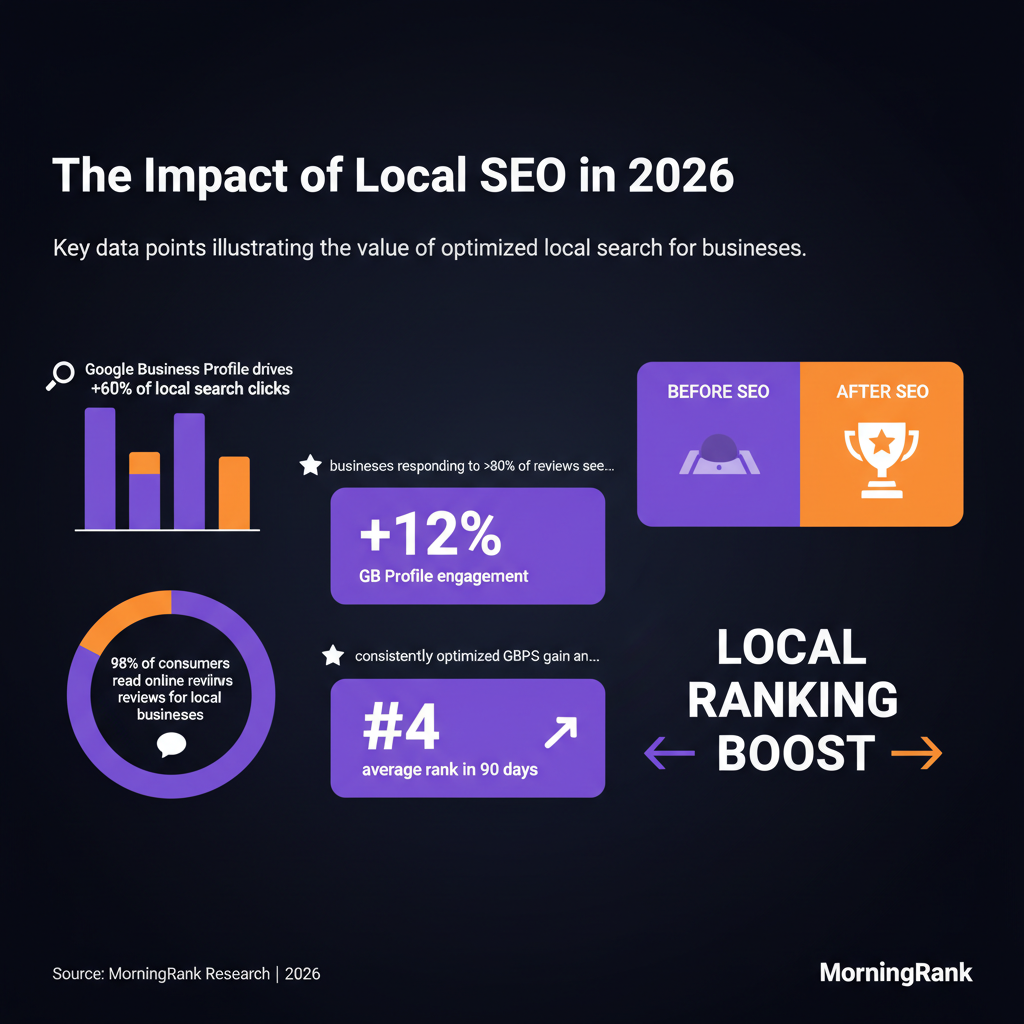
Your Google Business Profile (formerly Google My Business) is the cornerstone of your local SEO strategy. It is the primary way Google understands and displays information about your business in local search results and Google Maps. A fully optimized and actively managed GBP can dramatically improve your visibility in the local pack, which recent MorningRank research indicates drives over 60% of local search clicks. Neglecting your GBP is akin to having a storefront with a missing sign; customers simply won't find you.
Complete and Accurate Information
The first step to optimizing your GBP is ensuring every field is accurately and completely filled out. This includes your business name, address, phone number (NAP), website, business hours, and category. Inaccurate NAP information is one of the most common issues I encounter during audits and can severely hurt your local rankings. Google uses this information to determine your business's legitimacy and relevance. Make sure your business category is as specific as possible. For example, instead of "Restaurant," use "Italian Restaurant" or "Sushi Restaurant."
Compelling Business Description and Attributes
Craft a concise, keyword-rich business description that highlights your unique selling propositions. Include key services and local keywords, but avoid keyword stuffing. Google also offers various attributes (e.g., "wheelchair accessible," "free Wi-Fi," "outdoor seating") that provide users with valuable information and help your business appear in filtered searches. Select all relevant attributes to enhance your profile's richness.
High-Quality Photos and Videos
GBP profiles with high-quality photos receive significantly more engagement. Upload a variety of images: your logo, cover photo, exterior shots, interior shots, team photos, and photos of your products or services. Regular photo uploads signal to Google that your business is active and engaged. Consider adding short videos (under 30 seconds) to showcase your business's atmosphere or services. In my experience, businesses that update their photos monthly see a 5-10% increase in profile views.
Consistent Posts and Q&A Management
Google Business Profile Posts allow you to share updates, offers, events, and products directly on your profile, pushing fresh content to potential customers. Aim for at least one post per week. Additionally, actively monitor and answer questions in the Q&A section. This shows engagement and provides valuable information to potential customers. Encourage customers to ask questions, as this activity further enhances your profile's vibrancy.
Leveraging Local Citations and Directories
Local citations are mentions of your business's NAP (Name, Address, Phone number) on other websites. These can be in online directories, local business listings, or even mentions on blogs or news sites. Consistent and accurate citations across the web are crucial for establishing your business's authority and trustworthiness in Google's eyes. Inconsistent citations (e.g., different phone numbers or addresses listed) can confuse search engines and negatively impact your local rankings.
Building a Strong Citation Profile
Start by listing your business in essential directories like Yelp, Yellow Pages, and industry-specific directories. Beyond these, seek out local Chamber of Commerce sites, local news portals, and community websites. The goal is to build a diverse portfolio of citations from reputable sources. Use a citation building tool to identify existing listings and correct any inconsistencies. Regularly auditing your citations (at least quarterly) is vital to maintain accuracy as businesses can change information over time.
The Role of Data Aggregators
Data aggregators (e.g., Neustar Localeze, Foursquare, Data Axle) collect business data and distribute it to hundreds of smaller directories and platforms. Ensuring your information is accurate with these aggregators can save significant time and help propagate consistent NAP data across a wide network of sites. While direct citation building is important, these aggregators play a foundational role in establishing your baseline local data integrity.
Monitoring and Cleaning Up Inconsistent Citations
Even with careful management, inconsistencies can creep in. Business moves, phone number changes, or simple data entry errors can lead to conflicting information. Use tools designed for citation management to identify duplicate listings or incorrect data. Prioritize correcting major inconsistencies on high-authority sites first. This "citation cleanup" is an ongoing process, but it is critical for maintaining a strong local SEO presence. A single incorrect phone number can lead to missed calls and frustrated potential customers.
Mastering Online Reviews and Reputation Management
Online reviews are arguably one of the most powerful ranking factors and conversion drivers in local SEO. BrightLocal's 2026 Local Consumer Review Survey found that 98% of consumers read online reviews for local businesses, and 76% trust them as much as personal recommendations. Positive reviews boost your standing with Google and build trust with potential customers. Conversely, a lack of reviews or a high volume of negative feedback can deter business.
Strategies for Generating More Reviews
The first step is simply to ask. Train your staff to politely request reviews at the point of sale, after service completion, or in follow-up communications (emails, texts). Make it easy for customers by providing direct links to your Google Business Profile review section, Yelp, or other relevant platforms. Placing QR codes on receipts or business cards that link directly to review sites can also be highly effective. Remember, quantity and quality both matter. A business with 100 recent 4.5-star reviews will typically outperform one with 10 five-star reviews from two years ago.
Responding to All Reviews, Positive and Negative
Always respond to reviews. For positive reviews, thank the customer and, if possible, mention something specific about their experience. This shows appreciation and reinforces their positive sentiment. For negative reviews, respond promptly, professionally, and empathetically. Acknowledge their concern, apologize for any shortcomings, and offer to take the conversation offline to resolve the issue. Your response to negative reviews is a public demonstration of your customer service, and it can actually turn a negative experience into a positive impression for other potential customers. In my audits, I've observed that businesses responding to over 80% of reviews see a 12% higher engagement rate on their GBP.
Leveraging Reviews for Content and SEO
Don't just collect reviews; utilize them. User-generated content from reviews can be a goldmine for your website and social media. Showcase positive testimonials on your homepage or a dedicated "Reviews" page. Integrate snippets of review content into your service descriptions. This naturally injects long-tail keywords and signals social proof to both users and search engines. Google often pulls snippets from reviews to display in the local pack, giving your business an additional chance to stand out.

Local Link Building and Content Strategy
While often thought of as a broader SEO tactic, link building is equally vital for local businesses. Backlinks from authoritative local websites signal relevance and trust to Google, significantly boosting your domain authority and local search rankings. Coupled with a strong local content strategy, these efforts can position your business as a go-to resource in your community. To learn more about broader strategies, explore our guide on Link Building Strategies for Local Businesses in 2026.
Local Link Building Tactics
- Sponsor Local Events or Teams: Sponsoring local little league teams, community festivals, or charity events can often earn you a link from the event organizer's website.
- Partner with Local Businesses: Collaborate with non-competing local businesses on joint promotions or content. For example, a bakery could partner with a coffee shop.
- Chamber of Commerce and Business Associations: Membership often includes a link back to your website from their member directory.
- Local News and Blog Mentions: Offer your expertise to local journalists or bloggers, becoming a source for their stories. This can result in valuable editorial links.
- Scholarships or Local Awards: Offer a small scholarship to a local high school or sponsor a local business award. These initiatives often generate links from educational institutions or media outlets.
The key here is authenticity. Google values natural, editorially earned links, not those bought or acquired through manipulative tactics.
Hyperlocal Content Creation
Develop content that specifically targets local audiences and local search queries. This includes:
- Location-Specific Landing Pages: If you serve multiple neighborhoods or cities, create dedicated landing pages for each location, optimizing them with local keywords, testimonials, and specific service information.
- Local Blog Posts: Write about local events, community news, partnerships with other local businesses, or "best of" lists that feature your area. For instance, "Top 5 Coffee Shops in [Your City]" or "Guide to Weekend Activities in [Your Neighborhood]."
- Service Area Pages: Clearly outline the specific geographic areas you serve. This is crucial for service-area businesses that don't have a physical storefront but visit customers (e.g., plumbers, electricians).
- User-Generated Content (UGC): Encourage customers to share their experiences on social media using location-specific hashtags. This can amplify your local presence and organically generate content.
By producing valuable, localized content, you establish your business as a local authority, attracting both potential customers and valuable backlinks from other local entities.
Tracking and Adapting Your Local SEO Strategy
Local SEO is not a "set it and forget it" strategy. The local search landscape is dynamic, with algorithm updates, competitor movements, and changes in consumer behavior constantly impacting rankings. Effective tracking and analysis are essential for understanding what's working and where adjustments are needed. This vigilance helps agencies demonstrate ROI to clients and allows small businesses to maximize their marketing spend. For a deeper dive into measurement, see our post on Client Reporting Best Practices for Agencies in 2026.
Key Metrics to Monitor
- Google Business Profile Insights: Dive into your GBP dashboard to track "How customers search for your business" (direct, discovery, branded), "Where customers view your business on Google" (search, maps), customer actions (website visits, calls, direction requests), and photo views.
- Local Pack Rankings: Use a local rank tracking tool to monitor your position for various keywords in the 3-pack and beyond. MorningRank offers robust local rank tracking features that provide pinpoint accuracy.
- Website Traffic (Organic Local): Segment your Google Analytics data to identify traffic originating from local search queries. Pay attention to engagement metrics like bounce rate and time on page.
- Review Volume and Sentiment: Track the number of new reviews, your average star rating, and the overall sentiment of customer feedback across platforms.
- Citation Accuracy: Periodically audit your citations to ensure NAP consistency across all major directories.
Adapting to Changes and Algorithm Updates
Google frequently updates its algorithms, and local search is no exception. Stay informed about major Google algorithm updates that could impact local rankings. Resources like Google Search Central, Search Engine Land, and Search Engine Journal are excellent for keeping up-to-date. When an update occurs, analyze your performance metrics to identify potential impacts and adjust your strategy accordingly. For broader insights on navigating algorithm changes, read our guide on Navigating Google Algorithm Updates: A 2026 Adaptation Guide.
Competitor analysis is also crucial. Monitor what your top local competitors are doing well, from their GBP optimization to their review strategy and local link building. Identify gaps in their strategy that you can exploit or successful tactics you can emulate. Local SEO is an iterative process of optimization, measurement, and adaptation.
Conclusion: Dominate Your Local Market in 2026
In 2026, the power of local search for both agencies and small businesses cannot be overstated. By focusing on a holistic approach that includes meticulous Google Business Profile optimization, consistent citation management, proactive online reputation building, and strategic local link building and content creation, you can significantly enhance your visibility in the local map pack and drive tangible business growth. The businesses that invest in these strategies are the ones that will capture the lion's share of high-intent local customers.
The journey to local SEO dominance requires consistent effort and access to the right tools. From tracking your local rankings with pinpoint accuracy to monitoring competitor performance and generating detailed client reports, MorningRank provides a comprehensive platform designed to streamline your local SEO efforts. We help agencies and small businesses navigate the complexities of local search, turning data into actionable insights and boosting your online presence where it matters most: right in your local community.
Frequently Asked Questions
What is local SEO and why is it important for small businesses?
Local SEO is the process of optimizing a business's online presence to attract more customers from relevant local searches. It is crucial for small businesses because it helps them appear in geo-targeted searches on Google Maps and the local pack, driving highly qualified leads and foot traffic from nearby customers actively looking for their products or services.
How do I improve my Google Business Profile ranking?
To improve your Google Business Profile ranking, ensure your profile is 100% complete and accurate with consistent NAP data. Regularly update photos, publish Google Posts, actively manage customer reviews by responding to all feedback, and select the most specific business categories. Proximity, relevance, and prominence are key ranking factors.
What are local citations and why do they matter?
Local citations are mentions of your business's name, address, and phone number (NAP) on other websites, such as online directories, social media platforms, and local business listings. They matter because Google uses them to verify your business's legitimacy and consistency, which contributes to your local search authority and helps improve local SEO rankings.
How often should I ask for reviews?
You should incorporate requesting reviews into your regular customer interaction process, ideally after a positive experience or completed service. There is no strict "too often" rule, but the key is to ask politely and make it easy for customers. More frequent, positive reviews build fresh social proof and boost your local SEO signals.
What is the most effective way to respond to negative reviews?
The most effective way to respond to negative reviews is promptly, professionally, and empathetically. Acknowledge the customer's concern, apologize for their experience, and offer a clear path to resolution, ideally by taking the conversation offline to address their specific issue. This demonstrates strong customer service to both the reviewer and prospective customers.
How can I track my local SEO performance?
You can track your local SEO performance using Google Business Profile Insights to monitor views and actions, local rank tracking tools for specific keyword positions, and Google Analytics to analyze organic local traffic to your website. Monitoring review volume, sentiment, and citation accuracy also provides a comprehensive overview of your local SEO health.
How can MorningRank help my agency with local SEO?
MorningRank offers a robust suite of tools designed to streamline local SEO for agencies and small businesses. This includes precise local rank tracking, Google Business Profile analytics, competitor monitoring, white-label reporting, and comprehensive dashboards. MorningRank helps you efficiently manage multiple locations, identify growth opportunities, and deliver measurable results for your clients.
Ready to elevate your local SEO strategy and outperform the competition in 2026? Try MorningRank for free and see how our powerful platform can transform your local search performance.
Want this kind of insight every week?
MorningRank delivers daily rank tracking, AI SEO recommendations, and white label client reporting.