
Navigating Google Algorithm Updates: A 2026 Adaptation Guide
Google algorithm updates are a constant, often unpredictable force in the SEO landscape .
 Sofia Chen
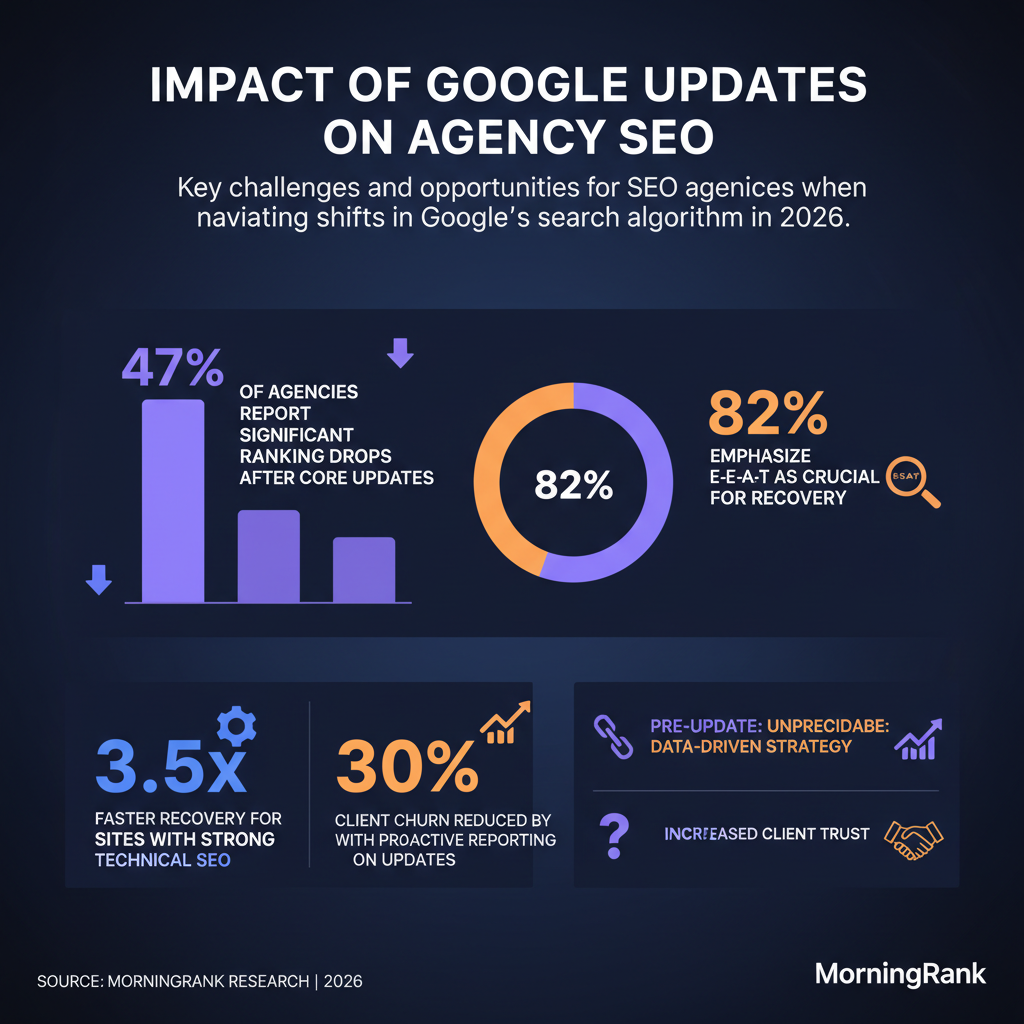
“Our research indicates that SEO agencies leveraging comprehensive, AI-powered rank tracking and proactive reporting can reduce client churn by as much as 30% during major Google algorithm update cycles.”
Google algorithm updates are a constant, often unpredictable force in the SEO landscape. For agencies and local businesses alike, these continuous shifts can feel like navigating a minefield. One day, your clients are ranking at the top, and the next, their organic visibility has plummeted. In 2026, with the increasing sophistication of AI in search, understanding and adapting to Google algorithm updates is no longer optional; it is a fundamental requirement for maintaining online presence and driving traffic. This comprehensive guide will equip you with the knowledge and strategies to not only survive but thrive amidst Google's ongoing evolution.
From understanding the various types of updates to implementing recovery strategies and proactive optimization techniques, I will share my insights as an AI Search Strategist. My goal is to help you build resilient SEO campaigns that withstand algorithmic shifts and consistently deliver results for your clients. Let's dive into how to effectively adapt your SEO strategy in 2026 and beyond.
Understanding Google Algorithm Updates in 2026
Google regularly rolls out changes to its search ranking algorithms, ranging from minor tweaks to major "core updates" that can significantly impact search engine results pages (SERPs). These updates are designed to improve the quality and relevance of search results, rewarding websites that provide excellent user experience and high-quality, authoritative content. Ignoring these updates is perilous, as a lack of adaptation can lead to substantial drops in organic traffic and revenue for your clients.
In 2026, Google's updates increasingly focus on user intent, E-E-A-T (Experience, Expertise, Authoritativeness, Trustworthiness), and the integration of AI-generated content. For instance, the emphasis on AI in search, particularly with advancements like AI Overviews, means that content needs to be not just helpful, but also summarizable and factually robust to be surfaced by generative AI experiences. My audits consistently show that sites demonstrating clear topical authority and genuine E-E-A-T signals are more resilient to algorithmic volatility.
Types of Google Algorithm Updates
It is important to differentiate between the various types of Google algorithm updates:
- Core Updates: These are broad, significant changes to Google's overall ranking algorithms. They don't target specific issues but aim to improve how Google assesses content quality across the board. They often result in noticeable shifts in rankings.
- Spam Updates: These updates specifically target spamming behaviors, such as unnatural link building, cloaking, or keyword stuffing. Websites engaging in these tactics often see steep declines.
- Helpful Content Updates: Introduced to ensure content is primarily created for people, not search engines. Sites with a significant amount of "unhelpful" content (often low-quality, AI-generated, or thinly veiled affiliate content) are demoted.
- Reviews Updates: Focused on promoting high-quality review content, helping users find genuine and insightful product or service reviews.
- Local Search Updates: These primarily affect local ranking factors, influencing the visibility of businesses in the Google Local Pack and Google Maps.
- Minor Updates/Tweaks: Google makes thousands of small changes annually that are not announced. These usually have minimal impact but are part of the continuous refinement of the algorithm.
Understanding which type of update has potentially impacted your site is the first step in formulating an effective recovery or adaptation strategy. For further reading on related topics, you might find our guide on Generative Engine Optimization (GEO) valuable as it touches on optimizing for a new frontier of search.
Assessing Impact and Identifying the Cause
When rankings drop, a common reaction is panic. However, a systematic approach to assessing the impact and identifying the root cause is far more productive. The first step involves monitoring your key performance indicators (KPIs) immediately after an announced update or if you notice unexpected traffic declines. This is where robust keyword rank tracking strategies become invaluable.
Key Metrics to Monitor
I advise agencies to pay close attention to the following metrics:
- Organic Traffic: Look for significant dips specifically from Google Search, differentiating from other traffic sources.
- Keyword Rankings: Track changes for your target keywords. Are specific keywords or keyword clusters more affected than others? MorningRank's detailed rank tracking provides daily granularity, essential for pinpointing affected terms.
- SERP Features: Monitor changes in visibility for Featured Snippets, Local Packs, People Also Ask boxes, and AI Overviews. These can indicate a shift in how Google understands your content's relevance.
- Backlink Profile: Sudden drops in rankings without content changes might point to algorithmic penalties related to unnatural links.
- Core Web Vitals: Poor loading speed, interactivity, or visual stability can negatively impact rankings, especially after updates emphasizing user experience.
Correlation, Not Just Coincidence
Google often pre-announces core updates on its Search Central Blog and communicates confirmations via X (formerly Twitter). Cross-reference any observed ranking declines with Google's official update announcements. If a drop coincides with a core update, you know to focus on broad quality improvements. If it aligns with a spam update, an audit of your backlink profile or content quality might be necessary. Google Search Console is your best friend here, providing data on crawl errors, manual actions, and specific performance trends. Identifying the specific pages or sections of your site most impacted can also provide clues as to the underlying cause.
Content & E-E-A-T Optimization for Resilience
After a Google algorithm update, especially a core update, content quality and E-E-A-T are almost always at the heart of the recovery process. Google consistently emphasizes rewarding high-quality content that genuinely helps users and is produced by knowledgeable sources. In 2026, with the rise of AI-generated content, demonstrating human experience, expertise, authoritativeness, and trustworthiness is more critical than ever.
Auditing Your Content for Quality
My approach to content audits after an update starts with ruthless honesty. Ask yourself:
- Is this content truly helpful? Does it answer the user's query thoroughly and accurately?
- Is it original and unique? Does it offer new perspectives or deeper insights than competitors? Duplicate or regurgitated content is a major red flag.
- Who created this content? Are author bios present, detailing their credentials and experience? This directly ties to the "Experience" and "Expertise" elements of E-E-A-T.
- Is the content well-researched and factually accurate? Link to authoritative sources when appropriate. For local businesses, ensure all information (NAP, services) is 100% correct.
- Is the content well-written and easy to read? Avoid jargon, poor grammar, and excessive keyword stuffing.
- Does it align with user intent? Is the content matching what users are actually looking for when they search for that keyword?
For more insights on optimizing content for the current search landscape, our post on AEO vs. SEO discusses how to craft content that appeals to both traditional search and AI answer engines.
Building Topical Authority for Longevity
Google rewards websites that demonstrate topical authority. This means covering a specific subject comprehensively and in depth, establishing your site as a go-to resource. Instead of creating isolated articles, think about content clusters or hubs. For example, if you're an agency specializing in local SEO, you wouldn't just have one post on "local SEO." You'd have a pillar page and supporting content on Google Business Profile optimization, local link building, local citation management, and local review generation.
This holistic approach signals to Google that you are a genuine expert in your niche, making your site more resilient to algorithm fluctuations. MorningRank helps identify content gaps and opportunities to build out your topical authority, ensuring your content strategy is robust and future-proofed against evolving Google algorithm updates.

Technical SEO: The Unsung Hero of Stability
While content and E-E-A-T often steal the spotlight after Google algorithm updates, ignoring your technical SEO foundation is a critical mistake. A technically sound website ensures that search engines can easily crawl, index, and understand your content. It also directly impacts user experience, which is a significant ranking factor.
Foundational Technical Checks
In my experience, many sites suffer from basic technical issues that can exacerbate the impact of an algorithm update. Here are key areas to audit:
- Crawlability & Indexability: Use Google Search Console's "Coverage" report to identify any pages that are not being indexed or have crawl errors. Ensure your robots.txt file isn't blocking important content and that your XML sitemaps are up-to-date.
- Site Speed & Core Web Vitals: Google explicitly states that Core Web Vitals (Largest Contentful Paint, First Input Delay, Cumulative Layout Shift) are ranking signals. Optimize images, leverage browser caching, minify CSS and JavaScript, and consider a CDN. You can find more detailed guidance in our technical SEO guides.
- Mobile-Friendliness: With mobile-first indexing, your site's mobile experience is paramount. Use Google's Mobile-Friendly Test to ensure all pages render correctly and are easy to navigate on smaller screens.
- Schema Markup: Implement relevant schema markup (e.g., LocalBusiness, Product, FAQPage) to help Google better understand your content and potentially qualify for rich results.
- Duplicate Content: Identify and resolve any issues with duplicate content, which can dilute ranking signals. Use canonical tags strategically.
- Internal Linking Structure: Ensure a logical internal linking structure that helps distribute "link equity" and guides both users and bots through your site's important content.
The Role of Secure and Accessible Websites
HTTPS is a non-negotiable ranking signal. Ensure your entire website is served over HTTPS to protect user data and signal trustworthiness. Furthermore, accessibility (WCAG compliance) is becoming increasingly important not just for inclusivity, but also as a signal of overall site quality. A site that is accessible to all users, including those with disabilities, is often a site with cleaner code, better structure, and a superior user experience.
Maintaining a strong technical foundation provides a buffer against many algorithm changes. It signals to Google that your site is well-maintained and prioritizes the user experience, often allowing you to recover faster or even avoid significant drops during updates.
Building Backlinks & Monitoring Your Link Profile
While content quality and technical SEO are fundamental, external validation in the form of backlinks remains a critical ranking factor. However, the quality and relevance of these links are far more important than quantity, especially after Google algorithm updates that target spam. A healthy, natural backlink profile can help solidify your E-E-A-T and pass valuable link equity to your site, boosting your authority in Google's eyes.
Strategies for Sustainable Link Building
After an update, particularly if you suspect a link-related penalty, a thorough backlink audit is your first step. Identify any low-quality, spammy, or irrelevant links pointing to your site. You may need to disavow these using Google Search Console, though this should be done with caution. Focus on building high-quality, editorial links from authoritative and relevant websites. Here are some effective strategies:
- Content Promotion: Create truly exceptional content that naturally earns links. This could be in-depth guides, original research, or compelling data visualizations.
- Broken Link Building: Find broken links on authoritative websites, then offer your relevant content as a replacement.
- Resource Pages: Discover industry resource pages, and suggest your valuable content as an addition.
- Guest Blogging: Contribute high-quality, relevant articles to other reputable sites in your niche (avoid spammy guest posting networks).
- Digital PR: Develop newsworthy content or insights that can attract media coverage and associated backlinks.
Monitoring Competitors and Your Own Profile
Regularly monitoring your backlink profile, as well as those of your top-ranking competitors, is crucial for identifying opportunities and preventing issues. Tools like MorningRank can help you track new and lost links, providing alerts for suspicious activity. Pay attention to the types of sites linking to your competitors and look for patterns that could inform your own link building strategy. Remember, Google is looking for naturally earned links that provide value, not manufactured ones.
In 2026, the focus has entirely shifted to quality over quantity. A few powerful, relevant links from highly authoritative sources are infinitely more valuable (and safer) than hundreds of low-quality, spammy links. Prioritize relationships, valuable content, and genuine outreach to build a resilient link profile.
Proactive Measures and Continuous Optimization
The best way to adapt to Google algorithm updates is to be proactive rather than reactive. By consistently optimizing your site with Google's guidelines and user experience in mind, you can build a more resilient online presence that is less susceptible to major ranking fluctuations.
Establishing a Consistent SEO Workflow
Agencies that succeed in a volatile search landscape integrate SEO into every stage of their clients' digital strategy. This includes:
- Regular Content Audits: Schedule quarterly or bi-annual content audits to refresh, update, or remove outdated or unhelpful content.
- Technical SEO Checks: Conduct monthly technical health checks to catch issues before they escalate.
- Backlink Profile Monitoring: Continuous monitoring of your backlink profile.
- User Experience (UX) Analysis: Regularly analyze user behavior metrics (bounce rate, time on page) and conduct UX audits to ensure your site provides a seamless experience.
- Staying Informed: Follow Google's official announcements, reputable SEO news sites (like Search Engine Journal, Search Engine Land), and industry experts.
Leveraging Analytics for Predictive Insights
Your analytics data, from Google Analytics 4 to Google Search Console and your SEO platform, holds a treasure trove of information. By analyzing trends, segmenting data, and looking beyond generic traffic numbers, you can often spot potential issues or opportunities before they become critical. For instance, a sudden drop in click-through rate for a specific content type might indicate that Google is experimenting with new SERP features or that competitors have created more compelling titles and meta descriptions.
MorningRank is built to provide these kinds of insights, giving you a holistic view of your SEO performance. Its robust feature set allows you to track keyword performance, monitor competitor moves, and identify content gaps, empowering you to make data-driven decisions that proactively address future Google algorithm updates.
Conclusion
Google algorithm updates are an enduring reality of the SEO world, and in 2026, their impact (especially with AI integration) continues to shape how we approach search marketing. While they can present challenges, they also offer opportunities for those who are prepared to adapt. By prioritizing high-quality, user-centric content, maintaining a strong technical foundation, building a natural backlink profile, and adopting a proactive, data-driven approach, you can create an SEO strategy that is resilient and future-proof.
Remember, surviving and thriving through Google algorithm updates isn't about chasing every rumored change. It's about understanding Google's fundamental goal: to deliver the best possible results to its users. By consistently aligning your efforts with this goal, you will build long-term organic visibility for your clients. Equip your agency with the tools and insights needed to navigate these shifts successfully.
Frequently Asked Questions
How often does Google update its algorithm in 2026?
Google makes thousands of small changes to its algorithm every year. Major "core updates" are usually announced a few times a year, often impacting various aspects of the ranking system. These core Google algorithm updates demand the most attention and adaptation from SEO professionals.
Why did my website suddenly drop in Google rankings after an update?
A sudden drop after a Google algorithm update can be due to various reasons, including changes in how Google assesses content quality (E-E-A-T), technical issues on your site, or penalties for spammy practices. It often indicates that your site's content or technical foundation no longer aligns with Google's updated quality standards.
Can I recover from a Google algorithm update penalty?
Yes, recovery is often possible, but it requires a systematic approach. You need to identify the specific areas where your site falls short (e.g., low-quality content, poor E-E-A-T, technical issues) and implement significant improvements. Consistent, high-quality optimization after a Google algorithm update is key to regaining rankings.
What is E-E-A-T and how does it relate to Google algorithm updates?
E-E-A-T stands for Experience, Expertise, Authoritativeness, and Trustworthiness. Google algorithm updates increasingly emphasize these factors to ensure users receive high-quality, reliable information. Demonstrating strong E-E-A-T signals through author bios, factual content, and trusted backlinks is crucial for ranking well in 2026.
Should I worry about AI-generated content in relation to Google updates?
Google has clarified that AI-generated content can rank if it is high-quality, original, and adheres to E-E-A-T principles. However, low-quality or mass-produced AI content solely for SEO purposes is often penalized, especially after helpful content updates. The focus should always be on providing value to users, regardless of how the content is generated.
How can MorningRank help my agency adapt to Google algorithm updates?
MorningRank provides essential tools for agencies to track keyword rankings, monitor competitors, identify content gaps, and analyze performance shifts caused by Google algorithm updates. Its comprehensive analytics and reporting features empower you to quickly diagnose issues and implement effective, data-driven adaptation strategies to maintain and improve client visibility.
Ready to empower your agency with the tools to confidently navigate Google algorithm updates? Try MorningRank free today and unlock advanced SEO insights for your clients.
Want this kind of insight every week?
MorningRank delivers daily rank tracking, AI SEO recommendations, and white label client reporting.