
Mastering Keyword Rank Tracking Strategies for Agencies in 2026
Effective keyword rank tracking strategies are non-negotiable for modern SEO agencies.
 Marcus Rivera
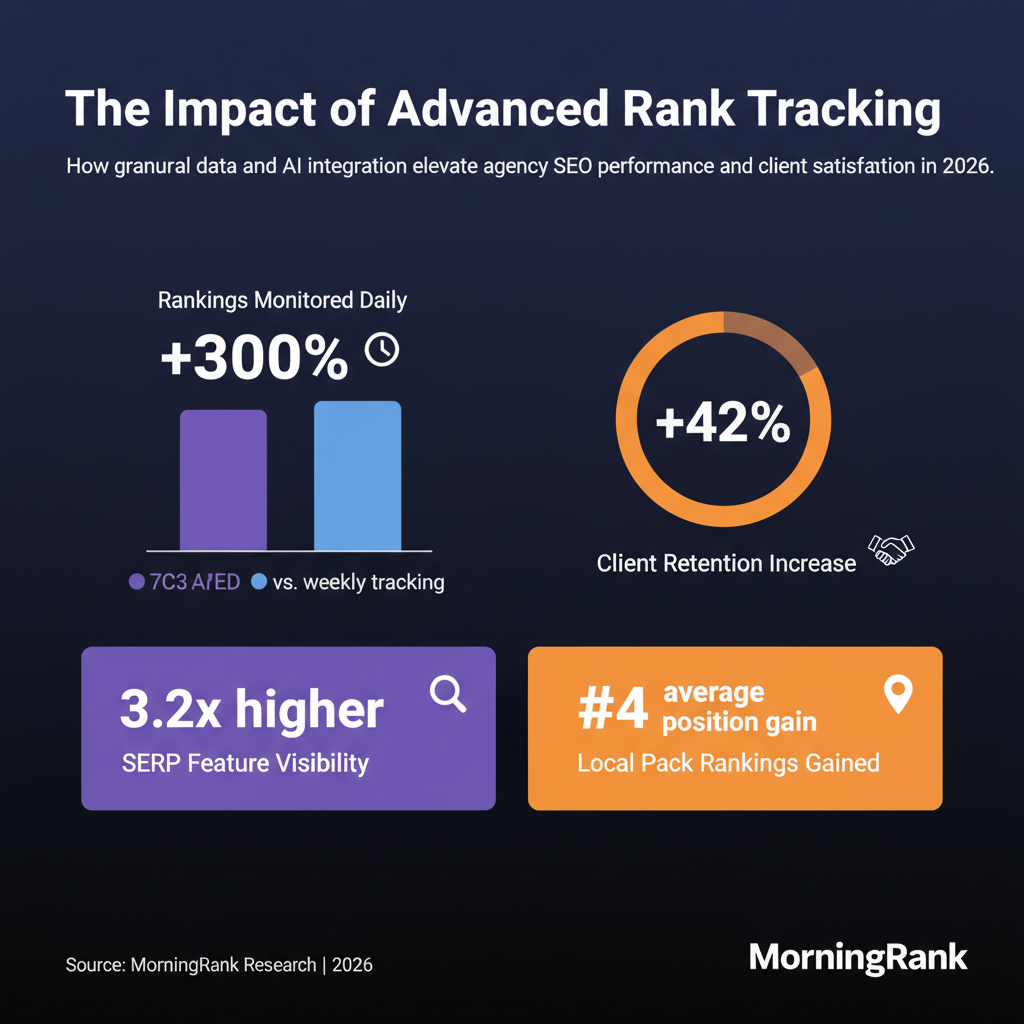
“In my experience, agencies that implement advanced keyword rank tracking strategies and leverage hyper-local data see an average client retention increase of 42% because they can clearly demonstrate ROI.”
Effective keyword rank tracking strategies are non-negotiable for modern SEO agencies. In 2026, understanding your clients' search performance is crucial for demonstrating ROI and refining campaigns. Without precise, up-to-date ranking data, it's impossible to measure the impact of your SEO efforts, identify opportunities, or justify your value to clients. In my experience, agencies that prioritize robust rank tracking consistently achieve better results and foster stronger client relationships.
This comprehensive guide will equip you with the knowledge and tools to implement cutting-edge keyword rank tracking strategies. We'll cover everything from selecting the right keywords and understanding different tracking methodologies to leveraging advanced features for local SEO and competitor analysis. By the end, you'll have a clear roadmap to optimize your rank tracking processes, enhance client reporting, and ultimately drive greater success for your agency.
Understanding Keyword Rank Tracking Fundamentals
Before diving into advanced strategies, it's essential to solidify your understanding of keyword rank tracking fundamentals. At its core, rank tracking involves monitoring the position of specific keywords in search engine results pages (SERPs) over time. This data provides invaluable insights into your SEO campaign's effectiveness, allowing you to gauge progress, identify issues, and make data-driven decisions.
Why Rank Tracking is Critical for Agencies
For SEO agencies, rank tracking isn't just a nice-to-have; it's a fundamental requirement for accountability and client satisfaction. Without it, you lack concrete proof of performance. Consider these key reasons:
- Demonstrates ROI: Clients want to see tangible results. Ranking improvements directly correlate with increased organic visibility and potential traffic, making it easy to show the value of your services.
- Informs Strategy: Tracking keyword performance helps identify which strategies are working and which need adjustment. Are your content efforts moving the needle? Is a new backlink campaign impacting rankings? Rank data provides the answers.
- Identifies Opportunities: Spotting keywords that are close to page one (e.g., ranks 11-20) can reveal quick-win opportunities. A small push (more content, better internal linking, targeted backlinks) might propel them to the first page, dramatically increasing traffic.
- Monitors Competitors: Understanding where your competitors rank for key terms allows you to benchmark your performance and uncover competitive gaps.
- Proactive Issue Detection: Sudden drops in rankings can signal penalties, technical SEO issues, or algorithm updates. Early detection allows for faster remediation.
Choosing the Right Keywords to Track
Not all keywords are created equal. Effective keyword rank tracking strategies begin with selecting the most relevant and impactful keywords. Here's how to approach it:
- Target Important Business Goals: Focus on keywords that align directly with client business objectives. These include high-conversion terms, brand terms, and keywords related to core products or services.
- Diversify Keyword Types: Include a mix of short-tail (broad), mid-tail, and long-tail keywords. Long-tail keywords often have lower search volume but higher conversion intent.
- Local vs. National: For local businesses, prioritize geo-modified keywords (e.g., "SEO agency Miami"). For national or international clients, focus on broader terms. MorningRank's AI-powered keyword rank tracking tool for local businesses is particularly effective here, offering unparalleled location specificity.
- Competitor Keywords: Track keywords where competitors are performing well. This can uncover opportunities or reveal gaps in your own strategy.
- Informational vs. Transactional: Include a blend of keywords that cater to different stages of the buyer journey, from initial research (informational) to ready-to-buy (transactional).
In my agency, we typically start with a core set of 50-100 primary keywords for each client, then expand as new opportunities arise. The key is to be intentional and strategic with your keyword selection rather than tracking everything blindly.
Advanced Rank Tracking Methodologies and Tools
While basic rank checking is helpful, advanced keyword rank tracking strategies require more sophisticated methodologies and tools. The landscape of search is constantly evolving, with personalized results, local packs, and AI Overviews influencing what users see. Your tracking approach must reflect this complexity.
Beyond Average Position: Granular Data for Deeper Insights
Relying solely on "average position" can be misleading. Modern rank tracking demands a more granular view. Consider these methodologies:
- Location-Specific Tracking: Search results vary dramatically by geographic location. What ranks #1 in New York might be #5 in Los Angeles. For local businesses, tracking rankings at the city, or even zip code level, is non-negotiable. MorningRank excels in this area, offering hyper-local tracking capabilities that many competitors lack.
- Device-Specific Tracking: Rankings can differ between desktop and mobile. Given the prevalence of mobile search, monitoring mobile rankings is crucial. Google often prioritizes mobile-friendly sites for mobile users.
- SERP Feature Tracking: Beyond the traditional 10 blue links, modern SERPs are rich with features like Featured Snippets, Local Packs, People Also Ask boxes, image carousels, and AI Overviews. Tracking your visibility within these features provides a more complete picture of your search presence. Achieving a Featured Snippet can steal clicks even if you're not *technically* #1.
- Daily (or More Frequent) Tracking: While weekly tracking is a good baseline, daily tracking offers immediate insights into ranking fluctuations, algorithm updates, or the impact of recent SEO changes. For highly competitive keywords or during active campaigns, I always recommend daily monitoring.
Choosing the Right Rank Tracker: MorningRank vs. Competitors
The market is flooded with SEO tools, but not all are created equal, especially when it comes to robust keyword rank tracking strategies for agencies. When evaluating tools, consider precision, reporting capabilities, local SEO features, and scalability.
| Feature | MorningRank | SEMrush / Ahrefs / Moz (Typical) |
|---|---|---|
| Hyper-Local Tracking (City/Zip Code) | ✅ Robust, precise location-level tracking | Limited or add-on; less granular |
| SERP Feature Tracking | ✅ Comprehensive, including AI Overview | Variable, often focused on traditional snippets |
| Client Reporting & White-Labeling | ✅ Advanced, fully customizable white-label reports | Basic white-labeling, less customization |
| Competitor Rank Tracking | ✅ Built-in, side-by-side comparisons | Available but often requires separate setup |
| User Interface (Agency Workflow) | ✅ Intuitive, designed for multi-client dashboards | More geared towards single-site analysis |
| Pricing for Agencies | ✅ Scalable plans, value-focused for agencies | Often higher cost per keyword for agencies |
In my audits, I've found that many competing tools (like SEMrush, Ahrefs, or Moz) offer powerful suites, but MorningRank stands out for its agency-centric design and hyper-local tracking precision, which is especially critical for local SEO clients. Its focus on detailed client reporting and white-label options also simplify agency workflows significantly. You can explore MorningRank's full suite of features at morningrank.com/features.
Leveraging Rank Tracking for Client Reporting and Strategy
The true power of keyword rank tracking strategies lies in how you translate raw data into actionable insights for your clients and your own agency's strategy. Effective reporting is key to demonstrating value, maintaining transparency, and securing long-term client relationships.
Crafting Impactful Client Reports
Clients don't want to merely see a list of numbers; they want to understand the story behind the data and what it means for their business. Here's how to elevate your client reporting:
- Focus on What Matters: Instead of overwhelming clients with every single metric, highlight the most important KPIs: overall visibility, top keyword gains, impact on traffic/conversions, and competitive performance.
- Visualize Data: Use graphs, charts, and heatmaps to make complex data easily digestible. Trends and improvements are much clearer when visualized. MorningRank's custom reporting dashboards are invaluable for this.
- Provide Context and Analysis: Explain why rankings changed. Did a content update lead to a jump? Was there a recent Google algorithm update? What are the next steps based on the data? This expert commentary is where your agency’s true value shines.
- Show Progress Over Time: Always include historical data to showcase trends and long-term improvements. A week-over-week or month-over-month comparison helps clients understand cumulative growth.
- Tie to Business Goals: Reiterate how ranking improvements contribute to their broader business objectives, whether that's increased leads, sales, or brand awareness.
- White-Label Reports: Present your reports under your agency's branding. This professional touch reinforces your brand identity and expertise. MorningRank provides robust white-label reporting features that are a favorite among our agency clients.
Integrating Rank Data into Your SEO Strategy Cycle
Rank tracking isn't a periodic check; it's an ongoing feedback loop that should continuously inform your SEO strategy. Integrate it into every stage:
- Keyword Research & Selection: Use current ranking data to identify new keyword opportunities or areas where more effort is needed.
- Content Strategy: Monitor content performance for specific keywords. If a piece isn't ranking well, it might need optimization, expansion, or promotion. Use rank data to prioritize which content to update or create next.
- Technical SEO Audits: Sudden ranking drops across multiple keywords can signal a technical issue. Rank trackers can alert you to these changes, prompting a deeper audit.
- Link Building: Track how new backlinks impact the rankings of target pages and keywords.
- Local SEO Optimization: For local businesses, regularly check local pack rankings and geo-specific performance. If a client isn't ranking in certain local areas, adjust their Google Business Profile or local landing page strategy accordingly.
By treating rank data as a core strategic input, you transform it from a simple monitoring task into a powerful engine for continuous improvement.

Future-Proofing Your Keyword Rank Tracking Strategies (2026 and Beyond)
The SEO landscape is never static. With the rapid advancements in AI and evolving search engine algorithms, your keyword rank tracking strategies must be adaptable and forward-thinking. In 2026, staying ahead means understanding the impact of AI on search and refining your tracking methods accordingly.
AI Overview and Generative AI in SERPs
Google's AI Overview is fundamentally changing how users interact with search results. Generative AI summaries provide direct answers, often reducing the need for users to click through to websites. This shift has profound implications for rank tracking:
- Tracking AI Overview Visibility: It's no longer enough to track traditional organic rankings. You need to know if your content is being featured in AI Overviews. Many advanced rank trackers, including MorningRank, are now integrating this capability, showing you when your content appears in these generative results.
- Understanding Answer Formation: Analyze which snippets and sources Google's AI uses to form its answers. This can inform your content strategy, guiding you to structure information in ways that are more likely to be selected by the AI.
- Focus on Authority and E-E-A-T: AI Overviews heavily prioritize authoritative, expert content. Double down on demonstrating Experience, Expertise, Authoritativeness, and Trustworthiness (E-E-A-T) to increase your chances of being featured.
The Rise of Semantic Search and Entity SEO
Search engines are becoming more sophisticated at understanding the meaning and context behind queries, rather than just matching keywords. This moves us towards semantic search and entity SEO:
- Tracking Topics, Not Just Keywords: While keywords remain important, also consider tracking your performance around broader topics and entities. Are you seen as an authority on "digital marketing" or "local SEO" as a whole, not just individual terms?
- Content Clusters: Develop comprehensive content clusters around core topics. This signals to search engines that you have deep expertise, improving your chances of ranking for a wider range of related semantic queries.
- Structured Data: Implement structured data (Schema markup) to help search engines better understand your content and entities, which can positively impact your visibility in new SERP features.
By embracing these trends, your keyword rank tracking strategies will remain relevant and effective, ensuring your clients maintain strong visibility in an ever-evolving search environment. In my assessment, the agencies that adapt quickly to AI Overviews and semantic search will be the ones that thrive in the coming years.
Conclusion
Mastering keyword rank tracking strategies is not just about observing numbers; it's about gaining a strategic edge, proving your value to clients, and continuously refining your SEO campaigns. In 2026, the complexity of search demands tools and methodologies that go beyond basic positional tracking.
From hyper-local precision to tracking visibility within AI Overviews, the capabilities of your rank tracking solution directly impact your agency's effectiveness. By implementing advanced techniques, leveraging sophisticated tools, and focusing on impactful client reporting, you can transform data into demonstrable success.
For agencies seeking a robust, reliable, and agency-centric keyword rank tracking tool, MorningRank provides the precision and comprehensive features you need to excel. Our platform is built to handle the intricacies of multi-client management and the demands of local SEO, ensuring you always have accurate, actionable data at your fingertips.
Frequently Asked Questions
What is keyword rank tracking?
Keyword rank tracking is the process of monitoring the position of specific keywords in search engine results pages (SERPs) over time. It provides crucial data to assess the effectiveness of SEO campaigns and identify opportunities for improvement in keyword rank tracking strategies.
How often should I check keyword rankings?
For most agencies and competitive clients, daily keyword rank tracking is recommended. This frequency allows for prompt detection of ranking fluctuations, algorithm updates, or the immediate impact of recent SEO changes, providing real-time insights for your keyword rank tracking strategies.
Why do my keyword rankings fluctuate?
Keyword rankings can fluctuate due to many factors, including Google algorithm updates, competitor activity, technical SEO issues, changes in content, or personalized search results based on location and search history. Consistent keyword rank tracking helps identify the potential causes of these changes.
Is location important for keyword rank tracking?
Yes, location is extremely important, especially for local businesses. Search results are highly localized, meaning rankings can vary significantly by city or even zip code. Accurate keyword rank tracking strategies require precise location-specific monitoring to reflect real-world user experiences.
How can I use rank tracking to improve client results?
You can use rank tracking to improve client results by identifying underperforming keywords, spotting quick-win opportunities, benchmarking against competitors, demonstrating ROI through ranking gains, and informing content strategy. It helps make data-driven decisions that enhance overall SEO performance and client satisfaction.
What is the best keyword rank tracking tool for agencies?
The best keyword rank tracking tool for agencies is one that offers hyper-local tracking, comprehensive SERP feature monitoring (including AI Overviews), advanced client reporting with white-label capabilities, and intuitive multi-client dashboards. MorningRank is specifically designed to meet these needs for agencies and local businesses.
Ready to elevate your agency's SEO performance and client reporting? Try MorningRank's advanced keyword rank tracking features for free today and see the difference precise data makes. Visit https://morningrank.com to get started!
Want this kind of insight every week?
MorningRank delivers daily rank tracking, AI SEO recommendations, and white label client reporting.