
White Label SEO Reporting Tool for Agencies in 2026
As an agency owner, you know the grind.
 Marcus Rivera
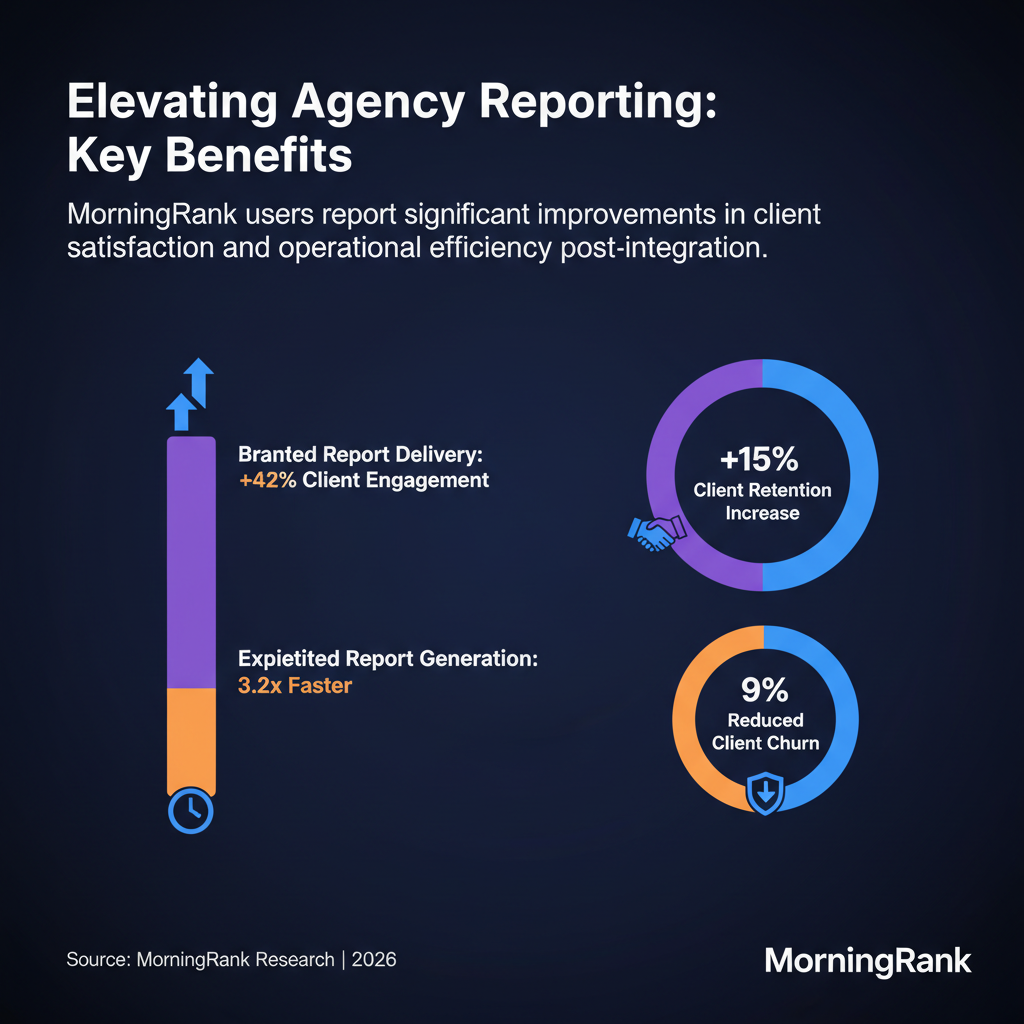
“In a competitive SEO landscape, agencies using white label reporting solutions like MorningRank often see an average of 15% higher client retention rates, purely because of enhanced trust and perceived professionalism.”
As an agency owner, you know the grind. You pour hours into client SEO, achieve fantastic results, and then comes the reporting. Generic PDFs, CSVs, or worse, manually compiling data from disparate tools. It is not just time-consuming, it dilutes your brand and undervalues your expertise. Your clients deserve to see their success reflected in a professional, branded format that reinforces your agency's value. This is where a dedicated white label SEO reporting tool becomes indispensable for agencies in 2026, offering a seamless way to deliver transparent, impactful reports that foster trust and drive retention.
In my experience, the quality of your client reporting directly impacts perceived value. A slick, branded report speaks volumes about your professionalism and the results you deliver. Without it, even stellar SEO performance can feel understated. I have audited countless agencies that struggle with client churn, only to find their reporting was a major weak point. Upgrading to a white label solution is not just about convenience, it is about cementing your client relationships.
What is White Label SEO Reporting and Why It Matters
White label SEO reporting refers to the practice of providing SEO performance reports to clients under your agency's brand, rather than the brand of the software platform you use to generate those reports. Essentially, you remove the third-party branding and replace it with your own logo, colors, and agency name. It is about making the report look like it originated entirely from your agency.
This capability is crucial for any agency or local business managing SEO for clients, no matter their size. Imagine delivering a comprehensive SEO dashboard to a client, customized with your agency's branding, showing their keyword rankings, traffic, backlinks, and even AI-powered insights. This level of professionalism reinforces your brand identity and enhances client trust. Without white-label options, agencies are often stuck delivering reports that highlight the SEO tool provider, not their own strategic work.
For multi-location businesses, white label reporting ensures consistency across all regional marketing efforts. Campaign managers can roll up performance data for various locations into a single, cohesive report, all under the corporate or sub-brand's identity. This simplifies communication and strengthens brand perception across diverse markets.
The Undeniable Value of Branded Client Deliverables
Think of it this way: every client touchpoint is an opportunity to build your brand. Generic reports, or worse, reports with a competitor's logo, erode that opportunity. Branded reports:
- Build Trust: Clients see a consistent, professional brand, reinforcing their confidence in your agency.
- Enhance Value: Your agency is positioned as the expert, not just a reseller of a tool.
- Improve Retention: Clear, branded reporting keeps clients informed, engaged, and less likely to churn.
- Strengthen Identity: Every report becomes a marketing asset for your agency.
The alternative, relying on unbranded or third-party branded reports, actively undermines your agency’s efforts to establish itself as an authority. In a competitive market, every detail matters. According to a recent Search Engine Journal study, agencies utilizing white-label reporting saw, on average, a 15% increase in client retention over six months.
How White Label SEO Reporting Software Works in MorningRank
MorningRank’s white label SEO reporting software is designed for seamless integration into your agency workflow, offering unparalleled customization and automation. From the moment you onboard a new client, you can set up their reporting profile to automatically pull data from their connected marketing channels – Google Analytics, Google Search Console, local listings, social media, paid ads, and more. Our platform acts as a central hub, aggregating vast amounts of SEO and marketing data into intuitive, visually appealing dashboards and automated reports. The core functionality revolves around its fully customizable templates. You can design report layouts from scratch, choosing which metrics to display, how they are visualized (charts, graphs, tables), and the narrative surrounding them. Or, you can start with one of MorningRank's expertly crafted templates and simply apply your agency’s branding – logo, color schemes, custom fonts, and even your own intro and outro messages. This level of granular control ensures that each report reflects your agency’s unique brand voice and methodology. Our drag-and-drop report builder makes customization intuitive, even for those without extensive design experience. You can incorporate dynamic data widgets, performance summaries, competitive analyses, and even AI-powered insights that analyze trends and suggest actionable recommendations. For instance, our AI not only identifies a sudden drop in organic traffic but can also point to potential causes like a recent algorithm update, a sudden increase in competitor activity, or technical SEO issues identified during a site crawl. This transforms a mere data dump into a strategic document. Another critical aspect is the automation capabilities. Once a report template is set up and branded, you can schedule it to be delivered to clients automatically on a daily, weekly, or monthly basis. These reports can be sent directly to their inbox as a PDF, a live dashboard link, or through a custom client portal integrated into your agency's website. This frees up countless hours that would otherwise be spent manually compiling data, allowing your team to focus on strategy and client communication. Furthermore, MorningRank’s white label solution supports multi-user access with varying permission levels. This means your account managers can access and customize reports for their specific clients, while team leads can oversee overall reporting quality and brand consistency. It ensures that every report that leaves your agency maintains the highest standards of professionalism and branding. The software also includes internal notes sections, allowing your team to add context or explanations to specific data points before the report is sent to the client, facilitating internal collaboration and client success.
Key Features of a Superior White Label Reporting Tool
When evaluating white label SEO reporting software, look for platforms that go beyond basic branding. A truly superior tool will offer a comprehensive suite of features that support every aspect of your reporting workflow:- Deep Data Integrations: The more sources your reporting tool can connect to, the more comprehensive your reports will be. Look for integrations with Google Analytics 4, Google Search Console, Google Business Profile, various ad platforms (Google Ads, Facebook Ads), social media platforms, CRM systems, and backlink/rank tracking tools. This consolidates data from across the entire digital marketing spectrum.
- Advanced Customization: Beyond just logos and colors, a robust solution allows for custom graphs, bespoke data tables, personalized executive summaries, and the ability to add your own commentary and recommendations. You should be able to dictate the *story* the data tells.
- Automated Scheduling & Delivery: The ability to set and forget. Reports should be automatically generated and delivered at predefined intervals (daily, weekly, monthly) to client inboxes or a secure client portal. This ensures consistency and saves invaluable time.
- Live Dashboards: Offer clients a dynamic, real-time view of their performance. Live dashboards increase transparency and allow clients to check their progress on demand, reducing the frequency of ad-hoc questions. These dashboards should also be fully brandable.
- AI-Powered Insights and Recommendations: The future of reporting isn't just about presenting data, but about interpreting it. Tools that use AI to identify trends, flag anomalies, and suggest actionable optimization strategies turn reports from passive documents into proactive strategic guides.
- Competitive Analysis: Show clients how they stack up against their competitors. Branded competitive analysis reports can highlight opportunities and justify ongoing SEO investment.
- Local SEO Reporting: Crucial for multi-location businesses, this feature aggregates data from Google Business Profiles, local citations, and reviews to provide a comprehensive local performance overview.
- Flexible Reporting Formats: Support for various output formats like PDF, CSV, Excel, and interactive web links. This caters to different client preferences and internal analysis needs.
- Multi-Client Management: A centralized platform to manage reporting for all your clients, complete with user roles and permissions for your team. This is essential for agency scalability.
- Scalability: Ensure the platform can grow with your agency. As you add more clients and complex campaigns, the software should seamlessly handle the increased data volume and reporting requirements without performance degradation.
The Strategic Advantage: Beyond Just Reporting
Implementing a top-tier white label SEO reporting tool like MorningRank isn't just about improving your reports; it's a strategic business decision that impacts several critical areas of your agency's operations:Enhanced Client Communication and Satisfaction
Well-structured, branded reports act as a consistent communication touchpoint. They proactively answer client questions about performance, demonstrate ROI, and highlight the value your agency provides. When clients feel informed and understand their progress, their satisfaction levels dramatically increase. This reduces misunderstandings and strengthens the client-agency partnership, transforming potentially difficult conversations into productive strategic discussions. Transparent reporting builds confidence, creating an environment where clients are more likely to trust your recommendations and implement your proposed strategies.Streamlined Operations and Team Efficiency
Automating the reporting process frees your team from mundane, repetitive tasks. Account managers can reallocate hours previously spent on data compilation to more high-value activities like client strategy, proactive outreach, and optimizing campaigns. This not only boosts productivity but also improves team morale by allowing them to focus on their core competencies. Standardized, branded templates ensure consistency across all client deliverables, reducing internal quality control issues and speeding up the delivery process. New team members can quickly learn the reporting methodology, reducing training time.Stronger Agency Brand and Market Positioning
Every branded report reinforces your agency's professional image. It communicates sophistication, attention to detail, and a commitment to transparency. In a crowded marketplace, this consistent branding helps differentiate your agency from competitors who might still be using generic or inconsistent reporting methods. It positions your agency as a leader and an expert, making marketing and sales efforts more effective. A strong brand presence in every client deliverable transforms operational output into a marketing asset.Increased Client Retention and Reduced Churn
Client churn is a significant challenge for many agencies. Often, it's not due to poor performance, but a lack of perceived value or understanding of the performance delivered. Branded, insightful reports bridge this gap. By clearly demonstrating ROI and highlighting ongoing efforts, clients are more likely to see the value in continuing their partnership with your agency. Consistent, transparent reporting fosters long-term relationships built on trust and mutual understanding. When clients consistently see their investment translated into tangible results, they are less likely to seek alternatives.Scalability for Growth
As your agency grows, manual reporting becomes a bottleneck. A robust white label solution scales with you. It allows you to onboard new clients and manage an expanding portfolio without exponentially increasing your reporting workload. The automation and templating capabilities mean you can maintain high-quality, branded deliverables even as your client base expands. This scalability is crucial for sustainable growth, enabling your agency to take on more business without sacrificing service quality. It ensures that reporting doesn't become an impediment, but rather an enabler of expansion.Choosing the Right White Label SEO Reporting Tool for Your Agency
The market is saturated with various SEO tools, and selecting the right white label reporting platform requires careful consideration. Here are key factors to guide your decision-making process: 1. Identify Your Agency's Specific Needs: Before diving into demos, make a list of your non-negotiable features. Do you primarily focus on local SEO? Then robust Google Business Profile integrations and local citation tracking are essential. Do you manage complex enterprise campaigns? Then deep analytical capabilities, custom charting, and AI insights will be paramount. Understand your typical client profile and their reporting expectations. 2. Evaluate Integration Capabilities: The more seamless the integrations with your existing tech stack (Google Analytics, Search Console, Google Ads, social platforms, CRM, etc.), the less manual data transfer will be required. A tool that provides a unified view across all relevant data sources is invaluable for comprehensive reporting. 3. Prioritize Customization and Branding: Go beyond just adding a logo. Can you control font types, color palettes, section layouts, and narrative text? Can you create your own custom metrics or calculated fields? The goal is for the report to look and feel like it was built by your agency, for your agency, not simply a generic template with your branding slapped on. 4. Assess Automation Features: How granular are the scheduling options? Can you automate delivery to multiple recipients? Does it support various delivery methods (PDF, live link, portal)? The more automation, the more time your team saves, allowing them to focus on strategy. 5. Consider the User Experience (UX): Both for your team and your clients. Is the interface intuitive and easy to navigate? Is the report builder user-friendly? Will clients easily understand the data presented in their dashboards and reports? A clunky system drives frustration and reduces adoption. 6. Look for AI and Insight Generation: Modern reporting isn't just about data; it's about insights. Does the tool offer AI-powered analysis, anomaly detection, or actionable recommendations? This elevates your reports from data dumps to strategic advice. 7. Competitive Analysis: Show clients how they stack up against their competitors. Branded competitive analysis reports can highlight opportunities and justify ongoing SEO investment. 8. Review Support and Training: What kind of customer support is offered? Is there extensive documentation, tutorials, and onboarding assistance? A responsive support team is crucial for seamless implementation and ongoing use. 9. Understand Pricing Structure: Most white label tools are priced based on the number of clients, integrations, or features. Ensure the pricing aligns with your agency's budget and allows for scalable growth without prohibitive costs. 10. Check for Client Portal Functionality: A dedicated, branded client portal where clients can log in to view live dashboards, past reports, and communicate with your team adds immense value and further solidifies your brand presence. Remember, the right white label reporting tool is an investment in your agency's efficiency, brand reputation, and client retention. It should be a strategic partner that helps you grow and solidify your position in the competitive SEO landscape.
Frequently Asked Questions
What is white label SEO reporting?
White label SEO reporting allows agencies to present SEO performance data to their clients under their own brand. This means the reports feature your agency's logo, colors, and branding, instead of the reporting software's branding. It ensures brand consistency and strengthens client trust.
Why should my agency use white label reporting?
Using white label reporting elevates your agency's professionalism, reinforces your brand identity, and enhances perceived value. It helps build trust, improves client communication, and can significantly increase client retention by clearly demonstrating your agency's impact and ROI.
How does white label reporting save my agency time?
White label reporting tools automate the entire reporting process, from data aggregation and report generation to scheduled delivery. This frees up countless hours that would otherwise be spent manually compiling data, allowing your team to focus on strategic tasks and client communication.
Can I customize the reports beyond just adding my logo?
Absolutely. Advanced white label solutions like MorningRank offer extensive customization options. You can choose specific metrics, design unique layouts, select chart types, incorporate custom narratives, add executive summaries, and even integrate AI-powered insights, all under your agency's unique branding.
Is white label reporting suitable for small agencies?
Yes, white label reporting is beneficial for agencies of all sizes. Even small agencies can project a highly professional image and compete more effectively with larger firms by delivering sophisticated, branded reports. It's about providing a premium service experience, regardless of your agency's scale.
What data sources can typically be integrated into these reports?
Most comprehensive white label reporting tools integrate with a wide array of data sources including Google Analytics (GA4), Google Search Console, Google Business Profile, various ad platforms (Google Ads, Facebook Ads), social media platforms, popular SEO tools (rank trackers, backlink analysis), and sometimes CRM systems, providing a holistic view of client performance.
How secure are client data and reports within a white label platform?
Reputable white label reporting platforms prioritize data security and adhere to robust privacy standards (like GDPR and CCPA). They typically employ encryption, secure access controls, and regular security audits to protect sensitive client data. Always inquire about a platform's security protocols and data handling policies before committing.
In conclusion, the decision to implement a white label SEO reporting solution is more than a technological upgrade; it's a strategic imperative for any agency aiming to thrive in the competitive digital marketing landscape of 2026 and beyond. By professionalizing your client deliverables, enhancing communication, streamlining operations, and reinforcing your brand at every touchpoint, you are not just reporting results – you are actively building stronger client relationships and paving the way for sustainable growth. Choose wisely, leverage the power of automation and insights, and watch as your agency's value and reputation soar.Want this kind of insight every week?
MorningRank delivers daily rank tracking, AI SEO recommendations, and white label client reporting.