
Topic Clusters and User-Intent Mapping: A 2026 Content Architecture Playbook for Agencies
In 2026, the landscape of search engine optimization continues its rapid evolution.
 Sofia Chen
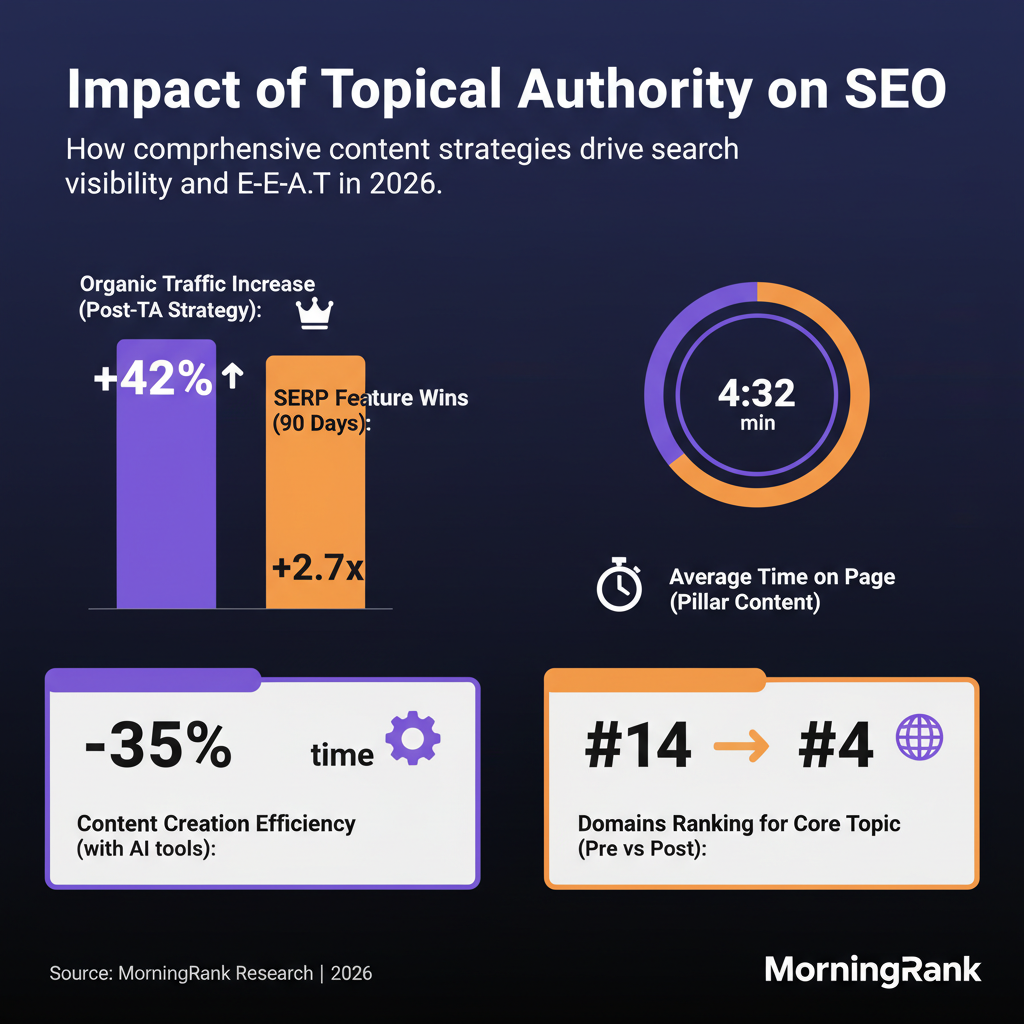
“In my experience, clients who strategically invest in building topical authority see an average organic traffic increase of 42% within 12 months, along with a 2.7x increase in SERP feature visibility.”
Owning a topic in 2026 is an architecture problem, not a keyword problem. This playbook walks agencies through a topic cluster strategy for agencies: mapping the full user intent journey for a client niche, designing pillar and cluster structure, and wiring internal links so search engines and AI Overviews recognize the entire subject area as yours.
The focus here is the build, not the theory. For the broader case on why topical authority and E-E-A-T matter as the foundation, read our companion piece on content SEO and topical authority building. Here we go straight into intent mapping, cluster blueprints, and the internal linking patterns that compound authority page by page.
The Evolution of Content SEO: Beyond Keywords
In the past, content SEO often revolved around identifying high-volume keywords, creating a page for each, and optimizing aggressively. While keywords remain a fundamental component of SEO, their role has fundamentally shifted. Google's sophisticated algorithms now understand context, user intent, and relationships between topics far better than ever before. This move away from simple keyword matching toward semantic understanding has profound implications for content strategy.
Today, effective content SEO requires a focus on comprehensively covering a topic, not just a single keyword. This means developing content clusters, linking related articles, and providing in-depth answers to user questions. Google aims to serve the most helpful, trustworthy content, and a site that demonstrates deep knowledge across a broad subject area is far more likely to achieve this than one with fragmented, shallow content.
From Keywords to Topics: Understanding User Intent
The core shift in content SEO is from "keywords" to "topics." A topic encompasses a range of related keywords and questions that users might have. For instance, the topic "coffee brewing methods" includes keywords like "how to make pour over coffee," "best espresso machine," "cold brew vs iced coffee," and "Aeropress instructions." Instead of creating disparate articles for each, a topical authority strategy aims to cover the entire topic comprehensively.
Understanding user intent is paramount. Are users looking for informational content, transactional pages, or navigational assistance? Each intent requires a different content approach. Topical authority is built by consistently addressing all facets of a user's journey within a particular subject area, providing value at every stage. This holistic approach signals to search engines that your site is a reliable and exhaustive resource. I often advise agencies to map user journeys for each service or product, identifying every potential question a client's customer might ask. This forms the backbone of a robust content plan.
The Role of E-E-A-T in Topical Authority
E-E-A-T (Experience, Expertise, Authoritativeness, Trustworthiness) is not a direct ranking factor, but rather a set of guidelines Google's quality evaluators use to assess content. However, building topical authority inherently aligns with E-E-A-T. A site that consistently publishes high-quality, in-depth, and accurate content on a specific topic demonstrates expertise and authority. If a site's content is created by recognized experts and can be trusted, it will naturally perform better in search. This is especially true for "Your Money Your Life" (YMYL) topics, where accuracy and trustworthiness are critical.
To bolster E-E-A-T and topical authority, consider featuring author bios with credentials, citing reputable sources, conducting original research, and updating content regularly. For clients, this could mean interviewing their internal subject matter experts or highlighting relevant industry certifications. These signals help both users and search engines perceive your content as reliable and authoritative. Google discusses E-E-A-T in detail in its Search Quality Rater Guidelines, underscoring its importance.
Developing a Topical Authority Content Strategy
Building topical authority isn't a quick fix, it's a strategic investment. It requires a structured approach to content planning, creation, and internal linking. For agencies, this means developing a scalable framework that can be applied across numerous client projects, ensuring consistent quality and measurable results.
Auditing Existing Content for Topical Gaps
Before creating new content, a comprehensive content audit is essential. This involves analyzing existing content for performance, identifying gaps in topical coverage, and assessing opportunities for consolidation or expansion. As part of my agency audits, I focus on identifying "orphan" content (pages with few internal links) or thin content pages that could be combined or expanded into authoritative pillar content. Utilize tools to map your current keyword rankings and traffic, then cross-reference this with a list of all relevant subtopics within your niche.
Look for clusters of keywords that are currently spread across multiple, thin articles. These are prime candidates for consolidation into a single, comprehensive pillar page. Identify topics where competitors are ranking but your client is not. This gap analysis informs your new content creation strategy, ensuring every new piece directly contributes to building comprehensive authority. MorningRank's AI keyword suggestion engine can help uncover these gaps, offering actionable insights for content expansion.
The Pillar Page and Content Cluster Model
The pillar page and content cluster model is the cornerstone of topical authority. A pillar page is a comprehensive, broad piece of content that covers an overarching topic at a high level. It then links out to several supporting cluster content pages, which delve into specific subtopics in much greater detail. In turn, these cluster pages link back to the pillar page, reinforcing its authority.
For example, a pillar page on "Digital Marketing Strategies" might link to cluster content on "SEO Best Practices," "Social Media Marketing," "Email Marketing Campaigns," and "Content Marketing Funnels." Each cluster page would then link back to the main "Digital Marketing Strategies" pillar. This internal linking structure clearly signals to search engines the hierarchical relationship and comprehensive nature of your content. This structured approach not only helps search engines understand your site's topical relevance but also improves user navigation and engagement.
Strategic Internal Linking for Authority Flow
Internal linking is a powerful, yet often underutilized, aspect of building topical authority. It helps distribute "link equity" throughout your site, signals the relationship between content pieces, and improves crawlability. When implementing a content cluster, strict attention to internal linking is crucial. Links from cluster content to the pillar should use descriptive anchor text that includes variations of the pillar page's focus keyword.
Beyond pillar-cluster relationships, actively seek opportunities to link relevant articles together across your entire site. For instance, an article discussing "Advanced Link Building Strategies for Local Businesses" (like our guide at /blog/link-building-strategies-for-local-businesses-in-2026) could link contextually to a post about "Local SEO Tips for Agencies" (/blog/local-seo-tips-for-agencies-and-small-businesses-in-2026). This creates a web of interconnected content, strengthening the overall topical relevance and authority of the domain. Ensure anchor text is natural and relevant, providing clear context for both users and search engines. I recommend using a tool to visualize your site's internal link structure periodically to identify any isolated content.
Content Creation Best Practices in 2026
With a solid strategy in place, the next step is creating the content itself. In 2026, content quality is paramount. This means going beyond simple text to include rich media, expert insights, and a user-centric approach.
Prioritizing Quality and Depth
Gone are the days when short, keyword-stuffed articles could rank. Today, long-form, comprehensive content that genuinely answers user questions and provides unique insights is favored. Google's core updates consistently reward content that demonstrates depth and value. Aim to create content that is 10x better than anything currently ranking for your target topic, offering a richer experience, more detailed information, and clearer explanations.
This often translates into longer articles, typically 1,500 words or more for complex topics, depending on the competitive landscape. However, length alone is not the goal. The goal is complete coverage and utility. Every paragraph, every sentence, should serve a purpose, adding value to the reader. Focus on clarity, conciseness, and scannability, using headings, subheadings, bullet points, and short paragraphs to break up text.
Integrating Rich Media and Interactivity
Text-only content can be dry. In 2026, user expectations for engaging content are higher than ever. Integrating rich media like images, infographics, videos, interactive tools, and data visualizations can significantly enhance user experience and engagement. These elements help explain complex concepts, break up text, and provide visual interest, which can reduce bounce rate and increase dwell time (key engagement metrics).
For agencies, this means investing in design and multimedia resources for clients or leveraging AI-powered content creation tools that can generate relevant visuals. For example, a detailed infographic summarizing key data points can vastly improve comprehension and shareability. Consider how multimedia can support and enhance your textual content, making it more digestible and appealing to a wider audience. MorningRank's platform has reporting features that support these rich media elements.
Optimizing for AI Answer Engines and Featured Snippets
As AI Overviews become more prominent in Google Search and users increasingly turn to large language models like ChatGPT, Gemini, and Claude for answers, optimizing for AI answer engines (AEO) and featured snippets is a critical aspect of content SEO. These AI systems often pull concise, direct answers from authoritative sources. Structuring your content with clear H2/H3 headings, using "answer box" style paragraphs for common questions, and providing definitive explanations can increase your chances of being featured.
I have seen tremendous success with clients who explicitly structure sections to answer common queries. For instance, dedicated FAQ sections, "What is X?" paragraphs, and clear comparative tables are highly effective. For more insights on optimizing for this new landscape, explore our guide on AEO vs. SEO: How to Optimize for AI Answer Engines in 2026. By creating content that directly answers questions concisely and accurately, you position your clients for maximum visibility in the generative search era. This is not just about rankings anymore, but about direct answers.

Measuring and Refining Topical Authority
Content SEO and topical authority building are ongoing processes. Continuous measurement, analysis, and refinement are crucial for sustained success. Agencies need robust tools and processes to track performance and adjust strategies.
Tracking Key Performance Indicators (KPIs)
While traditional SEO KPIs like organic traffic and keyword rankings remain important, specific metrics for topical authority also need to be tracked. These include:
- Topical Share of Voice: How much of the conversational landscape around your core topics does your client currently own compared to competitors?
- Organic Traffic to Pillar Pages: Increased traffic here indicates growing authority on the overarching topic.
- Internal Link Clicks: Tracking clicks between pillar and cluster content shows user engagement with your content clusters.
- User Engagement Metrics: Time on page, bounce rate, and scroll depth on content cluster pages provide insights into content quality and relevance.
- SERP Feature Wins: Monitoring how often your content appears in featured snippets, "People Also Ask" sections, and Google's AI Overview for target topics.
By regularly monitoring these KPIs, agencies can quickly identify what's working, what's not, and where adjustments are needed. Tools like MorningRank's AI visibility tracking and SERP feature tracking can provide invaluable data for these analyses.
Content Audits and Refresh Cycles
Content, even excellent content, has a shelf life. Information can become outdated, statistics can change, and competitors can publish new, better content. Regular content audits and refresh cycles are essential to maintain and grow topical authority. My recommendation is to audit core content clusters every 6-12 months.
During a content refresh, consider:
- Updating outdated statistics and facts.
- Adding new sections to cover emerging subtopics.
- Improving clarity, readability, and scannability.
- Integrating new internal and external links.
- Updating calls to action or product mentions.
- Consolidating thin content or splitting overly long pages.
This proactive approach ensures your content remains accurate, relevant, and helpful, continually reinforcing your client's expertise and authority in their niche. For example, a piece about "Navigating Google Algorithm Updates" will need yearly refreshes (like our guide at /blog/navigating-google-algorithm-updates-a-2026-adaptation-guide).
Leveraging AI for Content Strategy and Optimization
Artificial intelligence is transforming content SEO and topical authority initiatives. AI tools can assist with everything from gap analysis and keyword research to content generation and optimization suggestions. For agencies, leveraging AI can significantly increase efficiency and effectiveness.
AI-powered platforms can quickly analyze vast amounts of SERP data to identify topical gaps, suggest relevant subtopics, and even help structure content for optimal E-E-A-T. They can also assist with generating content briefs, outlining articles, and identifying opportunities to expand existing content. For instance, MorningRank's AI SEO recommendations feature provides actionable insights to improve content performance, accelerating the path to topical authority. However, always remember that AI is a co-pilot; human oversight, expert knowledge, and unique insights remain indispensable for creating truly authoritative content.
Conclusion
Building topical authority through strategic content SEO is no longer an optional strategy; it's a fundamental requirement for success in 2026. Agencies that embrace this holistic approach, moving beyond individual keywords to comprehensive topic mastery, will deliver superior results for their clients. By focusing on E-E-A-T, structuring content with pillar pages and clusters, and continuously refining based on performance data, you can establish your clients as the definitive voices in their industries.
The era of AI in search demands deeper, more helpful content. As AI Overviews and answer engines become more prevalent, the sites that have cultivated true topical authority will be the ones that consistently capture visibility, drive traffic, and generate leads. Equip your agency with the right strategies and the right tools to navigate this evolving landscape and achieve unparalleled content SEO success.
Frequently Asked Questions
What is topical authority in SEO?
Topical authority in SEO refers to a website's demonstrated comprehensive knowledge and expertise on a specific subject area. Instead of just ranking for individual keywords, a site with high topical authority covers an encompassing topic in great depth, addressing all related subtopics and user questions. This signals to search engines that the site is a definitive and trustworthy source of information, boosting its overall content SEO performance.
Why is topical authority building important in 2026?
Topical authority building is crucial in 2026 because search engines increasingly prioritize comprehensive, high-quality content that demonstrates E-E-A-T (Experience, Expertise, Authoritativeness, Trustworthiness). Google's algorithm updates reward sites that offer in-depth coverage, leading to better rankings, increased organic traffic, and higher visibility in AI Overviews and answer engines. It helps future-proof your SEO strategy against algorithm changes.
How do you build topical authority for a website?
To build topical authority, start by identifying your core topics and conducting a content audit. Then, implement a pillar page and content cluster strategy, creating comprehensive pillar pages that link to detailed cluster content on subtopics. Strategic internal linking is also vital to connect related articles. Consistently publish high-quality, in-depth content that covers all facets of a topic and optimize for user intent and AI answer engines to enhance your content SEO.
What is the difference between keyword stuffing and topical authority?
Keyword stuffing is an outdated practice of unnaturally repeating keywords in content, aiming to manipulate search engine rankings. It results in poor user experience and can lead to penalties. Topical authority, on the other hand, focuses on genuinely covering a subject comprehensively and naturally, using a wide range of related keywords and concepts to answer user questions thoroughly. It prioritizes user value and E-E-A-T over keyword density.
Can a local business achieve topical authority?
Yes, absolutely. A local business can achieve topical authority by focusing on niche topics highly relevant to its services and geographic area. For example, a local bakery could build authority on "sourdough bread baking techniques in [City Name]" or "best vegan pastries in [City Name]." By creating hyper-local, in-depth content that addresses specific community needs, local businesses can become the go-to resource in their niche, significantly boosting their local content SEO and attracting targeted customers.
What tools help with topical authority research and tracking?
Several tools can assist with topical authority research and tracking. Keyword research tools help identify related topics and long-tail keywords. SEO platforms like MorningRank offer features such as AI keyword suggestions, AI-powered content audits, competitive analysis, and SERP feature tracking to identify content gaps and monitor performance. These tools streamline the process of uncovering opportunities, planning content clusters, and measuring the impact of your topical authority efforts on content SEO.
How does MorningRank assist agencies in building topical authority for clients?
MorningRank assists agencies by providing an AI-first SEO platform designed for building topical authority and improving content SEO. Features like AI keyword suggestions, AI-driven content audits, competitive intelligence, and comprehensive rank tracking help identify content gaps and monitor progress. Our platform also offers AI SEO recommendations and AI weekly action plans to guide agencies in creating and optimizing content clusters. This streamlines the process of establishing clients as definitive industry experts and gaining top search visibility.
Ready to transform your clients' search visibility and establish them as definitive authorities in their niches? Try MorningRank free today and experience the power of AI-driven SEO for agencies and local businesses.
Want this kind of insight every week?
MorningRank delivers daily rank tracking, AI SEO recommendations, and white label client reporting.