
Advanced Keyword Rank Tracking Strategies for Agencies in 2026
Effective keyword rank tracking strategies in 2026 involve much more than simply logging daily position changes.
 Daniel Park
“In 2026, gaining a Featured Snippet can significantly boost organic traffic, even if the traditional organic ranking remains constant.”
Effective keyword rank tracking strategies in 2026 involve much more than simply logging daily position changes. For SEO agencies, it means adopting advanced methodologies to monitor nuanced SERP changes, track local results with precision, and understand visibility within AI-powered answer engines. Mastering these strategies is crucial for delivering exceptional client outcomes and maintaining a competitive edge.
Key Takeaways
- Advanced keyword rank tracking extends beyond basic position monitoring to include SERP feature visibility.
- Local rank tracking requires highly granular, location-specific data to be truly effective.
- AI answer engine visibility (AEO/GEO) is a critical new dimension of rank tracking in 2026.
- Effective rank tracking tools offer daily updates, historical data, and seamless reporting.
- Agencies should segment keywords by intent, campaign, and client to derive actionable insights.
In the dynamic realm of SEO, simply knowing where a keyword ranks is no longer enough. The search landscape of 2026 is complex, featuring AI Overviews, generative answers, diverse SERP features, and highly personalized local results. As a Technical SEO Lead, I have audited countless agency strategies and observed that those who thrive are continuously evolving their approach to keyword rank tracking. This post will delve into advanced methodologies that empower agencies to not only report on rankings but also to understand the deeper implications of search visibility and leverage that data for strategic growth.
The goal is to move beyond mere data collection to data interpretation, providing clients with actionable insights that drive real business value. We will explore how to track the full spectrum of SERP visibility, from traditional organic positions to specialized features, and how to effectively monitor performance in the evolving AI search ecosystem. Understanding these advanced keyword rank tracking strategies is vital for any SEO professional.
Why Do Agencies Need Advanced Keyword Rank Tracking in 2026?
Agencies operate in a highly competitive environment where clients demand measurable results and transparent reporting. Basic rank tracking, which only shows a website's average position for a set of keywords, often fails to capture the full picture of search performance. In 2026, search results pages (SERPs) are incredibly dynamic, featuring a multitude of elements beyond the classic "10 blue links, " such as Featured Snippets, local packs, image carousels, video results, and AI Overviews. Advanced keyword rank tracking allows agencies to precisely monitor a brand's visibility across all these critical SERP features.
For instance, gaining a Featured Snippet can significantly boost organic traffic, even if the traditional organic ranking remains constant. Semrush reported that Featured Snippets capture approximately 8% of all clicks, illustrating their importance for visibility (Source: Semrush). Without advanced tracking, agencies might overlook these crucial wins or, conversely, fail to identify areas where competitors are dominating non-traditional SERP real estate. This comprehensive view is essential for developing adaptive SEO strategies and accurately attributing success to specific optimization efforts.
Moreover, the rise of AI-powered search means that traditional rank tracking alone is insufficient. Generative AI (GEO) and Answer Engine Optimization (AEO) require distinct tracking methods to measure when a brand is cited or recommended by AI Overviews or chatbots. Agencies need to demonstrate not just organic ranking improvements but also how their clients are achieving visibility in these new, high-impact search formats. In my experience, agencies that adopt these advanced keyword rank tracking strategies are better equipped to showcase their expertise and secure long-term client relationships.
How Can Agencies Track Comprehensive SERP Feature Visibility?
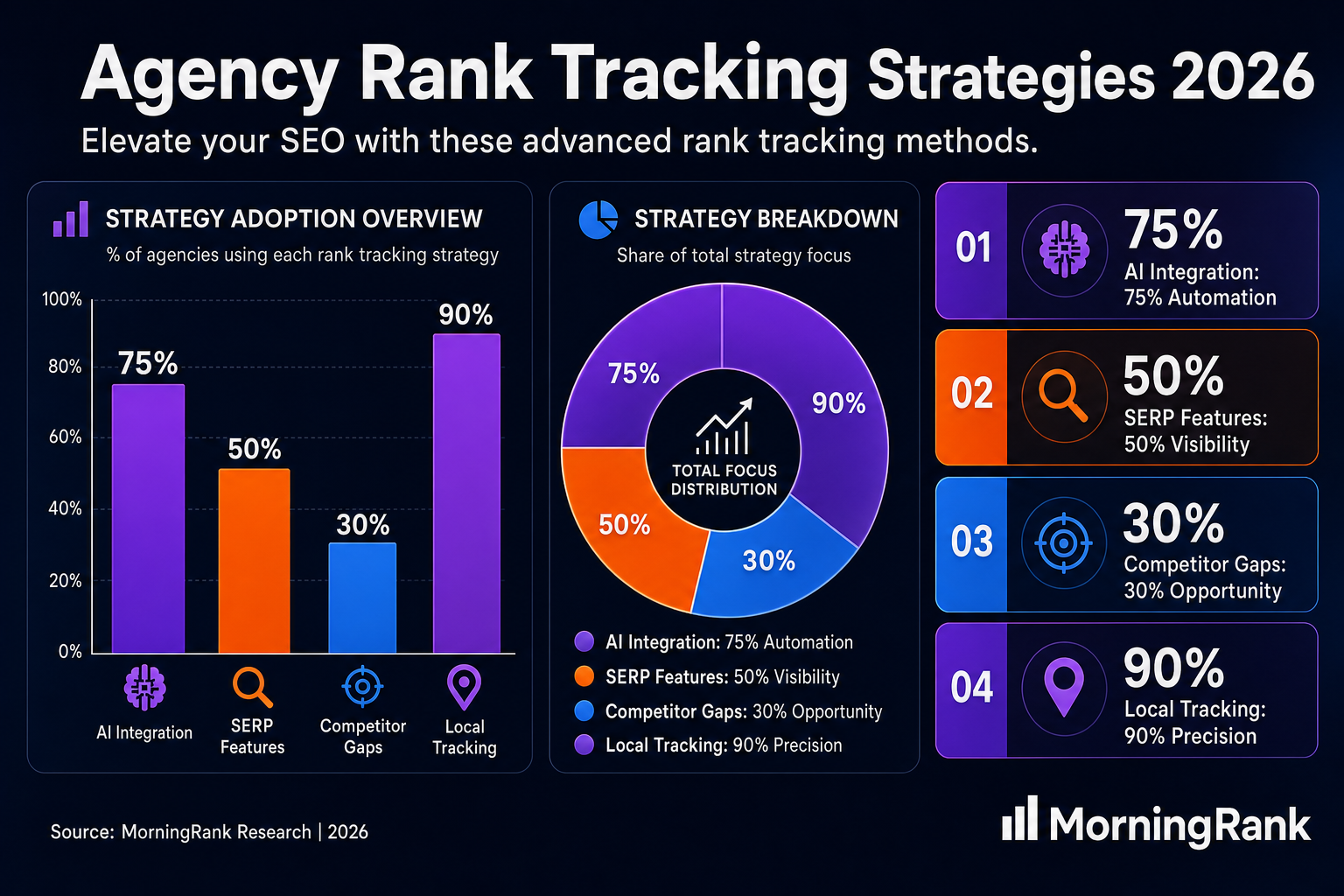
Tracking comprehensive SERP feature visibility involves monitoring not just the numeric ranking but also the presence and position of specific SERP elements for target keywords. This includes Featured Snippets, People Also Ask boxes, image packs, video carousels, top stories, shopping results, and local packs. Modern rank tracking tools provide capabilities to identify which of these features are appearing for your keywords and whether your client's content is earning those coveted spots. For example, MorningRank's SERP features tracking offers granular insights into these elements.
A tactical approach to SERP feature tracking begins with thorough keyword research, identifying keywords that commonly trigger specific features. Tools can then be configured to monitor these keywords daily, reporting on changes in feature presence and client visibility within them. This granular data allows agencies to prioritize content optimization efforts. For example, if a high-value keyword frequently triggers a "People Also Ask" box, the agency can create targeted FAQ content to aim for inclusion. If local packs are prominent, the strategy might shift towards enhancing Google Business Profile optimization. For more insights on GBP, read our guide on Mastering Local Google Business Profile Optimization in 2026.
Analyzing competitor performance within SERP features is equally important. By observing which competitors are consistently appearing in Featured Snippets or video carousels, agencies can reverse-engineer successful strategies. This goes beyond simple rank comparison; it involves understanding the content format, structure, and authority signals that Google favors for different features. Agencies that leverage detailed SERP feature tracking can identify new opportunities for their clients and proactively adapt to changes in Google's dynamic search results.

What Are the Best Practices for Granular Local Rank Tracking?
Granular local rank tracking is indispensable for agencies serving local businesses, as search results are highly localized and personalized. It goes beyond tracking national rankings to monitor performance in specific cities, neighborhoods, or even precise street addresses. The goal is to accurately reflect what a prospective customer in a given location would see when searching for a client's services. This level of detail is critical because a business ranking #1 nationally might not even appear in the local pack for a nearby suburb.
Best practices for local rank tracking include: using hyper-specific geolocations, targeting "near me" searches, and monitoring rankings for various local search terms. Agencies should configure their keyword tracking to simulate searches from multiple points within a client's service area. This often requires a tool that supports proxy-based tracking or local grid reporting, providing a heat map of visibility across a geographic region. For instance, a coffee shop in Seattle needs to track "coffee shop Seattle" but also "best coffee Capitol Hill" or "espresso near me Belltown" from those specific locations. According to BrightLocal's Local Consumer Review Survey, 87% of consumers used Google to evaluate local businesses in 2023 (Source: BrightLocal), highlighting the importance of local visibility.
Monitoring local pack rankings is a distinct aspect of granular local rank tracking. These map-based results are highly influential for local businesses. Agencies need to track not only whether their clients appear in the local pack but also their position within it and any associated Google Business Profile (GBP) elements, like ratings and hours. Integrating Google Business Profile data directly into rank tracking reports provides a holistic view of local search performance. This allows agencies to correlate GBP optimization efforts with tangible ranking improvements, providing concrete evidence of ROI to local business clients. MorningRank offers robust local SEO rank tracking capabilities to address these needs.
How Do AI Answer Engines Impact Keyword Rank Tracking in 2026?
The proliferation of AI answer engines and generative AI (GEO) platforms fundamentally changes how we think about keyword rank tracking in 2026. While traditional search engines provide lists of links, AI answer engines like Google AI Overviews, ChatGPT, Gemini, and Perplexity synthesize information and provide direct answers, often citing sources from the web. For agencies, this introduces a new dimension of visibility to track: whether a client's content is being cited, summarized, or recommended by these AI systems. This is often referred to as Answer Engine Optimization (AEO) or Generative Engine Optimization (GEO).
In this new landscape, "ranking" isn't just about a numbered position on a SERP; it's about being the authoritative source that an AI chooses to reference. Tracking this involves identifying which pieces of content are generating AI citations and understanding the attributes that lead to this visibility. My observations align with industry trends: content that is clear, concise, authoritative, and structured for easy extraction performs best in AI Overviews. Agencies must now monitor for brand mentions and direct citations within these AI-generated responses, not solely traditional organic rankings. This holistic understanding of visibility is crucial for crafting content strategies that resonate with both human users and AI algorithms.
The tools for tracking AI citations are rapidly evolving. Agencies need solutions that can identify when a client's website is referenced in an AI Overview or a conversational AI response. This involves monitoring specific keywords and phrases directly within AI platforms, not just Google's traditional SERPs. Successful agencies will integrate AI visibility tracking into their standard reporting, showcasing not just improved organic rankings but also enhanced brand authority and citation volume within AI search. This prepares clients for the future of search and demonstrates an agency's forward-thinking approach. To learn more, delve into our article on What is GEO (Generative Engine Optimization) and Why Agencies Need It in 2026.
What Are Key Metrics and Reports for Effective Agency Rank Tracking?
Effective keyword rank tracking for agencies goes beyond raw ranking numbers; it involves interpreting various metrics and compiling insightful reports that clearly communicate value to clients. Key metrics include average position, highest rank achieved, estimated traffic from rankings, visibility index, SERP feature wins, and AI citation volume. Each metric tells a different part of the story, and combining them provides a comprehensive overview of SEO performance. A visibility index, for example, can show overall search presence better than individual keyword ranks, especially when dealing with hundreds or thousands of keywords for a single client.
When it comes to reporting, agencies should focus on clarity, context, and actionable insights. Automated PDF reports and white-label client portals, like those offered by MorningRank, are essential for streamlining this process. Reports should highlight not only positive ranking movements but also explain any drops and outline the strategic adjustments being made. Segmenting keywords by intent (informational, commercial, navigational), campaign, or product category also enhances report relevance. This segmentation allows clients to see how SEO efforts are impacting specific business objectives.
In my experience, the most impactful reports include comparative data against competitors. Showing a client how their visibility stacks up against their top rivals, especially in key SERP features or local packs, adds significant value. This competitive analysis helps justify ongoing SEO investment and informs future strategy. Client reports should also include a brief executive summary, key performance indicators (KPIs), and clear recommendations for the next reporting period. For more on client reporting, see our post on Client Reporting Best Practices for Agencies in 2026.
Advanced Rank Tracking Tool Comparison for Agencies
Choosing the right advanced keyword rank tracking tool is a critical decision for any SEO agency. The ideal tool needs to offer accuracy, depth, and efficiency to manage multiple clients and complex strategies. Below is a comparison of key features that agencies should consider in 2026.
| Feature | MorningRank | Competitor A (General SEO Suite) | Competitor B (Basic Rank Tracker) |
|---|---|---|---|
| Daily Rank Updates | Yes | Often weekly or on-demand | Often weekly or less frequent |
| SERP Feature Tracking | Comprehensive (Snippets, PAA, Local Pack, etc.) | Moderate (Some features tracked) | Limited (Mainly organic positions) |
| Granular Local Rank Tracking | Extensive (City, neighborhood, grid, "near me") | Basic (City-level, some zip codes) | Minimal (County-level or broader) |
| AI Visibility Tracking (GEO/AEO) | Advanced (Citations, summaries in AI Overviews) | Developing (Limited or experimental) | Not Available |
| White-Label Reporting/Client Portal | Full White-Label, Client & Share Links | Often requires higher-tier plan | Limited or no white-label |
| Integration (GA4, GSC) | Seamless & Actionable | Standard integrations | Basic import options |
MorningRank offers daily rank updates, which ensures agencies have the freshest data, critical for reacting quickly to algorithm shifts or competitive movements. Its comprehensive SERP feature tracking, including specific elements like Featured Snippets and People Also Ask boxes, allows for a more nuanced understanding of search visibility. Crucially, MorningRank stands out with its advanced AI visibility tracking, providing insights into how client content is performing in the era of generative AI and AI Overviews.
Furthermore, for agencies managing multiple clients, the robust white-label reporting and client portal features offered by MorningRank are invaluable. They enable agencies to present data directly to clients under their own branding, enhancing professionalism and client trust. Competitor A, while a strong general SEO suite, often gates advanced features like granular local tracking or extensive white-label options behind higher price tiers. Competitor B typically focuses only on basic organic position tracking, falling short of the comprehensive view required for modern SEO agency work.
Conclusion
In 2026, advanced keyword rank tracking strategies are more than a monitoring exercise; they are a strategic imperative for SEO agencies. The evolving search landscape, characterized by dynamic SERP features, hyper-localized results, and the ascendancy of AI answer engines, demands a sophisticated approach. By embracing granular local tracking, comprehensive SERP feature analysis, and cutting-edge AI visibility monitoring, agencies can provide unparalleled value to their clients.
My experience has shown that agencies equipped with the right tools and strategies are best positioned to navigate these complexities, demonstrate clear ROI, and foster long-term client success. Moving forward, the ability to track, analyze, and report on the full spectrum of search visibility will differentiate top-tier agencies. This comprehensive understanding ensures that your clients not only rank but truly dominate the search results whether a user is looking locally or interacting with an AI.
Frequently Asked Questions
What are keyword rank tracking strategies?
Keyword rank tracking strategies encompass the methods and tools used to monitor a website's organic search performance for specific keywords across various search engines. In 2026, these strategies have evolved to include tracking traditional organic positions, diverse SERP features, and visibility within AI answer engines like Google AI Overviews.
Why is granular local rank tracking important for agencies?
Granular local rank tracking is important for agencies because local search results are highly personalized and location-dependent. It allows agencies to monitor a client's visibility in specific cities, neighborhoods, or even precise addresses, accurately reflecting what local customers see and helping to optimize for local pack prominence.
How do AI Overviews affect traditional keyword rank tracking in 2026?
AI Overviews significantly affect traditional keyword rank tracking in 2026 by shifting the focus from just organic positions to also tracking citations and summaries within AI-generated answers. Agencies must now monitor when client content is referenced by AI systems, a critical component of new keyword rank tracking strategies.
What key metrics should agencies focus on in their rank tracking reports?
Agencies should focus on key metrics such as average position, highest rank achieved, estimated traffic from rankings, visibility index, SERP feature wins, and AI citation volume in their rank tracking reports. These metrics provide a holistic view of search performance and demonstrate the value of SEO efforts to clients.
How often should keyword rankings be tracked for agency clients?
For agency clients, keyword rankings should ideally be tracked daily to capture the most up-to-date data on search performance. Daily tracking, offered by advanced platforms like MorningRank, allows agencies to react swiftly to algorithm changes, competitive movements, and new opportunities, ensuring agile SEO management.
Why is white-label reporting crucial for keyword rank tracking agencies?
White-label reporting is crucial for keyword rank tracking agencies because it allows them to present SEO performance data to clients under their own brand. This enhances professionalism, builds client trust, and reinforces the agency's identity, making reports feel like a seamless extension of their service.
Ready to elevate your agency's rank tracking capabilities? Try MorningRank free today and discover how our advanced tools can transform your client reporting and SEO strategy. Visit https://morningrank.com to get started.
Want this kind of insight every week?
MorningRank delivers daily rank tracking, AI SEO recommendations, and white label client reporting.