
AI Search Visibility and AI Overview Optimization in 2026
Achieving AI search visibility and optimizing for AI Overviews involves structuring content to be easily understood and extracted by AI models.
 Christina Blair
“Agencies that fail to adapt their SEO strategies for generative AI risk becoming invisible to a significant and growing segment of searchers. Simply optimizing for traditional SERPs is no longer sufficient in 2026.”
Achieving AI search visibility and optimizing for AI Overviews involves structuring content to be easily understood and extracted by AI models. This means focusing on clear, factual information, semantic markup, and direct answers to user queries, ensuring your brand's expertise is recognized by generative AI systems.
Key Takeaways
- Structure content with clear headings, bullet points, and concise answers to facilitate AI extraction.
- Implement semantic HTML and structured data to help AI understand context and relationships within your content.
- Prioritize factual accuracy, expertise, and authoritativeness to build trust with AI models and users.
- Monitor AI-generated answers and citations to identify optimization opportunities and potential inaccuracies.
- Adapt to the evolving AI search landscape by staying informed about new algorithms and user behavior trends.
The search engine landscape is undergoing a profound transformation, driven by the rapid integration of artificial intelligence. Generative AI models like Google's AI Overviews, ChatGPT, Gemini, and Perplexity are not just answering questions; they are reshaping how users discover information and interact with brands. For agencies and local businesses, this shift necessitates a new strategic approach to SEO, often referred to as Answer Engine Optimization (AEO) or Generative Engine Optimization (GEO). The core challenge is no longer just ranking on traditional Search Engine Results Pages (SERPs) but ensuring visibility and accurate representation within AI-generated responses. This means optimizing content not only for human readers but also for the AI models that are increasingly becoming the first point of discovery. Neglecting this evolving ecosystem risks a significant drop in AI search visibilityimpacting brand reach and organic discovery. This post will guide you through the essential strategies for mastering AI search visibility and optimizing your content for AI Overviews in 2026.
What is AI Search Visibility and Why Does It Matter in 2026?
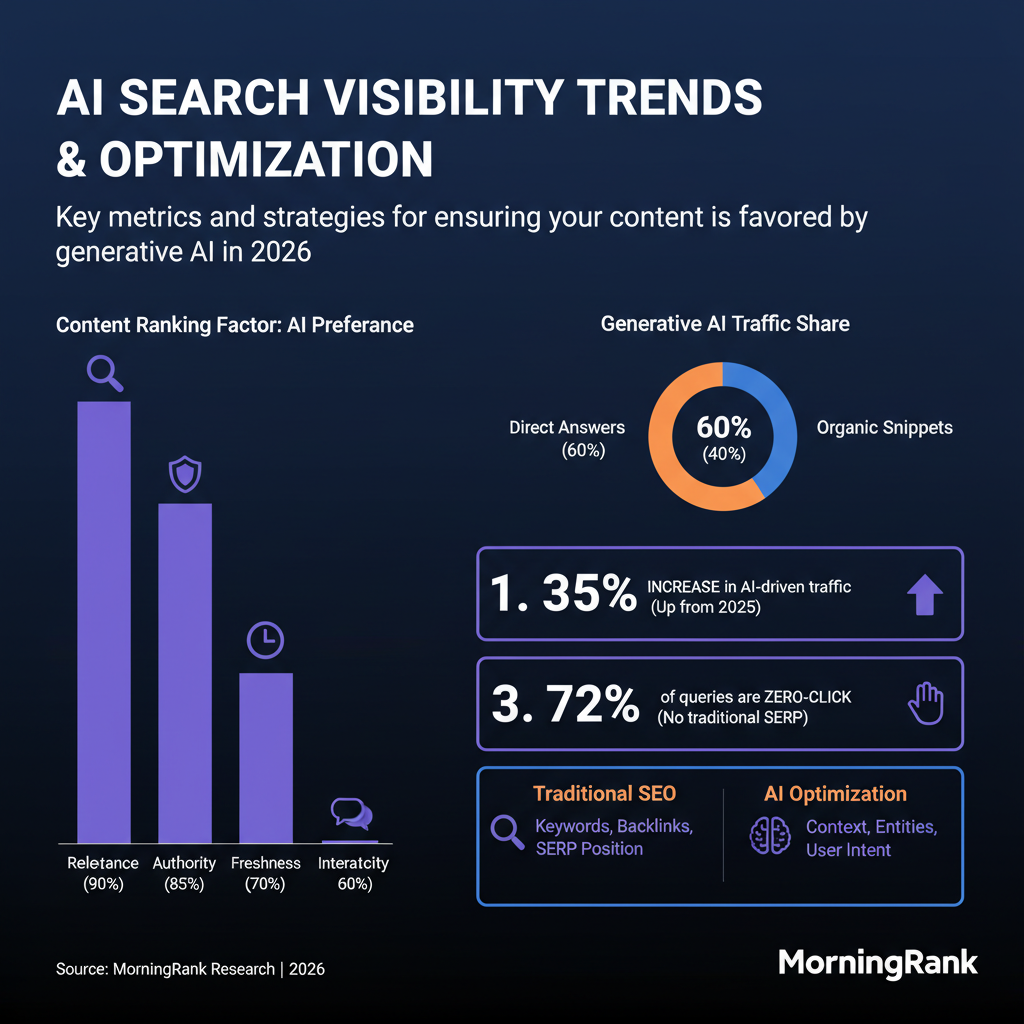
AI search visibility refers to the presence and prominence of a brand's content within AI-generated search results. This includes features like Google's AI Overviews, as well as direct answers and summaries provided by conversational AI models. In 2026, this is critical because an increasing percentage of search queries are being initiated and answered by AI. For instance, industry projections suggest that by 2026, a significant portion of total search queries could be handled by generative AI. This means if your content isn't optimized for AI consumption, you risk becoming invisible to a large and growing segment of searchers. Unlike traditional SEO, which focuses on ranking for specific keywords on a SERP, AI search visibility is about being correctly understood, cited, and presented by AI models. This requires a deeper focus on factual accuracy, clear structuring, and demonstrating expertise and authority in a way that AI can reliably process and trust. Agencies that fail to adapt risk losing valuable visibility, essentially ceding ground to competitors who are actively optimizing for these new AI-driven search experiences.
How Do AI Models Understand and Cite Content?
Generative AI models process vast amounts of data to understand and respond to user queries. They analyze content based on its structure, clarity, factual accuracy, and the perceived authority of its source. When an AI model generates an answer, it typically aims to cite the source material it used. This means ensuring your content is not only discoverable by the AI but also presented in a manner that makes it easy for the AI to attribute information to your brand. AI models look for direct answers, well-defined concepts, and supporting evidence within web pages. Structured data, such as Schema.org markup, plays a vital role here, providing explicit context that AI can readily parse. Furthermore, the inherent trustworthiness of a source, often signaled by E-E-A-T (Experience, Expertise, Authoritativeness, and Trustworthiness) signals, influences which content is favored and cited. In essence, AI models act as sophisticated information processors, prioritizing content that is clear, accurate, authoritative, and well-organized. Understanding this process is fundamental to optimizing for AI search visibility.

Strategies for Optimizing Content for AI Overviews
Optimizing content for AI Overviews in 2026 involves a multi-faceted approach that goes beyond traditional keyword optimization. At its core, it’s about making your content as digestible and trustworthy as possible for AI algorithms. First, focus on answer-first content structures. This means presenting the most important information upfront, often in paragraph or list form, to directly address potential user questions. Think of it as answering the question before elaborating on the details. Semantic HTML and structured data are also paramount. Using HTML tags semantically (e.g., correctly using <h2> for subheadings, <p> for paragraphs, <ul> for lists) helps AI understand the hierarchy and relationships within your content. Implementing Schema.org markup provides even more explicit contextual clues, allowing AI to grasp the nuances of your information more effectively. For example, using `FAQPage` schema can directly signal question-and-answer pairs to AI. In my experience auditing content for AI visibility, I've found that content rich in clear, verifiable facts and supported by authoritative sources performs exceptionally well. This directly relates to E-E-A-T principles: showcasing genuine experience, deep expertise, established authoritativeness, and unwavering trustworthiness. Ensure your content is factually sound, avoids ambiguity, and clearly attributes information to credible sources. For agencies, this means demonstrating subject matter expertise through detailed case studies, expert interviews, and research-backed articles. Regularly review your AI-generated search results and citations to ensure accuracy and identify any misinterpretations or omissions by the AI. This iterative process is key to maintaining and improving your AI search visibility.
Can Structured Data Enhance AI Search Visibility?
Yes, structured data is a powerful tool for enhancing AI search visibility. Structured data, often implemented using Schema.org vocabulary, helps search engines and AI models better understand the context and meaning of your content. By explicitly defining elements like articles, products, recipes, or FAQs, you provide AI with clear signals about the nature of your information. This can lead to richer AI interpretations and potentially more prominent placement or accurate summarization in AI Overviews. For instance, using `Article` schema with properties like `headline`, `author`, and `datePublished` provides essential metadata that AI can readily process. Similarly, `FAQPage` schema is invaluable, as it directly highlights question-and-answer pairs, making your content ideal for direct extraction by AI. A study by Semrush indicated that websites using structured data often experience improved visibility in search results, which naturally extends to AI features. In the 2026 landscape, where AI engines are becoming more sophisticated, leveraging structured data is no longer optional; it's a foundational element of an effective AEO/GEO strategy. It ensures that your meticulously crafted content is not just found, but accurately understood and presented by the AI, boosting your brand's authority and reach in this new search paradigm.
What Role Does E-E-A-T Play in AI Optimization?
E-E-A-T (Experience, Expertise, Authoritativeness, Trustworthiness) remains a cornerstone for AI optimization in 2026. AI models are designed to surface reliable and credible information. Therefore, content that robustly demonstrates E-E-A-T is more likely to be favored, cited, and accurately represented by generative AI. This means providing original research, citing reputable sources, showcasing author credentials, and demonstrating real-world experience. For example, an article discussing advanced SEO strategies should be written by experienced SEO professionals, cite data from authoritative industry reports, and include practical examples or case studies. AI algorithms evaluate these signals to gauge the trustworthiness and authoritativeness of a source. Content lacking in E-E-A-T signals may be downranked or ignored by AI models, even if it technically addresses a query. In my experience, agencies that consistently publish high-quality, expert-driven content that clearly showcases their E-E-A-T are the ones seeing the best results in AI Overviews and other generative AI outputs. This focus on quality and credibility is what builds true AI search visibility, ensuring your brand is seen as a reliable authority by both users and the AI systems that serve them.
How Can Agencies Measure AI Search Visibility?
Measuring AI search visibility is an emerging challenge, as traditional analytics tools do not directly capture AI Overview performance. However, agencies can adopt several indirect and emerging methods. Firstly, monitor brand mentions and citations within AI-generated responses. Tools like MorningRank's AI Visibility Tracking can help track when and how your brand or specific content pieces are cited by AI models like ChatGPT, Gemini, and Google AI Overviews. Secondly, analyze changes in direct traffic and branded search volume that correlate with the rise of AI Overviews. While not a direct measure, significant shifts might indicate an impact from AI-driven search changes. Thirdly, keep an eye on performance in specific SERP features that are precursors or related to AI Overviews, such as "People Also Ask" boxes or featured snippets, as these often indicate content that is well-suited for AI extraction. A study by HubSpot has suggested that AI-generated search experiences can siphon traffic from traditional SERPs, making direct brand traffic and citation monitoring crucial. Furthermore, directly searching for core queries and observing the presence and accuracy of AI Overviews featuring your content is a fundamental manual check. As the field matures, more specialized tracking tools will undoubtedly emerge, but for now, a combination of AI citation monitoring, traffic analysis, and manual SERP observation provides the best available insights into your AI search visibility.
What is the Future of AI Search Optimization?
The future of AI search optimization is intrinsically linked to the continued advancement of AI technology and its integration into search behaviors. We can expect AI models to become even more sophisticated in understanding nuanced user intent, complex queries, and the credibility of sources. This will likely lead to AI Overviews becoming more prevalent and more integrated into the overall search experience. For agencies, this means a perpetual need to adapt and refine their AEO/GEO strategies. We’ll likely see a greater emphasis on real-time data, multimodal content (images, video, audio), and personalized AI responses. The ability of AI to generate not just text but also creative content will further blur the lines between information retrieval and content creation. Furthermore, the ethical considerations of AI, including bias and factual accuracy, will become even more pronounced, making E-E-A-T and transparent sourcing non-negotiable. The ultimate goal will be to create content that is not only optimized for AI but also genuinely valuable and trustworthy for human users, ensuring that AI acts as a smart assistant rather than a barrier to relevant information. This ongoing evolution underscores the need for agile SEO practices and tools that can keep pace with AI developments.
Related reading: Schema Markup for AI Search: Boosting Visibility in 2026's AI Overviews.
Frequently Asked Questions
What is the primary goal of AI search visibility optimization?
The primary goal is to ensure your content is understood, accurately represented, and prominently cited within AI-generated search results, such as Google AI Overviews and conversational AI responses. This secures your brand's presence in the new AI-driven discovery ecosystem.
How does AI search differ from traditional SEO?
Traditional SEO focuses on ranking for keywords on a SERP. AI search optimization focuses on ensuring AI models can correctly interpret, extract, and confidently cite your content, prioritizing clarity, direct answers, and demonstrated authority over simple keyword matching.
Can I still rank in traditional search results while optimizing for AI Overviews?
Absolutely. Optimizing for AI Overviews often involves best practices like clear content structure, factual accuracy, and schema markup, which also benefit traditional SEO rankings. The two efforts are complementary, with strong E-E-A-T signals benefiting both.
What are the most important factors for AI content understanding?
AI models prioritize clear, factual, and well-structured content. Key factors include direct answers to questions, semantic HTML, structured data (like Schema.org), verifiable data, and strong E-E-A-T signals that demonstrate experience, expertise, authoritativeness, and trustworthiness.
How can I start optimizing my website for AI Overviews today?
Begin by structuring your content with clear headings and direct answers. Implement FAQ Schema for question-and-answer content. Ensure all factual claims are accurate and attributed to credible sources, and focus on demonstrating your expertise and trustworthiness.
Will AI Overviews replace traditional search results entirely?
It's unlikely they will entirely replace traditional results in the immediate future. Instead, AI Overviews and traditional SERPs will likely coexist, with AI providing instant summaries and deeper contextual answers, while traditional results offer a broader range of sources and perspectives.
How does MorningRank help with AI search visibility?
MorningRank offers specialized AI Visibility Tracking tools that monitor how your brand is cited across major AI answer engines, including Google AI Overview. This allows you to measure your presence in AI-generated results and identify optimization opportunities, ensuring your agency or business stays ahead in the evolving search landscape.
Ready to ensure your clients are visible in the age of AI search? You can also learn more about optimizing your content for Google AI Overviews and explore how MorningRank can help you master AI Overviews and Generative Engine Optimization. Start your free trial today!
Want this kind of insight every week?
MorningRank delivers daily rank tracking, AI SEO recommendations, and white label client reporting.