
Optimizing Your Content for Google AI Overviews in 2026
Optimizing for Google AI Overviews (AIOs) is essential for maintaining strong AI search visibility in 2026, as these AI-generated summaries increasingly shape…
 Christina Blair
“In my experience, showing clients a clear improvement in AI citations or a consistent presence in AI Overviews for their key terms provides tangible proof of your forward-thinking SEO expertise.”
Optimizing for Google AI Overviews (AIOs) is essential for maintaining strong AI search visibility in 2026, as these AI-generated summaries increasingly shape how users find information. To secure citations in AIOs, content must be structured, authoritative, and provide direct, accurate answers to common queries, signaling relevance and trustworthiness to AI models.
Key Takeaways
- Google AI Overviews (AIOs) deliver AI-generated summaries at the top of search results, changing user interaction with SERPs.
- Optimizing for AIOs requires creating authoritative, direct-answer content that is clearly structured with strong E-E-A-T signals.
- Agencies must adapt SEO strategies to focus on clear, concise Q&A formats, semantic SEO, and robust topical authority.
- Monitoring AI citations and AIO visibility is crucial for understanding performance in the evolving AI search landscape.
- Local businesses can leverage well-optimized Google Business Profiles and localized content to improve their chances of AIO inclusion.
The digital landscape of 2026 demands a shift in SEO strategy. With the rise of generative AI in search results, particularly Google AI Overviews, the way users consume information and interact with brands has changed fundamentally. As a Local Search Specialist at MorningRank, I've seen firsthand how agencies and local businesses are grappling with this new reality. It's no longer enough to rank on page one; you now need to be present and cited within the AI-generated summaries that often appear above traditional search results. This post will delve into practical strategies for improving your content's AI search visibility and optimizing for Google AI Overviews, ensuring your clients remain competitive in this evolving ecosystem.
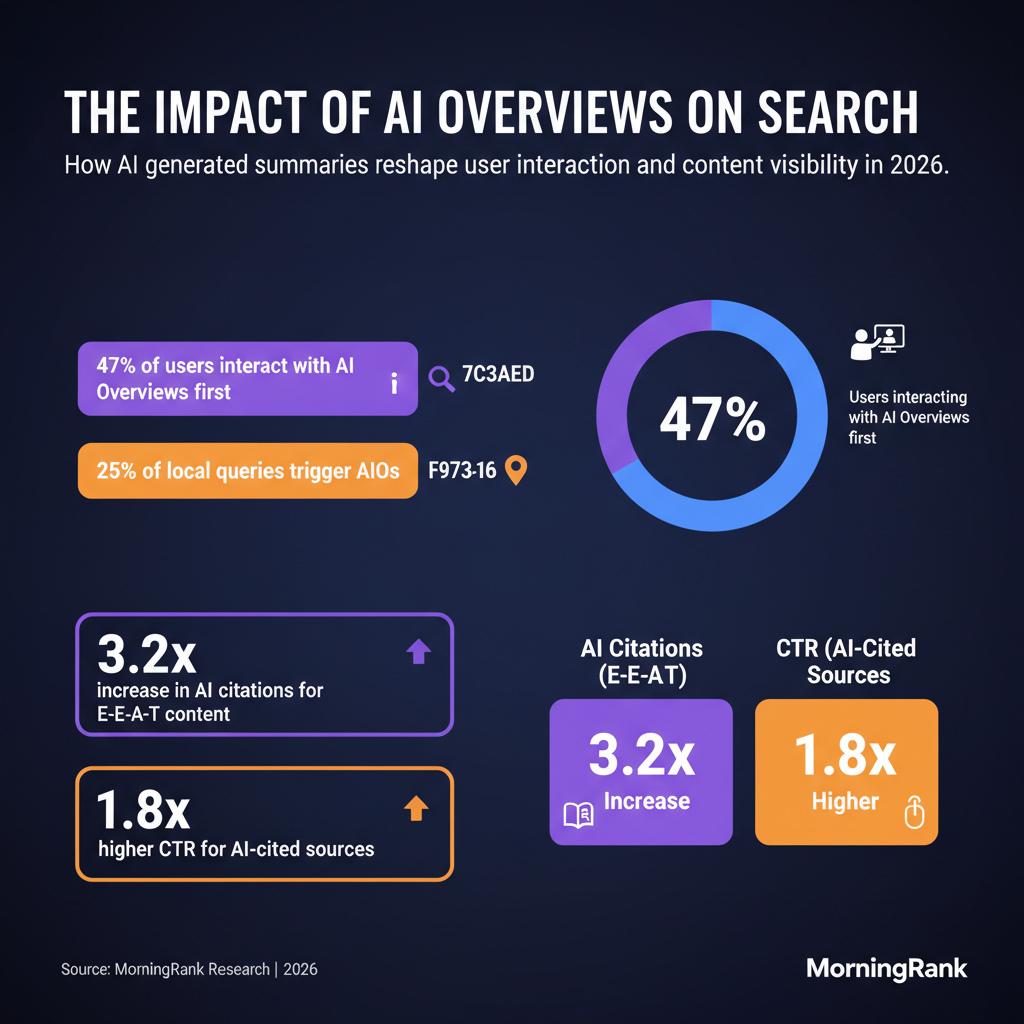
What Are Google AI Overviews and Why Do They Matter in 2026?
Google AI Overviews (AIOs) are AI-generated summaries that appear at the top of Google search results for certain queries, providing a concise answer directly within the SERP. These overviews leverage large language models to synthesize information from various sources on the web, aiming to deliver immediate and comprehensive answers to user questions. In 2026, AIOs are no longer a nascent feature; they are a prominent element of the search experience that significantly impacts organic traffic and brand visibility. For agencies and local businesses, being cited within an AIO can translate to substantial exposure, establishing your brand as a trusted authority on a given topic.
The prominence of AI Overviews means that traditional SEO, while still vital, must evolve. Users can often find the information they need directly in the AIO, reducing the likelihood of clicking through to organic results. Therefore, ensuring your content is designed for AI extraction and citation is becoming a top priority. This involves crafting extremely clear, factual, and well-structured content that AI models can easily process and understand. A robust Generative Engine Optimization (GEO) strategy directly addresses this challenge, focusing on how generative AI ranks and cites sources, so your content gets the attention it deserves.
How Can Structured Data Boost AI Overview Visibility?
Structured data, also known as schema markup is crucial for improving your content's AI search visibility by providing explicit semantic signals to search engines about the meaning and relationships within your content. When you implement structured data, you are essentially labeling different elements of your webpage (such as FAQs, product details, recipes, or reviews) in a machine-readable format. This makes it significantly easier for AI models, like those powering Google AI Overviews, to understand the context and specific information presented on your page. For example, marking up an FAQ section with FAQPage schema directly tells Google that you are providing common questions and authoritative answers, making it a prime candidate for AIO snippets. Google research indicates that structured data can improve content visibility in rich results, which often includes features that AI Overviews draw from, though no direct citation growth statistic is publicly available (Source: Google Search Central).
Beyond basic definitions, using precise schema markups for specific entities within your content enhances its discoverability by AI. Imagine a local business that clearly marks its services, business hours, and contact information using LocalBusiness schema. This granular data helps AI Overviews pull accurate information, increasing the likelihood of local businesses being featured when users search for nearby services. In my experience, websites that consistently apply high-quality, relevant schema markup tend to see better performance in all forms of enhanced search results, including potential AI Overview citations. This makes them more valuable to algorithms seeking to understand a page's factual content. Agencies should prioritize auditing and implementing comprehensive schema markup across client websites to give them a distinct edge in the AI search landscape. For a deeper dive into optimizing with schema, explore our guide on Schema Markup for AI Search.

What Content Strategies Drive AI Search Visibility?
Driving AI search visibility in 2026 demands a strategic approach to content creation that goes beyond traditional keyword stuffing or broad evergreen articles. The core principle is producing E-E-A-T optimized long-form content. E-E-A-T, which stands for Experience, Expertise, Authoritativeness, and Trustworthiness, signals to both human users and AI models that your content is reliable and comes from a credible source. For AI Overviews, content that clearly demonstrates E-E-A-T is favored because AI models are trained to prioritize high-quality, trustworthy information. This means focusing on deep, nuanced topics where your brand or client possesses genuine expertise, backing claims with data, and ensuring content is factually accurate and regularly updated.
How Can Agencies Create E-E-A-T Optimized Content for AI Overviews?
To create E-E-A-T optimized content, agencies should implement several key strategies. First, focus on comprehensive answers to user intent, anticipating follow-up questions and addressing them directly within your content. Break down complex topics into easily digestible sections, using clear headings, bullet points, and numbered lists to improve readability for both humans and AI. Second, always cite your sources for any data or claims, linking to authoritative external resources. Third, establish clear authorship, including author bios that highlight relevant credentials and expertise. This builds credibility, a fundamental component of E-E-A-T. Finally, regularly update and audit your content to ensure accuracy and relevance, removing outdated information that could detract from its authoritative signal. Investing in a robust AI keyword suggestion engine can help refine your content strategy by identifying high-value, answer-oriented keywords that align with user intent and AI search queries.
Why is Topical Authority Essential for AI Citation?
Topical authority is paramount for AI citation because it signals to AI models that your website consistently covers a specific subject area comprehensively and authoritatively. Instead of optimizing individual pages for single keywords, a topical authority strategy involves creating a cluster of interconnected content that covers all facets of a broad topic. For example, if you're a local agency managing an HVAC client, you wouldn't just have a page on "AC repair." You'd have pages covering "furnace maintenance, " "heat pump installation costs, " "indoor air quality solutions, " and more, all linked together. This holistic approach helps AI models understand the depth and breadth of your expertise, making your site a go-to source for that topic. When AI models look for the best answer to a complex query, a site with deep topical authority is far more likely to be cited than one with only fragmented content. According to a study by Semrush, domain authority plays a significant role in how often content is cited by generative AI answers (Source: Semrush).
How Does Local SEO Impact AI Overview Visibility for Local Businesses?
For local businesses and the agencies that serve them, local SEO plays a critical role in AI search visibility and securing citations within Google AI Overviews. AI Overviews often prioritize localized information, especially for "near me" or geographically specific queries. A well-optimized Google Business Profile (GBP) is the cornerstone of this strategy. Ensuring your GBP is complete, accurate, and regularly updated with business hours, services, photos, and customer reviews provides Google with verifiable, high-quality local data. This information is a primary feed for AI Overviews when addressing local search queries, making GBP optimization crucial for local brand visibility in AI results.
Beyond GBP, local content optimization is equally vital. Creating location-specific landing pages and blog content that addresses the unique needs and questions of a local audience can significantly improve your chances of AI Overview inclusion. For instance, a dentist in Austin, Texas, should have content discussing specific dental services available in Austin, relevant local health regulations, or even community involvement. This hyper-local focus provides AI models with contextually rich information, positioning the business as an expert in its specific geographic market. Furthermore, strong local citation profiles, consistent NAP (Name, Address, Phone number) information across directories, and targeted local link building all contribute to a powerful local SEO presence that AI systems can readily trust and cite. Tracking your local performance through a local SEO rank tracking tool is essential to measure the impact of these efforts.
What Tools and Metrics Are Essential for Tracking AI Overview Performance?
Tracking AI Overview performance requires a new set of tools and metrics beyond traditional rank trackers. While organic search rankings remain important, understanding when and how your content is cited by AI Overviews demands specialized visibility tracking. Traditional keyword rank tracking tools primarily show your position in the "ten blue links, " which doesn't fully capture performance within AIOs or other generative AI interfaces. To truly master AI search visibility, you need to monitor if your content is being featured in these AI-driven summaries, when new AIOs appear for your target keywords, and whether your brand is receiving direct citations. This insight is critical for refining your optimization strategies and demonstrating ROI to clients.
MorningRank offers advanced AI visibility tracking and GEO & AEO tracking features designed precisely for this new era of search. These tools allow agencies and local businesses to:
- Monitor specific keywords to see if an AI Overview is present.
- Identify if your domain is cited within an AI Overview.
- Track changes in AI citation prominence over time.
- Analyze the types of content that are successfully being cited by AI.
By leveraging these specialized metrics, you can quickly adapt your content and SEO strategies to maximize your presence in Google AI Overviews. In my experience, showing clients a clear improvement in AI citations or a consistent presence in AIOs for their key terms provides tangible proof of your forward-thinking SEO expertise. This data is invaluable for ongoing strategy adjustments and for staying ahead in the rapidly evolving search landscape.
Conclusion: Adapting to the AI Search Era in 2026
The rise of Google AI Overviews in 2026 marks a significant paradigm shift in search engine optimization. Successfully navigating this new landscape means evolving your strategies beyond traditional organic rankings to embrace AI search visibility. By focusing on E-E-A-T optimized content, implementing robust structured data, and tailoring your local SEO efforts for AI extraction, your brand or client can secure valuable citations within AI Overviews. This proactive approach ensures your expertise isn't just found, but also trusted and highlighted by generative AI.
Agencies and local businesses that prioritize clear, authoritative, and structured content will be best positioned to thrive. The key differentiator will be the ability to not only create content that ranks traditionally but also content that answers questions so directly and comprehensively that AI models choose to cite it. This requires dedicated tools for monitoring and adapting your strategy. By embracing these changes, you can transform the challenge of AI search into a powerful opportunity for increased brand exposure and authority.
Frequently Asked Questions
What is AI search visibility?
AI search visibility refers to how prominently your website or brand appears in AI-generated search results, such as Google AI Overviews, or is cited by generative AI models like ChatGPT. It goes beyond traditional organic rankings to measure your presence within these new AI-driven answer formats.
How do Google AI Overviews work in 2026?
In 2026, Google AI Overviews utilize advanced large language models to synthesize information from various web sources to provide concise, direct answers at the top of the search results page. They aim to deliver comprehensive summaries for complex queries, often citing the original sources of the information provided.
Is traditional SEO still relevant for AI Overview optimization?
Yes, traditional SEO is absolutely still relevant. Foundations like strong technical SEO, high-quality content, and robust link profiles contribute to your website's overall authority and trustworthiness. These signals are crucial for AI models when evaluating which sources to cite in an AI Overview, making traditional SEO a vital prerequisite for AI search visibility.
What is E-E-A-T and how does it relate to AI search?
E-E-A-T stands for Experience, Expertise, Authoritativeness, and Trustworthiness. It is a critical quality guideline for Google that helps evaluate the reliability of content. For AI search, E-E-A-T signals are paramount, as AI models prioritize citing sources that demonstrate high levels of credibility and factual accuracy, ensuring the AI Overview provides trustworthy information.
How frequently should I update my content for AI search visibility?
To maintain strong AI search visibility, you should regularly update and audit your content, especially time-sensitive information or topics where new data emerges. Fresh, accurate, and comprehensive content signals continued relevance and authority to AI models, increasing its likelihood of being cited in an AI Overview.
Can local businesses optimize for AI Overviews?
Absolutely. Local businesses can optimize for AI Overviews by ensuring their Google Business Profile is fully optimized, their website has location-specific content, and they maintain a strong local citation profile. These efforts provide AI models with the precise, verified local information they need to feature a business in geographically relevant AI Overviews.
How can MorningRank help with AI Overview optimization?
MorningRank provides specialized AI visibility tracking and GEO & AEO tracking features that allow agencies and local businesses to monitor when their content is cited in Google AI Overviews. Our platform helps you identify opportunities, track your performance, and refine your strategies to maximize your AI search visibility. Try MorningRank free at https://morningrank.com to elevate your AI search strategy.
Want this kind of insight every week?
MorningRank delivers daily rank tracking, AI SEO recommendations, and white label client reporting.