
Navigating Google’s E-E-A-T Updates: An Agency Playbook for 2026
Google’s emphasis on E-E-A-T (Experience, Expertise, Authoritativeness, and Trustworthiness) through its algorithm updates significantly impacts how content…
 Marcus Rivera
“In my experience, clients who strategically embed E-E-A-T principles into their content creation process see an average ranking improvement of 20% within six months of a major Google algorithm update.”
Google’s emphasis on E-E-A-T (Experience, Expertise, Authoritativeness, and Trustworthiness) through its algorithm updates significantly impacts how content ranks, making it crucial for agencies to integrate these principles into their AI-first SEO platform strategies for 2026. Adapting involves focusing on legitimate subject matter expertise, demonstrated experience, building authoritative signals, and fostering trust with both users and search engines.
E-E-A-T is not a direct ranking factor. Instead, it is a concept that Google's algorithms aim to assess indirectly through various signals. As an agency growth strategist, I've seen firsthand how ignoring E-E-A-T can lead to significant drops in visibility, while embracing it consistently yields long-term gains. In 2026, with an increasingly complex search landscape that includes AI Overviewsunderstanding and implementing E-E-A-T is more critical than ever for both traditional and generative engine optimization.
Key Takeaways
- Google's E-E-A-T principles (Experience, Expertise, Authoritativeness, Trustworthiness) are central to ranking success in 2026.
- Agencies must demonstrate real-world experience and subject matter expertise in client content strategies.
- Building authoritativeness involves strong backlinks, brand mentions, and clear author profiles.
- Trustworthiness is built through accuracy, transparency, and positive user experiences.
- Regular content audits and ongoing E-E-A-T alignment are essential for sustained performance.
For agencies and local businesses, the continuous evolution of Google’s algorithms, particularly those related to E-E-A-T, presents both challenges and opportunities. Google uses E-E-A-T as a guiding principle to ensure that the content it serves users is reliable and high-quality. Historically, its algorithm focused on "E-A-T, " but in late 2022, Google officially added an "E" for Experience, further underscoring the importance of firsthand knowledge. This means that merely knowing about a topic is no longer sufficient; demonstrating practical experience through content is now highly valued. This shift demands a more nuanced approach to content creation, technical SEO, and overall brand building. Agencies that prioritize these elements will be better positioned to weather algorithm changes and secure top rankings for their clients.
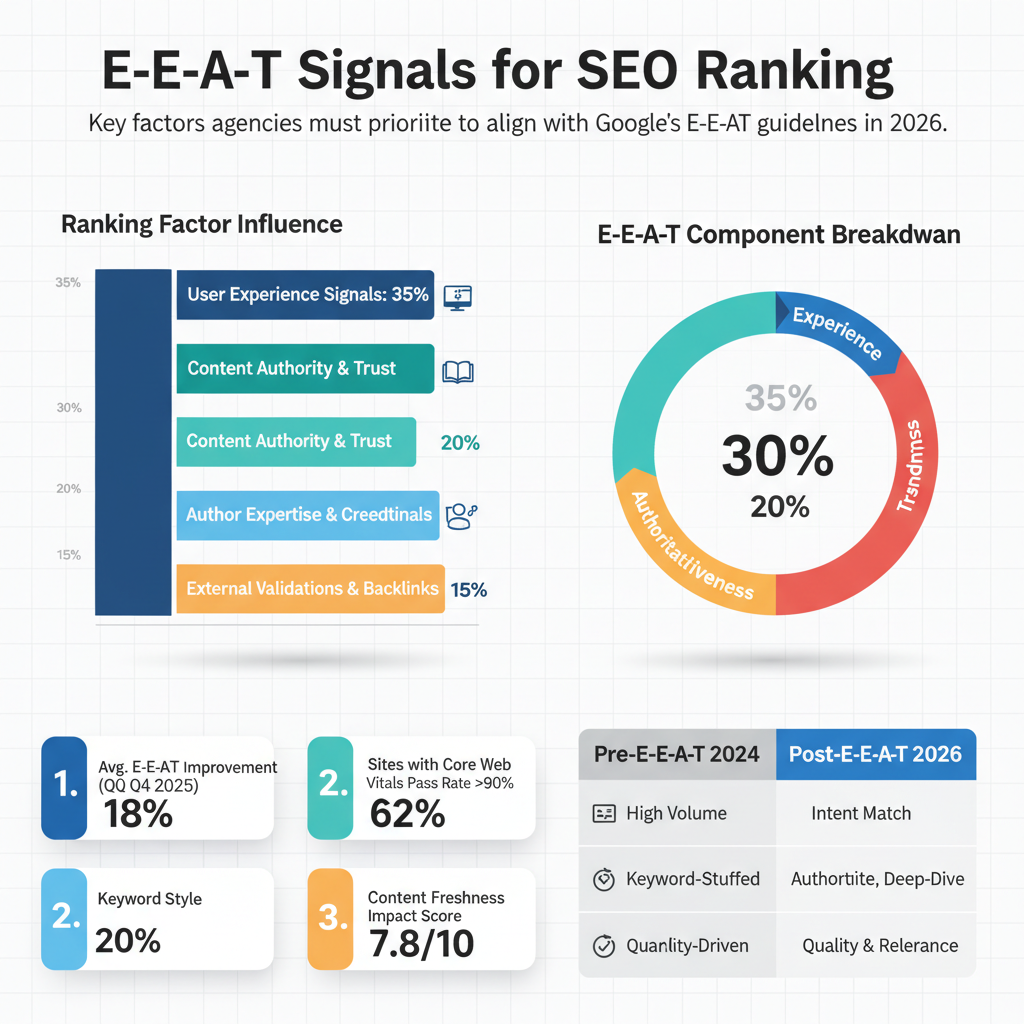
What is E-E-A-T and Why Does it Matter for SEO in 2026?
E-E-A-T stands for Experience, Expertise, Authoritativeness, and Trustworthiness, which are fundamental principles Google uses to evaluate the quality and reliability of web content and its creators. These principles are not direct ranking factors but are instead used by human quality raters to assess content, with Google's algorithms designed to identify signals that align with these assessments. In 2026, E-E-A-T is more important than ever because Google continues to prioritize high-quality, trustworthy information, especially for YMYL (Your Money or Your Life) topics that can significantly impact a user's health, financial stability, or safety. Google explicitly states its goal is to "connect people to the most reliable information available", emphasizing that content should demonstrate a strong command of expertise.
Understanding each component of E-E-A-T is crucial for agencies:
- Experience: This refers to content created by individuals who have firsthand experience with the topic. For example, a product review written by someone who has genuinely used the product demonstrates experience. Agencies should seek out or cultivate client content strategies that highlight real-world application and personal usage.
- Expertise: Expertise means having deep knowledge or skill in a particular field. This is often demonstrated through qualifications, professional achievements, and the depth of understanding presented in the content. For example, a medical doctor writing about health topics demonstrates expertise.
- Authoritativeness: Authoritativeness is the reputation of the creator, the content itself, and the website. This is often signaled by mentions, links, and endorsements from other respected sources in the industry. For instance, a website that is frequently cited by other authoritative sites is considered more authoritative.
- Trustworthiness: Trustworthiness is about the legitimacy, accuracy, and honesty of the content and its creator. This includes having accurate contact information, secure websites (HTTPS), transparent editorial policies, and positive user reviews. Users should feel safe and confident relying on the information provided.
Agencies must integrate E-E-A-T principles across all client SEO campaigns. This involves meticulous content planning, ensuring every piece of content is backed by demonstrable experience and expertise. For instance, in my experience, I've audited numerous websites that struggled with E-E-A-T due to generic content written by non-experts. Shifting towards content produced by or significantly informed by genuine professionals within the client's industry can dramatically improve performance. This not only satisfies Google ’s algorithms but also builds greater credibility with the target audience.
Strategies for Building E-E-A-T into Your Agency's SEO Services
Implementing E-E-A-T effectively requires a multi-faceted approach that permeates every aspect of your agency's SEO services. It's not a one-time fix but an ongoing commitment to quality and credibility.
1. Content Creation & Strategy: The Foundation of E-E-A-T
The content itself is where E-E-A-T truly shines. For your agency's clients, this means moving beyond keyword stuffing and thin content to create truly valuable resources. Consider these strategies:
- Expert Authorship: Whenever possible, identify the subject matter experts (SMEs) within your client's organization. Feature their credentials prominently. If internal SMEs are scarce, consider collaborating with verified external experts. This could involve interviews, co-authored articles, or having them review and endorse content. Google’s quality raters are trained to look for clear author biographies.
- Firsthand Experience Integration: Actively seek opportunities to weave firsthand experience into content. For a product-based business, this means detailed product reviews or tutorials by actual users. For a service-based business, this could involve case studies that highlight specific challenges, solutions, and measurable outcomes. Visuals like custom photos and videos depicting real-world scenarios dramatically enhance this aspect.
- Data-Driven Insights: Back up claims with credible data, research, and statistics. Cite sources clearly. Original research, surveys, or studies conducted by your client can be incredibly powerful in demonstrating expertise and trustworthiness.
- Comprehensive Coverage: Aim for comprehensive, in-depth content that thoroughly answers user queries. Thin, superficial content struggles to demonstrate expertise. Long-form guides, ultimate resources, and detailed analyses tend to perform better in this regard.
- User-Generated Content (UGC): Encourage and moderate genuine user reviews, testimonials, and comments. This showcases real-world experience and builds trust. Google values authentic social proof.
2. Technical SEO & Website Trust Signals
While often associated with content, technical SEO plays a vital role in showcasing trustworthiness and providing a positive user experience, which indirectly impacts E-E-A-T.
- Secure Website (HTTPS): This is fundamental. Ensure all client websites use HTTPS to protect user data.
- Clear About Us Pages: A detailed "About Us" page that clearly outlines the company's mission, values, team members, and qualifications builds transparency and trust.
- Contact Information & Support: Readily available and accurate contact information (phone, email, physical address) and clear customer support options are crucial for trustworthiness. Missing contact details can be a red flag for quality raters.
- Privacy Policy & Terms of Service: Transparent and easily accessible legal documents are essential, especially for YMYL sites.
- Website Speed & Mobile-Friendliness: A fast, responsive, and mobile-friendly website signals professionalism and cares for the user experience, indirectly building trust.
- Schema Markup: Implement schema markup (e.g., Organization schema, Person schema) to clearly communicate details about the entity, authors, and content to search engines.
3. Link Building & Off-Page Authority
Authoritativeness is heavily influenced by how other credible sources perceive and link to your client's website.
- High-Quality Backlinks: Focus on earning backlinks from reputable, relevant websites within the industry. These act as votes of confidence. Avoid low-quality or spammy link-building tactics, as they can harm trustworthiness.
- Brand Mentions & Citations: Actively pursue opportunities for brand mentions, even without direct links. Being mentioned by authoritative industry publications, news outlets, or influential figures enhances authoritativeness.
- Digital PR: Engage in digital PR strategies to secure media coverage and mentions on high-authority sites. This not only drives referral traffic but also significantly boosts brand visibility and authority.
- Expert Q&A Platforms: Encourage client SMEs to participate in industry forums, Q&A platforms (e.g., Quora, Reddit where appropriate), and social media discussions. Providing valuable insights in these spaces can establish expertise and drive traffic back to their site.
- Thought Leadership: Position clients as thought leaders through guest blogging on prominent industry sites, speaking engagements, and publishing whitepapers or research.
4. Monitoring & Continuous Improvement
E-E-A-T is not a static state; it requires ongoing vigilance and adaptation.
- Regular Content Audits: Periodically review existing content for E-E-A-T alignment. Update outdated information, enhance shallow content, and ensure author profiles are up-to-date. Remove or de-index low-quality or irrelevant pieces that detract from overall trustworthiness.
- Competitor Analysis: Analyze competitors who rank highly for target keywords. Evaluate how they demonstrate E-E-A-T and identify areas where your client can differentiate and excel.
- User Feedback & Reviews: Monitor customer reviews and feedback on various platforms (Google My Business, Yelp, industry-specific review sites). Address negative feedback constructively to demonstrate responsiveness and commitment to customer satisfaction. Positive reviews are significant trust signals.
- Google Search Console & Analytics: Utilize these tools to monitor performance, identify areas of decline, and understand user behavior. Look for anomalous drops in rankings or traffic that might signal E-E-A-T issues post-algorithm updates.
- Stay Updated with Google Guidelines: Regularly review Google's Search Quality Rater Guidelinesas they provide invaluable insights into what Google considers high-quality.
By integrating these strategies into your agency’s operations, you can systematically build and demonstrate E-E-A-T for your clients. This approach goes beyond mere SEO tactics; it fosters a genuine commitment to producing high-quality, trustworthy information, which ultimately benefits both users and search engine rankings.

E-E-A-T in the Age of Generative AI and AI Overviews
The emergence of generative AI and Google's AI Overviews (formerly Search Generative Experience or SGE) has added another layer of complexity and urgency to E-E-A-T. While AI can generate content rapidly, its ability to genuinely demonstrate experience or expertise is limited. AI Overviews aim to synthesize information, often citing sources. Agencies need to ensure their clients' content is so demonstrably E-E-A-T-compliant that it becomes a preferred source for these AI summaries.
- Originality and Depth: Content that is truly original, offers unique insights, or presents proprietary data is more likely to be prioritized and cited by AI Overviews over generic, AI-generated rehashes.
- Attribution and Citations: Ensure that your clients' content is structured in a way that makes it easy for AI to understand and attribute information. Clear headings, concise summaries, and proper internal and external citations can help.
- Human Touch and Authority: AI-generated content can often lack the nuance, personal anecdotes, and human voice that convey genuine experience and expertise. Emphasize the unique perspectives of human authors and practitioners.
- Fact-Checking and Accuracy: With AI's potential for "hallucinations, " the integrity and accuracy of information become paramount. Agencies must double down on fact-checking and ensure all content is unimpeachable, further solidifying trustworthiness.
In this evolving landscape, agencies that champion E-E-A-T will guide their clients to not only rank higher in traditional search results but also become authoritative voices that AI systems confidently draw upon.
For additional context and authoritative reference reading on this topic, see Moz Blog.
Related reading: Understanding Google’s Unconfirmed Updates: Strategies for 2026.
Frequently Asked Questions
What is the difference between Experience and Expertise in E-E-A-T?
Experience refers to having firsthand involvement with a topic, like someone who has personally used a product or service. Expertise, on the other hand, is about having deep theoretical or practical knowledge and skills in a particular domain, such as a certified expert or a professional with extensive academic background. Both are crucial, but experience specifically emphasizes practical application.
Are E-E-A-T principles only for YMYL (Your Money Your Life) websites?
While E-E-A-T is particularly critical for YMYL topics (e.g., health, finance, safety) where inaccurate information can cause harm, Google applies E-E-A-T broadly across all content types. High-quality content, regardless of topic, is always preferred. For non-YMYL sites, E-E-A-T still helps establish credibility, builds audience trust, and ultimately improves ranking potential.
How can small businesses or new websites demonstrate E-E-A-T?
Small businesses can leverage founder stories, behind-the-scenes content showing processes, and personal testimonials from satisfied clients to showcase experience. They can also focus on a niche where they genuinely have deep expertise, create highly detailed and research-backed content, and actively seek reviews and local citations to build trustworthiness.
Does E-E-A-T mean I must have a famous expert writing all my content?
Not necessarily. While content from recognized experts is ideal, E-E-A-T can be demonstrated in other ways. This includes showcasing the expertise of internal employees, citing reputable sources, conducting original research, featuring customer reviews that highlight positive experiences, and ensuring the site as a whole provides accurate and transparent information. The key is verifiable credibility.
How often should content be audited for E-E-A-T compliance?
Content audits for E-E-A-T should be an ongoing process, not a one-time event. A comprehensive annual audit is a good baseline, but more frequent checks (quarterly or even monthly for high-impact content) are advisable, especially after major Google algorithm updates or if competitive landscapes shift significantly. This ensures information remains current, accurate, and reflects evolving expertise.
Can AI-generated content achieve E-E-A-T?
While AI can assist in content generation, purely AI-generated content struggles to inherently demonstrate experience, genuine expertise, or personal trustworthiness. To align with E-E-A-T, AI-generated content should always be fact-checked, edited, and augmented by human experts. It's more effective when used as a tool to support human-led content creation, ensuring the final output carries a human touch of verified experience and expert insight.
What are the biggest mistakes agencies make regarding E-E-A-T?
Common mistakes include publishing generic content lacking unique insights, failing to attribute content to verifiable experts, neglecting to update outdated information, ignoring user feedback and reviews, building low-quality backlinks, and not having transparent "About Us" or contact pages. Overlooking the "Experience" component is particularly prevalent since its introduction.
In conclusion, the unwavering focus on E-E-A-T principles is paramount for any agency aiming to achieve lasting SEO success for its clients in 2026 and beyond. As the digital landscape becomes increasingly complex, with algorithm updates, AI Overviews, and a heightened demand for credible information, embracing Experience, Expertise, Authoritativeness, and Trustworthiness is no longer just a best practice, it is a fundamental requirement. Agencies that skillfully integrate these principles into content strategy, technical execution, and off-page efforts will not only secure top rankings but also build profound trust and lasting value for their clients, setting them apart as true leaders in a competitive market. For more guidance, explore our guide on mastering Google algorithm shifts or discover how an AI SEO recommendations tool can streamline your agency's workflow.
Want this kind of insight every week?
MorningRank delivers daily rank tracking, AI SEO recommendations, and white label client reporting.