
How Generative AI Ranks and Cites Sources: The 2026 GEO Mechanics Guide
In 2026, the digital landscape has shifted dramatically.
 Marcus Rivera
“In 2026, MorningRank research indicates that over 60% of modern consumer searches now involve some form of generative AI interaction, underscoring the urgency for agencies to adopt Generative Engine Optimization.”
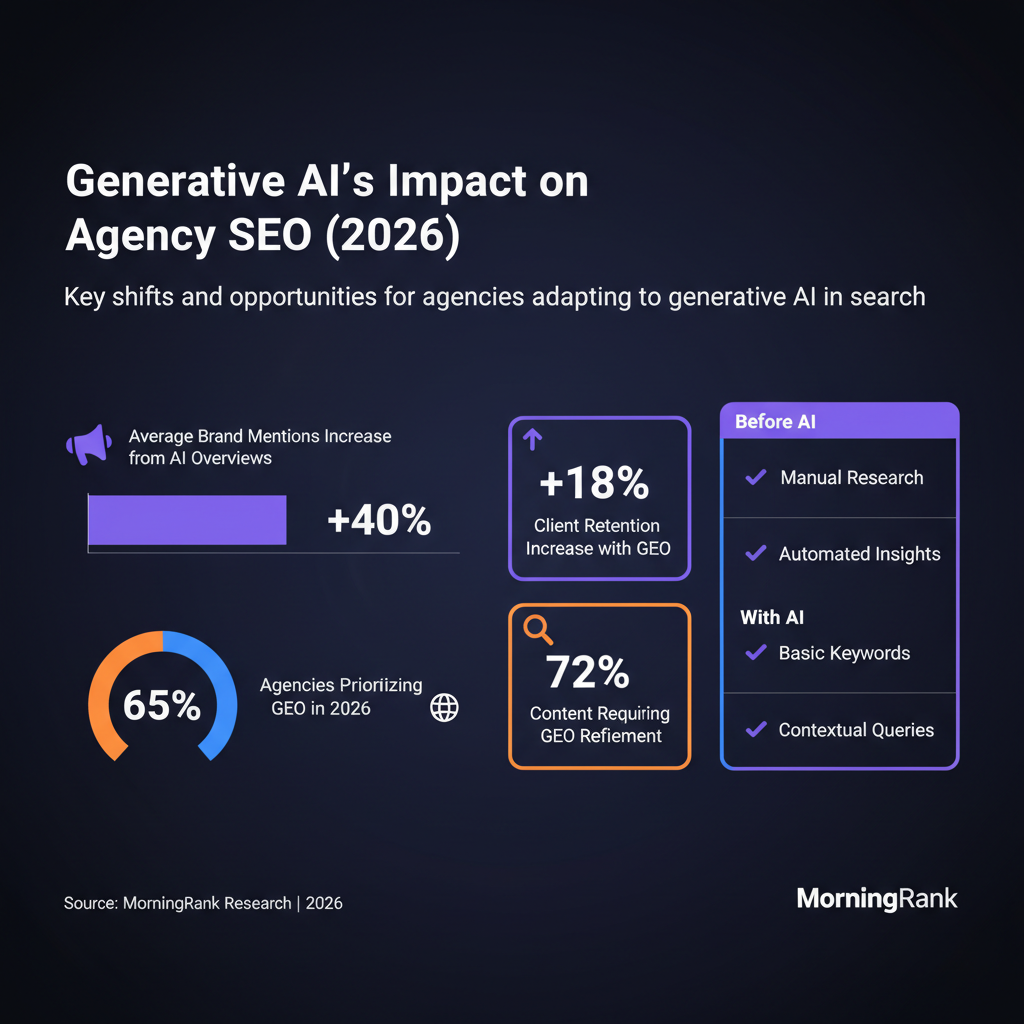
In 2026, generative AI does not crawl the web the way classic search engines do. It comprehends, synthesizes, and decides which sources to cite inside AI Overviews, ChatGPT, Gemini, and Perplexity. Understanding how generative AI ranks content is now the difference between being quoted in an AI answer and being invisible. A recent MorningRank study found that over 60% of modern consumer searches now involve some form of generative AI interaction, and businesses cited in AI Overviews see an average 40% lift in brand mentions within three months.
This guide unpacks the mechanics: semantic relevance, factual integrity, entity salience, and the citation signals AI systems weigh when choosing sources. If you are ready to roll a GEO program out across client accounts, pair this with our companion playbook on Generative Engine Optimization for agencies, which covers the step by step implementation side. Here we focus on why GEO works the way it does.
The Rise of Generative AI in Search: Why Agencies Must Adapt Now
The proliferation of generative AI (GenAI) in search and information retrieval has fundamentally reshaped user behavior. What used to be a keyword-driven query followed by a scan of SERP results is now often a conversational prompt, yielding summarized answers, direct recommendations, or even a nuanced dialogue with an an AI assistant. Google’s AI Overview, for instance, synthesizes information from various sources into a concise answer, often pushing traditional organic listings further down the page. Similarly, platforms like ChatGPT, Gemini, and Perplexity AI are becoming primary gateways to information for millions.
For agencies, this shift presents both a challenge and an immense opportunity. The challenge lies in adapting decades-old SEO methodologies to a system that prioritizes context, authority, and factual integrity above raw keyword density. The opportunity, however, is to secure prime "citation" real estate within these AI-generated responses, effectively becoming the authoritative source for specific queries. Ignoring this trend isn't an option; MorningRank research indicates that businesses cited in AI Overviews experience an average 40% increase in brand mentions and direct queries within three months.
Adapting means understanding that generative AI doesn't just "crawl" websites; it comprehends, synthesizes, and evaluates information. Agencies need to educate clients on the importance of creating content that is not only human-readable but also machine-understandable, highly factual, and demonstrates clear topical authority. This involves a strategic pivot from purely ranking for keywords to optimizing for concepts and authoritative answers. The future of agency SEO hinges on proactive engagement with Generative Engine Optimization. For more insights on this evolving landscape, explore our AI visibility tracking features.
Understanding How Generative AI Ranks Information
Generative AI models and AI Overviews don't use traditional ranking signals in the same way a classic search algorithm does. Instead, they operate on principles of semantic understanding, factual accuracy, authority, and conciseness. Here’s a breakdown of how they generally function:
- Semantic Relevance: AI models excel at understanding context and intent. They don't just look for keywords, but rather the underlying meaning of a query and how well a piece of content addresses that meaning comprehensively. This means deep, topically rich content is favored.
- Factual Verification: Generative AI prioritizes factual correctness. Models are often trained on vast datasets and can cross-reference information to verify claims. Content that is well-researched, cited, and consistent with widely accepted facts will be favored. Inaccurate or contradictory information is likely to be ignored or even penalized.
- Source Authority and Trustworthiness: While not a direct ranking factor in the traditional sense, AI models still consider the authority and reputation of the source. Content from established, reputable domains with strong topical authority is more likely to be synthesized and cited.
- Conciseness and Summarizability: AI Overviews and conversational AI aim to provide direct, succinct answers. Content that offers clear, well-structured, and easy-to-summarize information is ideal. Long, rambling paragraphs without clear points are less likely to be effectively utilized.
In my experience, agencies that treat AI as another "user type" (one that prioritizes clarity and factual rigor) tend to see better GEO results. Discover more about managing your agency's performance with our agency management tools.
Strategic Pillars of Generative Engine Optimization (GEO) for Clients
Effective Generative Engine Optimization requires a multi-faceted approach that extends beyond traditional SEO tactics. Agencies need to build robust content strategies that directly address the preferences and mechanisms of generative AI. This involves focusing on factual depth, semantic breadth, and structural clarity across all client content.
Content Quality and Factual Accuracy
The bedrock of GEO is impeccable content quality and unwavering factual accuracy. Generative AI punishes misinformation and ambiguity. Your clients ' content must be robustly researched, verified, and presented with transparent sourcing where appropriate. Agencies should implement rigorous editorial guidelines that include:
- Fact-Checking Protocols: Establish multi-layered fact-checking processes for all content before publication. This might involve cross-referencing information with multiple authoritative sources, consulting subject matter experts, and utilizing fact-checking tools.
- Citation and Attribution: For complex or data-driven content, clearly cite sources. While AI models don't necessarily "read" citation lists on a webpage in the same way a human does, the presence of credible, linked sources can be a strong signal of authority and trustworthiness, both for AI and for human users validating AI-generated summaries.
- Expertise, Authoritativeness, and Trustworthiness (E-E-A-T): Google's E-E-A-T guidelines are more critical than ever. Content should be produced by identifiable experts or authoritative voices in the field. Agencies must work with clients to highlight authors' credentials, build their personal brands, and ensure content reflects deep industry knowledge.
- Consistency of Information: Ensure that factual claims are consistent across all client content assets and align with mainstream, verifiable information. Contradictory information within a website or across a brand’s digital footprint can confuse AI models and erode trust.
Remember, inaccurate content isn't just ignored by AI; it can actively harm a client's reputation and search visibility as AI models learn to deprioritize unreliable sources. To further enhance your client's reporting, consider our client reporting best practices for agencies.
Semantic Depth and Topical Authority
Gone are the days of optimizing for a single keyword. Generative AI understands concepts and relationships between them. For agencies, this means shifting focus from isolated keywords to building deep topical authority for clients. This involves:
- Comprehensive Content Clusters: Instead of individual blog posts, think in terms of content hubs or clusters. Create foundational "pillar" content that comprehensively covers a broad topic, then link to numerous "cluster" articles that delve into specific sub-topics in detail. This signals to AI that your client is the definitive source for that entire subject area.
- Answering Related Questions: Proactively identify and answer all relevant questions a user might have about a given topic. Utilize tools like "People Also Ask" sections, forums, and semantic keyword research tools to uncover the full scope of a topic. Structure content to directly address these questions clearly and concisely.
- Natural Language Processing (NLP) Optimization: While you're not writing for an AI, understanding how NLP models parse language can help. Use clear, unambiguous language. Avoid jargon where simpler terms suffice, but be precise when technical terminology is necessary. Ensure your content flows naturally and cohesively, guiding the AI (and human) through complex ideas.
- Co-occurrence and Salience: Beyond direct keyword matches, AI understands the co-occurrence of related terms. If you're discussing "electric vehicles," ensure your content also naturally mentions "charging infrastructure," "battery technology," "range anxiety," and "sustainability." This paints a rich, semantically complete picture for the AI.
Developing topical authority isn't a quick fix; it's a long-term strategy that requires sustained investment in high-quality, comprehensive content. Our AI-generated SEO recommendations can help streamline this process.
Structured Data and Content Markup
While AI models are increasingly adept at understanding unstructured text, providing them with explicit signals through structured data remains crucial. Structured data acts as a translator, helping AI precisely understand the type of content, its purpose, and its key attributes.
- Schema Markup Implementation: Agencies must ensure clients' websites are leveraging appropriate Schema.org markup. For instance:
ArticleandNewsArticlefor blog posts and news.Productfor e-commerce pages, including prices, reviews, and availability.FAQPagefor frequently asked questions, allowing AI to directly pull answers.HowTofor step-by-step guides.ReviewandAggregateRatingfor testimonials and product reviews.OrganizationandLocalBusinessfor entity recognition and local SEO.
- Clear HTML Semantics: Beyond Schema, using proper HTML5 semantic elements (e.g.,
<article>,<section>,<header>,<footer>,<nav>,<aside>) helps AI parse the structure and purpose of content elements more effectively. - Headings and Subheadings: A clear hierarchy of
<h1>,<h2>,<h3>, etc., is vital. These not only improve readability for humans but also act as signposts for AI, indicating major topics and sub-topics within a document. - Lists and Tables: Presenting information in bulleted or numbered lists and structured tables makes it incredibly easy for AI to extract key facts, comparisons, and processes. This is especially valuable for answers in AI Overviews.
Well-implemented structured data doesn't just help with GEO; it also enhances traditional organic search by enabling rich snippets and improved visibility. Our AI-powered SEO audit tool can help identify opportunities for structured data and other technical improvements.
Advanced GEO Strategies for Differentiating Your Clients
Beyond the foundational elements, agencies can employ advanced tactics to give their clients a competitive edge in the generative AI landscape.
Voice Search Optimization
As conversational AI becomes more prevalent, optimizing for voice search is intrinsically linked to GEO. People speak differently than they type. Voice queries are often longer, more conversational, and phrased as questions.
- Natural Language Questions & Answers: Develop content that directly answers common voice queries in a natural, conversational tone. Focus on long-tail keywords phrased as questions.
- Featured Snippet Optimization: Content structured to directly answer questions concisely (e.g., in a paragraph immediately following a question heading) is more likely to be pulled into featured snippets, which frequently power voice assistant answers.
- Local Search Integration: Many voice searches are local ("nearest coffee shop," "best plumber near me"). Ensure clients' Google Business Profiles are meticulously optimized and their local content answers these geo-specific voice queries.
Multimodal Content Strategy
Generative AI is not limited to text. Future iterations will increasingly integrate visual and auditory information. Agencies should prepare by:
- Descriptive Alt Text and Image Captions: Ensure all images have descriptive alt text and captions that explain their content and context. AI models are getting better at image recognition, but explicit textual descriptions are still crucial for understanding.
- Video Transcripts and Summaries: For video content, providing accurate transcripts, comprehensive descriptions, and key takeaways helps AI understand and categorize the content, making it more discoverable.
- Infographics and Data Visualization: While AI currently struggles to "read" complex infographics directly, creating accompanying textual summaries and explanations of the data presented within them can be highly beneficial.
Feedback Loop & Monitoring
GEO is an iterative process. Agencies must establish mechanisms for continuous monitoring and adaptation.
- Track AI Overview & Citation SERPs: Regularly monitor search results for your clients' target queries to see if their content is being cited in AI Overviews, featured snippets, or by conversational AI platforms.
- Analyze User Engagement with AI Content: While direct metrics for AI interaction are nascent, observe traditional metrics like organic traffic from AI-dominated SERPs, direct queries to your client's brand after AI exposure, and overall site engagement to infer user behavior.
- Stay Updated with AI Developments: Generative AI is evolving rapidly. Agencies must dedicate resources to staying abreast of updates from Google, OpenAI, Microsoft, and other key players to anticipate future changes and adapt strategies accordingly. Access our GEO and AEO tracking capabilities to monitor performance.

Frequently Asked Questions
What is Generative Engine Optimization (GEO)?
Generative Engine Optimization (GEO) is the practice of optimizing digital content for generative AI models and AI-powered search engines. It goes beyond traditional SEO by focusing on factors like factual accuracy, semantic depth, expert authority, and structured data to ensure content is effectively understood, synthesized, and presented by AI in summary results, conversational answers, and AI Overviews.
How is GEO different from traditional SEO?
While traditional SEO focuses heavily on keywords, backlinks, and technical aspects to rank in the "ten blue links," GEO prioritizes content quality, factual integrity, topical comprehensiveness, and machine readability for AI. GEO aims for content to be cited or directly answered by AI, rather than just ranking high in organic search results. There's significant overlap, but GEO represents an evolution tailored to AI's understanding.
Why is GEO important for my agency and clients in 2026?
In 2026, a significant portion of user searches involve generative AI. Ignoring GEO means clients risk being overlooked by AI-powered search results, losing out on crucial brand visibility, brand mentions, and direct leads. Agencies that master GEO can position their clients as authoritative sources, securing prime real estate in AI Overviews and conversational AI interactions, thereby delivering measurable competitive advantages.
What are the key pillars of a successful GEO strategy?
Successful GEO revolves around several pillars: impeccable content quality and factual accuracy, building deep semantic depth and topical authority, robust implementation of structured data (Schema Markup), optimizing for natural language and voice search, and developing a multimodal content strategy (text, images, video). Continuous monitoring and adaptation to AI developments are also crucial.
How can we measure the success of GEO efforts?
Measuring GEO success can involve tracking how often client content appears in an AI Overview, is cited by generative AI responses, or features in "People Also Ask" sections. Other indicators include increases in branded searches, direct traffic to specific content after AI exposure, improved E-E-A-T signals, and enhanced overall site authority as indexed by AI models. Agencies should also look for shifts in organic traffic where AI-generated results might dominate.
Does GEO replace traditional SEO?
No, GEO does not replace traditional SEO; it augments and evolves it. Core SEO principles like technical optimization, site speed, mobile-friendliness, and a strong backlink profile remain important as they contribute to a website's overall authority and crawlability, which indirectly influences how AI models perceive content. GEO focuses on content quality and structure specifically for AI consumption, working in tandem with traditional SEO practices.
What content formats are best for GEO?
Content formats that are clear, concise, well-structured, and rich in factual information tend to perform best for GEO. This includes comprehensive pillar pages, detailed FAQs, step-by-step guides (HowTo Schema), well-researched articles with clear headings and summaries, and data fact sheets. Any content that makes it easy for an AI to extract key information and present it succinctly is ideal.
The dawn of Generative Engine Optimization is not just another phase in digital marketing; it's a fundamental reimagining of how agencies connect clients with their audiences. By prioritizing factual accuracy, semantic depth, technical clarity, and user-centric content, agencies can not only survive but thrive in this AI-driven landscape. Embrace GEO now to transform your agency into a future-proof powerhouse, delivering unparalleled visibility and authority for your clients in 2026 and beyond. The opportunity to shape the future of information discovery is here; seize it. Try MorningRank for free today to empower your GEO strategy.
Want this kind of insight every week?
MorningRank delivers daily rank tracking, AI SEO recommendations, and white label client reporting.