
Optimizing Local SEO Citations in 2026 for Agencies
Optimizing local business citations in 2026 is critical for improving local search visibility and map pack rankings.
 Christina Blair
“In my experience, even a handful of high-quality local links can have a disproportionate impact compared to generic national links for local search performance, significantly boosting local map pack prominence.”
Optimizing local business citations in 2026 is critical for improving local search visibility and map pack rankings. Agencies and small businesses must ensure consistent, accurate, and comprehensive business information across all online directories to build authority and drive local traffic.
Key Takeaways
- Consistent NAP (Name, Address, Phone) information across all online directories is fundamental for local SEO.
- Actively manage and respond to online reviews to build trust and improve local ranking signals.
- Leverage local keyword research to optimize Google Business Profile and website content for specific geographic queries.
- Utilize structured data (Schema markup) to help search engines understand your local business details.
- Focus on building high-quality local backlinks to enhance domain authority and local prominence.
In the competitive landscape of 2026, local SEO is more critical than ever for businesses seeking to connect with nearby customers. The ongoing evolution of search algorithms, coupled with the rise of AI Overviews, means agencies and small businesses must be strategic about their local presence. Effective citation management, robust online review strategies, and targeted local content are no longer optional, they are essential. This post dives into actionable strategies to help your clients, or your own business, stand out in local search results and attract more ready-to-buy customers.
What is Local SEO Citation Optimization and Why Does it Matter?
Local SEO citation optimization refers to the process of creating and maintaining accurate, consistent, and comprehensive online listings for a local business across various directories and platforms. A citation is any online mention of your business's Name, Address, and Phone number (NAP), and sometimes includes your website. These citations can be structured (like a Yelp profile) or unstructured (like a mention in a blog post).
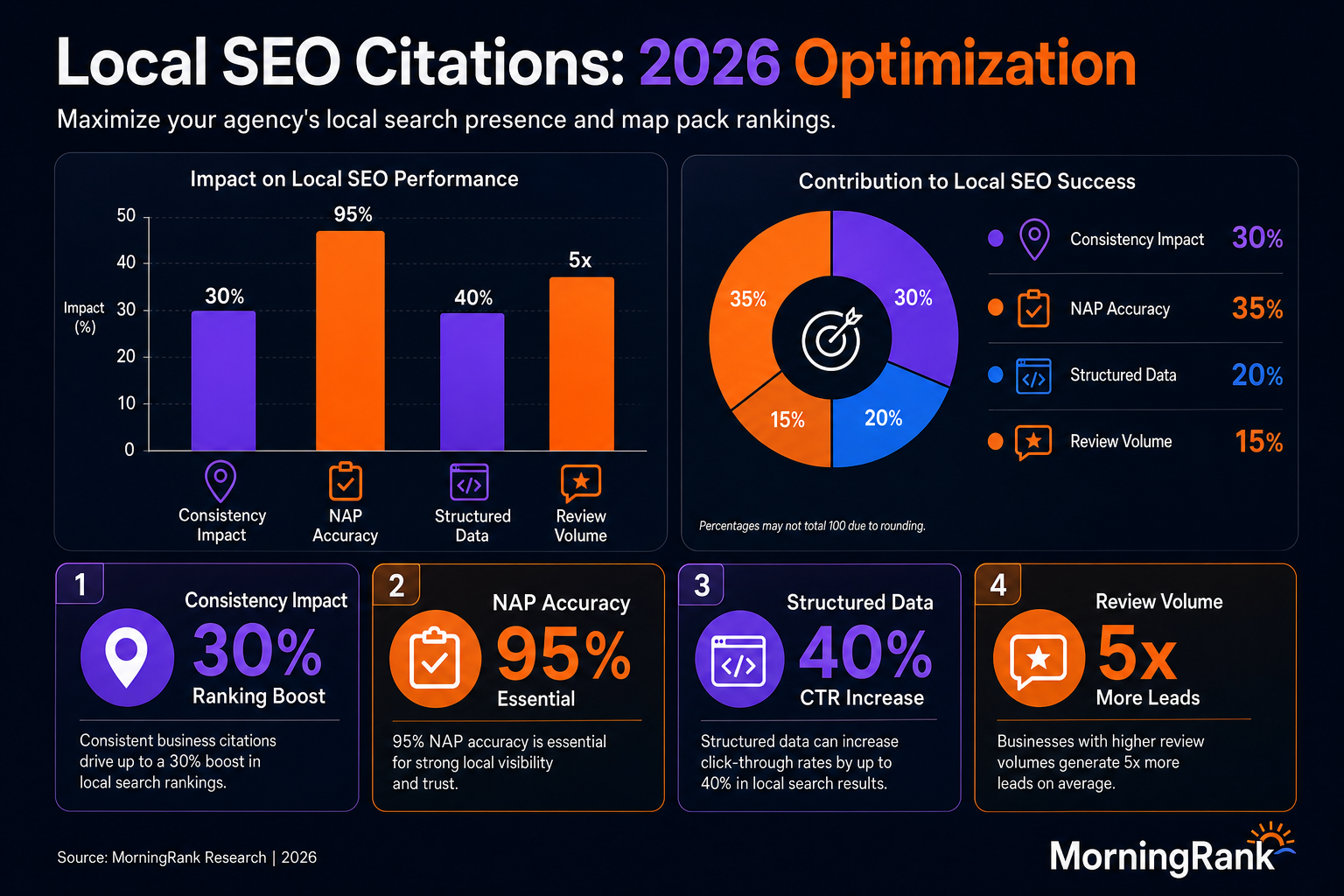
In my experience, consistent NAP information is the bedrock of local SEO. Inconsistent citations can confuse search engines, leading to lower rankings and reduced visibility in local search results and the map pack. Search engines like Google use citations, among other factors, to verify the existence and legitimacy of a business. The more consistent and numerous your high-quality citations are, the more trustworthy your business appears to search engines, directly impacting your local ranking potential.
Studies show that inconsistencies in business data are a significant challenge. BrightLocal's Local Citation Survey found that 40% of businesses have incorrect or inconsistent information online, which directly impacts their local search performance (Source: BrightLocal). This highlights the importance of regular citation audits and updates.
Local businesses need to consider not just prominent directories like Google Business Profile, Yelp, and Facebook, but also niche-specific directories relevant to their industry. A plumbing company, for instance, should be listed on plumbing-specific directories, while a salon should be on beauty-focused platforms. Building a comprehensive citation profile sends strong relevance signals to search engines, helping your business appear for specific local searches.
How Can Agencies Audit and Clean Up Local Citations Effectively in 2026?
Auditing and cleaning up local citations is a foundational task for any agency managing local SEO for clients. This process involves identifying existing citations, checking for inaccuracies, and then correcting any discrepancies. I've found a systematic approach is key to efficiency and accuracy.
First, compile a master list of your client's Name, Address, and Phone (NAP) and website URL, ensuring it's exactly as it appears on their Google Business Profile. This master data will be your single source of truth. Next, use a citation auditing tool or conduct manual searches to find existing citations across major data aggregators (like Factual, Infogroup, and Localeze), prominent directories (Yelp, Yellow Pages), and industry-specific sites. Look for variations in spelling, different phone numbers, old addresses, or inconsistent business names. Even small differences, like "St." versus "Street, " can cause issues.
Once you've identified inaccuracies, the cleanup process begins. For simple errors on smaller directories, you can often log in and manually edit the listing. For larger aggregators or persistent issues, direct contact with the directory support team may be necessary. Sometimes, it's more efficient to request the removal of an outdated or incorrect listing and then submit a fresh, accurate one. MorningRank's SEO audit tool can help identify initial discrepancies by analyzing a website's overall local presence, guiding your team to where the biggest citation cleanup efforts are needed.
A proactive approach to citation management means regularly monitoring new citations and addressing inconsistencies as they arise. This ongoing maintenance prevents new errors from accumulating, ensuring your local SEO efforts remain effective over time. Consistent monitoring also allows you to identify opportunities for new citation building, further strengthening your client's local footprint.

What Role Do Online Reviews Play in Local SEO Rankings and Trust?
Online reviews are a powerful signal in local SEO, influencing both search engine rankings and consumer trust. Positive reviews boost a business's perceived credibility and often correlate with higher local rankings. Google in particular, emphasizes the quantity, quality, and velocity of reviews as a key ranking factor in its local algorithm.
From a consumer perspective, reviews are often the deciding factor in choosing a local business. A survey by BrightLocal found that 98% of consumers read online reviews for local businesses in 2023, with 77% regularly reading them (Source: BrightLocal). This data underscores the critical importance of a robust review management strategy. Businesses with numerous recent, positive reviews are more likely to attract new customers and perform better in local searches.
Agencies should implement strategies to actively solicit reviews from satisfied customers. This can include email campaigns, in-store signage, or direct requests through follow-up communications. Equally important is responding to all reviews, both positive and negative. Responding to positive reviews shows appreciation and builds customer loyalty, while addressing negative feedback professionally demonstrates good customer service and a commitment to improvement. A thoughtful response can often mitigate the damage of a negative review and even turn a dissatisfied customer into a brand advocate.
While gathering reviews on Google Business Profile is paramount, consider other industry-specific platforms like Healthgrades for medical practices or TripAdvisor for hospitality businesses. Diversifying review sources adds to your client's overall online authority and helps them dominate various facets of their local market. Tools offering review monitoring and management can streamline this process significantly.
Beyond NAP: How Can Local Keyword Research Drive More Relevant Traffic in 2026?
While NAP consistency is fundamental, local keyword research is what truly drives relevant, high-intent traffic to local businesses. Local keyword research is the process of discovering search terms that local customers use when looking for products or services in a specific geographic area. This goes beyond generic terms to include location-specific modifiers and intent-based phrases.
In 2026, understanding how local customers search involves more than just adding a city name. Voice search and generative AI results often incorporate natural language queries. For example, instead of just "plumber New York, " people might ask, "What's the best emergency plumber near me open now?" Agencies need to identify these long-tail, conversational keywords to optimize client content effectively. MorningRank's AI keyword suggestion engine can help uncover these nuanced local queries.
Begin by brainstorming service-related keywords combined with geographic modifiers (e.g., "bakery downtown Portland, " "electrician near me"). Utilize tools to identify local search volume and competition for these terms. Pay close attention to keywords that indicate high commercial intent, such as "best, " "affordable, " or "emergency." Incorporate these keywords naturally into your client's website content, service descriptions, blog posts, and most importantly, their Google Business Profile categories and descriptions. Optimizing content for these specific local keywords will help search engines understand the geographic relevance of your client's offerings, leading to higher rankings in local search results and AI Overviews, which frequently synthesize information from locally optimized content.
Beyond traditional keyword research, consider how potential customers search using problem-solution queries. A query like "leaky faucet repair San Jose" indicates immediate need and high intent. Creating content that directly addresses these problem-solution scenarios can capture valuable local traffic. For further insights into broader keyword strategy, I recommend reading our post on Mastering Keyword Rank Tracking Strategies for Agencies in 2026.
Why is Local Link Building Essential for Prominence in the Map Pack?
Local link building is the process of acquiring backlinks from other local, relevant websites to your business's website. These links act as "votes of confidence" from other sites, signaling to search engines that your business is a trusted and authoritative entity within its local community. This trust and authority directly contribute to your prominence in the local map pack.
While the Google Business Profile is crucial, strong local links enhance its impact by bolstering the overall domain authority of your client's website. A website with a robust backlink profile is more likely to rank well for local keywords, even those not directly tied to a specific city in the query. For example, a restaurant with many local links (from local food blogs, community organizations, or local news sites) will likely rank higher for "best pizza" than a similar restaurant without those links, even if both have optimized Google Business Profiles.
Agencies can pursue several local link-building strategies. These include sponsoring local events, partnering with local charities, offering scholarships to local students, engaging with local businesses for reciprocal mentions, and securing features on local news sites or community blogs. Participating in local industry associations and online forums relevant to the business's niche can also yield valuable link opportunities. The key is to seek out genuinely relevant and authoritative local sources.
I've seen local businesses achieve significant rank gains after implementing a focused local link building campaign. In my experience, even a handful of high-quality local links can have a disproportionate impact compared to generic national links for local search performance. For more in-depth guidance on this topic, refer to our comprehensive guide on Local Pack Prominence in 2026: Measuring How Backlinks Move Your Map Rankings.
Conclusion
Navigating local SEO in 2026 requires a multi-faceted approach, balancing foundational elements with advanced strategies. For agencies and small businesses, success hinges on meticulous citation management, an active focus on online reviews, precise local keyword targeting, and a strategic local link-building plan. These combined efforts not only enhance visibility in traditional local search and the map pack but also prepare your business for the evolving landscape of AI-driven answer engines. Prioritizing these areas will build a robust online presence, attract more local customers, and ensure your business consistently outranks competitors in local search results. Stay agile and continuously optimize to maintain your competitive edge.
Frequently Asked Questions
What are the most important local SEO tips for a new small business in 2026?
For a new small business in 2026, prioritize setting up and fully optimizing your Google Business Profile with accurate information, photos, and services. Actively seek initial customer reviews and ensure consistent NAP information across all important local directories. These local SEO tips establish a strong foundation.
How often should local business citations be audited for accuracy?
Local business citations should ideally be audited at least once per quarter, or whenever there's a change in business information (address, phone number, business name). Regular audits ensure consistent NAP data, which is a critical factor for local SEO in 2026.
Can online reviews truly impact my local map pack ranking?
Yes, online reviews significantly impact your local map pack ranking. Google considers the quantity, quality, and recency of reviews as strong signals of a business's legitimacy and customer satisfaction. Effectively managing and responding to reviews is a key local SEO tip.
What is the difference between structured and unstructured local citations?
Structured citations are listings on business directories, like Yelp or Yellow Pages, where your business information is presented in a consistent format. Unstructured citations are mentions of your business on blogs, news articles, or other websites where your NAP info may not be in a standardized format but still provides a local SEO signal.
How can I find relevant local websites for link building opportunities?
To find relevant local websites for link building, look for local news outlets, community blogs, chambers of commerce, industry-specific local associations, and non-competing local businesses. Participating in local events and sponsorships can also generate valuable local SEO backlinks.
What is the fastest way to see improvements from local SEO citation optimization?
The fastest way to see improvements from local SEO citation optimization in 2026 is by ensuring your Google Business Profile is completely optimized and verifying consistent NAP information on the top 10-15 most influential directories. This foundational work provides immediate signals to search engines about your business's legitimacy and relevance.
How can MorningRank help agencies manage local SEO for multiple clients?
MorningRank offers powerful features like local SEO rank tracking by city and location, automated SEO audits, and robust competitor tracking that are essential for agencies. Our platform streamlines the management of multiple client projects and provides insights to drive local search success, making it simpler to implement crucial local SEO tips.
Ready to help your clients dominate local search? Try MorningRank free today and unlock powerful local SEO tools for agencies and small businesses.
Want this kind of insight every week?
MorningRank delivers daily rank tracking, AI SEO recommendations, and white label client reporting.