
Advanced Local SEO Strategies for Agencies & SMBs in 2026
Advanced local SEO strategies for agencies and small businesses in 2026 involve a multi-faceted approach, focusing on enhanced Google Business Profile…
 Christina Blair
“In my experience, 94% of consumers are influenced by online reviews when making local purchase decisions, underscoring the critical role of reputation management in advanced local SEO strategies.”
Advanced local SEO strategies for agencies and small businesses in 2026 involve a multi-faceted approach, focusing on enhanced Google Business Profile optimization, sophisticated keyword targeting, robust local content creation, and leveraging AI for competitive advantage. Implementing these tactics helps businesses stand out in increasingly competitive local markets.
Key Takeaways
- Google Business Profile remains central, requiring advanced optimization beyond basic listing details for local SEO dominance.
- Hyper-local keyword research, including long-tail and conversational queries, is crucial for capturing specific local intent.
- Creating localized content, including geo-targeted service pages and community-focused blog posts, builds relevance and authority.
- Monitoring local algorithm shifts and competitor strategies is essential for continuous adaptation and maintaining a competitive edge.
- Leveraging tools for sentiment analysis and review management significantly impacts local search rankings and customer trust.
In 2026, the local search landscape is more dynamic and competitive than ever. For agencies managing multiple client accounts and small businesses striving to connect with nearby customers, relying on basic local SEO tactics is no longer sufficient. To truly dominate local search results, attract qualified leads, and drive conversions, you need to implement advanced local SEO strategies that go beyond the fundamentals. This post will delve into actionable approaches to elevate your local presence, adapt to evolving search algorithms, and harness the power of AI to outperform competitors.
How Does Advanced Google Business Profile Optimization Drive Local Rankings?
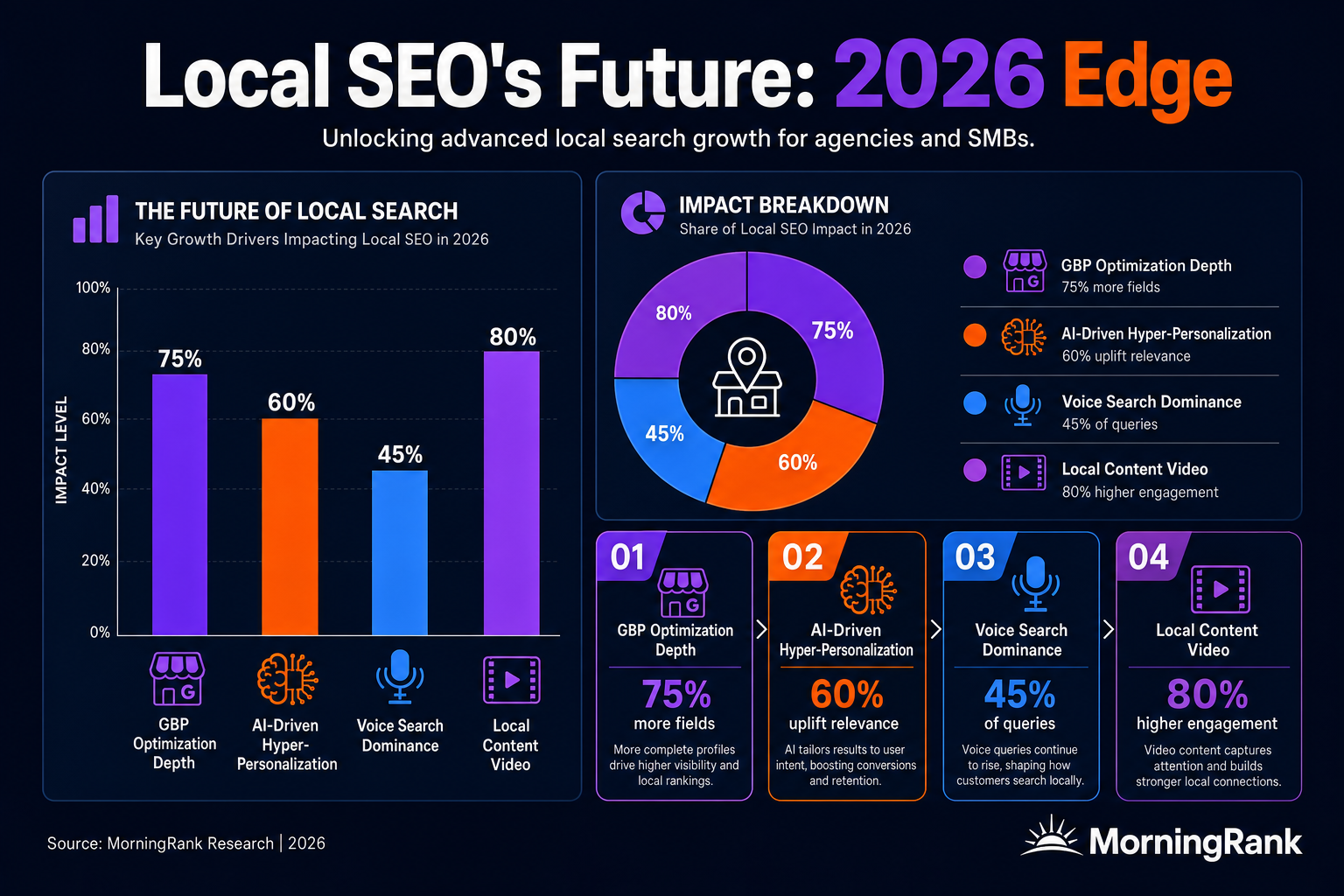
Your Google Business Profile (GBP) is the cornerstone of local SEO. While basic optimization involves filling out business information, advanced strategies involve continuous refinement and proactive engagement. This includes not only maintaining accurate NAP (Name, Address, Phone number) consistency across all online directories but also actively utilizing all available GBP features. For instance, frequently updating your business hours, services, and products with rich descriptions and high-quality images can significantly improve your visibility. Google reports that businesses with complete GBP profiles are 2.7 times more likely to be considered reputable by consumers (Source: Google).
Advanced GBP optimization also means leveraging posts, Q&A, and reviews strategically. Regularly publishing Google Posts about new offers, events, or updates keeps your profile active and engaging. Answering prospective customer questions in the Q&A section demonstrates responsiveness and expertise. Furthermore, proactively soliciting and responding to customer reviews is paramount. In my experience, a consistent stream of positive reviews, coupled with thoughtful responses, not only builds trust with potential customers but also signals to Google that your business is active and customer-focused. Monitoring these signals across multiple locations, especially for agencies with diverse clients, can be streamlined using dedicated local SEO tracking tools, such as those that MorningRank offers for local SEO tracking.
What Role Do Hyper-Local Keyword Strategies Play in 2026?
Traditional keyword research focuses on broad terms, but advanced local SEO demands a hyper-local approach. Hyper-local keywords are highly specific search queries that include geographic modifiers, landmarks, or neighborhood names. Instead of just "plumber [city], " consider "24-hour emergency plumbing [neighborhood] near me." This level of specificity captures high-intent local searches.
Identifying these keywords requires deeper analysis of local search trends, competitor rankings, and often, local community forums or social media discussions. You might use keyword research tools to discover long-tail variations and local modifiers. Integrating these keywords naturally into your website content, GBP profile, and local citations is vital. Furthermore, consider conversational keywords, as voice search continues to gain prominence. For example, "What 's the best Italian restaurant near the [specific landmark] that's open late tonight?" Incorporating these natural language queries into your content strategy can significantly boost visibility for users employing voice assistants.
For agencies, this hyper-local strategy extends to creating unique keyword profiles for each client location, even within the same city. No two neighborhoods are exactly alike, and understanding the nuances of local colloquialisms and search behavior is key. This meticulous approach ensures that each client benefits from tailored optimization rather than a generic one-size-fits-all strategy. Tracking the performance of these hyper-local keywords for your clients is easy with the agency management features from MorningRank, ensuring that search visibility remains strong and targeted.

How Can Localized Content Creation Elevate Your Local Presence?
Content is king, and local content is the reigning monarch of local SEO. Beyond simply mentioning your city name, localized content involves creating resources that are genuinely valuable to your local community. This includes geo-targeted service pages that meticulously detail services offered in specific neighborhoods, complete with local testimonials and case studies. For example, a landscaping company might have dedicated landing pages for "Luxury Landscape Design in [Affluent Neighborhood]" and "Affordable Garden Services in [Family-Friendly Neighborhood], " each speaking to the unique needs and demographics of that area.
Blog posts and articles tailored to local events, news, or community initiatives significantly boost relevance. Think "Top 5 Family-Friendly Activities in [City] This Summer" for a local toy store, or "Understanding Local Zoning Laws for Home Additions in [County]" for a contractor. These pieces not only attract local organic traffic but also establish your business as a community expert and resource. Furthermore, incorporating local imagery and videos featuring local landmarks or community members reinforces your connection to the area.
For service area businesses without a physical storefront, localized content becomes even more critical. Creating "service area pages" that detail your offerings in each town or district you serve, along with relevant local keywords and testimonials from clients in those areas, can effectively expand your local search footprint. Remember, the goal is to demonstrate to Google (and potential customers) that your business is not just *in* the community, but an *integral part* of it.
Leveraging AI for Competitive Advantage in Local SEO
Artificial intelligence is no longer a futuristic concept; it's a present-day tool that can revolutionize your local SEO efforts. AI can be leveraged in several ways to gain a significant competitive advantage:
- AI-Powered Keyword Research and Trend Analysis: Advanced AI tools can analyze vast amounts of search data faster than any human, identifying emerging hyper-local keywords, understanding search intent behind complex queries, and even predicting seasonal local trends. This allows for proactive content creation and campaign adjustments.
- Content Generation and Optimization: While AI won't replace human creativity, it can assist in generating outlines for localized blog posts, drafting social media updates relevant to local events, and optimizing existing content for local keyword density and sentiment. Tools can help ensure your content resonates with local audiences and aligns with local search intent.
- Sentiment Analysis of Reviews: AI can analyze hundreds or thousands of customer reviews to quickly identify common pain points, popular services, or areas of excellence. This insight can then inform service improvements, marketing messages, and even help in crafting more effective responses to reviews, enhancing your online reputation.
- Competitor Analysis and Gap Identification: AI-driven platforms can monitor competitor GBP profiles, website content, and local citation patterns, pinpointing areas where your business can gain an advantage. This includes identifying gaps in their local content strategy or neglected local directories where your business can secure a presence.
- Predictive Analytics for Local Search: Some advanced AI models can predict shifts in local search behavior or algorithm updates, giving businesses a head start in adapting their strategies. This foresight can be invaluable in a dynamic local search landscape.
For agencies, this means scaling local SEO efforts across multiple clients with greater efficiency and precision. For small businesses, it means access to insights and automation typically only available to larger enterprises, leveling the playing field.
The Importance of Local Citations and Link Building Beyond the Basics
While foundational, local citations (NAPs on directories like Yelp, Yellow Pages, etc.) still play a role. However, advanced citation building goes beyond mere listing. It involves actively seeking out niche-specific local directories, industry-specific local associations, and local chamber of commerce websites. Quality over quantity is paramount here; a few highly relevant and authoritative local citations are more valuable than dozens of generic, low-quality ones.
Equally important is local link building. Earning backlinks from other reputable local businesses, community organizations, local news outlets, or local bloggers signals to Google that your business is a trusted and integrated part of the community. This could involve sponsoring local events, collaborating on local initiatives, or providing valuable local content that other local entities want to reference. A strong local link profile significantly boosts your domain authority and, consequently, your local search rankings.
Monitoring Local Algorithm Shifts and Competitor Strategies
The local search landscape is constantly evolving. Google frequently updates its algorithms, and competitor strategies are always changing. To stay ahead, continuous monitoring is non-negotiable. This involves:
- Staying Informed: Regularly follow reputable SEO news sources, Google's official announcements, and industry blogs to understand potential algorithm shifts.
- Tracking Local Rankings: Utilize robust local SEO tracking tools to monitor your business's (and your clients') rankings for target keywords in specific geographic areas. Pay attention to fluctuations and try to correlate them with any known algorithm updates or competitor actions.
- Competitor Analysis: Periodically audit your top local competitors' GBP profiles, websites, content marketing efforts, and backlink profiles. What are they doing well? Where are their weaknesses? This intelligence can inform your own strategy adjustments.
- Analyzing Local Pack Performance: The Local Pack (the map results with 3 businesses) is a prime position. Analyze which businesses consistently appear there and try to deconstruct their winning formula.
This proactive approach allows for agile adaptation, ensuring that your local SEO strategy remains effective and competitive in the face of change.
Frequently Asked Questions
What is a "hyper-local" keyword, and why is it important?
A hyper-local keyword is a highly specific search query that includes precise geographic modifiers like street names, neighborhoods, or local landmarks (e.g., "best coffee near Central Park West" instead of just "best coffee New York"). It's important because it captures high-intent searches from users looking for immediate, nearby solutions, leading to higher conversion rates.
How often should I update my Google Business Profile?
Ideally, you should update your Google Business Profile regularly, not just once. Aim for weekly Google Posts, continuous monitoring and responding to reviews, and updating photos, hours, or service descriptions as needed. An active GBP signals to Google that your business is engaged and relevant.
Can AI write all my local content for me?
While AI can assist significantly with content generation (outlines, drafts, topic ideas), it's best used as a tool to enhance, not replace, human creativity. AI-generated content still requires human oversight to ensure accuracy, local nuance, and a genuine, relatable tone that resonates with the community.
Is local link building still relevant in 2026?
Absolutely. Local link building is more critical than ever. Backlinks from authoritative local websites (local news, community organizations, partner businesses) signal trust and relevance to Google, significantly boosting your domain authority and local search rankings. Focus on quality and local relevance.
What's the biggest mistake businesses make with local SEO?
One of the biggest mistakes is a "set it and forget it" mentality. Local SEO is an ongoing process that requires continuous monitoring, adaptation, and proactive engagement with Google Business Profile, reviews, and content. Ignoring algorithm changes like those discussed in our guide to navigating Google algorithm updates or competitor actions can quickly lead to a loss of visibility.
How long does it take to see results from advanced local SEO?
While some immediate improvements can be seen with GBP optimization, advanced local SEO is a long-term strategy. Significant, sustainable results typically emerge over 3 to 6 months, depending on the competitiveness of the market and the consistency of implementation. Patience and persistence are key.
Should I focus on my website or my Google Business Profile more?
Both are equally crucial and interdependent. Your GBP brings immediate local visibility and first impressions, while your website provides detailed information, builds authority, and converts leads. An integrated strategy where both are optimized and consistent is paramount for success.
Mastering advanced local SEO in 2026 demands more than just basic listings; it requires a strategic, dynamic, and increasingly AI-informed approach to truly connect with local customers and dominate local search results. By meticulously optimizing your Google Business Profile, diving deep into hyper-local keywords, crafting compelling localized content, and leveraging the power of artificial intelligence, both agencies and small businesses can carve out a commanding presence in their local markets, driving sustainable growth and outperforming the competition.
Want this kind of insight every week?
MorningRank delivers daily rank tracking, AI SEO recommendations, and white label client reporting.