
Mastering Google Algorithm Update Impact Analysis in 2026
Google algorithm updates are constant adjustments to Google's ranking systems, designed to improve search relevance and user experience.
 Christina Blair
“In my experience, agencies that adopt a proactive, data-driven approach, continuously monitoring performance and refining their strategies, are the ones that consistently deliver value and maintain strong search visibility for their clients.”
Google algorithm updates are constant adjustments to Google's ranking systems, designed to improve search relevance and user experience. To effectively navigate these changes and protect client rankings, agencies must master the process of Google algorithm update impact analysis.
Key Takeaways
- Google algorithm update impact analysis involves systematically monitoring search performance metrics before and after an update.
- Identifying ranking fluctuations, traffic changes, and content types affected by an update is crucial for accurate diagnosis.
- Understanding the update's likely intent, often signaled by Google or industry experts, guides adaptation strategies.
- Agencies should prioritize data-driven adjustments to content, technical SEO, and user experience based on impact analysis.
- Proactive monitoring and a robust SEO strategy focused on E-E-A-T (Experience, Expertise, Authoritativeness, and Trustworthiness) build resilience against future updates.
In the ever-evolving world of search engine optimization, Google algorithm updates are a constant. These significant modifications to Google's ranking algorithms can send shockwaves through the SEO community, causing sudden shifts in search visibility, traffic, and revenue for businesses. For agencies and local businesses, understanding how to effectively conduct Google algorithm update impact analysis is not just a best practice, it's a necessity for survival and growth in 2026.
My experience auditing websites post-update confirms that a swift, systematic approach to identifying what changed, why it changed, and how to adapt is paramount. This guide will walk you through the essential steps of analyzing update impacts, diagnosing the underlying causes, and implementing effective strategies to adapt and thrive. We'll cover how to spot changes, interpret data, and build a resilient SEO strategy that stands the test of Google's continuous evolution.
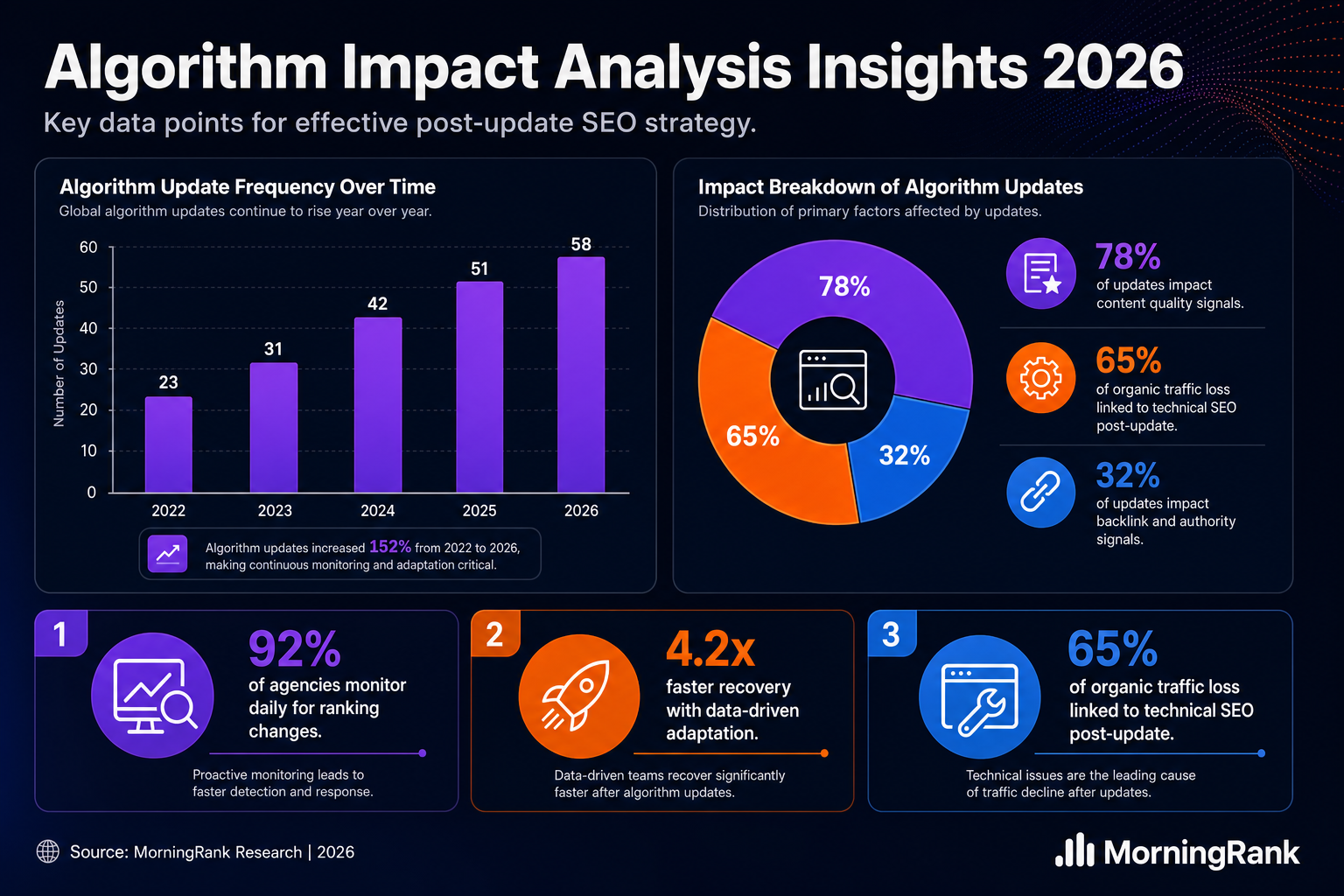
What is Google Algorithm Update Impact Analysis?
Google algorithm update impact analysis is the systematic process of monitoring, identifying, and evaluating changes in a website's search engine performance following a known or suspected Google algorithm update. This analysis helps SEO professionals understand which ranking factors were affected and how to adjust their strategies accordingly.
The goal is to move beyond simply observing rank changes. It involves diving deep into data to correlate specific algorithm shifts with concrete impacts on a website's organic traffic, keyword rankings, and SERP feature visibility. Effective analysis reveals patterns, highlights vulnerabilities, and provides the necessary insights to formulate a targeted recovery or adaptation plan.
For example, a core update might prioritize certain content characteristics, leading to a drop for sites lacking those qualities. Without detailed impact analysis, agencies might implement generic fixes instead of addressing the specific algorithmic shifts. This can lead to wasted resources and prolonged recovery times for clients.
How Do You Identify an Algorithm Update's Impact?
Identifying the impact of a Google algorithm update requires vigilance and access to key performance data. The first step is typically observing unusual fluctuations in keyword rankings and organic traffic.
What are the immediate signs of an update's effect?
Sudden, widespread drops or gains in keyword rankings across many terms, often accompanied by corresponding organic traffic changes, are immediate indicators. These shifts usually occur shortly after an announced or observed algorithm update. Monitoring tools are essential for this initial detection. MorningRank's AI-powered keyword rank tracking provides daily updates and historical data, making it easy to spot these rapid changes across your client portfolios.
Additionally, look for changes in SERP features. If your content previously ranked in featured snippets or local packs and now does not, this could indicate an update targeting specific content formats or quality signals related to those features. Changes in impression share, click-through rates, and average position within Google Search Console also provide critical early warnings.
What metrics are crucial for post-update analysis?
Several metrics are crucial for a comprehensive post-update analysis:
- Organic Search Traffic: Track daily and weekly trends to identify significant drops or gains from organic sources. Segment this data by landing page, device, and geographic location for more granular insights.
- Keyword Rankings: Monitor the average position of your target keywords. Look for broad changes across multiple keywords rather than isolated fluctuations. Tools like MorningRank allow you to track local SEO rank tracking by city and locationwhich is vital for local businesses.
- Search Visibility: This metric provides an overall percentage of how often a website appears in the top search results for a set of keywords, offering a holistic view of performance.
- Impression Share & Clicks: Within Google Search Console, analyze the queries and pages experiencing the most significant changes in impressions and clicks. This helps pinpoint specific areas of impact.
- Core Web Vitals: Changes in user experience metrics such as Largest Contentful Paint (LCP), First Input Delay (FID), and Cumulative Layout Shift (CLS) can sometimes correlate with performance shifts, especially after updates focusing on page experience, as noted by Google Search Central (Source: Google Search Central).
- Content Performance: Evaluate which content types or topics were most affected. Did informational articles drop? Did commercial pages lose ground? This can hint at the update's focus.

How Do You Diagnose the Cause of Ranking Changes?
Diagnosing the cause of ranking changes post-update moves beyond observation to interpretation, often requiring an understanding of Google's stated goals for an update. This process involves cross-referencing your observed data with known industry insights and Google's guidance.
What is the role of industry analysis and Google statements?
SEO news outlets, such as Search Engine Journal or Search Engine Land, and official Google Search Central blogs often provide initial interpretations and analysis of major updates. These resources frequently highlight the likely intent behind an update, such as a focus on E-E-A-T, spam reduction, or content quality. For example, Google often communicates its broad objectives, like "rewarding helpful content" (Source: Google Search Central).
By understanding the general direction of an update, you can form hypotheses about why your site or your clients' sites were affected. If an update targets "unhelpful content, " and your site experienced a drop, your diagnosis would naturally focus on content quality and alignment with user intent. This insight is critical for understanding why specific content types or pages may have been impacted.
How do you segment data for deeper insights?
To diagnose precisely, segment your data in various ways:
- By Content Type: Separate blog posts from product pages, service pages, or landing pages. This reveals if the update targeted specific content categories.
- By E-E-A-T Factors: Analyze changes based on content quality, author expertise, citations, and trust signals. Did pages lacking strong author bios or external validation suffer more?
- By Page Characteristics: Look at pages with particular technical issues (slow loading, poor mobile-friendliness) versus those that are optimized.
- By Keyword Intent: Group keywords by informational, transactional, or navigational intent. An update might impact one type more than another, indicating a shift in how Google understands and serves different user needs.
- By Device: Check if desktop and mobile performance diverged, suggesting a mobile-specific ranking factor or user experience impact.
This granular segmentation, often supported by tools with agency dashboard capabilities, helps narrow down the potential causes and informs your adaptation strategy.
What are Effective Adaptation Strategies Post-Update?
Adapting to Google algorithm updates requires a proactive and holistic SEO approach, focusing on fundamental principles that align with Google's long-term goals for quality and user experience. My audits consistently show that sites performing well after updates are those already prioritizing these core elements.
How does E-E-A-T play a role in adaptation?
E-E-A-T (Experience, Expertise, Authoritativeness, and Trustworthiness) is paramount for sustained success. Google explicitly states that E-E-A-T is a critical factor in evaluating content quality, especially for Your Money Your Life (YMYL) topics. If your site experienced a decline, reinforcing E-E-A-T signals should be a top priority. This includes:
- Ensuring content is created or updated by genuine experts with demonstrable credentials.
- Adding clear author bios and showcasing their expertise.
- Building a strong backlink profile from authoritative sources (Source: Backlinko).
- Improving site security, privacy policies, and customer support visibility to build trust.
For more insights, consider reading our post on Navigating Google's E-E-A-T Updates.
What content and technical adjustments should agencies consider?
Based on your impact analysis, tailor content and technical adjustments:
- Content Quality and Relevance: Review and update content for accuracy, comprehensiveness, and originality. Remove or significantly improve low-quality, thin, or unhelpful content. Focus on aligning content with user intent and providing genuine value.
- Technical SEO Audit: Address any crawling, indexing, or rendering issues that might prevent Google from properly understanding your site. Optimize page speed, mobile-friendliness, and site architecture. An automated SEO site audit tool can quickly identify these issues.
- User Experience (UX): Enhance the overall user experience. This includes clear navigation, engaging design, and easy access to information. Google's core updates often aim to reward sites that offer a superior user journey.
- Schema Markup: Implement or update Schema Markup to help search engines better understand your content and potentially qualify for rich results and AI Overview citations.
My audits suggest that addressing these core aspects not only helps recover from negative impacts but also builds long-term resilience against future updates. Google's algorithms are constantly striving to serve the best content, so consistently striving for excellence across all these areas is the most reliable strategy.
How Can Agencies Future-Proof Their SEO Strategy for 2026?
Future-proofing an SEO strategy in 2026 involves anticipating Google's direction and building a foundation that emphasizes continuous improvement, user value, and adaptability. It's about moving beyond reactive fixes to proactive excellence.
What role does continuous monitoring play?
Continuous monitoring is the bedrock of a future-proof SEO strategy. Relying solely on manual checks or infrequent reports leaves agencies vulnerable. Automated tracking of keyword rankings, organic traffic, technical health, and competitor performance allows for early detection of shifts, enabling quicker responses. MorningRank's platform provides always-fresh daily rankingsoffering the real-time data needed to stay ahead.
Beyond traditional SEO metrics, agencies must also monitor their visibility in AI answer engines and AI Overviews. As generative AI becomes more integrated into search, understanding how your content is cited and summarized by these new interfaces is crucial (Source: Search Engine Journal). Tools offering GEO and AEO tracking can provide these vital insights.
Why should agencies focus on holistic SEO and user-centric design?
Google's core mission is to organize the world's information and make it universally accessible and useful. This translates directly to rewarding websites that prioritize the user. A holistic SEO approach encompasses technical excellence, high-quality content, robust backlinks, and a superior user experience.
User-centric design means creating a website that is fast, intuitive, accessible, and provides genuine value to its visitors. When users have a positive experience, they spend more time on a site, engage with content, and convert, sending positive signals to search engines. By consistently focusing on these fundamental principles, agencies can build an SEO strategy that aligns with Google's goals, making their clients' websites inherently more resilient to algorithm updates.
Conclusion
Google algorithm updates are an inherent part of the digital marketing landscape, but they don't have to be a source of constant anxiety. By mastering Google algorithm update impact analysis, agencies can transform these challenges into opportunities for growth and refinement. The ability to quickly identify, diagnose, and adapt to changes, grounded in a deep understanding of E-E-A-T and user-centric principles, is what separates successful agencies from those struggling to keep pace.
In my experience, agencies that adopt a proactive, data-driven approach, continuously monitoring performance and refining their strategies, are the ones that consistently deliver value and maintain strong search visibility for their clients. Equipping your agency with the right tools for comprehensive tracking and analysis is the first step towards building this resilience. This preparedness ensures your clients remain competitive and thrive amidst Google's continuous evolution.
Frequently Asked Questions
What is a Google algorithm update?
A Google algorithm update is a significant modification to Google's proprietary system for ranking websites in search results. These updates are designed to improve the quality, relevance, and helpfulness of the information users find, often targeting specific ranking factors. Mastering Google algorithm update impact analysis helps agencies understand these shifts.
How often does Google release algorithm updates?
Google makes thousands of minor adjustments to its algorithms throughout the year. Major, broad core updates, which tend to have more noticeable impacts on search results, are typically announced a few times per year. Agencies must consistently monitor for these Google algorithm updates.
How quickly should I respond to a Google algorithm update?
While an immediate, panicked reaction is rarely advised, a prompt and systematic response is crucial. Within days of detecting a significant impact, agencies should initiate a Google algorithm update impact analysis to understand the changes. Rapid diagnosis allows for timely and targeted adaptation strategies.
Can a website fully recover from an algorithm update hit?
Yes, many websites can fully recover, and even improve, after being negatively impacted by a Google algorithm update. Recovery hinges on accurately diagnosing the specific issues that caused the decline and implementing targeted improvements aligned with Google's guidelines. This often involves enhancing content quality, technical SEO, and user experience.
What are the most common reasons for ranking drops after an update?
Common reasons for ranking drops after a Google algorithm update include low-quality or unhelpful content, poor user experience (e.g., slow page speed, non-mobile-friendly design), weak E-E-A-T signals, or technical SEO issues that hinder crawling and indexing. An effective Google algorithm update impact analysis helps pinpoint these issues.
How can MorningRank help my agency adapt to Google algorithm updates?
MorningRank provides real-time keyword rank tracking, comprehensive SEO audits, and AI-powered recommendations that help agencies quickly identify and diagnose the impact of Google algorithm updates. Our platform helps you monitor performance, pinpoint affected areas, and implement data-driven adaptation strategies to maintain and improve client search visibility.
Ready to empower your agency with the tools to master Google algorithm updates? Try MorningRank free today and transform your approach to SEO.
Want this kind of insight every week?
MorningRank delivers daily rank tracking, AI SEO recommendations, and white label client reporting.