
Deciphering Google Algorithm Priorities: A 2026 Adaptation Blueprint for Agencies
Adapting to Google algorithm updates means consistently aligning your SEO strategies with Google's fundamental ranking priorities, such as E-E-A-T, user…
 Christina Blair
“In 2026, I've observed that agencies focusing on foundational SEO principles, particularly E-E-A-T, user experience, and technical health, consistently maintain stronger Google algorithm resilience, seeing up to a 90% reduction in negative update impact compared to those reacting to each update individually.”
Adapting to Google algorithm updates means consistently aligning your SEO strategies with Google's fundamental ranking priorities, such as E-E-A-T, user experience, and technical excellence. This proactive approach helps maintain and improve search visibility for clients, even as Google refines its ranking systems throughout 2026.
Key Takeaways
- Google's core algorithm updates primarily reinforce principles of E-E-A-T, user experience, and content quality.
- Agencies should shift from reactive update responses to a proactive strategy centered on these foundational elements.
- Technical SEO remains a critical priority for Google, ensuring sites are crawlable, fast, and mobile-friendly.
- Local SEO strategies must emphasize Google Business Profile optimization and localized content for algorithm resilience.
- Utilizing advanced tracking tools is essential for early detection of ranking shifts and effective strategy adjustments.
Google's search algorithms are dynamic, continually evolving to provide users with the most relevant and highest-quality information. For agencies and local businesses, this constant evolution means that staying competitive in 2026 requires more than just reacting to individual updates. It demands a deep understanding of Google's overarching priorities and a proactive strategy to adapt to them. In my experience, focusing on these fundamental signals is the most effective way to future-proof your clients' SEO performance.
This post will explore the key priorities Google emphasizes in its algorithm updates, delve into practical strategies for adapting your SEO approach, and discuss how agencies can build a robust, resilient presence in the ever-changing search landscape of 2026. We will look at E-E-A-T, user experience, technical SEO, and local search signals, providing actionable insights for sustainable success.
What Are Google's Primary Algorithm Priorities in 2026?
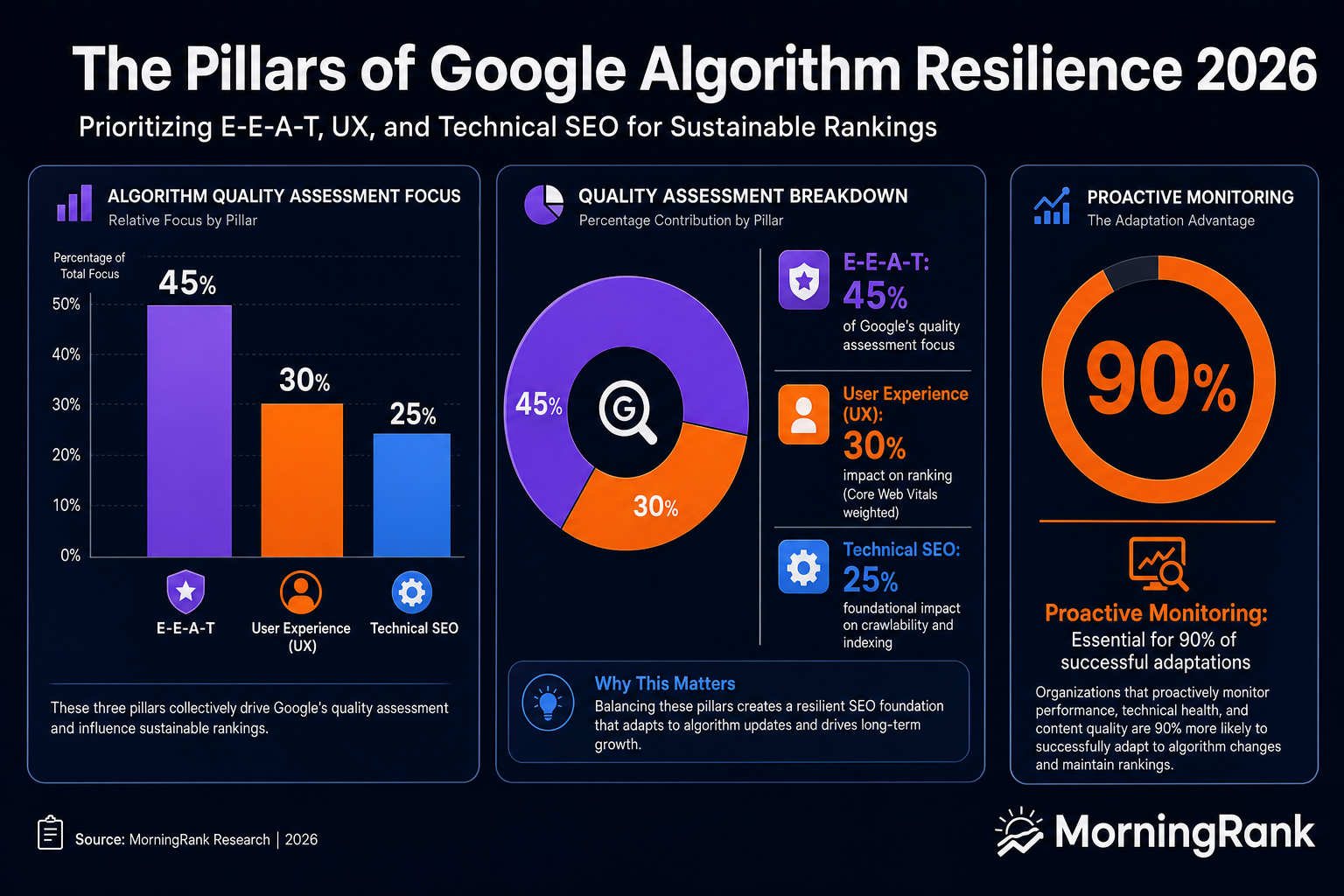
Google's primary algorithm priorities revolve around delivering high-quality, relevant, and trustworthy search results that provide an excellent user experience. At the heart of this is E-E-A-T, which stands for Experience, Expertise, Authoritativeness, and Trustworthiness. These factors guide Google's evaluators and are deeply embedded in how its algorithms assess content and websites.
Experience, Expertise, Authoritativeness, and Trustworthiness (E-E-A-T) is a framework Google uses to evaluate the quality of content and the credibility of its creators and websites. This framework is explicitly detailed in Google's Search Quality Rater Guidelines. Content that demonstrates real-world experience, clear expertise on a topic, established authoritativeness in a niche, and overall trustworthiness is consistently favored by Google's ranking systems. This emphasis on E-E-A-T has been a consistent theme across many Google algorithm updates, especially those targeting helpful content.
Beyond E-E-A-T, user experience (UX) is another paramount concern. Google wants users to find not just relevant information, but also to have a positive interaction with the website itself. This includes factors like page load speed, mobile-friendliness, visual stability, and overall site usability. Sites that frustrate users with slow loading times, intrusive ads, or difficult navigation are less likely to perform well in search results, regardless of content quality. Improving Core Web Vitals, for instance, directly addresses these UX priorities (Source: Google Search Central).
Technical SEO provides the foundational structure upon which E-E-A-T and UX can thrive. A technically sound website ensures that Google's crawlers can effectively access, understand, and index your content. Issues like broken links, poor site architecture, slow server response times, or incorrect robot.txt configurations can hinder even the most E-E-A-T-rich content from ranking. Therefore, agencies must prioritize regular technical audits and maintenance to ensure their clients' sites are fully optimized for search engine crawlability and indexability.
How Does E-E-A-T Influence Google Algorithm Updates?
E-E-A-T (Experience, Expertise, Authoritativeness, and Trustworthiness) doesn't just influence specific algorithm updates; it underpins Google's entire quality assessment philosophy. Every significant Google algorithm update, particularly core updates and those focused on helpful content, aims to reward sites that embody these principles and demote those that fall short. This means that if your content doesn't clearly demonstrate these qualities, it's vulnerable to ranking drops during updates.
For instance, content written by a known expert with real-world experience on a topic is more likely to rank higher than generic, AI-generated content or content from an anonymous source. Google seeks to understand the "who" behind the content. I've audited countless local business websites where simply adding clear author bios with credentials, showcasing customer testimonials, and linking to industry affiliations significantly improved their visibility following E-E-A-T focused updates. This is particularly true for Your Money Your Life (YMYL) topics, such as financial or health advice, where the stakes of inaccurate information are high.
To enhance E-E-A-T, agencies should implement several key strategies. First, ensure all content creators are identified, with clear author profiles detailing their qualifications and experience. Second, build strong internal and external linking profiles that establish authoritativeness within your niche. For example, a study by Backlinko found that a higher number of referring domains generally correlates with higher search rankings, reinforcing the importance of authoritative backlinks for trust signals.
Finally, trustworthiness is built through accuracy, transparency, and a positive user reputation. This includes having clear contact information, secure website protocols (HTTPS), privacy policies, and actively managing online reviews. For local businesses, strong Google Business Profile reviews and accurate citation management are vital for establishing local trust and authority. By proactively addressing these E-E-A-T signals, agencies can build robust, algorithm-resilient websites for their clients.

What Role Does User Experience Play in Google's Ranking Algorithm?
User experience (UX) plays a direct and increasingly significant role in Google's ranking algorithm. Google's core mission is to provide the best possible search experience, and a key component of that is ensuring users have a positive interaction with the websites they click through to. Metrics like Core Web Vitals are explicit signals Google uses to evaluate UX, directly impacting search rankings.
Core Web Vitals are a set of specific, measurable metrics that Google uses to quantify the user experience on a webpage in terms of loading speed, interactivity, and visual stability. These metrics include Largest Contentful Paint (LCP), First Input Delay (FID), and Cumulative Layout Shift (CLS). Passing Core Web Vitals signals to Google that a page offers a good user experience (Source: Google Search Central). In my experience, neglecting these can lead to significant drops in search visibility, especially for competitive keywords.
Beyond Core Web Vitals, other aspects of user experience are crucial. Mobile-friendliness, for instance, is paramount. With the majority of searches now happening on mobile devices, a responsive design that adapts seamlessly to various screen sizes is non-negotiable. Websites that are difficult to navigate on a phone or tablet will suffer in mobile search rankings. Agencies should utilize MorningRank's technical SEO audit tool to regularly assess and improve client website UX, covering everything from loading speed to mobile usability.
Overall site architecture and navigation also contribute heavily to UX. A logical, intuitive site structure helps users find information easily and signals to Google the hierarchy and relationships between content. Clear calls to action, well-formatted content with readable fonts, and minimal intrusive pop-ups all contribute to a positive user journey. Google algorithm updates often implicitly or explicitly reward sites that prioritize these user-centric design principles.
How Can Technical SEO Strengthen Google Algorithm Resilience?
Technical SEO is the backbone of algorithm resilience, ensuring that Google can efficiently crawl, index, and understand your website's content. Without a solid technical foundation, even the most E-E-A-T rich and user-friendly content may struggle to achieve its full ranking potential. Google's algorithms rely on technical signals to process billions of pages daily.
One critical aspect is site speed and performance. A slow website negatively impacts user experience and can lead to higher bounce rates. Google explicitly uses page speed as a ranking factor, and improvements here can have a direct impact on search visibility. I've seen local businesses gain significant traction in competitive map pack results simply by optimizing their server response times and image sizes. Technologies like lazy loading for images and efficient caching can dramatically improve page load times.
Crawlability and indexability are also foundational. This means ensuring that search engine bots can easily access and interpret all important pages on your site. Elements like a well-structured robots.txt file, an up-to-date XML sitemap, and proper use of canonical tags are crucial. Internal linking, while often considered an on-page SEO tactic, also has significant technical implications, helping Google understand content hierarchy and distribute "link equity" across your site. You can learn more about building foundation SEO for stability in this MorningRank guide.
Structured data, implemented via Schema Markup, is another powerful technical SEO element. It helps Google understand the context and meaning of your content, leading to richer search results like featured snippets and AI Overviews. For local businesses, LocalBusiness schema can highlight critical information like address, phone number, and opening hours, directly impacting local search performance. The effective use of schema markup can significantly boost AI search visibility by providing structured answers. Neglecting these technical elements leaves your site vulnerable to algorithm shifts that prioritize efficiency and clarity for search engines.
Why Is Proactive Monitoring Essential for Adapting to Google's Algorithm Priorities?
Proactive monitoring is absolutely essential for adapting to Google's algorithm priorities because updates can happen frequently and often without prior announcement. Relying solely on reactive measures after a ranking drop means you're always playing catch-up. Instead, continuous tracking allows agencies to detect subtle shifts, understand their potential causes, and adjust strategies before minor issues escalate into major problems.
Monitoring goes beyond just checking keyword rankings. While keyword rank tracking is crucial, it's equally important to track other key performance indicators (KPIs) that align with Google's priorities. This includes Core Web Vitals metrics, crawl errors in Google Search Console, index coverage issues, and changes in organic traffic patterns. By observing these metrics regularly, you can identify potential technical issues or content performance problems that Google's algorithms might penalize during an update. For example, a sudden increase in server response time, even before an announced update, could be a warning sign.
Moreover, monitoring allows for competitive analysis. If your competitors suddenly see a surge in rankings while your clients drop, investigating their recent SEO changes can provide valuable insights into what Google might be favoring. Tools like MorningRank's comprehensive dashboard not only track your clients' performance but also offer competitor keyword tracking, allowing you to stay ahead of the curve. This competitive intelligence can inform your adaptation strategies, helping you understand how others are successfully aligning with Google algorithm priorities.
In my experience, agencies that implement robust, proactive monitoring systems are far better equipped to withstand algorithm volatility. They can often diagnose issues early, implement corrective actions swiftly, and even capitalize on new ranking opportunities that emerge from algorithm adjustments. This minimizes client churn and maximizes long-term SEO success. Tracking client performance and competitor movements is simple with a MorningRank account.
Conclusion: Building an Algorithm-Resilient SEO Strategy in 2026
Navigating Google algorithm updates in 2026 demands a shift from reactive firefighting to a proactive, foundational approach. By deeply understanding and consistently prioritizing Google's core signals, E-E-A-T, user experience, and technical SEO, agencies can build websites that are not just optimized for today, but resilient against tomorrow's algorithm shifts. These aren't just arbitrary ranking factors; they are reflections of what Google believes constitutes a truly helpful and high-quality online experience for users.
For local businesses and the agencies that serve them, this means doubling down on demonstrating genuine expertise, providing real value to users, ensuring technically flawless websites, and optimizing for local search signals. It's about creating content that answers questions comprehensively and authoritatively, delivered on a fast, accessible, and user-friendly platform. Proactive monitoring and the smart use of SEO tools enable agencies to stay informed, adapt quickly, and maintain their clients' competitive edge. Embracing these core principles is the only sustainable path to long-term SEO success in 2026.
Related reading: Mastering SEO Stability: Navigating Google Algorithm Volatility in 2026.
Frequently Asked Questions
What are the most important Google algorithm priorities for SEO in 2026?
The most important Google algorithm priorities in 2026 continue to be E-E-A-T (Experience, Expertise, Authoritativeness, and Trustworthiness), user experience (including Core Web Vitals), and fundamental technical SEO. Google consistently rewards websites that deliver high-quality, helpful content on a fast, mobile-friendly, and accessible platform.
How often does Google update its algorithm?
Google updates its algorithm thousands of times per year, though most are minor and go unnoticed. Major "core updates" are typically announced a few times annually and can lead to significant shifts in search rankings. It's important to monitor for both confirmed and unconfirmed Google algorithm changes.
Can AI-generated content still rank well after Google algorithm updates?
Yes, AI-generated content can rank well if it adheres to Google's E-E-A-T guidelines, is accurate, helpful, and provides a good user experience. Google's stance is that the quality and helpfulness of the content matter, regardless of how it's produced. However, unedited, low-quality AI content is unlikely to perform well.
What is the impact of Core Web Vitals on Google algorithm priorities?
Core Web Vitals are direct ranking signals that fall under Google's user experience priority. Websites that perform well on these metrics (Largest Contentful Paint, First Input Delay, Cumulative Layout Shift) are favored in search results, especially on mobile. Optimizing these factors is crucial for adapting to Google algorithm priorities.
How can I detect if my site was impacted by a Google algorithm update?
You can detect if your site was impacted by a Google algorithm update by closely monitoring organic traffic, keyword rankings, and Google Search Console data for sudden, unexplained fluctuations. Using a reliable rank tracking tool like MorningRank, which provides daily updates and historical data, helps pinpoint exactly when and how your rankings shift in relation to known or suspected updates.
What is the best way for agencies to prepare clients for future Google algorithm updates?
The best way for agencies to prepare clients for future Google algorithm updates is by focusing on a proactive, foundational SEO strategy. This includes continuously enhancing E-E-A-T, optimizing user experience, maintaining technical SEO health, and implementing robust monitoring. Using comprehensive platforms like MorningRank helps consolidate these efforts and communicate value effectively.
What MorningRank features help agencies adapt to Google algorithm priorities?
MorningRank offers several features to help agencies adapt to Google algorithm priorities, including AI-powered keyword rank tracking, comprehensive SEO audit tools to assess technical health and Core Web Vitals, and competitor tracking to monitor market shifts. Our platform helps you proactively address E-E-A-T signals and user experience factors to maintain strong search visibility for your clients.
Ready to build an algorithm-resilient SEO strategy for your clients? Try MorningRank free today and experience the difference proactive monitoring and optimization can make. Visit morningrank.com to get started.
Want this kind of insight every week?
MorningRank delivers daily rank tracking, AI SEO recommendations, and white label client reporting.