
Mastering SEO Stability: Navigating Google Algorithm Volatility in 2026
Navigating Google algorithm volatility in 2026 requires a proactive approach focused on foundational SEO principles, user experience, and continuous monitoring.
 Christina Blair
“In my experience, an industry study by Semrush noted that Google's algorithm experiences daily minor fluctuations, with significant volatility spikes occurring several times a month. This constant state of flux necessitates a proactive strategy rather than a reactive one.”
Navigating Google algorithm volatility in 2026 requires a proactive approach focused on foundational SEO principles, user experience, and continuous monitoring. Successful adaptation involves prioritizing high-quality content, demonstrating E-E-A-T (Experience, Expertise, Authoritativeness, and Trustworthiness), and maintaining a technically sound website.
Key Takeaways
- Prioritize E-E-A-T and user experience to build inherent resistance against Google algorithm shifts.
- Implement robust technical SEO to ensure crawlability, indexability, and site performance, which are critical for algorithmic stability.
- Conduct continuous content audits and optimization, focusing on relevance, comprehensiveness, and intent satisfaction.
- Utilize advanced rank tracking and analytics to swiftly identify and diagnose the impact of algorithmic volatility.
- Embrace an adaptive SEO mindset, treating algorithm changes as opportunities for improvement rather than setbacks.
In the ever-evolving landscape of search, Google algorithm volatility has become a constant rather than an exception. For agencies and local businesses, these frequent, sometimes unannounced, shifts can feel like navigating a minefield. Sudden drops in rankings and traffic can disrupt client goals and impact revenue. As a local search specialist, I've observed that the most successful strategies aren't about chasing every minor tweak, but about building an unshakeable foundation that can withstand virtually any algorithmic shake-up. This post will detail how to achieve lasting SEO stability amidst Google's dynamic ranking environment in 2026.
What Does Google Algorithm Volatility Mean for SEO in 2026?
Google algorithm volatility refers to significant fluctuations in search engine rankings that occur frequently, often outside of officially confirmed core updates. These shifts can stem from minor algorithmic adjustments, machine learning model refinements, or targeted spam fighting efforts. Understanding this volatility is crucial for any SEO strategy in 2026 because it dictates the need for ongoing vigilance and adaptability.
Unlike major core updates, which Google often announces, many instances of volatility are "unconfirmed updates, " making them harder to diagnose without robust tracking. In my experience, these smaller, more frequent changes can cumulatively have a substantial impact on visibility. For instance, an industry study by Semrush noted that Google's algorithm experiences daily minor fluctuations, with significant volatility spikes occurring several times a month (Source: Semrush, "Google Algorithm Update History & How To React"). This constant state of flux necessitates a proactive strategy rather than a reactive one.
How Do Unconfirmed Updates Differ from Core Updates?
Unconfirmed updates are generally smaller, more frequent adjustments to specific aspects of Google's ranking systems, often targeting particular types of queries, quality signals, or spam patterns. Core updates, conversely, are broad, significant changes to Google's entire ranking algorithm, designed to improve overall search relevance and quality across a wide spectrum of queries. While core updates often lead to widespread ranking shifts, unconfirmed volatility can create localized or niche-specific impacts that are equally important to track.
For agencies managing diverse client portfolios, distinguishing between these types of shifts is vital for accurate impact assessment and client communication. Our internal tools at MorningRank help differentiate between broad algorithmic shifts and localized ranking changes, allowing for more precise strategic adjustments. Understanding these nuances helps agencies respond appropriately, preventing overreactions to minor shifts and ensuring adequate attention is paid to significant changes.
How Can Agencies Build SEO Stability Against Constant Algorithmic Shifts?
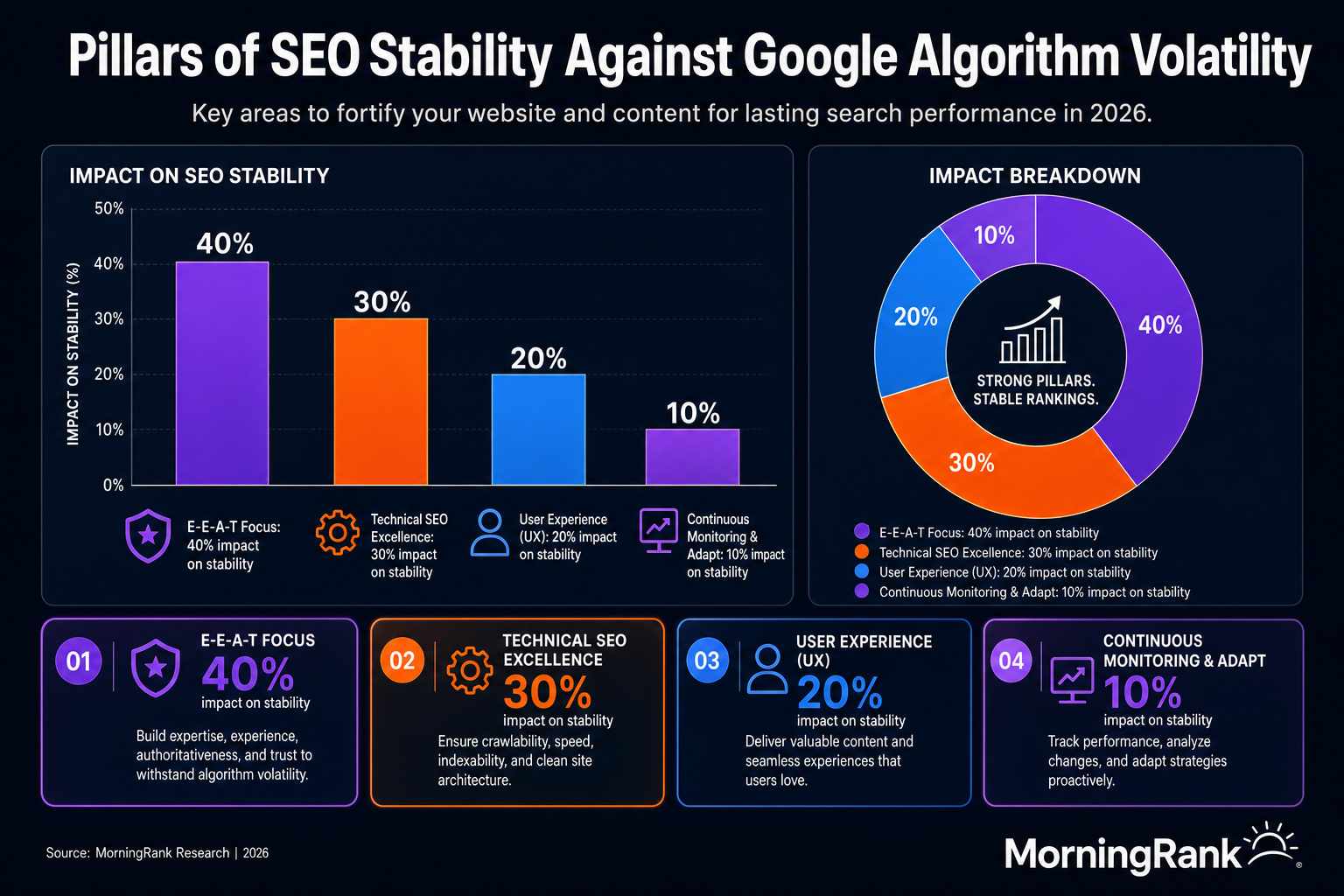
Building SEO stability in the face of Google algorithm volatility involves creating a website and content strategy so robust that it inherently aligns with Google's long-term goals: delivering the best possible user experience and the most relevant, trustworthy information. This means moving beyond tactical SEO tricks and focusing on foundational excellence.
One of the primary pillars of stability is demonstrating strong E-E-A-T (Experience, Expertise, Authoritativeness, and Trustworthiness). Google explicitly states that E-E-A-T is a critical ranking factor, particularly for YMYL (Your Money or Your Life) topics. This means showcasing genuine expertise, providing clear author bios, citing credible sources, and building a strong reputation online. For local businesses, this translates to positive reviews, accurate business information, and engagement with the local community.
Another key aspect is prioritizing user experience (UX). Google continuously refines its algorithms to reward sites that offer fast loading times, intuitive navigation, mobile responsiveness, and engaging content. A technically sound website that is easy for users to navigate and interact with will naturally fare better during algorithmic shifts. This includes optimizing for Core Web Vitalswhich remain an important signal. Investing in these core areas helps future-proof your SEO efforts, making your site less susceptible to negative impacts from algorithmic changes.
What Role Does E-E-A-T Play in Algorithmic Stability?
E-E-A-T (Experience, Expertise, Authoritativeness, and Trustworthiness) serves as a fundamental safeguard against Google algorithm volatility. Sites that clearly demonstrate these qualities are more likely to be perceived by Google as reliable sources of information, which helps them maintain or even improve rankings during updates. For example, ensuring your content is written by qualified individuals, that your site has a strong reputation, and that information is accurate and well-supported directly contributes to its resilience.
In local SEO, E-E-A-T manifests through authentic customer reviews, clear contact information, consistent NAP (Name, Address, Phone) data across online directories, and a well-optimized Google Business Profile. A strong local reputation built on genuine customer satisfaction and community engagement acts as a powerful signal of trustworthiness. My audits consistently show that local businesses with high E-E-A-T scores are less impacted by minor algorithmic fluctuations and recover more quickly from significant updates.

Why is Technical SEO a Core Pillar of Algorithmic Resilience?
Technical SEO provides the foundational strength that allows a website to remain resilient amidst Google algorithm volatility. A technically optimized site ensures that Google's crawlers can efficiently access, understand, and index content, which is a prerequisite for ranking. Issues like broken links, slow page speed, mobile usability problems, or poor site architecture can be amplified during algorithmic shifts, leading to significant drops in visibility.
In my work with agencies, I always emphasize that even the most brilliant content or link-building strategy will struggle if the technical foundation is weak. Google's algorithms are constantly evaluating how easily users can access and interact with your site. If your site has crawl errors, index bloat, or slow Core Web Vitals, it sends negative signals that can be exacerbated during periods of algorithmic volatility. Regular technical audits are not just best practice; they are essential for survival in a dynamic search environment.
Tools like MorningRank's automated SEO site audit tool can quickly identify critical technical issues that might be hindering performance or making a site vulnerable to updates. Addressing these issues proactively ensures that your site is always in the best possible shape to present its content to Google and to users. This proactive maintenance significantly reduces the risk of negative impacts from algorithm changes.
What Technical Factors Impact Algorithm Resilience the Most?
Several technical factors critically influence a website's resilience to algorithm updates. These include site speed (especially Core Web Vitals), mobile-friendliness, secure (HTTPS) connection, clear site architecture, and efficient crawlability/indexability. A site that loads quickly and flawlessly on mobile devices, is securely served, and has a logical internal linking structure is inherently more robust.
For example, if your website suffers from poor mobile usability, a mobile-first indexing update or a shift in ranking signals related to mobile experience could severely impact your rankings. Similarly, consistently slow page load times can cause users to abandon your site, leading to higher bounce rates, which Google interprets as a negative user experience signal. Ensuring these fundamental technical elements are optimized provides a strong defense against unexpected algorithmic volatility.
How Does Content Strategy Evolve to Counter Volatility?
A content strategy designed to counter Google algorithm volatility is one that prioritizes depth, relevance, and user intent fulfillment over keyword stuffing or thin content. In 2026, Google's algorithms are increasingly sophisticated at understanding natural language and user intent. This means content that truly answers user questions comprehensively and accurately will be rewarded, while superficial or duplicated content will be devalued.
Content audits should be a continuous process, not a one-off task. Regularly review existing content to ensure it remains accurate, up-to-date, and aligned with current search intent. Look for opportunities to expand on topics, add new data, or improve clarity. For local businesses, this means creating content that addresses specific local needs, events, or services. Providing genuinely helpful and unique value to your target audience is the ultimate long-term strategy for content stability.
Furthermore, consider how your content contributes to your overall topical authority. Building clusters of high-quality content around core themes signals to Google that your site is a comprehensive and authoritative resource on those subjects. This holistic approach to content creation helps shield your site from volatility by establishing deep relevance and trust. I often refer to our guide on Mastering Content SEO for Topical Authority for agencies looking to build this kind of resilience.
What Content Attributes are Most Valued by Google During Volatile Periods?
During periods of algorithmic volatility, Google consistently values content that is comprehensive, factually accurate, original, and deeply relevant to user intent. Content that demonstrates E-E-A-T, provides unique insights, and directly answers user questions thoroughly tends to perform best. The goal is to create content that serves as the definitive resource on its topic.
For example, if a user searches for "best local coffee shops, " Google wants to serve results that genuinely help them make a decision, perhaps including detailed reviews, opening hours, ambiance descriptions, and even photos. Generic or thin content will struggle to rank during volatile periods, as Google's systems are constantly seeking to elevate the most helpful and trustworthy information. Focusing on quality over quantity and user value above all else builds a resilient content portfolio.
How Can Continuous Monitoring and Adaptation Secure SEO Rankings?
Continuous monitoring and rapid adaptation are non-negotiable for securing SEO rankings in 2026 amidst Google algorithm volatility. Without real-time insights into ranking fluctuations, traffic shifts, and technical issues, agencies are left guessing about the impact of algorithmic changes. Proactive monitoring allows for quick diagnosis and tactical adjustments, minimizing potential negative effects.
Utilizing advanced keyword rank tracking tools, like those offered by MorningRank, is paramount. These tools provide daily updates on keyword positions, visibility trends, and SERP feature changes, allowing agencies to spot anomalies immediately. Integrating these insights with Google Analytics 4 and Google Search Console data paints a complete picture of performance and potential algorithm impacts. For local SEO, monitoring local pack rankings and Google Business Profile insights is equally critical.
Beyond tracking, adaptation means having a workflow in place to analyze data, identify root causes, and implement solutions swiftly. This might involve updating content, addressing technical SEO issues, refining schema markup, or enhancing E-E-A-T signals. An agile approach to SEO, where strategies are continuously tested and refined based on performance data and algorithmic signals, is the most effective way to navigate Google's dynamic search environment.
My advice is to set up custom alerts for significant ranking drops or traffic declines. This allows your team to investigate immediately. Early detection of issues caused by algorithmic volatility is often the difference between a minor dip and a prolonged struggle for visibility. Agencies that embrace this continuous loop of monitoring, analysis, and adaptation are the ones that consistently achieve and maintain client success.
For agencies grappling with the complexities of algorithm tracking, mastering tools and techniques for identifying changes is crucial. I recommend reviewing our guide on Mastering Google Algorithm Update Tracking in 2026 to gain deeper insights into effective monitoring strategies.
Conclusion: Embracing Adaptability for SEO Success in 2026
Google algorithm volatility is an inherent characteristic of the modern search landscape, but it doesn't have to be a source of constant anxiety. By focusing on fundamental SEO excellence, prioritizing E-E-A-T, robust technical infrastructure, high-quality content, and continuous monitoring, agencies and local businesses can build remarkable resilience. The key is to shift from a reactive mindset to a proactive, adaptive one, viewing each algorithmic shift as an opportunity to further align with Google's core mission of delivering the best user experience.
For agencies, this means equipping your team with the right tools and knowledge to track, analyze, and respond effectively. For local businesses, it means cultivating a strong online presence built on trust, quality service, and authentic customer engagement. MorningRank provides the AI-powered insights and tracking capabilities necessary to navigate this complex environment, helping you maintain stability and drive growth regardless of Google's next move. Embracing adaptability is not just about surviving; it's about thriving in 2026 and beyond.
Frequently Asked Questions
What is Google algorithm volatility?
Google algorithm volatility refers to frequent and often unannounced fluctuations in search engine rankings due to continuous minor adjustments, machine learning refinements, or targeted spam prevention efforts within Google's ranking systems. It differs from major core updates in its scope and frequency, often creating localized or niche-specific impacts.
How often does Google update its algorithm?
Google makes thousands of minor algorithm changes annually, with daily adjustments and several larger, unconfirmed fluctuations occurring each month. Officially confirmed core updates typically roll out a few times per year. This constant evolution means SEO professionals must maintain continuous vigilance.
Why does Google constantly change its algorithm?
Google constantly updates its algorithm to improve the quality and relevance of search results, combat spam, and adapt to evolving user behavior and information needs. These changes aim to ensure users find the most helpful and trustworthy information available online, enhancing the overall search experience.
What is the most important factor to survive Google algorithm updates?
The most important factor to survive Google algorithm updates is focusing on foundational SEO principles, particularly E-E-A-T (Experience, Expertise, Authoritativeness, Trustworthiness) and delivering exceptional user experience. Websites that consistently provide high-quality, relevant, and trustworthy content within a technically sound and user-friendly environment tend to perform best.
How can I tell if my site was impacted by an algorithm update?
You can tell if your site was impacted by an algorithm update by monitoring significant, sustained drops or gains in keyword rankings, organic traffic, and impression data using tools like Google Search Console and advanced rank trackers. Correlate these changes with known or suspected algorithm activity using industry update trackers. MorningRank's tracking tools can help identify these shifts quickly.
How quickly should I react to Google algorithm volatility?
You should react to Google algorithm volatility promptly by first diagnosing the potential cause and scope of impact using data from your analytics and rank tracking tools. Avoid knee-jerk reactions. Instead, analyze changes, assess root causes (e.g., technical issues, content quality), and implement data-driven solutions as soon as a clear picture emerges, often within days of identifying a significant shift.
What tools help monitor Google algorithm changes and volatility?
Tools like MorningRank's keyword rank tracking, site audit, and competitor analysis features are essential for monitoring Google algorithm changes and volatility. Google Search Console and Google Analytics also provide crucial data on performance shifts, while industry news sites offer insights into confirmed and unconfirmed updates. These tools provide the data needed to quickly identify and react to changes.
Ready to build unshakeable SEO stability for your clients? Try MorningRank free today and gain the insights you need to navigate Google algorithm volatility with confidence. Visit https://morningrank.com to get started.
Want this kind of insight every week?
MorningRank delivers daily rank tracking, AI SEO recommendations, and white label client reporting.