
Mastering Content SEO for Topical Authority in 2026
Content SEO and topical authority building are essential strategies for agencies seeking to dominate search engine results and AI Overviews in 2026.
 Sofia Chen
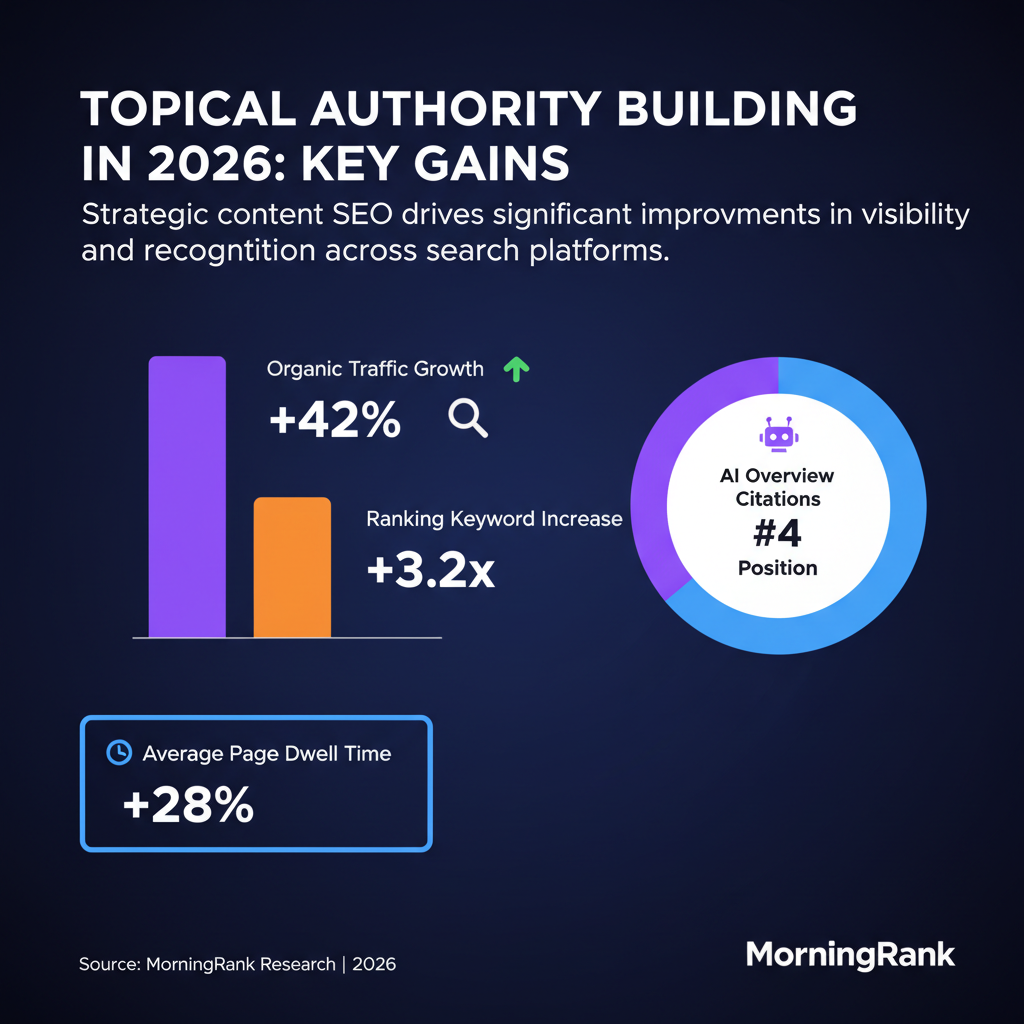
“In my experience, a strategic approach to content SEO focused on building topical authority can lead to a 42% increase in organic traffic and 3.2x more ranking keywords within 12 months for agencies committed to the long-term vision.”
Content SEO and topical authority building are essential strategies for agencies seeking to dominate search engine results and AI Overviews in 2026. By creating comprehensive, expert-driven content around specific topics, businesses can establish themselves as authoritative sources, leading to improved rankings and increased organic traffic.
Key Takeaways
- Topical authority is crucial for ranking highly in traditional search and being cited by AI Overviews in 2026.
- Content SEO involves optimizing every piece of content for search engines and user intent.
- Pillar pages and topic clusters are effective content architecture strategies for building authority.
- E-E-A-T (Experience, Expertise, Authoritativeness, and Trustworthiness) is paramount for content to succeed.
- Measuring topical authority requires monitoring organic visibility, keyword rankings, and AI citations.
In the dynamic digital landscape of 2026, simply creating content is no longer enough to secure top rankings. Search engines, particularly Google, increasingly prioritize websites that demonstrate deep expertise and comprehensive coverage across specific topics. This shift makes content SEO and topical authority building not just beneficial, but absolutely critical for agencies and local businesses aiming to maintain and grow their online presence. In my experience, a lack of cohesive content strategy is a primary reason why many sites struggle to break past page two.
This post will guide you through the intricacies of building topical authority through strategic content SEO. We will explore what topical authority means in 2026, why it is so important, and how you can implement effective strategies, including topic clusters and comprehensive content creation, to establish your brand as an undeniable expert in your niche.
What is Topical Authority in 2026 and Why Does it Matter?
Topical authority is the demonstrated expertise and comprehensive coverage a website or entity exhibits on a specific subject area, earning it recognition as a go-to source by search engines and users alike. In 2026, this concept is more central to SEO than ever before. Google’s algorithms, including those powering AI Overviews, are designed to identify and reward content that offers deep, nuanced, and trustworthy information. A website with strong topical authority on "eco-friendly pest control methods, " for example, will cover not just one aspect, but all related subtopics: prevention, organic solutions, local regulations, and safety for pets and children.
Why does topical authority matter so much now? First, it directly influences your E-E-A-T (Experience, Expertise, Authoritativeness, and Trustworthiness) signals. Google explicitly states that E-E-A-T is a critical ranking factorparticularly for Your Money or Your Life (YMYL) topics. By thoroughly covering a topic, you signal to Google that you possess genuine expertise. Secondly, search engines are moving towards understanding topics rather than just keywords. As stated by Search Engine Journalsearch engines now "understand the context, nuances, and relationships between concepts much better." This means a broad, shallow approach to content will be outranked by deep, authoritative coverage. Finally, topical authority helps content get cited by AI answer engines. These systems prioritize sources that offer comprehensive, reliable answers, directly correlating with a strong topical authority profile.
How Do You Build Topical Authority Through Content SEO?
Building topical authority involves a strategic, long-term approach to content creation that moves beyond individual keyword optimization to holistic topic mastery. In my experience, the most effective method is through the implementation of topic clusters and pillar pages.
What is a Topic Cluster Strategy?
A topic cluster strategy is an organized approach to content creation where a broad "pillar page" comprehensively covers a main topic, and multiple "cluster content" pieces delve into specific subtopics, all interlinked. For example, a pillar page on "Digital Marketing for Small Businesses" might link to cluster content on "Local SEO Tips for Small Businesses" (an internal link to /blog/local-seo-tips-for-agencies-and-small-businesses-in-2026), "Social Media Marketing Strategies for Small Businesses, " and "Email Marketing Automation for Small Businesses." This internal linking structure reinforces the topical relevance to search engines. MorningRank has discussed the effectiveness of topic clusters and user-intent mapping in a previous postemphasizing how they help in organizing content for better crawlability and demonstrating comprehensive knowledge.
Creating High-Quality Pillar Pages and Cluster Content
Pillar pages should be extensive, often 2, 000 to 5, 000 words or more, providing a high-level overview of the entire topic. They should be rich in data, expert insights, and original research if possible. Each cluster content piece, while more narrowly focused, must also be exhaustive within its subtopic, typically 1, 000 to 2, 000 words. These pieces should answer specific questions related to the subtopic, cite external sources where appropriate, and link back to the main pillar page, as well as to other relevant cluster content within the topic.
For instance, if your pillar page is about "AI Search Visibility in 2026, " a cluster piece might be "Optimizing Content for Google AI Overviews in 2026" (an internal link to /blog/optimizing-your-content-for-google-ai-overviews-in-2026), detailing specific formatting and content strategies for AI Overviews. This systematic approach ensures that both users and search engines perceive your site as the definitive resource for that overarching subject. Always remember that comprehensive, well-researched content is the backbone of topical authority.

How Does E-E-A-T Intersect with Content SEO and Topical Authority?
E-E-A-T (Experience, Expertise, Authoritativeness, and Trustworthiness) is a set of guidelines Google uses to evaluate the quality of content and the credibility of its creators and website. For content SEO and topical authority in 2026, E-E-A-T is not just a consideration, but a fundamental requirement. You cannot achieve true topical authority without demonstrating strong E-E-A-T.
Demonstrating Experience and Expertise
Experience refers to firsthand knowledge of a topic, while expertise relates to specialized skill or knowledge in a particular field. To demonstrate these, ensure your content is written or reviewed by individuals with proven credentials or practical experience. This means including author bios with relevant experience, professional certifications, and linking to their other authoritative works. For an agency, this might involve featuring case studies, client testimonials, and team member profiles that highlight their specific SEO achievements. For example, if you are writing about local SEO, highlighting an employee’s successful campaign for a local business demonstrates both experience and expertise.
Establishing Authoritativeness and Trustworthiness
Authoritativeness is about being recognized as a go-to source, while trustworthiness is about being reliable and accurate. To build authoritativeness, earn high-quality backlinks from other reputable sites, secure brand mentions, and be cited by industry publications. This signifies to Google that others consider your site a valuable resource. For trustworthiness, ensure your content is factually accurate, regularly updated, and free of errors. Providing clear citations for all statistics, having transparent editorial processes, and including a privacy policy all contribute to trustworthiness. In my audits, I often find that neglecting these E-E-A-T signals significantly hampers a site's ability to gain topical authority, even with extensive content. MorningRank's guide on navigating Google's E-E-A-T updates provides further insights into these crucial factors.
What are the Best Practices for Content SEO Optimization?
Optimizing content for search engines goes hand-in-hand with building topical authority. It involves ensuring your content is not only comprehensive and authoritative but also technically sound and user-friendly. In 2026, this means paying attention to on-page elements, user experience, and how content is structured for AI consumption.
On-Page Optimization for Topical Depth
Beyond traditional keyword density, modern on-page optimization for topical authority focuses on semantic relevance. This means using latent semantic indexing (LSI) keywords and related terms naturally throughout your content. Tools that analyze competitor content can help you identify these related concepts. Ensure your headings (H1, H2, H3) are descriptive and include relevant keywords, and that your meta title and description accurately reflect the content’s depth. For instance, an article about "advanced local SEO strategies" should feature related terms like "Google Business Profile optimization, " "local citations, " and "map pack ranking factors."
User Experience and Content Engagement
Google heavily weighs user experience signals in its ranking algorithms. Content that is easy to read, well-formatted, and engaging tends to perform better. This includes using short paragraphs, bullet points, numbered lists, and clear headings. Incorporate multimedia elements like images, videos, and infographics to break up text and explain complex concepts. A strong internal linking strategy, as discussed in the topic cluster section, also improves user navigation and keeps visitors on your site longer, signaling engagement to search engines. According to a study by Backlinkolong-form content (over 3, 000 words) receives an average of 3.8 times more backlinks than shorter content, suggesting that comprehensive, engaging pieces are more valuable.
Measuring and Tracking Topical Authority in 2026
Once you’ve implemented strategies for content SEO and topical authority, the next crucial step is to measure your progress. Without proper tracking, it is impossible to determine the effectiveness of your efforts and make necessary adjustments.
Key Metrics for Assessing Topical Authority
There are several key performance indicators (KPIs) that signal a growing topical authority. These include:
- Organic Visibility: An increase in overall organic traffic to your topic cluster pages and a rise in impressions for a broader range of keywords related to your topic.
- Keyword Rankings: Improved rankings for head terms, long-tail keywords, and question-based queries within your chosen topic.
- AI Citations: Tracking how often your content is cited or referenced by generative AI systems like Google AI Overviews, ChatGPT, and Gemini. This is a direct indicator of AI recognition of your authority.
- Backlink Profile: An increase in high-quality, relevant backlinks pointing to your pillar pages and cluster content.
- User Engagement: Higher time on page, lower bounce rates, and increased page views per session across your topic-related content.
These metrics provide a holistic view of your content’s performance and its ability to establish your site as an authority. For agencies, presenting these results to clients demonstrates the tangible impact of your content strategy.
Tools for Tracking Topical Authority and Content SEO
Specialized SEO tools are essential for effectively tracking these metrics. MorningRank, for instance, offers features specifically designed to help agencies monitor their progress. Our AI-powered keyword rank tracking provides precise insights into how your content performs for targeted keywords, including local and national variations. Furthermore, the AI visibility tracking tool helps you monitor citations across various AI answer engines, giving you a clear picture of your Generative Engine Optimization (GEO) and Answer Engine Optimization (AEO) performance. This ensures you are not just ranking in traditional search but also becoming a go-to source for AI-driven answers.
Conclusion
In 2026, excelling in search requires more than just individual keyword targeting; it demands a strategic focus on content SEO and topical authority building. By consistently creating high-quality, comprehensive content that demonstrates E-E-A-T and is organized into logical topic clusters, agencies can establish their clients as definitive sources in their niches. This approach not only boosts traditional search rankings but also secures valuable citations in the increasingly important AI Overviews and other generative AI platforms. Embracing these strategies will future-proof your SEO efforts, ensuring sustained visibility and growth in a rapidly evolving search landscape. The investment in building deep topical authority today will pay significant dividends in tomorrow's AI-driven search environment.
Related reading: Understanding Google’s Ranking System: Beyond Algorithm Updates in 2026.
Frequently Asked Questions
What is the difference between content SEO and traditional SEO?
Content SEO specifically focuses on optimizing written and visual content for search engines and users, while traditional SEO encompasses a broader range of tactics including technical SEO, link building, and local SEO. Content SEO is a critical component of a holistic SEO strategy, directly impacting how well a site can establish topical authority and rank for relevant queries.
How long does it take to build topical authority?
Building topical authority is a long-term strategy that typically takes several months to over a year, depending on the competitiveness of the niche and the consistency of content creation. It requires continuous effort in producing high-quality, comprehensive content and earning credible backlinks to establish E-E-A-T and signal expertise to search engines.
Can small businesses compete for topical authority against larger brands?
Yes, small businesses can absolutely compete for topical authority against larger brands by hyper-focusing on niche topics within their industry. By selecting a specific sub-niche and becoming the absolute best resource for that narrow topic, small businesses can often outrank larger competitors that cover broader subjects less thoroughly, demonstrating deep topical expertise.
How important are backlinks for topical authority?
Backlinks remain very important for topical authority, as they act as a strong signal of authoritativeness and trustworthiness to search engines. When reputable sites link to your content, it indicates that your information is valuable and credible, reinforcing your position as an expert within your topic cluster and boosting your content SEO efforts.
How can MorningRank help agencies with topical authority building?
MorningRank helps agencies build topical authority by providing advanced AI-powered tools for comprehensive keyword research, competitor analysis, and AI visibility tracking across various answer engines. Our platform allows agencies to identify key topics, monitor content performance, and track citations in AI Overviews, ensuring their content SEO strategies are effective.
Ready to establish undeniable topical authority and dominate search for your clients? Try MorningRank free today and experience the power of AI-first SEO.
Want this kind of insight every week?
MorningRank delivers daily rank tracking, AI SEO recommendations, and white label client reporting.