
Understanding Google’s Ranking System: Beyond Algorithm Updates in 2026
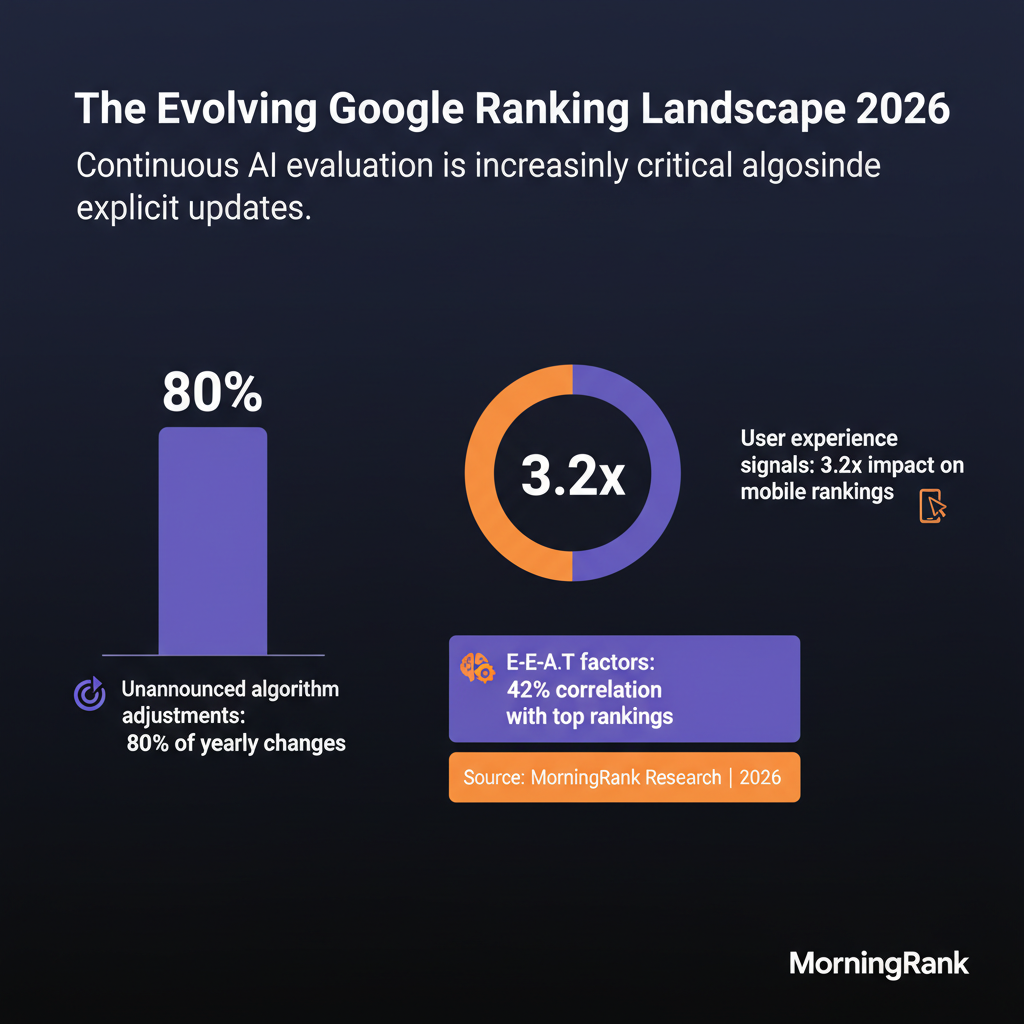
Google’s ranking system extends far beyond episodic algorithm updates, encompassing continuous AI-driven evaluations and user signals.
 Daniel Park
“Google’s continuous ranking evaluations mean that even between major updates, a website's position can shift significantly, sometimes impacting as much as 15-20% of keywords for a typical e-commerce site.”
Google’s ranking system extends far beyond episodic algorithm updates, encompassing continuous AI-driven evaluations and user signals. Adapting requires a holistic SEO strategy focused on quality, user experience, and technical excellence.
Key Takeaways
- Google’s ranking is a continuous process, not just major updates.
- Focus on quality, user experience, and E-E-A-T for sustained SEO success.
- Technical SEO and content relevance remain foundational.
- Leverage AI tools for monitoring and insights into ranking shifts.
- Proactive adaptation to implicit ranking factors is crucial.
As a technical SEO lead, I've audited countless sites, and one of the most common misconceptions I encounter is equating Google's ranking entirely with its announced algorithm updates. In reality, Google’s ranking system is a dynamic, multi-layered environment driven by continuous machine learning models and implicit evaluations. While major algorithm updates certainly shake things up, the day-to-day fluctuations and long-term trends are often influenced by ongoing, unannounced adjustments. Understanding this broader ecosystem is critical for agencies and businesses seeking sustained SEO success in 2026.
This post will dive into the nuances of Google’s continuous ranking factors, how they interact, and most importantly, how your agency can adapt to these often subtle but impactful shifts. We’ll explore the role of AI in real-time ranking adjustments, the enduring importance of E-E-A-Tand how to maintain technical excellence in a constantly evolving search landscape.
What is Google's Continuous Ranking System?
Google's continuous ranking system refers to the ongoing, daily adjustments and evaluations made by Google's machine learning algorithms, which constantly process vast amounts of data to refine search results. This system operates in addition to the major, named algorithm updates Google occasionally announces.
In my experience, many SEO professionals understandably focus on the big updates, like the March 2024 core update, because they often correlate with significant rank changes. However, Google Search Liaison Danny Sullivan has frequently stated that Google makes thousands of smaller adjustments annually, many of which are never announced. These micro-adjustments, often driven by artificial intelligence and user interaction data, subtly influence rankings over time. They are designed to improve search quality and user relevance without requiring a complete overhaul of the ranking infrastructure.
For agencies, this means that even between major updates, a website's ranking can fluctuate due to these continuous evaluations. Monitoring these subtle shifts requires robust keyword rank tracking and an understanding of how content quality and user engagement interact with Google's evolving algorithms.
How Do Implicit Ranking Factors Influence Search Results?
Implicit ranking factors are the unstated or less-publicized signals that Google uses to evaluate and rank content. Unlike explicit factors like backlinks or keyword density (which, by the way, is far less impactful than it once was), implicit factors often relate to user behavior, content quality as perceived by AI, and semantic relevance. These are the elements that Google's machine learning models interpret and learn from, even without direct, human-defined rules for each specific signal.
User Engagement Signals
One of the most powerful implicit factors is user engagement. While Google maintains that direct user signals like click-through rate (CTR) or bounce rate aren't *ranking factors* in the traditional sense, their algorithms absolutely learn from user interactions. If users consistently click on a search result, spend a significant amount of time on the page, and don't immediately return to the SERP (indicating a successful search), Google's systems interpret this as a positive signal. Conversely, if users click a result and quickly "pogo-stick" back to the search results, it signals dissatisfaction, and the algorithm may subtly demote that content over time for that specific query.
Consider the cumulative effect of millions of these interactions daily. Google’s AI is constantly learning what content best satisfies user intent. This learning is continuous, occurring in real-time, and it directly influences the weight and interpretation of other ranking signals. For SEO agencies, this means optimizing for user experience (UX) isn't just a nicety; it's a fundamental part of staying competitive. Fast loading times, intuitive navigation, and highly readable content all contribute to positive user engagement signals.
Semantic Relevance and Entity Recognition
Gone are the days of simple keyword matching. Google’s algorithms, powered by natural language processing (NLP) and AI, now understand the semantic meaning behind queries and content. This means they don't just look for keywords; they understand concepts, entities (people, places, things), and the relationships between them. An implicit factor here is how comprehensively and accurately your content addresses the user’s underlying intent, not just their literal query.
For instance, if a user searches for "best way to brew coffee, " Google's AI understands that they're likely looking for various methods (pour-over, French press, espresso), equipment recommendations, and step-by-step instructions. Content that covers these related entities and concepts comprehensively will implicitly be seen as more relevant and authoritative than content that merely repeats the phrase "best way to brew coffee" multiple times. This continuous evaluation of semantic depth and breadth means content creators must focus on true expertise and comprehensive coverage, rather than keyword stuffing.
Content Quality as Perceived by AI
While E-E-A-T (Experience, Expertise, Authoritativeness, Trustworthiness) is an explicit guideline, how Google's AI *perceives* and evaluates these qualities is an implicit factor. Google’s algorithms use a vast array of signals to infer E-E-A-T. These could include the author's other published works, mentions of the author/website on reputable sites, the freshness and accuracy of information, the clarity of writing, and even the absence of grammatical errors or typos. These are not direct ranking factors but contribute to an overall "quality score" that influences visibility.
The challenge for agencies is that these AI-driven evaluations are constantly evolving. What Google's AI deems "high quality" in 2024 may be subtly different in 2025 as its models become more sophisticated. Therefore, continuous monitoring of content performance and ongoing refinement based on user feedback and industry shifts are essential. Agencies must encourage their clients to publish content written by genuine experts and to showcase that expertise transparently on their websites.

Adapting to Google's Continuous Ranking: A Proactive Approach
Given the dynamic nature of Google's ranking system, a reactive approach to SEO is no longer sufficient. Agencies and businesses must adopt a proactive, adaptive strategy to maintain and improve their search visibility.
1. Embrace Data-Driven Content Strategy
Your content strategy needs to be constantly informed by data. This goes beyond traditional keyword research. Utilize tools that provide insights into:
- Search Intent Shifts: Are users' underlying needs for certain queries changing? Google Trends, search console data, and competitive analysis can reveal these shifts.
- Content Gaps: Are there topics or entities related to your core themes that your competitors cover comprehensively, but you don't?
- User Engagement Metrics: Monitor dwell time, bounce rate, and conversion rates on your content. These provide direct feedback on how well your content is satisfying user intent.
- SERP Feature Analysis: Which SERP features (featured snippets, "People Also Ask, " knowledge panels) are appearing for your target queries? Optimizing for these can significantly increase visibility even without a #1 organic ranking.
By continuously analyzing this data, you can refine your content to be more semantically relevant, comprehensive, and engaging, aligning it with Google's evolving understanding of quality and user satisfaction.
2. Prioritize Technical SEO Excellence, Continuously
Technical SEO is the foundation upon which all other SEO efforts are built. In a continuous ranking environment, technical issues can rapidly erode visibility as Google's crawlers and algorithms constantly re-evaluate your site.
- Core Web Vitals (CWV): These are no longer just a "nice to have." Poor CWV scores can implicitly impact how Google perceives your site's overall user experience, affecting rankings. Regularly audit and optimize for Largest Contentful Paint (LCP), First Input Delay (FID), and Cumulative Layout Shift (CLS).
- Crawlability & Indexability: Ensure your site is easily crawlable and indexable. Use tools like Google Search Console to monitor crawl errors, sitemap status, and index coverage.
- Mobile-First Indexing: As Google primarily uses the mobile version of your content for indexing and ranking, ensure your mobile site is fully functional, fast, and provides an excellent user experience.
- Structured Data: Implementing schema markup helps Google understand the context of your content, which can improve visibility in rich results and contribute to a stronger implicit understanding of your content’s entities and relationships.
- Site Speed & Performance: Beyond CWV, overall site speed is crucial for user engagement. Optimize images, leverage caching, and minimize render-blocking resources.
Technical audits should not be a one-time event but an ongoing process, as website changes, new content, and evolving standards can introduce new issues.
3. Cultivate and Demonstrate E-E-A-T
E-E-A-T is central to Google's continuous evaluation of content quality. For agencies, this means guiding clients to explicitly demonstrate their expertise, experience, authoritativeness, and trustworthiness.
- Author Bios: Include detailed, credible author bios for all content creators, highlighting their qualifications, experience, and any relevant professional affiliations.
- Citations & References: For factual or scientific content, cite reputable sources. This not only builds trust with users but also signals to Google's algorithms that your content is well-researched.
- About Us Pages & Company Profiles: Strengthen your "About Us" page, highlighting the company's mission, values, history, and the expertise of its team. Build out detailed LinkedIn profiles for key personnel.
- Reviews & Testimonials: Encourage legitimate customer reviews and testimonials. These provide social proof and build trustworthiness.
- External Mentions & Backlinks: While not the only factor, high-quality backlinks from authoritative sites still signal trust and authority to Google. Focus on earning natural links through valuable content and strong relationships.
E-E-A-T is not a single factor but a composite of many signals. Agencies must help clients build a comprehensive digital footprint that consistently projects these qualities.
4. Leverage AI for Monitoring and Insights
The irony of fighting AI with AI isn't lost on us, but it's a crucial part of the modern SEO toolkit. AI-powered tools can help track, analyze, and predict shifts in Google’s continuous ranking system.
- Advanced Rank Trackers: Look for rank tracking tools that offer more than just daily positions. Many now provide competitive intelligence, SERP feature tracking, and even alert you to potential algorithm shifts.
- Sentiment Analysis Tools: Understand how your brand and content are perceived online. Positive sentiment can implicitly boost trustworthiness.
- Content Optimization Platforms: AI-driven content tools can help you analyze competitor content, identify content gaps, and optimize your own content for semantic relevance and comprehensiveness, often suggesting entities and topics to cover.
- Predictive Analytics: Some advanced SEO platforms are beginning to use AI to predict potential algorithm impacts based on historical data and current trends.
Embracing these tools allows agencies to detect subtle changes in ranking behavior and adapt strategies more quickly than manual analysis ever could.
5. Focus on Long-Term Relationship Building and Brand Authority
Ultimately, Google’s goal is to present the most authoritative, trustworthy, and helpful content to its users. Building a strong brand, cultivating a loyal audience, and becoming an industry leader will naturally align your efforts with Google's objectives.
- Thought Leadership: Invest in creating unique, insightful content that positions your client as a thought leader. This attracts natural links, mentions, and builds brand authority over time.
- Community Engagement: Participate in industry forums, social media discussions, and events. Being a recognized and helpful voice in your niche contributes to perceived authority.
- Public Relations: Strategic PR can secure mentions on high-authority news sites and industry publications, boosting both brand recognition and implicit authority signals.
These efforts might not lead to immediate ranking surges, but they build a robust foundation that is resilient to continuous algorithmic shifts and less susceptible to the whims of specific updates.
Related reading: Navigating Google's Quality Rater Guidelines Updates for 2026Decoding Google Core Algorithm Updates: A Modern SEO Playbook for 2026.
Frequently Asked Questions
What's the difference between a major algorithm update and continuous ranking?
Major algorithm updates are significant, sometimes announced overhauls to Google's core ranking systems that can lead to widespread and noticeable shifts in search results. Continuous ranking, on the other hand, refers to the ongoing, daily, unannounced adjustments made by Google's machine learning models that subtly refine search results based on real-time data and user interactions. Think of major updates as software version releases and continuous ranking as the constant flow of micro-patches and learning.
How can I tell if a ranking drop is due to a continuous adjustment or a major update?
It can be challenging. For major updates, Google often confirms them or SEO community tools (like SEMrush Sensor or RankRanger) detect widespread volatility. If your site experiences a gradual decline or minor fluctuations without a major announcement, it's more likely due to continuous adjustments or competitive shifts. Look for specific page performance dips rather than a sitewide catastrophe, and analyze user engagement data for those pages.
Is E-E-A-T still important for continuous ranking?
Absolutely. E-E-A-T (Experience, Expertise, Authoritativeness, Trustworthiness) is a foundational principle that guides Google's algorithms, both for major updates and continuous evaluations. Content that demonstrates strong E-E-A-T signals will consistently perform better in the long run because it aligns with Google's goal of providing high-quality, reliable information to users.
Do backlinks still matter with continuous ranking?
Yes, backlinks remain a critical ranking signal. While Google's algorithms have become much more sophisticated at discerning link quality and context, authoritative and relevant backlinks continue to signal trust and authority to Google. However, the focus is increasingly on quality over quantity and on natural, earned links rather than manipulative link-building tactics.
How often should I audit my site for continuous ranking factors?
Technical SEO audits should be conducted at least quarterly, or more frequently if significant changes are made to the website. Content strategy should be an ongoing, data-driven process with continuous monitoring and optimization. User engagement metrics should be reviewed weekly or bi-weekly. Essentially, elements affecting continuous ranking require continuous attention, not just periodic checks.
Can AI tools fully automate adapting to continuous ranking?
While AI tools are invaluable for data analysis, monitoring, and identifying opportunities, they cannot fully automate adaptation. Human expertise is still essential for strategic decision-making, content creation, creative problem-solving, and building authentic E-E-A-T. AI tools empower SEO professionals, they don't replace them.
What's the single most important thing to focus on for continuous ranking success?
If I had to pick one, it would be "user satisfaction." Google's continuous ranking system is constantly learning what users find valuable and satisfying. By focusing relentlessly on providing the best possible experience and most comprehensive, trustworthy information to your target audience, you inherently align with Google's objectives and position your site for sustained success.
The era of treating Google's algorithm as a static target is long over. For agencies and businesses alike, understanding and proactively adapting to the nuances of continuous ranking factors is no longer optional, it's paramount for survival and growth in the competitive digital landscape. By prioritizing quality, technical excellence, genuine E-E-A-T, and leveraging intelligent tools, your SEO strategy will become a resilient, future-proof engine for sustained online visibility. The continuous evolution of search demands nothing less than continuous adaptation.
Want this kind of insight every week?
MorningRank delivers daily rank tracking, AI SEO recommendations, and white label client reporting.