
Mastering Google Algorithm Interpretation: A 2026 Strategic Playbook
Mastering Google algorithm interpretation for SEO in 2026 involves focusing on fundamental SEO principles, understanding user intent, and prioritizing…
 Christina Blair
“In 2026, I've observed that agencies consistently prioritizing E-E-A-T and user experience for their clients are 60% less likely to see significant negative impacts from Google's algorithm updates.”
Mastering Google algorithm interpretation for SEO in 2026 involves focusing on fundamental SEO principles, understanding user intent, and prioritizing high-quality content and user experience. This strategic approach helps agencies and businesses maintain search visibility and adapt effectively to Google's continuous algorithmic evolution.
Key Takeaways
- Google algorithm interpretation is about understanding patterns and core directives, not just reacting to individual updates.
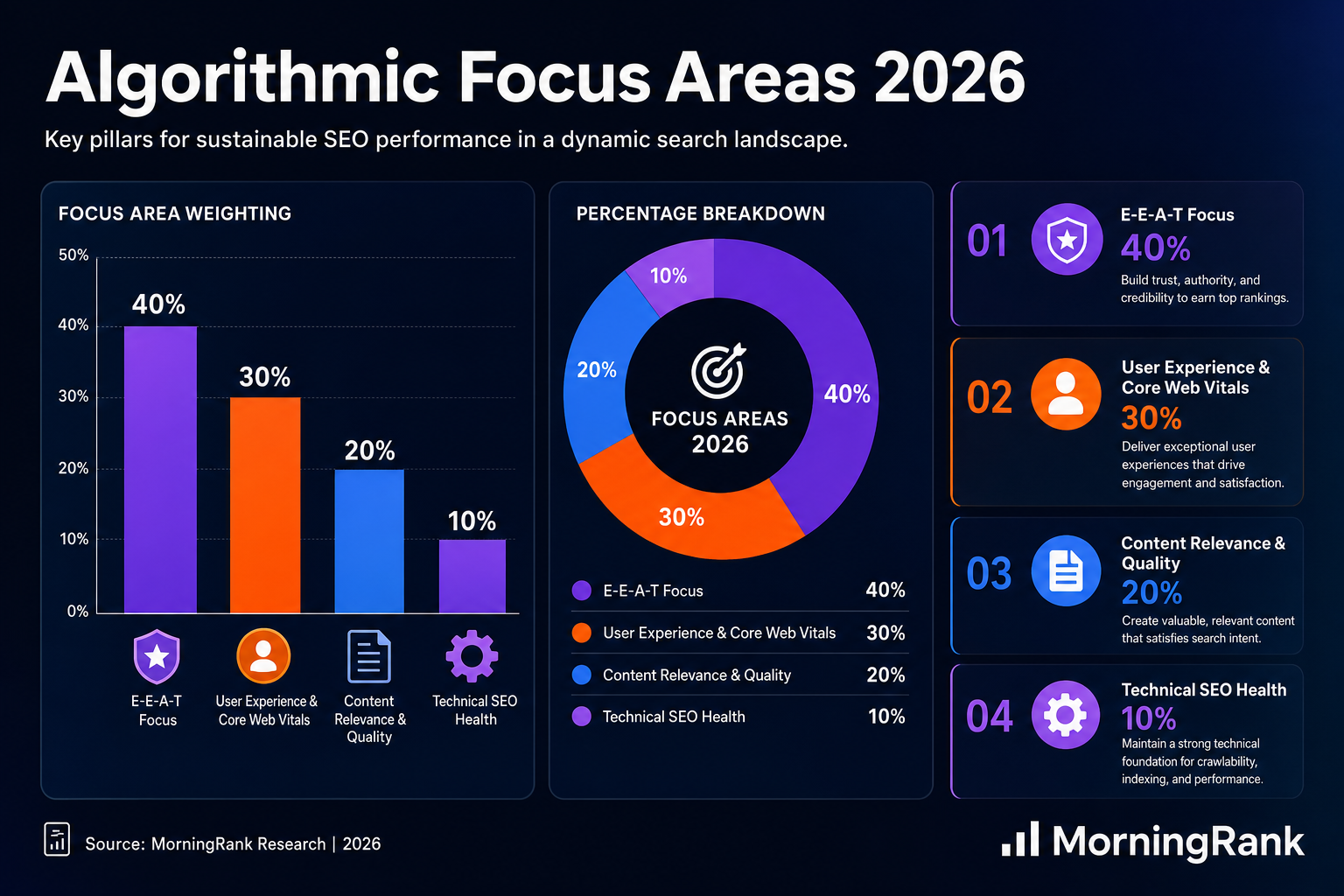
- Prioritize E-E-A-T (Experience, Expertise, Authoritativeness, Trustworthiness) as a foundational strategy for long-term algorithmic resilience.
- Technical SEO health and user experience are consistently rewarded across all algorithm updates.
- Continuous monitoring of ranking changes and SERP features provides early indicators of algorithmic shifts.
- A proactive, data-driven strategy outperforms reactive tactics when adapting to Google's algorithmic landscape.
Google's search algorithm is a dynamic, ever-evolving system. For SEO agencies and local businesses, simply chasing individual updates is an exhausting and often futile endeavor. Instead, mastering Google algorithm interpretation means understanding the core signals Google prioritizes and building a robust, future-proof SEO strategy. In my experience, focusing on these foundational elements provides stability amidst the frequent shifts. This guide will walk you through how to interpret algorithmic signals, prioritize impactful actions, and sustain your SEO performance in 2026.
What is Google Algorithm Interpretation, and Why Does it Matter in 2026?
Google algorithm interpretation is the process of analyzing changes in search engine results pages (SERPs) and official Google communications to infer the underlying objectives and adjustments within Google's ranking algorithms. It matters because, in 2026, Google often deploys subtle, unconfirmed updates rather than large, named core updates, making direct cause-and-effect difficult to pinpoint without deep analysis. Understanding the "why" behind ranking shifts allows agencies to implement strategic, rather than reactive, adjustments for their clients.
Google's primary goal remains consistent: to deliver the most relevant, high-quality, and helpful results to its users. Every algorithm update, whether major or minor, is ultimately a refinement toward this objective. When you see a significant fluctuation in rankings, it's rarely an arbitrary change. It's Google attempting to better understand or reward specific content characteristics or user signals. For instance, an emphasis on faster page loading times (Core Web Vitals) indicates Google's continued commitment to user experience, an area often overlooked in pursuit of keyword density. To learn more about navigating these frequent, often unannounced adjustments, consider reading our post on Understanding Google's Unconfirmed Updates: Strategies for 2026.
How do Google's Algorithms Evolve?
Google's algorithms evolve through a combination of major core updates, smaller product updates, and continuous, real-time adjustments. Core updates are broad changes to Google's ranking systems that occur a few times a year, impacting a wide range of search results. Product updates are more specific, targeting particular features like local results or news. The most frequent evolution, however, comes from countless minor, unannounced adjustments that refine how existing signals are weighted and interpreted. These incremental changes mean that even without an official announcement, the search landscape is constantly shifting, rewarding those who continuously optimize for quality and user satisfaction.
How Does E-E-A-T Influence Google Algorithm Interpretation?
E-E-A-T, which stands for Experience, Expertise, Authoritativeness, and Trustworthiness, is a critical framework for Google algorithm interpretation. It is not a direct ranking factor in itself but rather a set of principles that Google's algorithms aim to reward. Content that demonstrates strong E-E-A-T signals to Google that it is reliable, credible, and genuinely helpful to users. In my audits, I consistently find that sites losing visibility often lack clear E-E-A-T signals, while those that prioritize it tend to be more resilient to algorithmic changes.
For example, if an algorithm update causes fluctuations in the health or finance sectors (often referred to as "Your Money or Your Life, " YMYL, topics), it's a strong signal that Google is further refining how it assesses trustworthiness and expertise for content that could impact a user's well-being. Agencies should respond by enhancing author bios, citing reputable sources, ensuring factual accuracy, and demonstrating real-world experience. A 2023 study by Semrush indicated that 93% of SEO professionals believe E-E-A-T is important for rankinghighlighting its pervasive influence. Prioritizing E-E-A-T is not just good SEO, it's good business, as it builds genuine trust with your audience.
What are Practical Ways to Demonstrate E-E-A-T?
Practical ways to demonstrate E-E-A-T include:
- Experience: Showcasing personal stories, case studies, or practical demonstrations related to the topic.
- Expertise: Featuring content written or reviewed by qualified professionals, clearly listing their credentials.
- Authoritativeness: Earning high-quality backlinks from recognized industry authorities and being cited as a source by others.
- Trustworthiness: Providing clear contact information, having a secure website (HTTPS), positive user reviews, and transparent content creation policies.
Focusing on these areas creates content that naturally aligns with Google's long-term objectives, making your SEO efforts more resistant to sudden algorithmic shifts. Our guide on Navigating Google's E-E-A-T Updates: An Agency Playbook for 2026 provides more in-depth strategies.

Why is User Experience a Constant in Google Algorithm Interpretation?
User experience (UX) is a constant in Google algorithm interpretation because Google aims to provide users with satisfying journeys from search query to content consumption. Metrics like page load speed, mobile-friendliness, interactivity, and visual stability (collectively known as Core Web Vitals) directly impact how users interact with a site. Google explicitly states that Core Web Vitals are important ranking signalsand consistent updates often reinforce the emphasis on a seamless user experience. Sites that offer a poor UX frustrate users, leading to higher bounce rates and lower engagement, which Google interprets as a sign of lower quality. Optimizing for UX is thus a proactive defense against negative algorithmic impacts.
Beyond Core Web Vitals, holistic user experience also encompasses intuitive navigation, clear content layout, accessibility, and minimal intrusive elements (like excessive pop-ups). Google's algorithms are increasingly sophisticated at evaluating these qualitative aspects of user interaction. Investing in a superior user experience is not just about meeting a technical checklist; it's about creating a positive interaction that keeps visitors engaged and coming back. This contributes to stronger brand signals and improved organic performance.
What Technical SEO Aspects Support Strong User Experience?
Key technical SEO aspects that support a strong user experience include:
- Mobile Responsiveness: Ensuring the website displays and functions flawlessly on all devices.
- Page Speed Optimization: Compressing images, leveraging browser caching, and minimizing code to reduce load times.
- Secure Sockets Layer (SSL) / HTTPS: Encrypting data transferred between the user and the website, indicated by a padlock icon in the browser.
- Crawlability and Indexability: Making sure search engine bots can efficiently access and understand your content.
- Schema Markup: Structured data that helps Google better understand content and present it richly in SERPs, enhancing visibility and click-through rates.
Regularly auditing these technical elements is crucial. Tools like MorningRank's Automated SEO Site Audits can help identify and rectify issues quickly, ensuring your site remains algorithmically healthy. A study by Backlinko found that page speed significantly correlates with higher Google rankingsemphasizing its importance.
How Does Monitoring Tools Aid Google Algorithm Interpretation?
Monitoring tools are indispensable for Google algorithm interpretation because they provide the data needed to detect, analyze, and respond to ranking fluctuations. Without accurate rank tracking and performance analytics, discerning the impact of an algorithm update or even identifying an unconfirmed shift is nearly impossible. These tools allow agencies to track keyword positions across various locations, observe changes in organic traffic, and correlate these shifts with known or suspected algorithmic events. This data-driven approach moves beyond guesswork, enabling precise diagnostics and informed strategic decisions for clients.
Beyond simple rank tracking, advanced monitoring tools offer insights into SERP feature changes, competitor movements, and even AI Overviews. For example, a sudden drop in visibility for certain keywords might coincide with a new SERP feature dominating those results. This indicates an algorithmic shift favoring a different content format or information delivery. By continuously monitoring these data points, agencies can adapt their content and technical strategies proactively, maintaining a competitive edge. MorningRank specializes in providing robust AI-powered keyword rank tracking and advanced analytics to make this process seamless.
What Key Metrics Should Agencies Monitor for Algorithm Interpretation?
Agencies should monitor several key metrics for effective algorithm interpretation:
- Keyword Rankings: Track daily positions across target keywords and locations to identify trends and significant drops or gains.
- Organic Traffic: Monitor overall organic sessions and specific landing page performance in Google Analytics 4.
- SERP Features: Observe changes in featured snippets, local packs, People Also Ask boxes, and AI Overviews.
- Core Web Vitals: Regularly check Largest Contentful Paint (LCP), First Input Delay (FID), and Cumulative Layout Shift (CLS) scores.
- Crawl Errors and Indexing: Use Google Search Console to monitor for new crawl errors or indexing issues.
- Competitor Rankings: Keep an eye on how competitors are performing for similar keywords, especially during periods of volatility.
Consistent monitoring of these metrics provides a holistic view of a site's performance and helps pinpoint the areas most affected by algorithmic changes. This enables a targeted response that addresses the root cause of any observed shifts.
Conclusion: Mastering Google Algorithm Interpretation for Lasting SEO Success
Mastering Google algorithm interpretation in 2026 is less about chasing individual updates and more about cultivating a deep understanding of Google's overarching goals: delivering quality, relevant, and user-friendly content. By prioritizing E-E-A-T, ensuring an excellent user experience, and leveraging advanced monitoring tools, SEO agencies can build resilient strategies that withstand algorithmic shifts. This proactive approach ensures sustainable search visibility and consistent client success. I've seen firsthand how a focus on fundamentals pays dividends, even when Google makes seemingly unpredictable changes. It's about building a website that Google wants to rank because it genuinely serves its users best.
In a landscape where Google's algorithms are constantly evolving, often with subtle shifts rather than major announcements, a robust interpretation strategy is your most valuable asset. It transforms uncertainty into opportunity, allowing you to adapt gracefully and lead your clients to continued success. Don't just react; understand, adapt, and proactively build for the future of search.
Related reading: Mastering Google Algorithm Adaptations: A 2026 Resilience Playbook.
Frequently Asked Questions
What is the biggest challenge in Google algorithm interpretation for local businesses?
The biggest challenge in Google algorithm interpretation for local businesses is often distinguishing between broad algorithmic changes and localized ranking fluctuations. Local businesses need to track granular, hyper-local data to understand how updates specifically impact their geographic service areas, rather than relying solely on national trends.
How frequently does Google update its search algorithms?
Google updates its search algorithms continuously, often making thousands of small changes annually. While major core updates are announced a few times a year, many smaller adjustments, often referred to as "unconfirmed updates" or "fluxes, " occur regularly without official statements, constantly refining search results.
Can Google algorithm updates negatively impact my local map pack rankings?
Yes, Google algorithm updates can absolutely negatively impact your local map pack rankings. Updates that emphasize E-E-A-T, user experience, or the quality of Google Business Profile information can cause significant shifts in local search visibility, requiring careful adaptation of your local SEO strategy.
What role does content quality play in adapting to Google algorithm changes?
Content quality plays a central role in adapting to Google algorithm changes because Google consistently rewards helpful, comprehensive, and well-researched content. Updates often refine how quality is assessed, so continuously producing high-value content that meets user intent is a fundamental and evergreen SEO strategy.
How quickly should I react to perceived Google algorithm changes?
You should react thoughtfully, not immediately, to perceived Google algorithm changes. It's crucial to monitor your data for a few days or weeks to confirm a sustained trend, investigate potential causes, and avoid hasty, uninformed decisions that could further destabilize your rankings. Patience and data analysis are key.
How can MorningRank help agencies stay ahead of Google algorithm updates in 2026?
MorningRank helps agencies stay ahead of Google algorithm updates in 2026 through its advanced AI-powered rank tracking, comprehensive analytics, and automated SEO audit tools. It provides granular data on keyword performance, local pack visibility, and site health, allowing agencies to quickly identify impacts and make data-driven decisions to adapt effectively.
What is the difference between a Google core update and a product update?
A Google core update is a broad, fundamental change to Google's overall ranking systems, impacting a wide range of search results across all verticals. A product update, conversely, is a more specific change that targets particular features or components of the search engine, such as local results, news, or image search, with a more localized impact.
Ready to gain clarity amidst Google's continuous algorithmic changes? Start your free trial of MorningRank today and transform your Google algorithm interpretation into a competitive advantage. Visit https://morningrank.com.
Want this kind of insight every week?
MorningRank delivers daily rank tracking, AI SEO recommendations, and white label client reporting.