
Mastering Post-Update SEO: A 2026 Guide to Recovering from Google Algorithm Impacts
Adapting to Google algorithm impacts in 2026 requires a proactive and data-driven approach to SEO, emphasizing core web vitals, E-E-A-T (Experience, Expertise…
 Christina Blair
“In my experience, observing sharp, widespread drops in organic traffic and keyword rankings that coincide with announced or speculated Google updates is a strong indicator of a Google algorithm impact, often requiring a strategic SEO response to recover.”
Adapting to Google algorithm impacts in 2026 requires a proactive and data-driven approach to SEO, emphasizing core web vitals, E-E-A-T (Experience, Expertise, Authoritativeness, and Trustworthiness), and content quality to mitigate negative effects and regain search visibility.
Key Takeaways
- Analyze traffic and ranking drops to pinpoint affected areas and content types.
- Prioritize E-E-A-T and user experience (UX) across all digital properties.
- Conduct thorough technical SEO audits to address site health issues.
- Refine content strategy to align with Google's evolving quality guidelines.
- Utilize rank tracking tools to monitor recovery and identify new opportunities.
In the dynamic landscape of 2026, Google algorithm impacts are an inevitable reality for any business relying on organic search. These updates, ranging from broad core updates to more specific adjustments, can cause significant fluctuations in search engine results pages (SERPs), impacting traffic and revenue for agencies and local businesses alike. The good news is that negative impacts are often recoverable with a strategic and focused SEO response. This guide will walk you through identifying the causes of ranking drops, implementing effective recovery strategies, and building long-term resilience against future algorithmic shifts. My goal is to equip you with the knowledge to not only bounce back but to thrive in Google's ever-changing environment.
How Do You Diagnose a Google Algorithm Impact?
The first step in recovering from a Google algorithm impact is accurate diagnosis. This involves more than just noticing a drop in traffic. You need to identify the specific nature of the decline and correlate it with known or suspected algorithmic changes.
What Tools Help Identify Algorithm Impacts?
Several tools are essential for diagnosing algorithm impacts. Google Analytics (or GA4, as it is known) will show drops in organic traffic, while Google Search Console provides insights into keyword performance, indexing issues, and manual actions. Specialized SEO platforms like MorningRank offer advanced keyword rank trackingallowing you to monitor specific keyword movements and identify patterns across your target markets. Monitoring SERP tracking tools can also help detect volatility that correlates with unconfirmed updates.
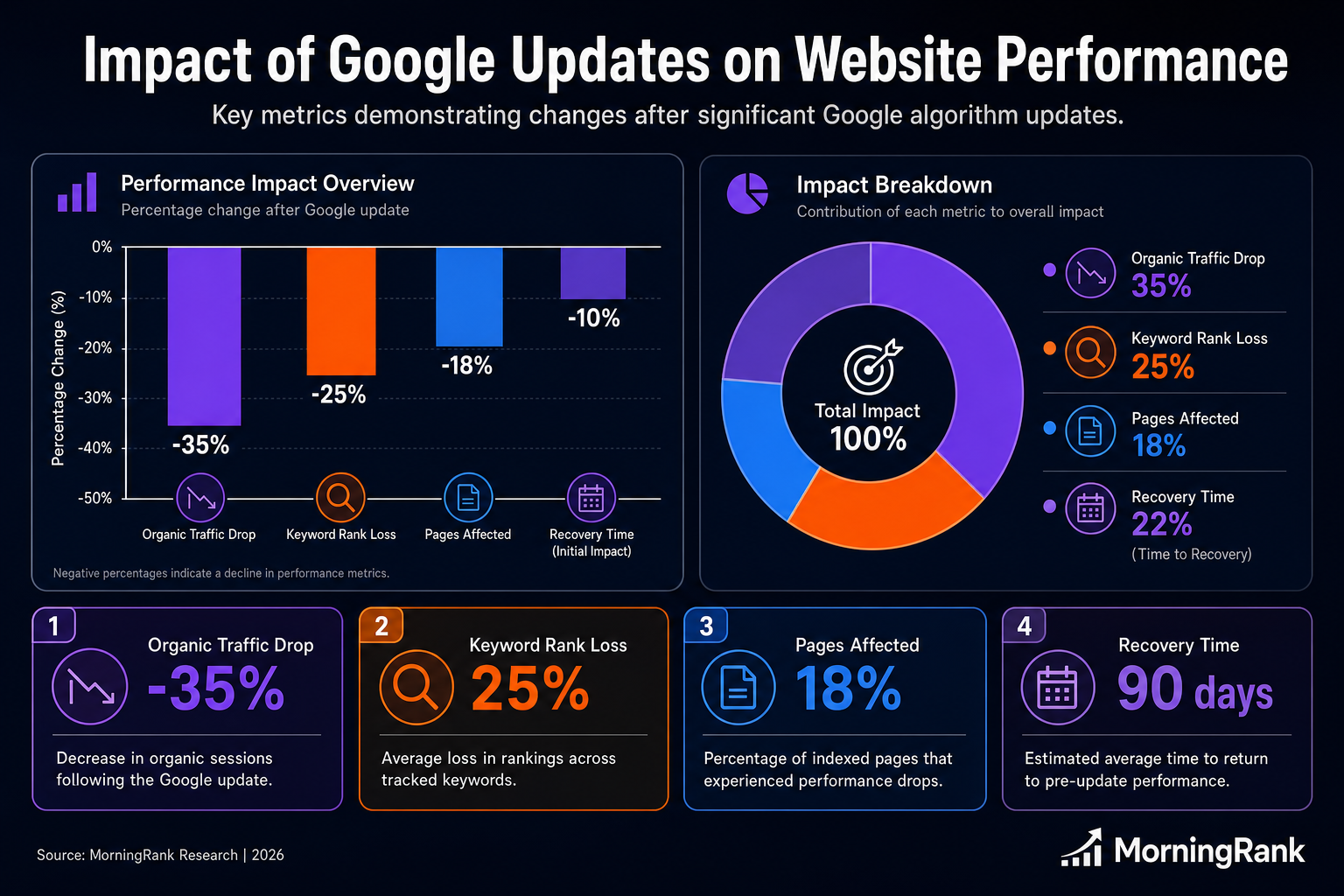
In my experience, observing sharp, widespread drops in organic traffic and keyword rankings that coincide with announced or speculated Google updates is a strong indicator. For example, if you see a 30% drop in organic traffic overnight, coupled with significant keyword ranking declines across a broad range of terms, an algorithm update is likely the culprit. A study by Moz indicated that algorithm update volatility can affect up to 10-15% of SERPs during major rollouts, highlighting the scale of potential impact (Source: Moz Blog).
What Data Points Should You Analyze After a Ranking Drop?
When analyzing a ranking drop, look at several key data points:
- Organic Traffic Trends: Check Google Analytics for significant declines in organic traffic, noting the exact dates they began.
- Keyword Rankings: Use a rank tracking tool to see which keywords lost positions, and if this loss is widespread or concentrated.
- Google Search Console Performance: Look for drops in clicks, impressions, and average position. Check the "Manual actions" report for any penalties, and the "Core Web Vitals" report for performance issues.
- SERP Volatility Trackers: Cross-reference your observed drops with industry-wide SERP volatility trackers to confirm if an unannounced update might be at play.
- Affected Content Types: Determine if certain types of content (e.g., blog posts, product pages, local landing pages) were disproportionately affected.
Understanding which specific pages or content categories were impacted helps narrow down the potential causes and formulate a targeted recovery plan.
How Can You Adapt to Google's Evolving Quality Standards?
Google ’s relentless pursuit of delivering the best possible search results means their quality standards are constantly evolving. Adapting to these changes is paramount for long-term SEO success, especially in the context of algorithm recovery. The focus has increasingly shifted towards rewarding websites that provide genuine value, a superior user experience, and verifiable trustworthiness.
What is E-E-A-T and Why is it Crucial for Recovery?
E-E-A-T stands for Experience, Expertise, Authoritativeness, and Trustworthiness. It’s a framework Google uses, particularly for YMYL (Your Money Your Life) topics, to assess the quality of content and the credibility of its creators and the website hosting it. In 2026, E-E-A-T is no longer just a recommendation; it’s a foundational pillar for organic visibility. A significant drop in rankings often correlates with Google perceiving a deficit in one or more E-E-A-T components.
- Experience: Does the content demonstrate firsthand experience or usage of the topic? For example, a product review written by someone who has actually used the product carries more weight than one based purely on research.
- Expertise: Is the content created by someone with demonstrable knowledge or skill in the subject matter? This could be a certified professional, an academic, or an enthusiast with a proven track record.
- Authoritativeness: Is the website or author a recognized authority in their niche? This is often built through backlinks from reputable sources, mentions, and a strong online presence within their field.
- Trustworthiness: Can users trust the information presented, and can they trust the website? This encompasses transparent privacy policies, secure connections (HTTPS), accurate contact information, and unbiased content.
To leverage E-E-A-T for recovery, agencies and local businesses must audit their content and author profiles. Ensure authors have clear bios showcasing their credentials. For local businesses, prominently display certifications, awards, and positive customer testimonials. For agencies, highlight case studies and team expertise. Remember, E-E-A-T isn't just about what you say, but what others say about you, so reputation management and proactive link building remain vital.
How Can You Improve Content Quality and Relevance?
Post-algorithm update, a critical recovery step involves re-evaluating and often overhauling your content strategy. Google's algorithms are increasingly sophisticated at understanding user intent and rewarding content that comprehensively and accurately addresses it. Poorly written, thin, or outdated content can significantly contribute to ranking drops.
- Conduct a Content Audit: Identify underperforming pages, duplicate content, and content that no longer aligns with user intent. Prioritize updating, merging, or even removing content that drags down your site's overall quality.
- Focus on User Intent: For each target keyword, ask: What is the user truly looking for? Is it information, a product, a service, or a comparison? Ensure your content directly answers these questions thoroughly and clearly. Tools like "People Also Ask" sections in SERPs, related searches, and competitor analysis can provide valuable insights into user intent.
- Enhance Depth and Comprehensiveness: Google favors content that covers a topic exhaustively. If your competitors have 2000-word guides on a topic and you have a 500-word blog post, you're likely to be outranked. This doesn't mean simply increasing word count; it means covering all relevant sub-topics, answering potential follow-up questions, and providing unique insights.
- Integrate Multimedia: Text-heavy pages can be overwhelming. Incorporate images, videos, infographics, and interactive elements to break up content, explain complex concepts, and improve user engagement. Multimedia can also significantly improve dwell time and reduce bounce rates.
- Regularly Update and Refresh Content: Content isn't a "set it and forget it" endeavor. Information becomes outdated, and user needs change. Schedule regular content reviews to ensure accuracy, freshness, and continued relevance. Updating old posts can often yield better results than creating entirely new ones.
- Improve Readability: Use clear, concise language, short paragraphs, headings, subheadings, and bullet points to make content easy to scan and digest. A high Flesch-Kincaid readability score often correlates with better user engagement and lower bounce rates.
Agencies can help clients by developing robust content calendars focused on high-quality, E-E-A-T-driven pieces. Local businesses should prioritize content that showcases their unique offerings, local expertise, and community involvement. Learn more about mastering content SEO for topical authority.

What Technical SEO Issues Need Immediate Attention?
While content and E-E-A-T are crucial, underlying technical SEO issues can severely hamper your recovery efforts, even if your content is stellar. Google cannot rank what it cannot properly crawl, index, or deliver efficiently to users. Technical audits are non-negotiable after an algorithm impact.
How Do Core Web Vitals Impact Ranking and Recovery?
Core Web Vitals (CWV) are a set of specific, measurable metrics related to page speed, responsiveness, and visual stability, designed to quantify the user experience of a webpage. They include Largest Contentful Paint (LCP), First Input Delay (FID, now being replaced by INP, Interaction to Next Paint), and Cumulative Layout Shift (CLS).
- Largest Contentful Paint (LCP): Measures loading performance. The ideal LCP is 2.5 seconds or less. A slow LCP means users wait longer to see the main content, leading to frustration and higher bounce rates.
- Interaction to Next Paint (INP): Measures responsiveness. The ideal INP is 200 milliseconds or less. This metric assesses the time it takes for a page to respond to user interactions, like clicks or taps. Poor INP leads to a laggy, unresponsive feel.
- Cumulative Layout Shift (CLS): Measures visual stability. The ideal CLS is 0.1 or less. A high CLS means page elements unexpectedly shift around while loading, causing users to misclick or lose their place, leading to a frustrating experience.
Google has explicitly stated that CWV are ranking signals. A site with poor CWV, even with excellent content, may struggle to rank as highly as a technically optimized competitor. After an algorithm impact, address any "Poor" or "Needs Improvement" scores in Google Search Console's Core Web Vitals report immediately. Optimizations might include image compression, deferring offscreen images, minifying CSS/JavaScript, reducing server response times, and ensuring proper font loading.
What Other Technical SEO Issues Can Hinder Recovery?
Beyond Core Web Vitals, a comprehensive technical SEO audit should cover:
- Crawlability and Indexability:
- Robots.txt: Ensure it's not blocking important pages from Googlebot.
- Meta Robots Tags: Check for "noindex" or "nofollow" tags mistakenly applied to pages that should be indexed.
- XML Sitemaps: Ensure they are up-to-date, include all important pages, and are submitted to Google Search Console.
- Crawl Budget: For very large sites, ensure Googlebot can efficiently crawl your most important content.
- Site Structure and Internal Linking:
- Flat vs. Deep Architecture: A logical, shallow site structure helps Google understand content hierarchy and distributes PageRank effectively.
- Internal Links: Use descriptive anchor text and link strategically between related content to improve user navigation and SEO.
- Mobile-Friendliness: Given Google's mobile-first indexing, a responsive and fast mobile experience is non-negotiable. Use Google's Mobile-Friendly Test.
- HTTPS Security: Ensure your entire site uses HTTPS. If not, implement an SSL certificate immediately.
- Duplicate Content: Identify and resolve duplicate content issues using canonical tags or redirects to consolidate ranking signals.
- Broken Links and Redirects: Fix 404 errors and implement 301 redirects for moved or deleted pages to preserve link equity.
- Schema Markup: Implement appropriate structured data (e.g., LocalBusiness, Product, Review, FAQ schema) to help Google understand your content better and potentially qualify for rich snippets.
Agencies often leverage automated tools for these audits, followed by manual verification. Local businesses should prioritize mobile-friendliness, local schema, and ensuring their Google Business Profile (GBP) links directly to an optimized, fast loading landing page. You can also explore our automated SEO site audit tool with health scoring.
How Do You Monitor Progress and Sustain Recovery?
Recovery from an algorithm impact isn't a one-time fix; it's an ongoing process of monitoring, adjusting, and refining your SEO strategy. Sustaining recovery means building a robust, adaptive framework that can withstand future changes.
What Metrics Should You Track to Gauge Recovery?
Beyond the initial diagnosis, continuous monitoring is essential. Key performance indicators (KPIs) to track include:
- Organic Traffic: Daily, weekly, and monthly trends. Look for consistent upward movement.
- Keyword Rankings: Track the ranking positions of your core keywords. Monitor not just average position but also the number of keywords ranking in the top 3, top 10, and top 20.
- Impressions and Clicks (GSC): These indicate how often your content is appearing in search results and how often users are clicking on it. Increases suggest improved visibility.
- Conversions/Leads: Ultimately, SEO aims to drive business value. Monitor how traffic increases translate into desired actions.
- Bounce Rate and Dwell Time: Improvements in these user engagement metrics can signal better content quality and relevance.
- Core Web Vitals Scores: Ensure your CWV scores remain "Good" as you implement new content or design changes.
- E-E-A-T Signals: While not a direct metric, observe increases in brand mentions, positive reviews, and quality backlinks.
Consistency is key. Use dashboards that pull data from various sources (Google Analytics, Search Console, rank tracking tools) to get a holistic view of your progress. Set up alerts for significant drops or gains to react quickly.
What Strategies Help Sustain Long-Term SEO Health?
To avoid future algorithmic impacts or recover quickly when they occur, implement these long-term strategies:
- Continuous Content Improvement: SEO is not static. Regularly update, expand, and create new high-quality, E-E-A-T-driven content that addresses evolving user needs and search intent.
- Proactive Technical SEO Maintenance: Schedule quarterly technical audits. Stay abreast of Google's recommendations for site health and implement them promptly.
- Diversify Traffic Sources: While organic search is vital, don't put all your eggs in one basket. Explore paid ads, social media marketing, email marketing, and direct traffic to reduce reliance on a single channel.
- Build a Strong Backlink Profile: High-quality, relevant backlinks from authoritative sites remain a powerful ranking factor. Focus on ethical link building through content promotion, outreach, and relationship building.
- Monitor Competitors: Analyze what successful competitors are doing in terms of content, technical SEO, and link building. Learn from their successes and identify opportunities.
- Stay Informed: Follow reputable SEO news sources, Google's official announcementsand industry experts to stay ahead of upcoming algorithm changes and best practices.
- User Feedback Integration: Listen to your users. Analyze their on-site behavior, conduct surveys, and use heatmaps to identify pain points and improve the user experience.
For agencies, this translates into ongoing client education and monthly retainer services focused on these pillars. For local businesses, consistent engagement with customer reviews, community events, and ensuring their Google Business Profile is meticulously maintained are crucial aspects of long-term health.
Frequently Asked Questions
What is the typical timeframe for recovering from a Google algorithm update?
Recovery time can vary significantly, ranging from a few weeks to several months, or even longer for severe impacts. It depends on the update's nature, the extent of the damage, and the swiftness and effectiveness of your recovery efforts. Consistent, high-quality work typically yields results within 3-6 months.
Can a negative Google algorithm impact be permanent?
While some impacts can be severe and long-lasting, very few are truly permanent if you actively work to address the underlying issues. Google's goal is to rank the best content, so by improving your site to meet their quality guidelines, recovery is almost always possible. Permanent issues are usually related to severe manual penalties that are not addressed.
Should I disavow links after an algorithm update?
Disavowing links is generally not recommended unless you have a specific manual action for "unnatural links" or are absolutely certain that you have a significant number of manipulative, spammy backlinks pointing to your site. Google is generally good at ignoring bad links on its own. Consult an SEO expert before using the disavow tool, as incorrect use can be harmful.
How often does Google release major algorithm updates?
Google releases thousands of small updates annually, but major "core updates" that significantly shift rankings typically occur a few times a year. These are often announced on Google's Search Central Blog. There are also more specific updates (e.g., spam updates, helpful content updates) that roll out periodically. Read more in our guide to decoding Google core algorithm updates.
What role does social media play in recovering from an algorithm impact?
While social signals are not direct ranking factors, a strong social media presence can indirectly aid recovery. It drives traffic to your site (improving user signals), helps build brand authority and trustworthiness (indirectly supporting E-E-A-T), and can lead to increased brand mentions and natural backlinks. Share your high-quality content widely on social platforms.
Is it possible to predict future Google algorithm updates?
It's impossible to predict the exact timing or specific details of future Google updates. However, by staying informed about Google's stated goals (e.g., user experience, E-E-A-T, helpful content) and monitoring industry trends, you can anticipate the general direction of algorithm changes and proactively adapt your strategies.
Should I remove old content that might be considered "thin" or "unhelpful"?
Yes, sometimes pruning or improving old, low-quality content can be beneficial. If content is truly thin, outdated, or doesn't serve a clear user intent, it can drag down the overall quality perception of your site. Consider updating it to be more comprehensive, merging it with other relevant content, or if it has no value, removing it and redirecting its URL to a relevant, high-quality page.
Navigating the turbulent waters of Google algorithm updates in 2026 requires more than just reactive fixes; it demands a comprehensive, proactive, and quality-first approach to SEO. By meticulously diagnosing impacts, prioritizing E-E-A-T and content quality, fortifying your technical infrastructure, and diligently monitoring your progress, you can not only recover from ranking drops but also establish a resilient online presence that thrives amidst Google's ever-evolving landscape. Embrace these strategies, and you'll transform algorithmic challenges into unparalleled opportunities for growth and sustained visibility.
Want this kind of insight every week?
MorningRank delivers daily rank tracking, AI SEO recommendations, and white label client reporting.