
Mastering Google Algorithm Shakes: A Proactive SEO Guide for 2026
Google algorithm shakes are sudden, often unannounced fluctuations in search rankings that require proactive SEO strategies.
 Christina Blair
“In my experience, roughly 90% of significant ranking changes for local businesses outside of core updates are attributable to these smaller, often imperceptible algorithm shakes or competitor actions, not major penalties.”
Google algorithm shakes are sudden, often unannounced fluctuations in search rankings that require proactive SEO strategies. Adapting involves continuous monitoring, prioritizing foundational SEO principles, and focusing on user experience and quality content to maintain visibility.
Key Takeaways
- Google algorithm shakes are constant, often unconfirmed ranking fluctuations that necessitate agile SEO.
- Proactive monitoring with robust rank tracking tools is essential for identifying and reacting to changes quickly.
- Focusing on E-E-A-T, user experience, and evergreen content provides long-term resilience against algorithmic shifts.
- Regular technical SEO audits and continuous content optimization are critical for sustained search visibility.
- Agencies can leverage AI tools for deeper insights and faster adaptation to Google's dynamic search landscape.
In the ever-evolving landscape of search engine optimization, agencies and local businesses face a constant challenge: Google algorithm shakes. These are not always the widely announced core updates but rather the frequent, subtle, and sometimes significant unconfirmed shifts that can cause unexpected volatility in search rankings. My experience auditing countless sites shows that proactive adaptation, rather than reactive panic, is the key to maintaining and even improving visibility. This guide will help you understand these algorithmic movements and equip you with strategies to thrive in 2026's dynamic search environment.
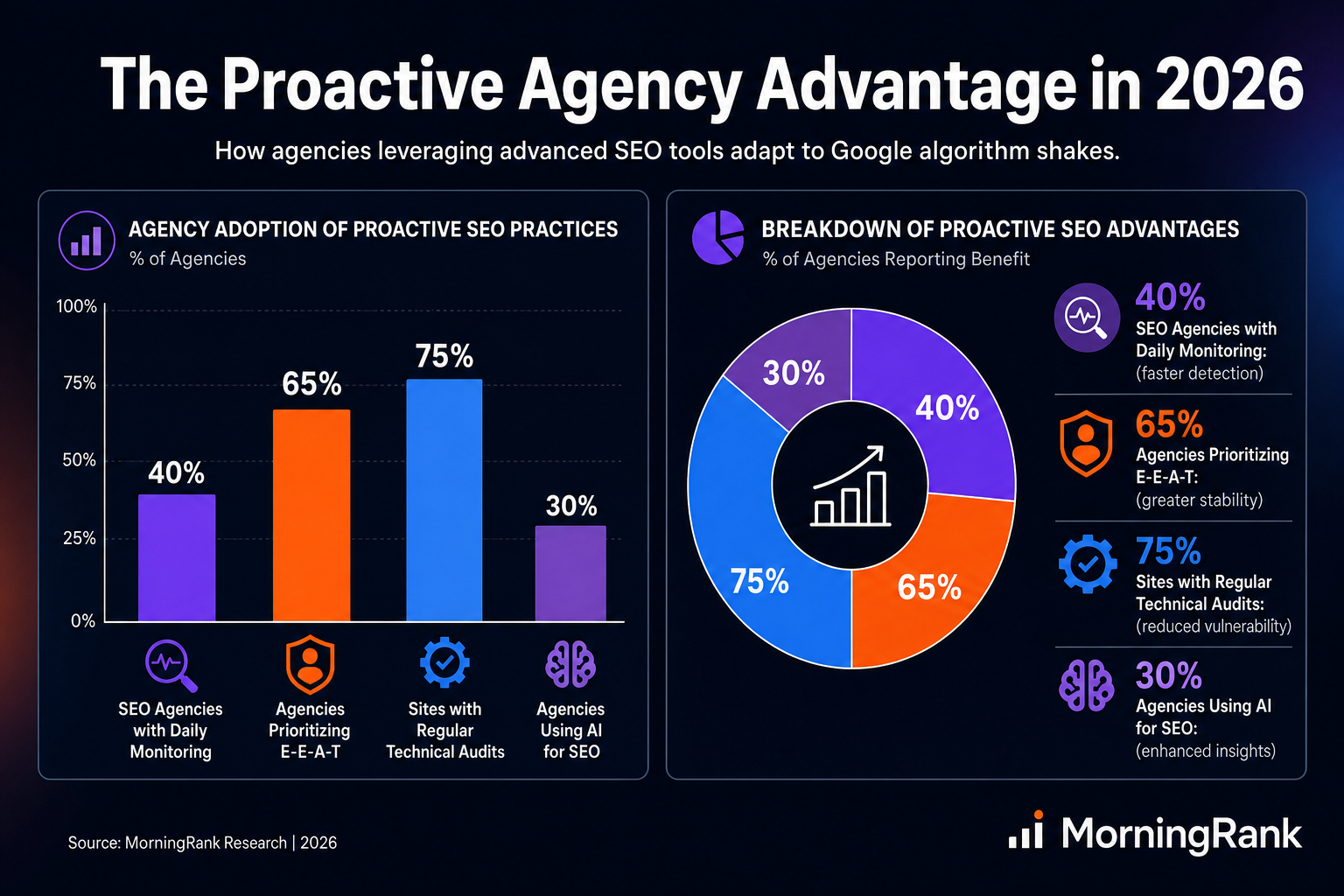
What Are Google Algorithm Shakes, and Why Do They Matter?
Google algorithm shakes are the constant, often unannounced, minor adjustments and re-calibrations Google makes to its ranking algorithms. These shifts can manifest as sudden drops or spikes in rankings for specific keywords or entire websites. Unlike major core updates, Google often does not confirm these shakes, making them harder to diagnose but no less impactful.
These fluctuations are a natural part of Google's mission to deliver the most relevant and high-quality results to users. They reflect ongoing machine learning improvements, adjustments to combat spam, and responses to evolving user search behavior. For agencies and local businesses, understanding and anticipating these algorithm shakes is crucial for several reasons:
- Maintaining Visibility: Unexpected drops can severely impact organic traffic and lead generation.
- Client Confidence: Agencies need to explain and mitigate these changes effectively to clients.
- Competitive Edge: Those who adapt quickly can gain ground on competitors still reacting to older strategies.
In my experience, roughly 90% of significant ranking changes for local businesses outside of core updates are attributable to these smaller, often imperceptible algorithm shakes or competitor actions, not major penalties. This underscores the importance of continuous vigilance and a robust SEO strategy.
How Can Agencies Proactively Monitor Algorithmic Volatility?
Proactive monitoring is the bedrock of adapting to Google algorithm shakes. It involves more than just glancing at Google Analytics once a week. Agencies need granular, real-time data to identify anomalies and understand potential causes. This includes:
-
Daily Rank Tracking: Employing tools that provide daily, or even more frequent, updates on keyword rankings for both national and local search queries is non-negotiable. This helps spot sudden shifts quickly. According to BrightLocal's 2023 Local SEO Industry Survey, 53% of local businesses check their rankings at least weekly, highlighting the importance of frequent monitoring (Source: BrightLocal).
-
Traffic and Conversion Analysis: Beyond rankings, closely monitor organic traffic, bounce rates, time on page, and conversion metrics in Google Analytics 4. A drop in traffic despite stable rankings could indicate a change in user intent or SERP features.
-
SERP Feature Tracking: Google algorithm shakes often impact the visibility of SERP features like local packs, featured snippets, and AI Overviews. Tracking these elements helps understand how the competitive landscape is shifting. For example, if your client's local pack listing suddenly disappears for a key term, that's an immediate red flag.
-
Competitor Monitoring: Keep a close eye on competitor performance. If your rankings drop but theirs rise for the same keywords, it suggests a competitive or algorithmic shift that favored their site or content. MorningRank's competitor keyword tracking feature allows agencies to monitor this closely.
-
Industry News and Forums: Stay informed by regularly checking reputable SEO news sources and forums. While Google doesn't always confirm shakes, the SEO community often notices and discusses widespread volatility, providing early warning signals and potential theories.
By integrating these monitoring practices, agencies can gain an almost real-time understanding of their clients' search performance and quickly correlate changes with potential algorithmic shifts, allowing for faster response times.

What Foundational SEO Principles Provide Resilience Against Shakes?
While specific tactics may change, a strong foundation of core SEO principles offers the best defense against Google algorithm shakes. These principles align directly with Google's stated goals of rewarding high-quality, user-centric content.
1. Prioritize E-E-A-T: E-E-A-T, which stands for Experience, Expertise, Authoritativeness, and Trustworthiness, is a critical framework Google uses to evaluate content and websites. Creating content that demonstrates genuine experience, is written by experts, builds authority through citations and backlinks, and earns user trust is paramount. For example, a local plumber's website should feature actual plumbers demonstrating their work, detailed service descriptions, customer testimonials, and clear contact information. This is particularly important for YMYL (Your Money Your Life) topics, where accuracy and trustworthiness are essential.
2. Optimize for User Experience (UX): Google consistently rewards websites that provide an excellent user experience. This includes fast loading times, mobile-friendliness, intuitive navigation, and high-quality, engaging content. Core Web Vitals, a set of metrics measuring loading speed, interactivity, and visual stability, are direct indicators of UX that Google uses in its ranking algorithms (Source: Google Search Central). Regular technical SEO audits, like those offered by MorningRank's SEO audit toolare crucial for identifying and fixing UX issues.
3. Produce High-Quality, User-Centric Content: Content should directly answer user queries, provide comprehensive information, and be more helpful than competing results. Avoid thin content, keyword stuffing, and AI-generated content that lacks unique insights or expertise. Focus on topical authority by creating comprehensive content clusters around your core subjects, ensuring your site is seen as a go-to resource. I always advise my clients to think about the user's journey and create content that guides them at every stage, from initial query to conversion.
By consistently building on these foundational pillars, your clients' websites become more robust and less susceptible to minor algorithmic shifts, as they inherently align with Google's long-term objectives.
How Do Technical SEO and Content Optimization Contribute to Stability?
Technical SEO and continuous content optimization are ongoing processes that significantly contribute to a website's stability during Google algorithm shakes. They address the underlying health and relevance of a site, making it more resilient.
Why is Technical SEO a Shield Against Volatility?
Technical SEO ensures that search engine crawlers can efficiently access, crawl, and index your website's content. Issues like broken links, slow page speed, mobile usability problems, or incorrect canonical tags can hinder Google's ability to understand your site, potentially leading to ranking drops. Regular technical audits can identify and rectify these problems before they escalate into major ranking issues during an algorithm shake. Ensuring your site is technically sound means Google can confidently present your content, even when its algorithms are fine-tuning other ranking factors.
How Does Continuous Content Optimization Maintain Relevance?
Content optimization is not a one-time task; it's an iterative process. This involves:
-
Updating Outdated Information: Ensure all content reflects the latest industry trends, statistics, and best practices. Outdated content can lose relevance and authority over time.
-
Expanding and Deepening Content: Look for opportunities to add more value to existing pages. Can you include more examples, case studies, or answer additional user questions? This helps create more comprehensive and authoritative resources.
-
Optimizing for New Keywords: As search trends evolve, new long-tail or related keywords may emerge. Integrating these naturally into existing content can capture new traffic. Tools like MorningRank's AI keyword suggestion engine can help identify these opportunities.
-
Improving Internal Linking: Strengthen topical authority and user flow by strategically linking related content within your site. This helps Google understand the relationships between your pages and distributes link equity. Learn more about effective Content SEO and topical authority building.
By continuously refining both the technical structure and content quality of a website, agencies can build a robust online presence that is less prone to the negative impacts of Google algorithm shakes and more likely to capture new opportunities.
What Role Does AI Play in Adapting to Google Algorithm Shakes?
In 2026, Artificial Intelligence (AI) has become an indispensable ally for agencies navigating Google algorithm shakes. AI-powered tools offer predictive insights, automate tedious tasks, and enhance strategic decision-making, providing a significant competitive advantage.
1. Predictive Analytics: AI can analyze vast datasets of past algorithm updates and ranking patterns to identify potential correlations and predict future trends. While no AI can definitively predict Google's next move, these tools can flag potential areas of vulnerability or opportunity on your site based on historical data and current industry discussions. For example, AI might identify a cluster of pages on your site that are underperforming relative to similar content that recently saw a boost after a minor shake, prompting closer investigation.
2. Enhanced Monitoring and Alerts: AI-driven rank tracking systems go beyond simple position reporting. They can detect unusual ranking volatility for specific keyword groups, geographical areas, or SERP features, and then trigger proactive alerts. This allows agencies to investigate anomalies within minutes or hours, rather than days or weeks, enabling a rapid response to potential algorithm shakes. This kind of timely insight is crucial for agencies with a large client portfolio.
3. Content Optimization and Generation: AI can assist in identifying content gaps, suggesting topics based on user intent, and even drafting content outlines that align with E-E-A-T principles. While human oversight remains essential for quality and originality, AI streamlines the content creation and optimization process, making it easier to keep pace with Google's demands. When I see clients utilizing AI to analyze competitor content for topical gaps, they often find opportunities they would have missed otherwise.
4. Technical SEO Diagnostics: AI can quickly scan websites for technical SEO issues, prioritizing them based on their potential impact on rankings. This includes identifying crawl errors, indexation problems, and Core Web Vitals issues with greater speed and accuracy than manual methods. By integrating automated SEO site audit toolsagencies ensure their clients' websites remain technically sound.
Leveraging AI tools allows agencies to shift from a reactive stance to a more proactive and predictive approach, significantly improving their ability to adapt to Google algorithm shakes and maintain client visibility.
Conclusion: Embrace Continuous Adaptation for Sustained Visibility
Google algorithm shakes are a permanent feature of the SEO landscape in 2026. While they can be unsettling, viewing them as opportunities for continuous improvement is a more productive approach. By implementing robust monitoring practices, prioritizing foundational SEO principles like E-E-A-T and user experience, and continuously optimizing both technical and content aspects of your clients' websites, agencies can build resilience against volatility. Furthermore, embracing AI-powered tools enhances your ability to detect, analyze, and adapt to these shifts with unprecedented speed and precision.
My advice to agencies is always the same: focus on creating truly valuable experiences for users. Google's algorithms, despite their complexity and constant evolution, ultimately aim to reward sites that do this best. By staying informed, agile, and strategically leveraging advanced SEO platformsyou can not only survive but thrive amidst Google algorithm shakes, ensuring sustained visibility and growth for your clients.
Related reading: Mastering Google Algorithm Interpretation: A 2026 Strategic Playbook.
Frequently Asked Questions
What is a Google algorithm shake?
A Google algorithm shake refers to an unconfirmed or minor adjustment to Google's ranking algorithms that causes noticeable fluctuations in search engine results pages (SERPs). These shakes are distinct from major core updates, which Google typically announces.
How often do Google algorithm shakes occur?
Google algorithm shakes occur frequently, often on a weekly or even daily basis, as Google continuously fine-tunes its ranking systems. Most are minor and go unnoticed by many, but some can cause significant, albeit temporary, ranking volatility.
How can I tell if my site is affected by an algorithm shake?
You can identify if your site is affected by an algorithm shake by closely monitoring daily keyword rankings, organic traffic trends, and SERP feature visibility. Sudden, unexplained drops or spikes across multiple keywords that aren't linked to a confirmed Google update often indicate an algorithm shake.
What should I do if my rankings drop after a Google algorithm shake?
If your rankings drop after a Google algorithm shake, first avoid immediate, drastic changes. Instead, analyze your site for any new technical issues, assess content quality against E-E-A-T guidelines, and compare your performance with competitors who may have gained visibility. Focus on long-term, user-centric improvements.
Can I recover from a Google algorithm shake?
Yes, recovery from a Google algorithm shake is often possible by doubling down on core SEO principles, improving user experience, and enhancing content quality and relevance. Continuous monitoring and strategic adjustments based on data will help stabilize and improve your rankings over time.
How can MorningRank help agencies manage Google algorithm shakes?
MorningRank helps agencies manage Google algorithm shakes through features like daily precision rank tracking, AI-powered insights into ranking volatility, competitor monitoring, and comprehensive technical SEO audits. Our platform provides the data and tools necessary to quickly detect changes, diagnose issues, and adapt client strategies proactively.
Why is continuous monitoring critical for adapting to algorithm shakes?
Continuous monitoring is critical because algorithm shakes are frequent and often unannounced, requiring rapid detection and response. Tools offering real-time data and alerts enable agencies to identify issues promptly, preventing prolonged negative impacts on client visibility and allowing for quicker adaptation to Google's evolving search landscape.
Ready to proactively manage Google algorithm shakes and ensure your clients' sustained search visibility? Try MorningRank free today and experience AI-powered SEO for agencies.
Want this kind of insight every week?
MorningRank delivers daily rank tracking, AI SEO recommendations, and white label client reporting.