
Mastering Google Algorithm Update Responses: A 2026 Playbook for Agencies
Navigating Google algorithm updates in 2026 requires a proactive and strategic response to maintain search visibility and client performance.
 Christina Blair
“In my experience, effective responses to Google algorithm updates turn potential setbacks into opportunities, often leading to a 30% or more change in organic traffic for affected sites when proactive strategies are implemented.”
Navigating Google algorithm updates in 2026 requires a proactive and strategic response to maintain search visibility and client performance. Agencies must swiftly diagnose impacts, adapt their SEO strategiesand implement quality-focused changes to recover or reinforce rankings.
Key Takeaways
- Google algorithm updates demand immediate action, including impact assessment and strategic recalibration.
- Prioritizing E-E-A-T and user experience is a foundational defense against negative update impacts.
- A robust technical SEO foundation ensures your site can adapt quickly to algorithmic shifts.
- Data-driven analysis and continuous monitoring are essential for effective update response.
- AI Overviews and Answer Engine Optimization (AEO) are increasingly central to algorithm considerations.
The landscape of search engine optimization is in constant flux, primarily driven by Google algorithm updates. For agencies managing client SEO, these updates are not just news events, they are critical moments that can significantly impact visibility, traffic, and revenue. My experience auditing hundreds of websites post-update confirms that preparedness and a structured response are key to turning potential setbacks into opportunities. This guide provides a 2026 playbook for effectively responding to Google algorithm updates, ensuring your agency and your clients can thrive amidst change.
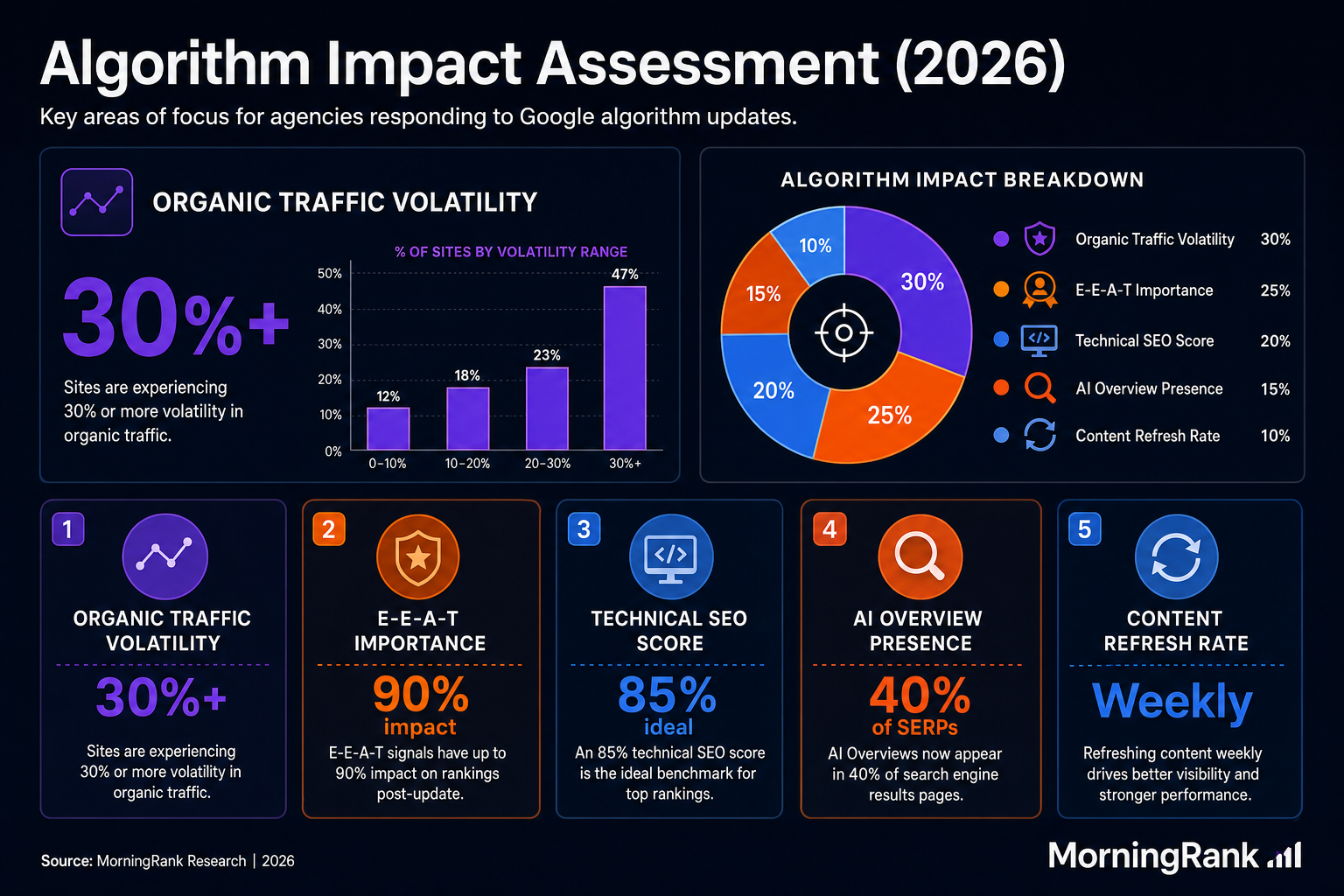 Google algorithm update responses infographic" loading="lazy" style="width:100%;border-radius:12px;" />
Why Are Google Algorithm Update Responses Critical for SEO Agencies?
Responding effectively to Google algorithm updates is paramount because these changes directly influence organic search rankings and visibility. An update can drastically shift search engine results pages (SERPs)leading to significant fluctuations in traffic and conversions. For instance, a major core update can cause a 30% or more change in organic traffic for affected sites, according to industry analyses.
Agencies that can quickly understand, diagnose, and adapt to these changes provide immense value to their clients. Proactive responses minimize negative impacts and capitalize on opportunities to outrank competitors who are slower to react. In my experience, clients appreciate transparency and swift action during periods of algorithmic volatility. This demonstrates expertise and reinforces trust, strengthening client relationships and retention.
Moreover, effective update responses showcase an agency's ability to stay ahead in a dynamic environment, differentiating them from less agile competitors. This capability is not merely about recovery, it is about continuous improvement and maintaining a competitive edge in search marketing. For comprehensive monitoring of these shifts, leveraging a platform like MorningRank's keyword rank tracking can provide crucial insights into performance changes.
How Do You Diagnose Google Algorithm Update Impacts?
Diagnosing the impact of Google algorithm updates requires a systematic approach, combining data analysis with an understanding of Google's stated goals. First, monitor your rankings and traffic data closely using tools like Google Analytics 4 and Google Search Console. Look for sudden drops or spikes in organic traffic, keyword positions, and impression data that correlate with announced or observed update dates. Pay attention to specific URL performance and keyword groups.
Second, compare your site's performance to industry trends and competitor activity. If a widespread update is announced, check if similar sites in your niche are experiencing comparable shifts. Tools that track SERP volatility can indicate the broadness of an update. If your competitors are performing well while you are not, this suggests areas for improvement on your part.
Third, analyze changes in SERP features and content types for your target keywords. Has Google started favoring video results, AI Overviews, or highly authoritative sources more prominently? Understanding these shifts provides clues about the update's focus. For a detailed look into the nuances of algorithm impacts, review Mastering Post-Update SEO: A 2026 Guide to Recovering from Google Algorithm Impacts.

What Core Principles Guide Successful Algorithm Adaptation in 2026?
Successful algorithm adaptation in 2026 is rooted in prioritizing user experience and Google's core directives, especially E-E-A-T. E-E-A-T (Experience, Expertise, Authoritativeness, and Trustworthiness) is a critical framework Google uses to assess content quality and creator credibility. Ensuring your content demonstrates clear experience, is written by experts, is authoritative within its niche, and is highly trustworthy provides a strong defense against negative update impacts.
Technical SEO remains a foundational pillar. A fast, mobile-friendly, secure website with a clear site structure and crawlable content signals quality to Google. Addressing Core Web Vitals issues, schema markup implementation, and proper internal linking help Google understand and evaluate your content effectively. In my experience, even excellent content struggles if technical barriers impede indexing or user experience. Consider leveraging MorningRank's automated SEO site audit tool to identify and resolve these technical issues proactively.
Furthermore, understanding user intent and providing truly comprehensive answers is vital. Google aims to deliver the most relevant and helpful results. Content that genuinely satisfies user queries, anticipates follow-up questions, and offers unique value will consistently perform better over time, regardless of specific algorithmic tweaks. This focus on content quality and user satisfaction transcends individual updates, forming the bedrock of sustainable SEO. Explore further by reading Navigating Google’s E-E-A-T Updates: An Agency Playbook for 2026.
How Can Agencies Protect Client Rankings Post-Update?
Protecting client rankings post-update involves a combination of reactive analysis and proactive strategy adjustment. Immediately after identifying an update's impact, conduct a thorough content audit. Identify pages that experienced significant drops and analyze their content quality against E-E-A-T standards. Look for areas where content might be thin, outdated, or lacking in clear author expertise. Prioritize updating or enhancing these pages with fresh insights, expert contributions, and clear calls to action.
Second, bolster your link profile. High-quality backlinks from authoritative and relevant sources continue to be a strong ranking signal. Focus on ethical link-building strategies, such as creating valuable, shareable content and engaging in digital PR. Google's algorithms often reward sites with strong, natural backlink profiles. Ahrefs found that 55.24% of pages ranking in the top 10 for competitive keywords have at least one backlink (Source: Ahrefs, "38 SEO Statistics for 2024").
Third, optimize for emerging search paradigms like AI Overviews (AIOs). Google's integration of generative AI means that content structured for clear, concise, and direct answers has an advantage. Use clear headings, bullet points, and summary sentences. This approach, known as Answer Engine Optimization (AEO), ensures your content is easily digestible by AI models. Agencies should also track their AI visibility to understand how content performs in these new result types. For more insights, refer to Optimizing Your Content for Google AI Overviews in 2026.
Conclusion
Google algorithm updates are an inherent and continuous aspect of the SEO landscape in 2026. For agencies, mastering the response to these changes is not just about mitigating damage, it is about consistently delivering value and demonstrating unparalleled expertise to clients. By focusing on rapid diagnosis, adhering to core principles like E-E-A-T and technical excellence, and adapting to new search paradigms like AI Overviews, agencies can ensure their clients' online presence remains robust and competitive. The ability to pivot quickly and implement data-driven strategies is what defines a leading SEO agency today.
Frequently Asked Questions
What are Google algorithm updates in 2026?
Google algorithm updates in 2026 are ongoing adjustments and significant changes to Google's complex systems that determine how web pages are ranked in search results. These updates aim to improve search relevance, quality, and user experience, often emphasizing factors like E-E-A-T, technical performance, and content helpfulness.
How do Google algorithm updates affect local businesses?
Google algorithm updates can significantly affect local businesses by altering their visibility in local search results and the Google Map Pack. Changes might impact how proximity, relevance, and prominence signals are weighted, making ongoing Google Business Profile optimization and local SEO strategies crucial for maintaining local rankings.
What is the typical timeframe for seeing ranking changes after a Google algorithm update?
The timeframe for seeing ranking changes after a Google algorithm update can vary widely, from a few days for minor fluctuations to several weeks or even months for major core updates to fully roll out and stabilize. Initial volatility is common, and a full assessment of impact often requires patience and continuous monitoring.
How important is E-E-A-T in responding to 2026 algorithm updates?
E-E-A-T (Experience, Expertise, Authoritativeness, and Trustworthiness) is critically important in responding to 2026 algorithm updates, as Google increasingly prioritizes high-quality, reliable content. Demonstrating clear E-E-A-T signals across your website content and author profiles helps build credibility and protects against negative ranking shifts.
Can a negative impact from a Google algorithm update be reversed?
Yes, a negative impact from a Google algorithm update can often be reversed through strategic and sustained SEO efforts. This typically involves diagnosing the root causes, addressing any quality or technical deficiencies, improving E-E-A-T signals, and implementing content enhancements over time. Recovery is a process, not an instant fix.
How does MorningRank help agencies manage Google algorithm updates?
MorningRank assists agencies in managing Google algorithm updates by providing advanced keyword rank tracking, AI-powered insights, and comprehensive site auditing tools. Our platform helps agencies quickly identify ranking fluctuations, diagnose performance issues, and monitor the impact of their optimization efforts, ensuring agile adaptation to Google algorithm changes.
What is the best way to stay informed about Google algorithm updates?
The best way to stay informed about Google algorithm updates is by following official Google Search Central announcements, reputable SEO news outlets, and industry experts. Continuously monitoring your analytics data and SERP volatility tools can also provide early indications of unconfirmed changes, allowing for proactive adjustments.
Want this kind of insight every week?
MorningRank delivers daily rank tracking, AI SEO recommendations, and white label client reporting.