
Mastering Google Algorithm Update Trends: A Proactive SEO Guide for 2026
Google algorithm updates continually reshape the SEO landscape .
 Christina Blair
“My experience auditing countless sites post-update has shown that anticipating Google algorithm update trends and adapting proactively is far more effective than scrambling to recover.”
Google algorithm updates continually reshape the SEO landscape. Adapting involves understanding recurring patterns and proactively building a resilient, user-centric online presence. By focusing on fundamental quality signals and strategic content, businesses can thrive amidst algorithmic shifts.
Key Takeaways
- Google algorithm updates are frequent and follow discernible trends, focusing on user experience, quality content, and E-E-A-T.
- Proactive SEO means continuous optimization, not reactive fixes, by building authority and technical excellence.
- Diversifying traffic sources and prioritizing holistic SEO builds resilience against ranking fluctuations.
- AI-powered tools are essential for monitoring algorithmic shifts and identifying actionable insights quickly.
- Adapting to updates requires a strategic approach that aligns with Google's long-term goals of delivering the best user experience.
In the dynamic world of search engine optimization, Google algorithm updates are a constant. For agencies and local businesses, these updates are not just periodic disruptions, but rather crucial indicators of Google's evolving priorities. My experience auditing countless sites post-update has shown that anticipating these trends and adapting proactively is far more effective than scrambling to recover.
This post will explore the major Google algorithm update trends in 2026, detail proactive strategies to maintain and improve your search visibility, and highlight how a resilient SEO approach can future-proof your digital presence. Understanding these trends allows you to align your SEO efforts with Google's overarching goals for quality and user satisfaction, transforming uncertainty into opportunity.
What are the Prevailing Google Algorithm Update Trends in 2026?
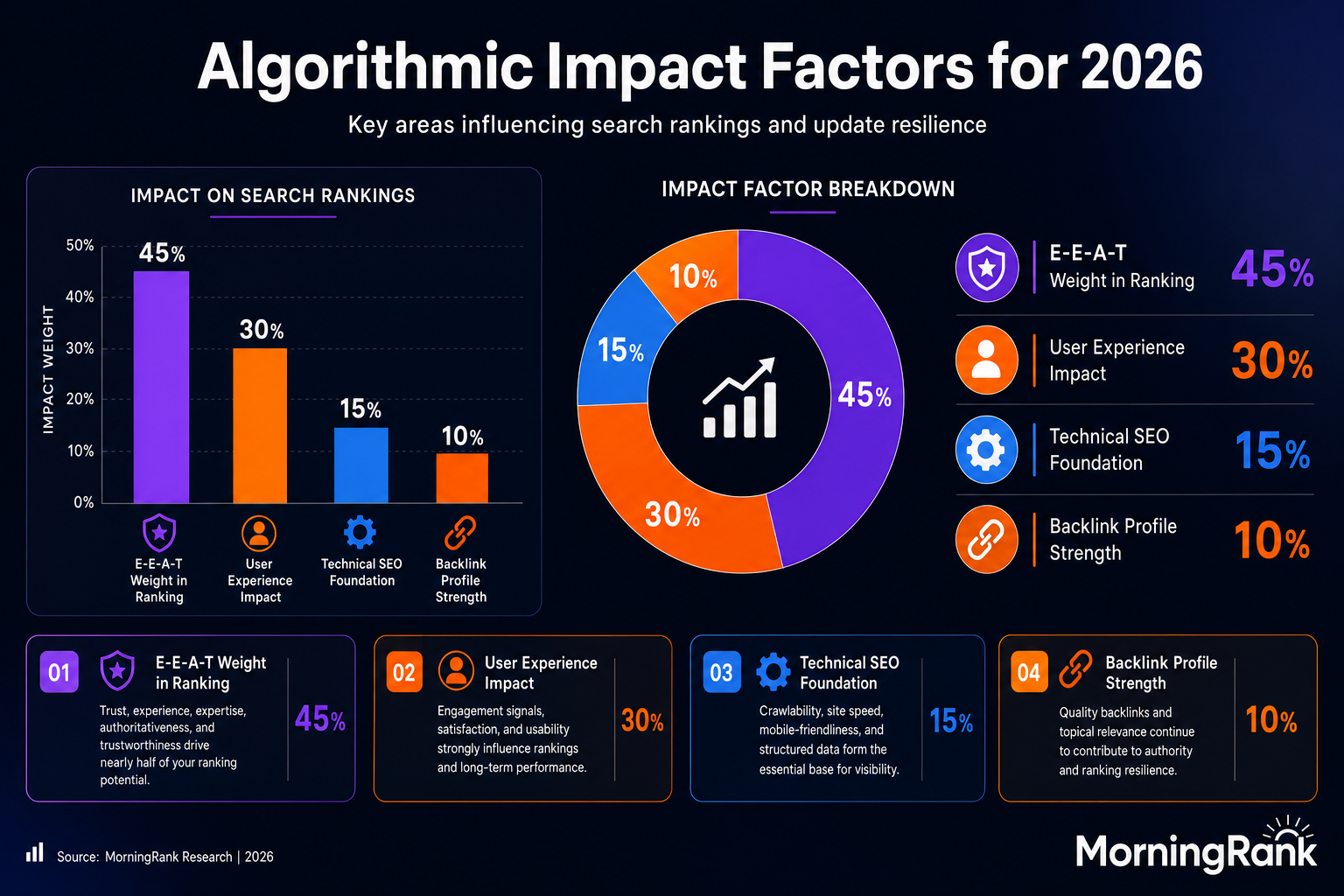
Google algorithm updates are continuous adjustments and improvements to Google's ranking systems, designed to deliver the most relevant, reliable, and high-quality results to users. In 2026, the overarching trends in Google's algorithmic evolution continue to revolve around enhanced user experience, heightened content quality, and the deepening emphasis on E-E-A-T. Google is continually refining its ability to discern genuine value and expertise from superficial content, making foundational SEO principles more critical than ever.
How is E-E-A-T Influencing Algorithm Updates?
E-E-A-T, which stands for Experience, Expertise, Authoritativeness, and Trustworthiness, remains a cornerstone of Google's evaluation of content and websites. Updates are increasingly sophisticated at identifying and rewarding content that demonstrates real-world experience, deep subject matter expertise, established authority in its niche, and unwavering trustworthiness. For instance, a study by Semrush in 2023 found that sites demonstrating strong E-E-A-T signals saw significantly better performance in core algorithm updates. This means prioritizing verifiable credentials, clear authorship, and building a strong reputation, both online and offline.
What is Google's Focus on User Experience (UX)?
User experience (UX) is another paramount trend driving Google algorithm updates. Beyond Core Web Vitals, which remain important, Google is increasingly evaluating the overall journey a user takes on a website. This includes factors like intuitive navigation, mobile responsiveness, accessibility, and content readability. Sites that provide a seamless, engaging, and frustration-free experience are favored. I've audited sites where slow load times or intrusive pop-ups directly contributed to ranking drops after a broad core update, even when content quality was high.
How do Generative AI and Answer Engines Impact Updates?
The rise of generative AI and answer engines like Google AI Overviews has significantly influenced algorithm updates. Google is optimizing its algorithms to extract and synthesize information effectively for these new formats. This means rewarding content that is structured, factual, concise, and provides direct answers to user queries. Optimizing for these new search paradigms requires a different content strategy, emphasizing structured data and clarity, which MorningRank helps you track through GEO and AEO tracking.
Why is Proactive Adaptation Key to Navigating Google Algorithm Updates?
Reactive SEO strategies, where you only address issues after a ranking drop, are no longer sufficient in 2026. Proactive adaptation means constantly optimizing your site to meet evolving quality standards, rather than waiting for an update to hit. This approach builds resilience, reduces recovery time, and positions your site for consistent growth.
How Can Continuous Site Audits Help?
Regular, comprehensive site audits are a cornerstone of proactive SEO. These audits identify technical issues, content gaps, and user experience problems before they become major ranking factors during an update. Utilizing tools like MorningRank's automated SEO site audit tool allows agencies to continuously monitor website health. These tools provide prioritized recommendations, helping you address potential weaknesses that Google's algorithms might penalize.
What Role Does Content Strategy Play in Proactive SEO?
A robust content strategy, focused on evergreen, high-quality, and E-E-A-T-driven content, is crucial. Instead of chasing keywords with thin content, focus on developing comprehensive, authoritative resources that genuinely serve user intent. This means creating content that is well-researched, accurately cited, and clearly presented. For instance, Backlinko's research on content marketing highlights that long-form content often generates more backlinks and higher rankings, reinforcing the value of depth and quality.
How Do Backlinks and Authority Build Resilience?
Building a strong, natural backlink profile from authoritative and relevant sources significantly enhances your site's overall authority and trustworthiness. Google algorithms interpret high-quality backlinks as votes of confidence. Sites with diverse and strong backlink profiles tend to weather algorithm updates more effectively, as their established authority provides a buffer against minor fluctuations. Regular backlink monitoring using tools like those found in MorningRank is vital for maintaining a healthy link profile.
What Strategies Should Agencies Implement for Google Algorithm Updates in 2026?
Agencies serving local businesses need specialized strategies to navigate Google algorithm updates, ensuring their clients remain visible in local search results and map packs. These strategies encompass a blend of technical optimization, content refinement, and continuous monitoring.
How Can Local SEO Benefit from Proactive Updates?
Local SEO is particularly sensitive to algorithm updates, especially those impacting Google Business Profile (GBP) and local pack rankings. Ensuring GBP listings are fully optimized, accurate, and regularly updated with fresh content and responses to reviews is paramount. Google often fine-tunes its local ranking factorsmaking it critical to stay current with guidelines. For more insights, refer to our guide on Mastering Local Google Business Profile Optimization in 2026.
Why is Continuous Rank Tracking and Analysis Essential?
Implementing sophisticated keyword rank tracking that monitors local and national performance is non-negotiable. MorningRank's AI-powered keyword rank tracking provides daily updates across various geographic locations, allowing agencies to quickly identify ranking shifts post-update. This granular data enables rapid analysis of which keywords or pages are affected, informing immediate corrective actions. Regular tracking helps to identify patterns and predict future algorithmic impacts based on historical data.
What is the Importance of Technical SEO Maintenance?
Flawless technical SEO provides a strong foundation for weathering algorithm updates. This includes ensuring fast page load speeds, mobile-friendliness, proper indexability, and clean site architecture. Google algorithms are increasingly adept at identifying and penalizing sites with technical debt. Proactive technical maintenance, including schema markup implementation, ensures that content is easily crawled, indexed, and understood by search engines, crucial for both traditional and AI-driven search. You can find more details in our Technical SEO Guides.
How Does AI Assist in Adapting to Algorithmic Shifts?
Artificial intelligence (AI) has become an indispensable ally for SEO professionals adapting to Google algorithm updates. AI tools enhance monitoring, analysis, and strategy development, enabling faster and more accurate responses to algorithmic shifts.
How Can AI-Powered Monitoring Help Detect Changes?
AI-powered monitoring tools analyze vast amounts of data, including SERP fluctuations, traffic patterns, and competitor movements, to identify correlations with suspected algorithm updates. These systems can detect subtle shifts that might go unnoticed by manual review, providing early warnings and helping prioritize investigative efforts. For example, some AI tools can identify specific content elements that might be impacted by a new update, guiding optimization efforts.
What Role Does AI Play in Content Optimization?
AI tools can assist in content optimization by analyzing existing content for E-E-A-T signals, readability, and topical depth. They can suggest areas for improvement, identify content gaps, and even help generate outlines for new, comprehensive content pieces designed to meet Google's evolving quality standards. This ensures content is not only optimized for keywords but also structured for maximum relevance and authority, which is critical for both human readers and search engine algorithms.
How Can Predictive Analytics Inform Strategy?
While Google algorithm updates are inherently unpredictable in their timing, AI-driven predictive analytics can help forecast potential impacts. By analyzing historical data and known algorithmic patterns, AI can flag content areas that might be vulnerable to upcoming shifts or highlight new opportunities. This allows agencies to adjust their SEO strategies proactively, minimizing risks and capitalizing on emerging trends, moving beyond reactive measures to genuinely proactive planning.
Conclusion: Proactive SEO for Enduring Success in 2026
Navigating Google algorithm update trends in 2026 requires a proactive and comprehensive approach that prioritizes user experience, content quality, and robust technical foundations. My professional opinion, based on extensive audits, is that agencies and local businesses that embed these principles into their ongoing SEO strategies will not only withstand algorithmic shifts but will also thrive. Continuous monitoring, data-driven insights, and a commitment to E-E-A-T are no longer optional, they are fundamental for sustained search visibility.
The landscape of search is constantly evolving, with new AI capabilities and user behaviors influencing how content is discovered and valued. By leveraging advanced tools and adopting a forward-thinking mindset, SEO professionals can transform the challenge of Google algorithm updates into a powerful catalyst for growth and long-term success. The key is to always optimize for the user, as Google's algorithms are ultimately designed to do the same.
Related reading: Mastering Google Algorithm Update Impact Analysis in 2026.
Frequently Asked Questions
What are Google algorithm updates?
Google algorithm updates are changes made to Google's complex systems that rank web pages in search results. These updates aim to improve the quality and relevance of search results, ensuring users find the best possible information for their queries.
How often does Google release algorithm updates?
Google makes thousands of minor algorithm changes annually, but it also rolls out several major "core updates" each year. These core updates are often significant and can cause noticeable shifts in search rankings for many websites.
What is E-E-A-T and why is it important for Google algorithm updates?
E-E-A-T stands for Experience, Expertise, Authoritativeness, and Trustworthiness. It's a crucial framework Google uses to evaluate content quality. Websites demonstrating strong E-E-A-T signals tend to perform better in search results, especially after algorithm updates that focus on content quality.
How can I tell if my site was impacted by a Google algorithm update?
Signs of an algorithm impact include sudden, significant drops or gains in organic traffic and keyword rankings that cannot be attributed to other factors. Monitoring your analytics and rank tracking data daily is crucial for early detection of these changes.
What should I do if my site is negatively impacted by a Google algorithm update?
If your site is negatively impacted, first identify the potential cause by analyzing recent changes on your site and comparing them to the update's known focus. Then, prioritize improvements to content quality, technical SEO, user experience, and E-E-A-T signals, which are critical for Google algorithm update recovery.
How can MorningRank help agencies adapt to Google algorithm updates?
MorningRank helps agencies adapt to Google algorithm updates through features like AI-powered keyword rank tracking for granular performance insights, comprehensive SEO site audits for proactive issue detection, and GEO/AEO tracking to optimize for emerging AI search trends. Our tools provide the data and recommendations needed to make informed, timely adjustments.
Ready to proactively adapt your SEO strategy to Google's evolving algorithms? Start your free trial with MorningRank today and gain the competitive edge at https://morningrank.com.
Want this kind of insight every week?
MorningRank delivers daily rank tracking, AI SEO recommendations, and white label client reporting.