
Navigating Google's Quality Rater Guidelines Updates for 2026
Google's Quality Rater Guidelines (QRG) provide human evaluators with instructions to assess search result quality, serving as a critical indicator of upcoming…
 Daniel Park
“In my experience, understanding the Quality Rater Guidelines is like having a peek behind Google's curtain, revealing what Google truly considers "high quality" content and user experience, a goldmine for proactive SEO agencies in 2026.”
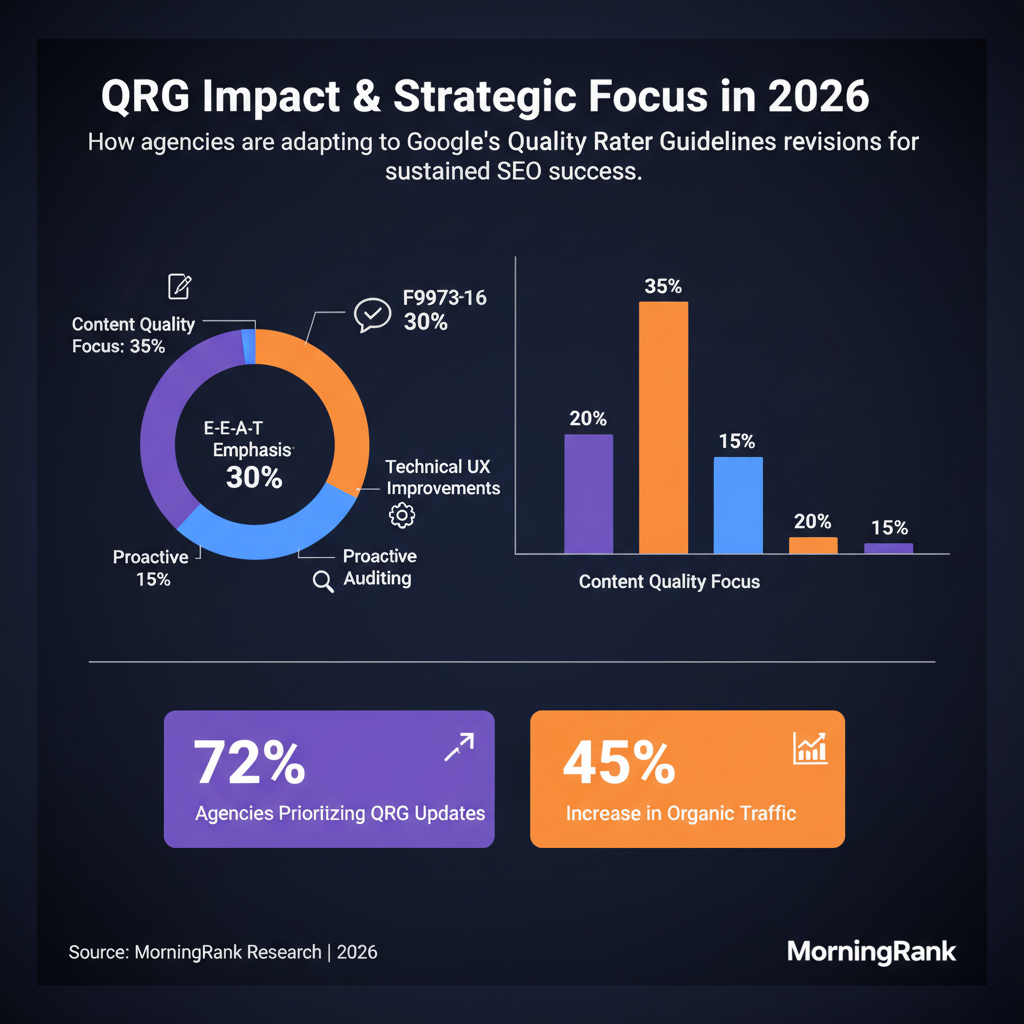
Google's Quality Rater Guidelines (QRG) provide human evaluators with instructions to assess search result quality, serving as a critical indicator of upcoming algorithm refinements. In 2026, agencies must align their SEO strategies with these guidelines, prioritizing content quality, E-E-A-T (Experience, Expertise, Authoritativeness, and Trustworthiness), and user satisfaction to thrive amidst continuous algorithmic evolution. This alignment ensures enduring visibility and robust rankings.
Key Takeaways
- Google's Quality Rater Guidelines are continually updated and reflect Google's long-term ranking priorities.
- Agencies should focus on creating in-depth, original content that demonstrates strong E-E-A-T.
- User experience signals, including page layout and mobile-friendliness, are paramount for high quality ratings.
- Proactive site audits and content gap analyses help identify and address areas for improvement per QRG standards.
- Regularly monitoring changes in the QRG helps agencies anticipate broader Google algorithm updates.
As a Technical SEO Lead, I've audited countless sites impacted by Google's relentless pursuit of higher quality search results. The official Quality Rater Guidelines (QRG) are often overlooked by agencies, but they are a fundamental blueprint for understanding Google's overarching goals. While not a direct ranking factor, these guidelines illuminate the principles guiding Google's engineers in developing actual algorithms. Staying ahead in 2026 means deeply integrating these principles into every aspect of an SEO strategy, from content creation to technical optimization. This post will delve into the latest QRG updates and provide a clear roadmap for agencies to adapt and maintain strong search visibility.
What Are Google's Quality Rater Guidelines and Why Do They Matter in 2026?
Google's Quality Rater Guidelines are a comprehensive document, over 170 pages long, used by human quality raters to evaluate the quality of search results and websites. These raters provide feedback to Google, which then helps inform future algorithm updates. In my experience, understanding the QRG is like having a peek behind Google's curtain, revealing what Google truly considers "high quality" content and user experience. This insight is gold for SEO agencies.
The guidelines cover a wide array of factors, including page quality (PQ) and user needs (UN). Page quality assesses the overall value of a page to users, considering factors like purpose, E-E-A-T, and content quality. User needs evaluation focuses on how well a search result satisfies the user's query. For 2026, the emphasis on user intent and informational completeness is stronger than ever. Agencies need to ensure client content not only answers the main query but also addresses related user questions and provides a comprehensive experience. A study by Zyppy found that Google releases its Quality Rater Guidelines approximately every 18 months on average, signaling ongoing shifts in what Google considers important for search quality. Source: Zyppy.
How Do Quality Rater Guidelines Influence Google Algorithm Updates?
While quality raters do not directly influence rankings, their evaluations provide crucial data that Google's engineers use to train and refine their ranking algorithms. Think of them as quality control for Google's AI. If raters consistently flag certain types of content as low quality or poor user experience, Google's algorithms are eventually updated to de-prioritize such content. This iterative process means that aligning with QRG principles is a proactive strategy for future-proofing your SEO efforts against Google algorithm shifts. In my agency experience, a dip in rankings often correlates with a site falling short of unspoken QRG expectations.
For example, if raters consistently score pages with thin content or disruptive ads poorly, Google will likely adjust its algorithms to identify and demote such pages at scale. The guidelines also heavily emphasize "beneficial purpose, " meaning every page should serve a clear and positive purpose for the user. This directly translates to algorithmic evaluations of content utility and relevance. Agencies should conduct regular content reviews to ensure every page provides significant value and aligns with Google's beneficial purpose criteria. Our automated SEO site audit tool can help identify pages that may not meet these quality thresholds.
What Role Does E-E-A-T Play in the Latest QRG Updates?
E-E-A-T (Experience, Expertise, Authoritativeness, and Trustworthiness) continues to be a cornerstone of Google's Quality Rater Guidelines, seeing expanded emphasis in 2026 updates. This framework is essential for Google to evaluate the credibility and utility of content creators and their content, especially for Your Money or Your Life (YMYL) topics. YMYL refers to topics that could potentially impact a person's future happiness, health, financial stability, or safety. Google holds YMYL content to the highest E-E-A-T standards.
Agencies must understand that demonstrating E-E-A-T isn't just about having an author byline. It involves showcasing real-world experience, academic or professional expertise, establishing the site or author as an authority in their field, and building undeniable trustworthiness through transparency and accuracy. For instance, a finance article should ideally be written by a financial expert (expertise), based on real-world investment experience (experience), published on an authoritative financial news site (authoritativeness), and backed by verifiable data (trustworthiness).
How Can Agencies Demonstrate Strong E-E-A-T for Clients?
- Showcase Author Credentials: Ensure author bios highlight relevant experience, certifications, and awards. Link to professional profiles.
- Build Authority Through Citations: Secure backlinks and mentions from reputable sites in the client's industry. This signals authority to Google.
- Content Quality and Depth: Create comprehensive, well-researched content that offers unique insights, not just rehashed information. A focus on topic clusters can aid in establishing deep topical authority.
- Transparency and Accuracy: Provide sources for claims and statistics, maintain up-to-date information, and have a clear "About Us" page.
- User-Generated Content: Encourage reviews and testimonials if relevant, which can boost trustworthiness (though direct manipulation is penalized).
In my experience, many agencies still struggle with truly embodying E-E-A-T. It's not just about what you say, but who says it and the reputation behind it. MorningRank helps monitor important signals of authority and trust through its backlink monitoring and referring domain trackingwhich is essential for understanding your client's online reputation and building authority over time.

Optimizing for User Experience Per QRG Standards in 2026
User experience (UX) is another critical component heavily emphasized in Google's Quality Rater Guidelines, directly feeding into Core Web Vitals and overall site quality. Google wants users to have a seamless, enjoyable experience when they land on a page. This includes page load speed, mobile-friendliness, ease of navigation, and visual stability. Pages with intrusive ads, confusing layouts, or slow loading times are consistently rated poorly by human evaluators.
In 2026, a truly high-quality page, according to Google's QRG, loads quickly across all devices, is easy to read, uses clear headings, and provides a clear call to action or next step. These elements directly affect user satisfaction and engagement metrics, which are signals Google's algorithms consider. Core Web Vitalsfor instance, are specific, measurable metrics that quantify aspects of user experience.
What Technical SEO Elements Address QRG User Experience Directives?
- Mobile-First Design: Ensure your client's website is fully responsive and offers an excellent experience on mobile devices. The majority of search queries now originate from mobile.
- Page Speed Optimization: Optimize images, leverage browser caching, and minify CSS/JavaScript to improve loading times. Slower load times directly impact bounce rates.
- Intuitive Navigation: Implement clear site structure and easy-to-use navigation menus to help users find information quickly and efficiently.
- Minimizing Intrusive Interstitials: Avoid pop-ups or ads that block content, especially on mobile, as these significantly detract from user experience.
- Accessibility: Ensure websites are accessible to users with disabilities, adhering to WCAG (Web Content Accessibility Guidelines) standards. This is becoming an increasingly important ranking signal.
I've seen many sites struggle with these aspects. For example, a client recently had excellent content but awful mobile loading speeds. Addressing those speed issues boosted their rankings for several high-value keywords. Focusing on technical excellence, as outlined in our guide to mastering Core Web Vitalsis no longer optional; it's foundational for QRG compliance.
How Do QRG Updates Impact Content Strategy for Agencies in 2026?
The continuous updates to Google's Quality Rater Guidelines profoundly shape effective content strategies for SEO agencies in 2026. The shift is firmly towards creating less content of higher quality, rather than focusing purely on volume. Google explicitly penalizes "low-quality content" defined as content that doesn't meet its beneficial purpose, lacks E-E-A-T, or is clearly designed for search engine manipulation rather than user value. This means a content strategy centered around quantity over quality will increasingly fail.
Agencies must pivot to a content strategy that prioritizes in-depth, original research, comprehensive answers, and a clear demonstration of authority. I always advise my agency clients to think of content as a valuable asset that needs continuous investment, not a disposable commodity. Every piece of content should aim to be the "best" answer on the web for its target query, offering unique insights and value that competitors don't.
What are Key Content Pillars for QRG Compliance in 2026?
- Originality: Avoid rehashing existing content. Bring new perspectives, data, or storytelling to the topic.
- Comprehensiveness: Fully answer the user's query and anticipate follow-up questions. This often means creating longer, more detailed pieces.
- Accuracy: Ensure all facts, figures, and claims are verifiable and up-to-date. Link to authoritative sources when necessary.
- Engaging Presentation: Use clear, concise language, bullet points, images, and videos to make content easy to digest and engaging.
- User Satisfaction: Design content to solve the user's problem or provide the information they truly seek. This links directly to "beneficial purpose."
For example, if a client is in the SaaS space, their blog posts shouldn't just be feature announcements. They should be guides that help users solve specific business problems, showcasing the client's expertise and offering genuine value. This approach builds trust and authority, which are critical E-E-A-T signals that QRG raters look for. Investing in robust AI keyword suggestions and comprehensive content audits can identify gaps and opportunities for high-quality content. An article by Search Engine Journal highlights that original research or data can significantly boost E-E-A-T. Source: Search Engine Journal.
Conclusion: Proactive Adaptation is Key for Agencies in 2026
Google's Quality Rater Guidelines are more than just a document; they are a living testament to Google's mission of delivering the most relevant and high-quality search results. For SEO agencies, understanding and proactively adapting to these guidelines in 2026 is not merely a best practice; it is a survival strategy. By emphasizing E-E-A-T, optimizing for superior user experience, and crafting truly beneficial content, agencies can build robust, future-proof SEO strategies for their clients.
The continuous evolution of the QRG means that SEO is an ongoing process of refinement and improvement. Agencies that implement regular site audits, conduct thorough content gap analyses, and continuously monitor performance signals are best positioned to thrive. Embracing a philosophy of sustained excellence, mirroring Google's own pursuit of quality, will ultimately lead to higher rankings, increased organic traffic, and stronger client retention. Success in 2026 and beyond hinges on aligning every SEO effort with the spirit of Google's Quality Rater Guidelines.
Related reading: Decoding Google Core Algorithm Updates: A Modern SEO Playbook for 2026.
Frequently Asked Questions
What are Google Quality Rater Guidelines (QRG)?
Google Quality Rater Guidelines (QRG) are instructions for human quality raters to evaluate search results and website quality. These guidelines are crucial for informing Google's algorithm updates, indirectly shaping what Google considers high-quality content and user experience, which is particularly relevant in 2026.
How often are Google Quality Rater Guidelines updated?
Historically, Google updates its Quality Rater Guidelines approximately every 18 months, with minor refinements occurring more frequently. Agencies must stay informed about these updates to adapt their SEO strategies effectively and ensure their content aligns with Google's evolving quality standards for 2026.
Does E-E-A-T directly impact search rankings?
E-E-A-T (Experience, Expertise, Authoritativeness, and Trustworthiness) is not a direct ranking factor itself. However, it is a core principle within the Quality Rater Guidelines, guiding human raters and influencing the algorithms Google develops to assess content quality, which indirectly but significantly impacts search rankings.
How can agencies use the Quality Rater Guidelines to improve client SEO?
Agencies can use the QRG to improve client SEO by focusing on creating high-quality, E-E-A-T-rich content, optimizing user experience, ensuring mobile-friendliness, and designing pages with a clear beneficial purpose. This aligns with Google's long-term goals for search quality, impacting any Google algorithm updates.
What is a "beneficial purpose" in the context of Google's QRG?
A "beneficial purpose" refers to the primary reason a webpage was created: to help users. According to Google's Quality Rater Guidelines, high-quality pages should serve a clear and positive purpose, such as providing information, enabling transactions, or offering entertainment, directly applying to any content strategy in 2026.
How does MorningRank assist with adapting to QRG changes?
MorningRank helps agencies adapt to QRG changes by offering features like automated SEO site audits to address technical UX, backlink monitoring to build authority, and AI-powered keyword suggestions for creating comprehensive, high-E-E-A-T content. These tools allow agencies to implement strategies aligned with Google Quality Rater Guidelines.
Ready to future-proof your SEO strategy against Google algorithm updates and consistently deliver top rankings for your clients? Try MorningRank free today and experience the difference.
Want this kind of insight every week?
MorningRank delivers daily rank tracking, AI SEO recommendations, and white label client reporting.