
Understanding Google Algorithm Penalties: A 2026 Agency Guide
Google algorithm penalties significantly impact search visibility and can drastically reduce organic traffic.
 Christina Blair
“In my experience, a comprehensive site audit, coupled with continuous monitoring and a commitment to Google's quality guidelines, is the most effective defense against devastating algorithm penalties.”
Google algorithm penalties significantly impact search visibility and can drastically reduce organic traffic. Agencies must understand how to identify, diagnose, and implement effective recovery strategies to restore client rankings and traffic in 2026.
Key Takeaways
- Google algorithm penalties are either automated algorithmic adjustments or manual actions, both designed to enforce quality guidelines.
- Identifying the type of penalty is crucial for effective recovery; algorithmic penalties require broad site improvements, while manual actions need specific issue resolution.
- Agencies must conduct thorough technical and content audits, focusing on E-E-A-T and user experience, to prevent and recover from penalties.
- Proactive monitoring with SEO tools is essential for early detection of ranking drops and traffic loss associated with penalties.
- Recovery involves sustained effort, transparent communication with clients, and a commitment to long-term SEO best practices.
As an SEO professional, I've witnessed the profound impact a Google algorithm penalty can have on a business. The sudden drop in organic traffic, the frantic calls from clients, and the urgent need for a clear recovery plan. In 2026, Google's algorithms are more sophisticated than ever, meaning penalties can be harder to diagnose and resolve without a strategic approach. This guide will equip agencies and local businesses with the knowledge to understand, identify, and recover from Google algorithm penalties, ensuring sustained online visibility for their clients.
Understanding the nuances of Google's enforcement mechanisms is paramount. These penalties are Google's way of maintaining a high-quality search experience for users by discouraging manipulative or low-value practices. My goal here is to demystify the process and provide actionable steps for navigating these challenging situations.
What Exactly Are Google Algorithm Penalties in 2026?
Google algorithm penalties are actions taken by Google against websites that violate its Webmaster Guidelines, resulting in a demotion in search rankings or even de-indexing. These penalties can be broadly categorized into two types: algorithmic penalties and manual actions.
An algorithmic penalty is an automatic demotion applied by Google's algorithms, often as part of broader core updates or continuous algorithmic adjustments. These are not explicitly communicated to webmasters through Google Search Console. For example, a sudden drop in rankings after a core update might indicate an algorithmic penalty related to content quality or user experience. In my experience, these are often a signal that your site is not meeting Google's evolving standards for helpful, reliable content.
A manual action is a penalty applied by a human reviewer at Google, who has identified violations of the Webmaster Guidelines on a specific site. These are explicitly communicated to the website owner via Google Search Console, detailing the type of violation and providing guidance on how to fix it. Common manual actions include unnatural links to your site, thin content, or cloaking. According to Google Search Central, manual actions are issued when a site has violated its policies (Source: Google Search Central).
The distinction between these two types is critical because the recovery process differs significantly. Algorithmic penalties typically require a holistic site improvement, whereas manual actions demand a targeted resolution of the reported issues.
How Do Agencies Identify Google Algorithm Penalties?
Identifying a Google algorithm penalty requires keen observation, diligent data analysis, and an understanding of typical ranking fluctuations. The first sign is usually a sudden, significant, and sustained drop in organic traffic and keyword rankings that cannot be attributed to seasonal trends or competitor activity.
For manual actions, the process is straightforward: check Google Search Console. Google provides direct notifications in the "Manual actions" report within Search Console, detailing the penalty and the reason. This direct communication is invaluable for pinpointing the exact issue. If you haven't set up Search Console for your clients, that should be your first step.
Algorithmic penalties are more challenging to diagnose because there's no direct notification. In my experience, a common approach involves cross-referencing significant ranking drops with known Google algorithm update dates. Tools that track Google's algorithmic volatility, like Semrush Sensor or MozCast, can be incredibly helpful here. For instance, if a client's site experiences a significant dip around the same time Google confirms a broad core update, it's highly probable you're dealing with an algorithmic impact. Monitoring tools like MorningRank that offer always-fresh rankings can provide granular daily insights into these shifts.
Another key indicator is a broad impact across many keywords or pages, rather than isolated drops. If specific sections of a site or certain types of content are disproportionately affected, it can provide clues about the nature of the algorithmic issue. For example, a quality-related update might impact many low-E-E-A-T pages simultaneously. Agencies should also scrutinize their Google Analytics data, looking for changes in organic search traffic segmentation, bounce rates, and time on site, which can point to user experience issues that Google's algorithms are now penalizing.

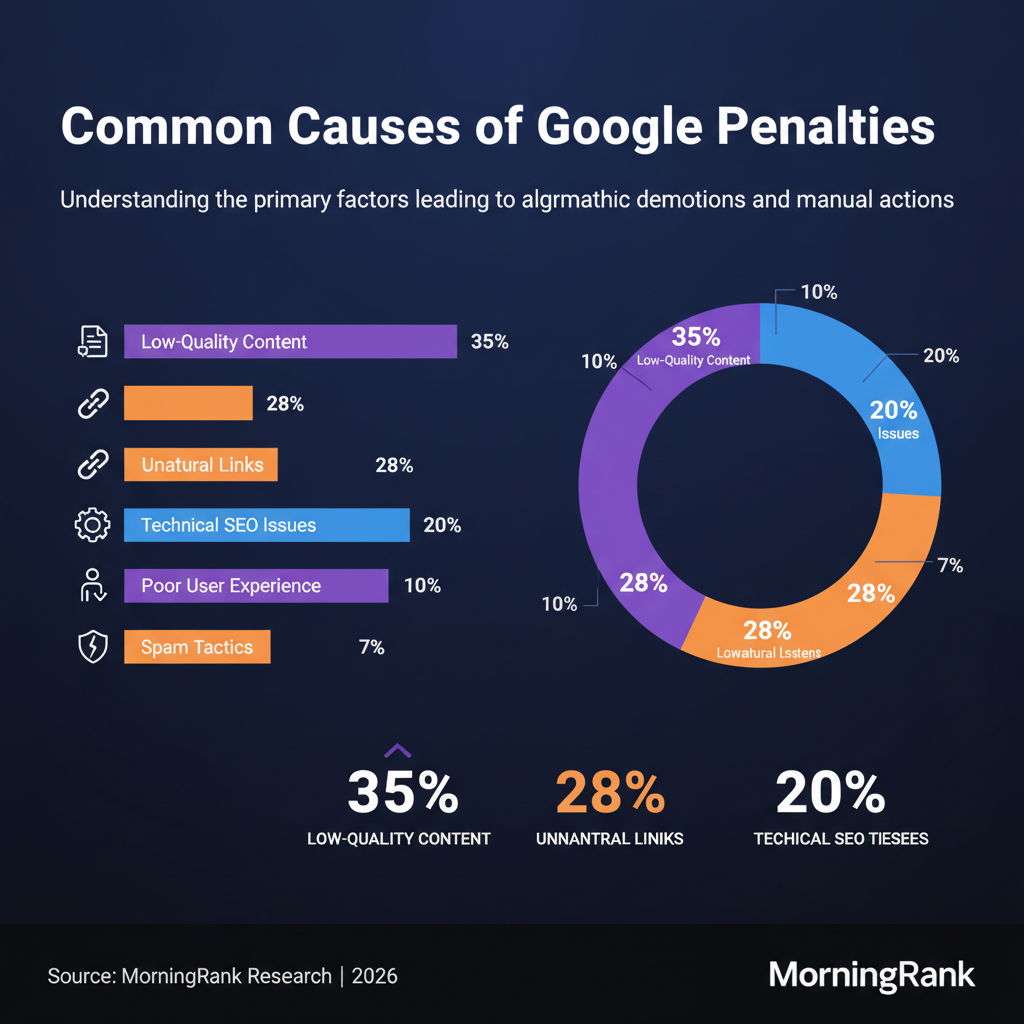
What Are Common Causes of Google Algorithm Penalties?
Google algorithm penalties stem from violations of Google's Webmaster Guidelines, which are designed to ensure a fair and high-quality search experience. In my audits, I consistently see several recurring themes that lead to penalties.
Low-Quality or Thin Content: This is a frequent culprit. Content that lacks substance, is copied from other sites, or provides little value to the user can trigger algorithmic flags, especially after content-focused updates. Examples include doorway pages, scraped content, or pages with minimal original text. Google's emphasis on E-E-A-T (Experience, Expertise, Authoritativeness, and Trustworthiness) means that thin or unhelpful content is increasingly targeted.
Unnatural Links: Both inbound and outbound unnatural links are major red flags. This includes buying links, participating in link schemes, or creating excessive reciprocal links. Google views these tactics as attempts to manipulate PageRank and will penalize sites involved. A common manual action is for "unnatural links to your site." Conversely, linking out to low-quality, spammy sites can also be detrimental.
Technical SEO Issues: While not always a direct "penalty, " severe technical problems can mimic the effects of one. Slow page load times, poor mobile usability, broken internal links, or excessive crawl errors can all depress rankings. Google's Page Experience update, which includes Core Web Vitals, further solidifies the importance of technical excellence. MorningRank's automated SEO site audit tool can help identify these issues proactively.
User Experience (UX) Problems: A poor user experience, characterized by intrusive interstitials, deceptive layouts, or difficult navigation, can negatively impact rankings. Google prioritizes sites that provide a good experience, and algorithms are increasingly capable of assessing user satisfaction signals, even if indirectly. For example, high bounce rates and low time-on-site metrics can suggest a poor user experience that the algorithms might de-prioritize.
Keyword Stuffing and Cloaking: These are classic spam techniques. Keyword stuffing involves excessively loading pages with keywords in an attempt to manipulate rankings. Cloaking involves showing different content to search engine crawlers than to human users. Both are clear violations of Google's guidelines and will almost certainly result in a penalty.
What is a Step-by-Step Google Algorithm Penalty Recovery Plan?
A structured recovery plan is essential once a Google algorithm penalty is identified. The approach will vary slightly between algorithmic and manual penalties, but the core principles remain consistent.
Step 1: Confirm and Diagnose the Penalty
For manual actions, check Google Search Console immediately. The "Manual actions" report will provide specific details on the violation. For algorithmic penalties, analyze traffic drops against known update dates using tools that track algorithmic volatility. Look for patterns in ranking declines across different keyword groups or content types. This diagnostic phase is critical for understanding the scope and nature of the problem.
Step 2: Conduct a Comprehensive Site Audit
Regardless of the penalty type, a thorough audit is necessary. This includes:
- Content Audit: Identify low-quality, thin, duplicate, or unhelpful content. This might involve rewriting, expanding, combining, or even removing pages that don't meet E-E-A-T standards.
- Backlink Audit: For unnatural link penalties, identify and disavow spammy or manipulative inbound links. For algorithmic issues, evaluate the overall quality of your link profile.
- Technical SEO Audit: Address any crawl errors, site speed issues, mobile usability problems, or indexing issues. Use tools like Google Search Console and MorningRank's technical SEO audit software.
- User Experience (UX) Audit: Analyze user behavior metrics and identify any intrusive elements or design flaws that could negatively impact engagement.
Step 3: Implement Fixes and Document Changes
Systematically address every identified issue. For manual actions, follow Google's specific guidance provided in Search Console. For algorithmic penalties, implement broad improvements across the site, prioritizing fixes that align with Google's stated quality guidelines. Document every change made, including dates and specific actions. This documentation is crucial for future reference and for reconsideration requests in the case of manual actions.
Step 4: Submit a Reconsideration Request (for Manual Actions Only)
Once all issues identified in a manual action are resolved, submit a reconsideration request through Google Search Console. Clearly explain the steps taken to fix the violations and how the site now complies with Webmaster Guidelines. Be patient, as this process can take several days or weeks.
Step 5: Monitor and Maintain
After implementing fixes, continuously monitor your site's performance. Track keyword rankings, organic traffic, and core web vitals. For algorithmic penalties, look for gradual improvements as Google re-evaluates the site. Recovery is often a slow process, reflecting Google's need to re-crawl and re-index the improved content. Regular monitoring, ideally with a robust rank tracker like MorningRank, is key to confirming recovery and preventing future penalties.
How Can Agencies Proactively Prevent Google Algorithm Penalties in 2026?
The best strategy for Google algorithm penalties is prevention. Agencies can adopt several proactive measures to future-proof their clients' websites against algorithmic demotions and manual actions.
Prioritize E-E-A-T and Quality Content: Google consistently emphasizes quality, helpful content. Agencies should focus on creating original, insightful, and authoritative content that genuinely serves user intent. Every piece of content should demonstrate Experience, Expertise, Authoritativeness, and Trustworthiness. I always advise clients to have content written or reviewed by genuine subject matter experts, which builds legitimate authority.
Build a Clean, Natural Backlink Profile: Focus on earning high-quality, relevant backlinks through genuine outreach and content promotion, rather than manipulative link schemes. Monitor your backlink profile regularly using tools that detect spammy links and disavow them if necessary. A strong, organic backlink profile is a powerful trust signal for Google.
Ensure Technical SEO Excellence: Regular technical SEO audits are non-negotiable. Ensure fast page load times, mobile-friendliness, secure HTTPS protocols, and a clean site architecture. Addressing Core Web Vitals proactively keeps your site in good standing with Google's page experience signals. My team often uses MorningRank's automated SEO site audit tool to catch these issues early.
Optimize for User Experience (UX): Design websites with the user in mind. This includes intuitive navigation, clear calls to action, minimal intrusive elements, and accessible design. A positive user experience encourages longer visits and lower bounce rates, signaling to Google that your site is valuable.
Stay Informed and Adapt: The SEO landscape is constantly evolving. Agencies must stay current with Google's official announcements, Webmaster Guidelines updates, and industry news. Tools like MorningRank provide algorithmic volatility trackingwhich can help anticipate potential shifts. Adapting quickly to new guidelines and algorithmic changes is a hallmark of successful SEO agencies.
Regular Monitoring and Reporting: Implement robust rank tracking and analytics monitoring. Early detection of ranking drops or traffic anomalies allows for quicker diagnosis and intervention. Regular reporting also keeps clients informed and demonstrates proactive management. In my experience, clients appreciate transparency, even when facing challenges.
Conclusion
Google algorithm penalties are a reality in the ever-evolving SEO landscape of 2026. While they can be daunting, a clear understanding of their types, causes, and recovery processes empowers agencies to navigate these challenges effectively. By prioritizing high-quality content, ethical link building, technical excellence, and superior user experience, agencies can not only recover from penalties but also build resilient, future-proof websites for their clients. Proactive monitoring and a commitment to continuous improvement are your strongest defenses. Remember, Google's ultimate goal is to provide the best possible search results, and by aligning your strategies with that goal, you will ultimately succeed.
Frequently Asked Questions
What is a Google algorithm penalty?
A Google algorithm penalty is a negative impact on a website's search ranking or visibility due to violations of Google's Webmaster Guidelines, either automatically by an algorithm or through a manual action by a human reviewer.
How long does it take to recover from a Google algorithm penalty?
Recovery time varies significantly depending on the type and severity of the Google algorithm penalty. Manual actions can often be resolved within a few weeks after submitting a successful reconsideration request, while algorithmic penalties might take months of sustained effort to see improvements.
Can an algorithmic penalty be seen in Google Search Console?
No, algorithmic penalties are not explicitly shown in Google Search Console. Only manual actions, which are human-issued penalties, are reported directly in the "Manual actions" section of Search Console. Algorithmic impacts require analysis of ranking and traffic data.
What is the difference between an algorithmic penalty and a manual action?
An algorithmic penalty is an automated demotion applied by Google's algorithms due to a detected violation, with no direct notification. A manual action is a human-issued penalty explicitly communicated via Google Search Console, detailing the specific guideline violation.
How often does Google issue algorithm penalties?
Google's algorithms are constantly evaluating websites, meaning algorithmic adjustments that might act as penalties are ongoing. Manual actions are issued as human reviewers identify significant violations. Major algorithmic updates that can lead to widespread ranking shifts occur several times a year.
How can MorningRank help detect Google algorithm penalties?
MorningRank helps detect Google algorithm penalties by providing always-fresh daily rank tracking and monitoring tools that highlight sudden, significant drops in keyword rankings, which are often the first sign of an algorithmic impact. Its automated SEO audit features can also pinpoint technical issues that might contribute to such penalties.
What should I do if my site receives a Google algorithm penalty?
If your site receives a Google algorithm penalty, first, confirm the type (manual or algorithmic) and diagnose the root cause. Then, conduct a comprehensive audit (content, backlinks, technical SEO, UX), implement necessary fixes, and continuously monitor your recovery. For manual actions, submit a reconsideration request.
Ready to safeguard your clients' rankings and proactively manage their SEO performance? Try MorningRank free today and leverage our advanced tools for comprehensive monitoring and insights. Visit https://morningrank.com/ to get started.
Want this kind of insight every week?
MorningRank delivers daily rank tracking, AI SEO recommendations, and white label client reporting.