
Generative Engine Optimization (GEO) Framework for Agencies in 2026
Generative Engine Optimization (GEO) is a strategic SEO framework designed for agencies to optimize content specifically for AI answer engines and generative…
 Sofia Chen
“A recent study found that over 60% of Google searches result in zero clicks to websites, a trend significantly accelerated by AI-powered answers. This underscores the critical need for agencies to adopt Generative Engine Optimization (GEO) to secure visibility beyond traditional SERPs.”
Generative Engine Optimization (GEO) is a strategic SEO framework designed for agencies to optimize content specifically for AI answer engines and generative AI models. It focuses on structuring information, establishing expertise, and ensuring content is easily digestible and citable by AI, moving beyond traditional SERP rankings to capture AI search visibility in 2026.
Key Takeaways
- Generative Engine Optimization (GEO) is crucial for agencies to secure visibility in AI-powered search results and earn citations.
- The GEO framework involves optimizing for AI understanding, trust, and direct answer delivery.
- Agencies must focus on structured data, E-E-A-T signals, and clear, concise content that directly answers user queries.
- Monitoring AI citations and adapting content based on AI behavior are key components of a successful GEO strategy.
- Implementing a GEO strategy enhances topical authority and future-proofs client SEO efforts against evolving AI search landscapes.
The digital landscape of 2026 is no longer solely about ranking on page one of Google's traditional search results. With the proliferation of generative AI tools and AI Overviews, a new frontier for search visibility has emerged. Agencies now face the critical challenge of ensuring their clients' content not only ranks but also gets cited and synthesized by AI models. This necessitates a strategic shift, leading to the development of a comprehensive Generative Engine Optimization (GEO) framework for agencies.
In my experience, simply applying traditional SEO tactics will not guarantee success in the AI search environment. A dedicated GEO approach is vital to prepare agencies and their clients for this seismic shift. This guide will walk you through the essential components of a robust GEO framework, from understanding AI intent to measuring citation impact, helping your agency thrive in the era of AI-powered search.
What is Generative Engine Optimization (GEO) for Agencies?
Generative Engine Optimization (GEO) is the practice of optimizing digital content to be readily consumed, understood, and cited by generative AI models and answer engines like Google AI Overviews, ChatGPT, Gemini, and Perplexity. For agencies, this means adapting content strategies to secure "AI citations, " where AI models directly reference client content as the source for their generated answers.
Unlike traditional SEO, which primarily targets algorithmic ranking in blue-link SERPs, GEO prioritizes discoverability and extractability by AI. The goal is to become an authoritative and trustworthy source that AI systems prefer for synthesizing information. This often involves clear, factual content, well-structured data, and explicit declarations of expertise. As of 2026, AI Overviews are becoming a dominant feature in Google Search, demonstrating the immediate need for agencies to integrate GEO into their service offerings. For instance, a recent study by SparkToro and Rand Fishkin found that more than 60% of Google searches result in zero clicks to websites, a trend accelerated by AI-powered answers.
How Does GEO Differ from Traditional SEO and AEO?
While GEO shares foundational principles with traditional SEO and Answer Engine Optimization (AEO), its focus is distinct. Traditional SEO aims for organic rankings, driving clicks to websites through keyword optimization, link building, and technical excellence. AEO (Answer Engine Optimization) is a subset of SEO focused on optimizing content for direct answers in SERP features, like featured snippets and People Also Ask boxes. GEO expands on this by specifically targeting the unique mechanisms of generative AI. It recognizes that AI models process and synthesize information differently than human users or traditional search algorithms.
A key difference lies in the emphasis on structured data, semantic clarity, and the explicit demonstration of E-E-A-T (Experience, Expertise, Authoritativeness, and Trustworthiness) signals tailored for AI consumption. While AEO might get you a featured snippet, GEO aims for your content to be the *source* cited within a comprehensive AI-generated answer. This requires a deeper understanding of how generative models interpret context, verify facts, and attribute sources. Agencies that master GEO will be able to demonstrate client value beyond mere traffic numbers, showcasing direct AI citations and increased brand visibility within AI-generated responses.
What are the Core Pillars of a Generative Engine Optimization (GEO) Framework?
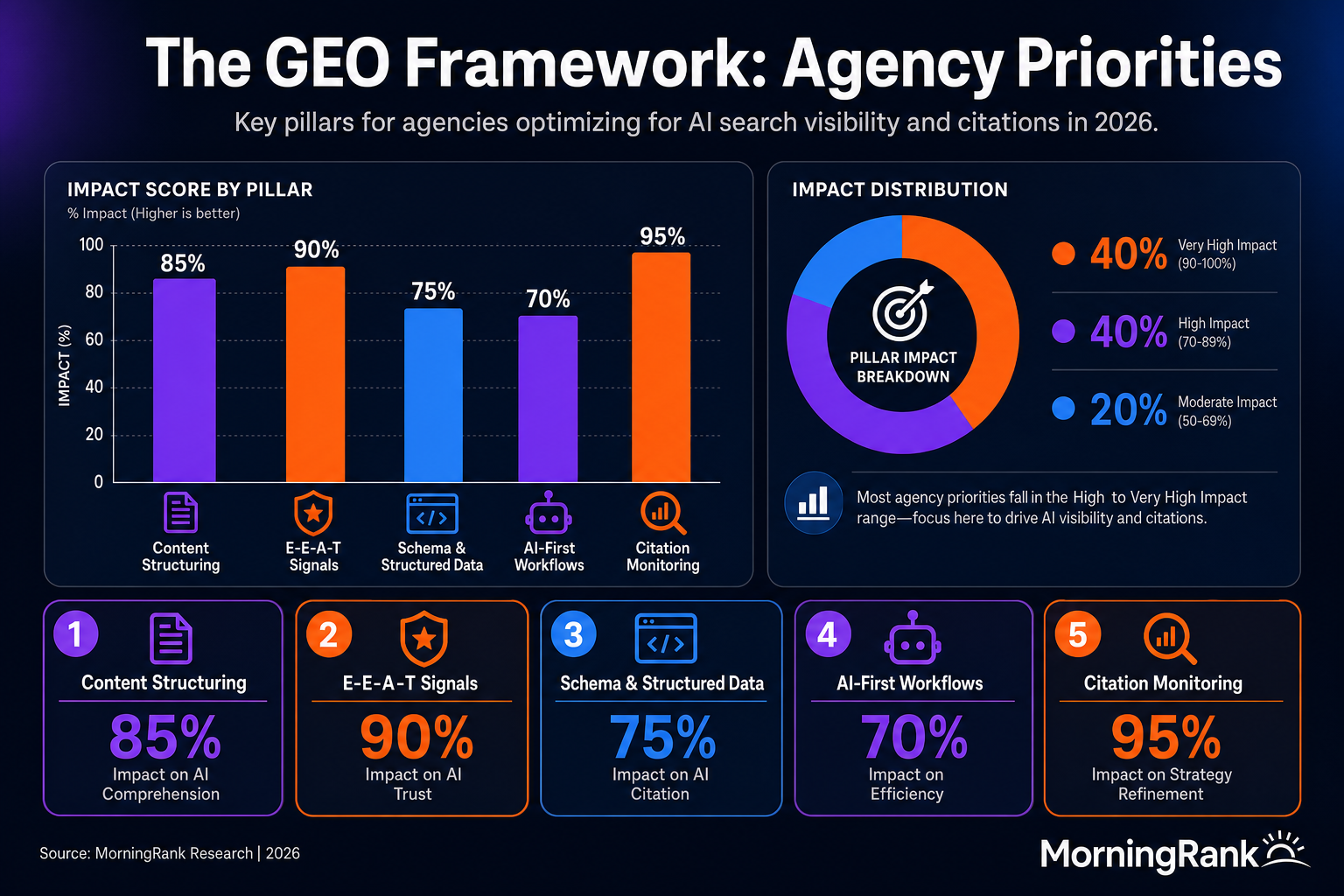
A successful Generative Engine Optimization (GEO) framework for agencies rests on several interconnected pillars, each designed to make content appealing and digestible for AI models. These pillars ensure that your client's information is not only found but also trusted and accurately cited by AI systems.
Content Structuring for AI Comprehension
The way content is structured significantly impacts how well generative AI understands and extracts information. Agencies must advocate for clear, logical organization. This means using headings, subheadings, bullet points, and numbered lists effectively. Each section should address a specific question or sub-topic concisely, making it easy for AI to identify key data points and relationships. Implement glossary-style definitions for important terms, where the term is followed by its clear, self-contained definition. This level of clarity helps AI parse complex information quickly and accurately.
In my experience, content written in a journalistic, inverted pyramid style, starting with the most important information, performs best for AI extraction. It allows AI models to quickly grasp the core message without having to process extraneous details. For example, ensuring that the first sentence of a paragraph answers the question posed in the heading significantly improves AI comprehension and citation potential. To learn more about optimizing content for AI, check out our guide on AI Search Visibility and AI Overview Optimization in 2026.
Semantic Clarity and Entity Salience
Generative AI thrives on semantic clarity and understanding entities. Semantic clarity ensures that the meaning of words and phrases is unambiguous, preventing misinterpretations by AI models. Agencies should prioritize using precise language, avoiding jargon where simpler terms suffice, and clearly defining any necessary technical terms. This means writing with a "definition-first" mindset, ensuring that core concepts are explained as soon as they are introduced.
Entity salience refers to how prominently and consistently important entities (people, places, organizations, concepts) are mentioned and contextualized within the content. By clearly identifying and linking these entities (e.g., using proper nouns, internal links, or even structured data), agencies help AI models build a robust knowledge graph around the client's domain. For example, if a client is an expert in "sustainable agriculture, " consistently using this term and related entities (e.g., "crop rotation, " "biodiversity, " "organic farming") signals to AI that the content is a rich source on this topic.
E-E-A-T Signals and Trustworthiness for AI
E-E-A-T (Experience, Expertise, Authoritativeness, and Trustworthiness) is paramount for both human searchers and AI models. For GEO, agencies must emphasize demonstrating E-E-A-T not just for Google's human raters, but explicitly for AI. This involves showcasing authors' credentials (e.g., bios with relevant experience), citing authoritative sources, and ensuring factual accuracy. AI models are trained on vast datasets and are increasingly adept at identifying reliable sources.
Agencies should focus on content creators with demonstrable experience and expertise in the client's field. This could involve publishing case studies, interviews with industry leaders, or research-backed articles. Establishing a strong external linking profile to reputable sources and having reputable sources link back to client content (a key part of traditional SEO) also enhances trustworthiness in the eyes of AI. Google has explicitly stated the importance of E-E-A-T in its Search Quality Rater Guidelineswhich AI systems increasingly mirror.
Schema Markup and Structured Data Implementation
Schema markup and structured data are the native language of AI. Implementing relevant schema types (e.g., Article, FAQPage, HowTo, Product) helps AI models understand the context and relationships within your content with unprecedented clarity. For agencies, mastering schema implementation is a non-negotiable aspect of GEO.
This goes beyond basic schema. Think about semantic relationships: using `sameAs` properties to link entities to their authoritative profiles (Wikipedia, LinkedIn) or `mentions` to highlight key topics. The more accurately and comprehensively structured data represents your content, the easier it is for AI to extract facts, understand intent, and confidently cite your client as a source. For a deeper dive into this, consider our post on Schema Markup for AI Search: Boosting Visibility in 2026's AI Overviews.

How Can Agencies Implement a GEO Framework in 2026?
Implementing a Generative Engine Optimization (GEO) framework in 2026 requires a systematic approach, integrating new practices into existing SEO workflows. Agencies need to adapt their content creation, technical optimization, and reporting to align with the demands of AI search.
AI-First Content Creation Workflows
Shift your content creation process to an "AI-first" mindset. This means that from keyword research to content drafting, the potential for AI citation should be a primary consideration. Start by identifying common questions users ask about a topic (which often translate directly into AI queries). Structure content with clear, direct answers, and use headings that pose these questions explicitly. Prioritize factual accuracy and cite external sources to build credibility. Content should be exhaustive yet concise, covering a topic comprehensively without unnecessary verbosity, allowing AI to easily pull out key facts and figures.
For example, instead of just writing a general article about "SEO trends, " create sections like "What are the top 5 SEO trends for agencies in 2026?" and provide numbered lists or tables. This makes extraction straightforward for AI models. This approach will also strengthen your content SEO and topical authority building in 2026.
Technical SEO for AI Indexing and Extraction
Technical SEO remains critical for GEO, focusing on making content accessible and parseable for AI. Ensure your client websites have excellent core web vitals, mobile responsiveness, and a clean crawl budget. AI models, like search engine crawlers, need to access and understand your content efficiently. Implement schema markup diligently across all relevant content types.
Beyond standard schema, explore emerging semantic web technologies that can further enhance AI comprehension. Ensure internal linking structures are logical and robust, helping AI understand the relationships between different pieces of content and the overall topical authority of your site. Our automated SEO site audit tool can help identify and rectify technical issues that might hinder AI access.
Monitoring and Measuring AI Citations and Visibility
The adage "what gets measured gets managed" is particularly true for GEO. Agencies must implement tools and processes to monitor how and when client content is cited by AI answer engines. This goes beyond traditional rank tracking, as AI citations might not always correlate directly with a top-ranking blue link. Look for mentions in Google AI Overviews, responses from chatbots like ChatGPT or Gemini, and knowledge panels. Tools designed for AEO and GEO tracking, such as MorningRank's GEO and AEO tracking feature, become invaluable here.
Track metrics like "AI mention share, " "citation frequency, " and "AI answer snippet quality." Analyze which content formats and topics generate the most AI citations, then refine your strategy based on these insights. This proactive monitoring allows agencies to demonstrate the tangible impact of their GEO efforts to clients, providing clear evidence of their enhanced AI search visibility.
How Does a GEO Framework Benefit Agencies and Their Clients?
Embracing a Generative Engine Optimization (GEO) framework offers significant advantages for agencies and their clients, extending beyond traditional SEO metrics to future-proof their digital presence in 2026.
-
Increased Brand Visibility and Authority: When content is consistently cited by AI answer engines, it positions the client as a leading authority in their niche. This direct attribution significantly boosts brand visibility, as AI-generated answers often reach a broad audience, including those who may not click through to a traditional search result. This cements client trust and credibility in a rapidly evolving search landscape.
-
Early Adoption Advantage: Agencies that proactively implement GEO strategies gain a significant competitive edge. By mastering AI-centric optimization now, they position themselves as leaders in the space, attracting forward-thinking clients who understand the importance of AI search visibility. This early adoption translates into more robust strategies and deeper experience before GEO becomes universally standard.
-
Enhanced Content Utility and Longevity: Content optimized for GEO is inherently more useful and durable. Its clear structure, semantic clarity, and E-E-A-T signals make it valuable not just for AI, but also for human users and future algorithmic changes. This focus on high-quality, comprehensive, and well-organized information ensures content remains relevant and effective for longer periods, maximizing client ROI.
-
New Revenue Streams and Client Offerings: Offering GEO as a specialized service allows agencies to expand their service portfolio and create new revenue streams. It differentiates them from competitors still clinging solely to traditional SEO. Clients are increasingly asking about their AI visibility, and agencies equipped with a GEO framework can confidently address these concerns, providing measurable results in a new, high-demand area.
By integrating GEO, agencies can offer a more comprehensive and resilient SEO strategy, demonstrating tangible value as the search ecosystem continues its AI-driven transformation. This strategic move ensures clients remain visible, authoritative, and relevant in 2026 and beyond.
Conclusion: Mastering Generative Engine Optimization for Agency Growth in 2026
The shift towards generative AI in search isn't a future possibility, it's a current reality shaping how users find information and interact with brands in 2026. For agencies, embracing a robust Generative Engine Optimization (GEO) framework is no longer optional; it's essential for maintaining client visibility, driving authority, and securing long-term success. By prioritizing clear content structuring, semantic clarity, explicit E-E-A-T signals, and advanced schema implementation, agencies can ensure their clients' content is not only discovered but also preferred and cited by AI answer engines.
As an SEO strategistI've audited countless content strategies, and the ones that consistently thrive are those that anticipate and adapt to major shifts like AI search. A well-executed GEO strategy will differentiate your agency, provide measurable results, and position you as an indispensable partner in the evolving digital landscape. It's about being the source that AI trusts, which in turn builds immense trust with human users. Don't let your clients get left behind in the AI-powered search revolution.
Frequently Asked Questions
What is Generative Engine Optimization (GEO)?
Generative Engine Optimization (GEO) is a specialized SEO framework focused on optimizing content for generative AI models and answer engines like Google AI Overviews. Its goal is to make content easily digestible, understandable, and citable by AI, securing direct mentions and enhancing AI search visibility.
How does GEO differ from traditional SEO?
While traditional SEO aims for organic rankings and clicks to websites, GEO specifically targets AI models to earn direct citations within AI-generated answers. It emphasizes structured data, semantic clarity, and explicit E-E-A-T signals tailored for AI comprehension, moving beyond just ranking in blue links.
Why is GEO important for agencies in 2026?
GEO is critical for agencies in 2026 because AI Overviews and generative AI tools are increasingly dominating search results. Agencies need a GEO framework to ensure client content is visible and authoritative in these new AI-powered environments, future-proofing their digital presence and driving new growth.
What are the key components of an effective GEO strategy?
An effective GEO strategy involves clear content structuring for AI comprehension, semantic clarity, strong E-E-A-T signals for AI trust, and diligent implementation of schema markup and structured data. These components collectively make content appealing and digestible for AI models.
How can agencies measure success in Generative Engine Optimization?
Agencies can measure GEO success by tracking AI citations, monitoring "AI mention share" in AI Overviews, and analyzing the quality of AI-generated snippets that reference client content. Specialized GEO and AEO tracking tools, like those offered by MorningRank, are essential for this type of measurement.
What role does E-E-A-T play in Generative Engine Optimization?
E-E-A-T (Experience, Expertise, Authoritativeness, Trustworthiness) is foundational for GEO. Agencies must demonstrate strong E-E-A-T through author credentials, factual accuracy, and reliable sourcing. AI models prioritize content from trusted, expert sources for their generated answers, making E-E-A-T a critical ranking factor for AI citation.
How can MorningRank help my agency with Generative Engine Optimization?
MorningRank offers specialized features for Generative Engine Optimization, including GEO and AEO tracking and AI visibility tracking. These tools help agencies monitor how their clients' content is cited and synthesized by major AI answer engines and AI Overviews, providing the data needed to refine your GEO strategy and prove ROI.
Ready to lead your clients into the age of AI search? Discover how MorningRank's advanced GEO and AEO tracking tools can transform your agency's strategy and client results. Try MorningRank free today.
Want this kind of insight every week?
MorningRank delivers daily rank tracking, AI SEO recommendations, and white label client reporting.