
GEO Guide: Strategic Content Optimization for AI Answer Engines in 2026
Generative Engine Optimization (GEO) is the practice of strategically structuring and creating content to maximize its visibility and citation within AI answer…
 Sofia Chen
“In 2026, I've observed that merely ranking for a keyword isn't enough; client success now hinges on content being actively cited and summarized by AI answer engines like Google AI Overviews and ChatGPT.”
Generative Engine Optimization (GEO) is the practice of strategically structuring and creating content to maximize its visibility and citation within AI answer engines and generative search experiences. For agencies in 2026, mastering GEO ensures client content is not only found but actively used and cited by AI models, driving critical brand exposure and authority in a rapidly evolving digital landscape.
Key Takeaways
- Generative Engine Optimization (GEO) focuses on making content highly digestible and citable by AI models and answer engines.
- Agencies must adapt content strategies to prioritize E-E-A-T (Experience, Expertise, Authoritativeness, Trustworthiness) and structured data for AI visibility.
- Optimizing for explicit answers, topic clusters, and factual accuracy is crucial for ranking in AI Overviews and other generative results.
- Measuring GEO success involves tracking citations in AI answer engines, direct traffic from generative results, and overall topical authority.
- A proactive GEO approach leverages AI content creation tools and integrates with traditional SEO to build a robust AI-first presence for clients.
The rise of AI-powered search, epitomized by Google AI Overviews and conversational AI models like ChatGPT and Gemini, has fundamentally shifted the SEO landscape. For agencies, this means moving beyond traditional ranking signals to embrace Generative Engine Optimization (GEO). I've observed that clients are increasingly asking not just "where do I rank on Google?" but "why doesn't our brand appear in AI answers?" This comprehensive guide will explore how agencies can strategically optimize content for these new generative experiences, ensuring their clients achieve maximum AI search visibility in 2026 and beyond.
What is Strategic Generative Engine Optimization (GEO)?
Strategic Generative Engine Optimization (GEO) is a specialized branch of SEO focused on optimizing content for generative AI models, aiming to increase the likelihood of content being referenced, summarized, or directly cited in AI-powered search results and conversational interfaces. Unlike traditional SEO, which often focuses on organic rankings in a list of blue links, GEO prioritizes the extractability and synthesis of information by AI.
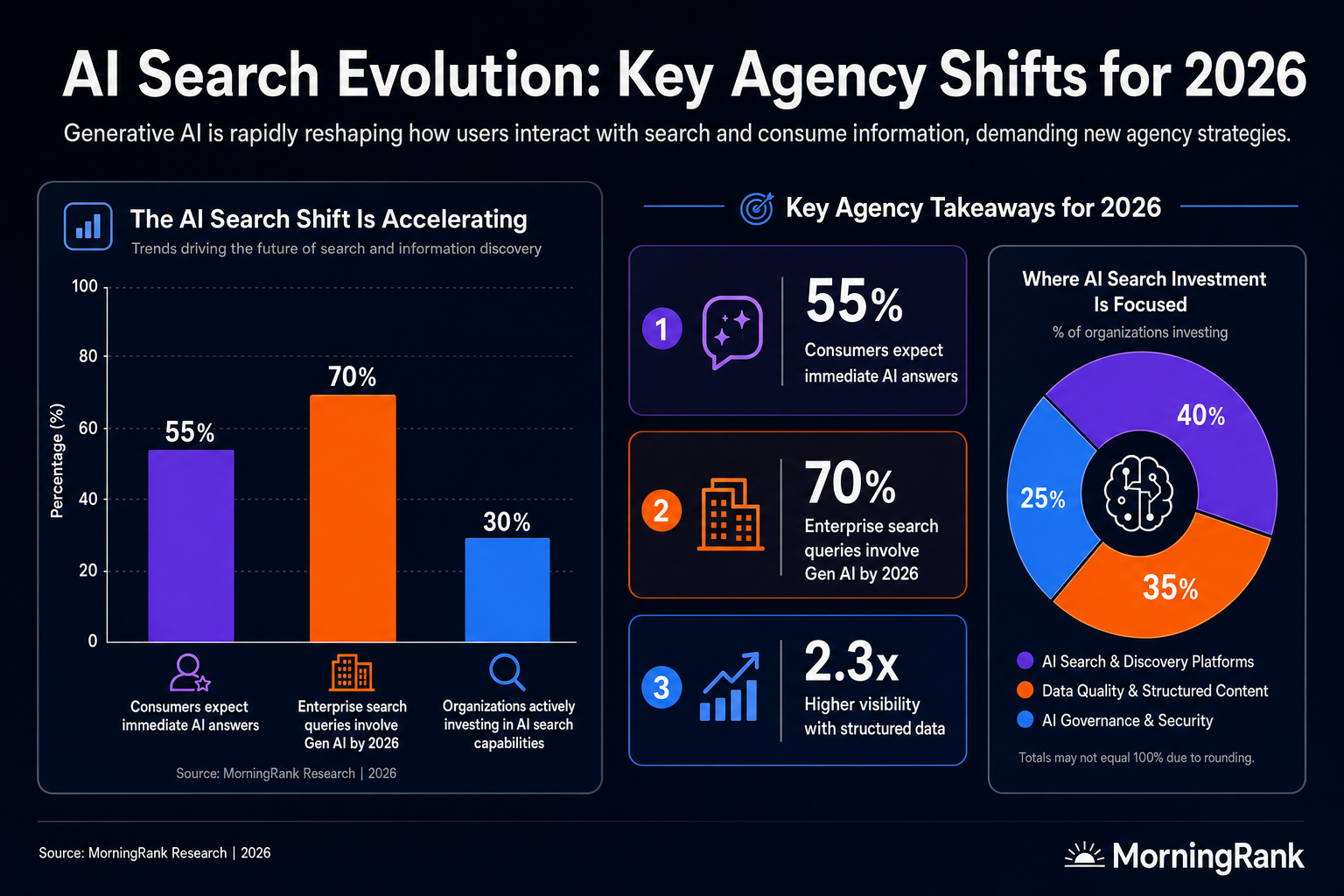
In my experience, agencies that treat GEO as an extension of their existing SEO efforts, rather than a separate discipline, achieve the best results. It involves a deep understanding of how large language models (LLMs) consume and process information. This includes focusing on clarity, conciseness, factual accuracy, and explicit answers to common questions. For instance, a study by Perficient found that 55% of consumers expect AI to provide immediate answers to complex questions, underscoring the need for content that can be easily parsed for direct responses (Source: Perficient, 2024 AI in Business Report). This highlights the shift from users clicking links to receiving summarized information directly, making citation by AI a primary goal.
Effective GEO also heavily relies on enhancing E-E-A-T (Experience, Expertise, Authoritativeness, and Trustworthiness) signals. Google's Search Quality Rater Guidelines emphasize E-E-A-T as a critical factor in determining content quality, which directly influences how AI models perceive and utilize information. Agencies must ensure that client content is not only well-written but demonstrably created by experts, backed by evidence, and published on authoritative platforms.
How Does Content Architecture Impact AI Citation for Agencies?
The way content is architected plays a pivotal role in its citability by AI answer engines. AI models thrive on well-organized, logically structured information that can be easily understood and extracted. For agencies, this means adopting a content architecture that prioritizes clarity and semantic relationships.
A key strategy is the implementation of topic clusters and user-intent mapping. Instead of creating isolated articles, agencies should develop comprehensive content hubs around core topics. This signals to AI models that the website is a deep resource for a particular subject, increasing the likelihood of citation. Each piece of content within a cluster should address specific sub-questions related to the main topic, providing exhaustive coverage. For example, a "GEO guide" cluster might include articles on "what is GEO, " "GEO tools for agencies, " and "measuring GEO performance." This interconnectedness helps AI understand the breadth and depth of expertise.
Furthermore, using clear headings (H2, H3, H4) as question-answer pairs directly addresses how AI models process information. AI is designed to answer questions, so presenting content in this format makes it easier for the AI to identify and extract relevant snippets. Bulleted lists, numbered steps, and tables also enhance scannability and extractability. I've audited many sites where simply reformatting existing content into a more Q&A-centric structure significantly improved its AI visibility.
Finally, semantic HTML and structured data (Schema Markup) are foundational for AI citation. Schema Markup provides explicit context to search engines and AI about the meaning of content, making it machine-readable. Agencies should meticulously implement relevant schema types like `Article`, `FAQPage`, `HowTo`, and `Q&A` to highlight critical information. According to a study by Semrush, pages with structured data consistently outperform those without it in terms of SERP visibility (Source: Semrush, The Impact of Structured Data on SEO Performance, 2023).

Why is E-E-A-T Critical for Generative Engine Optimization in 2026?
E-E-A-T (Experience, Expertise, Authoritativeness, and Trustworthiness) is paramount for Generative Engine Optimization in 2026 because AI models are engineered to prioritize credible and high-quality information. AI answer engines are designed to provide accurate, reliable answers, and they draw heavily on signals that demonstrate a source's E-E-A-T.
For agencies, this means going beyond simply mentioning expertise. It involves actively showcasing the qualifications and experience of content creators and the organization itself. For example, author bios with relevant credentials, linking to academic or industry publications, and third-party endorsements all contribute to stronger E-E-A-T signals. When AI models assess content for citation, they analyze these signals to determine if the information is trustworthy enough to present to users.
Google's continued emphasis on E-E-A-T, especially with updates like the Helpful Content System, underscores its importance for all forms of search visibility. AI models are trained on vast datasets, but their outputs are constantly evaluated for factual accuracy and safety. Content that lacks strong E-E-A-T signals is less likely to be used or cited by AI, regardless of how well it answers a query. Agencies need to educate clients on the long-term value of building legitimate authority and trust, not just short-term ranking tactics. I've seen firsthand how content from a demonstrably expert source gains preference in AI Overviews.
This also extends to the broader digital footprint of the client. Consistent brand mentions, positive online reviews, and a strong backlink profile from reputable sources all indirectly bolster E-E-A-T, providing AI with more confidence in the source. Monitoring these external signals is crucial, and backlink monitoring tools can help agencies track this aspect effectively.
How Can Agencies Integrate GEO with Traditional SEO Efforts?
Integrating Generative Engine Optimization (GEO) with traditional SEO efforts is not only possible but essential for a holistic digital strategy in 2026. Rather than viewing them as separate disciplines, agencies should consider GEO as an advanced layer built upon foundational SEO principles.
Many core SEO best practices directly support GEO. For instance, robust keyword research still informs content creation, but with an added focus on identifying question-based queries and explicit answer opportunities. On-page SEO elements like meta descriptions and title tags can be optimized to signal direct answers to AI. High-quality content, a cornerstone of traditional SEO, is even more critical for GEO, as AI prioritizes comprehensive, accurate, and expert-driven information. Therefore, agencies should leverage content SEO and topical authority building to great effect.
Agencies can streamline this integration by adopting unified workflows. When planning content, include a "GEO review" step to ensure content is structured for AI extractability, includes relevant structured data, and clearly showcases E-E-A-T. For existing content, a GEO audit can identify opportunities to reformat sections into Q&A, add summary bullet points, or implement missing schema markup. This dual optimization ensures that content performs well in both traditional SERPs and generative AI experiences. For example, a detailed answer in a blog post might also be perfect for a Google AI Overview snippet.
Furthermore, the tools used for traditional SEO, such as keyword rank trackers and site audit tools, can be adapted for GEO. MorningRank's GEO and AEO tracking features, for example, allow agencies to monitor client citations within AI answer engines, providing direct insights into GEO performance. This measurement capability is vital for demonstrating ROI to clients and refining strategies.
What are the Best Practices for Measuring GEO Performance for Clients?
Measuring Generative Engine Optimization (GEO) performance for clients requires a shift in key performance indicators (KPIs) beyond traditional organic traffic and rankings. Agencies need to focus on metrics that directly reflect visibility and citation within AI answer engines and generative AI experiences.
One primary metric is **AI Citation Volume and Quality**. This involves tracking how often a client's content is directly cited or summarized by AI models in platforms like Google AI Overviews, ChatGPT, Gemini, and Perplexity. The quality of the citation, meaning whether it accurately represents the content and positively portrays the brand, is also crucial. Tools specifically designed for GEO and AEO citation trackingsuch as those offered by MorningRank, are indispensable here.
Another important KPI is **Direct Generative Traffic**. While AI Overviews might reduce clicks to traditional websites for simple queries, they can also drive highly qualified traffic for more complex or follow-up questions. Monitoring direct traffic attributable to AI answers (e.g., through specific tracking parameters or analytics insights) provides valuable data. According to a report by Gartner, 70% of enterprise-level search queries will involve generative AI by 2026 (Source: Gartner, Predicts 2024: Generative AI's Impact on Marketing and Search, 2023), highlighting the growing importance of this traffic source.
Finally, **Topical Authority Score** and **E-E-A-T Signals** serve as foundational measurements for GEO. While not direct performance metrics, improvements in these areas directly correlate with increased AI citation likelihood. Agencies should track changes in domain authority, backlink profiles from authoritative sources, and the demonstrated expertise of content authors. Regular content audits focused on E-E-A-T compliance and structured data implementation will also contribute to a strong GEO foundation.
Conclusion: Embracing GEO for Agency Success in 2026
The evolution of search into generative AI experiences presents both challenges and immense opportunities for SEO agencies in 2026. By embracing a strategic approach to Generative Engine Optimization (GEO), agencies can ensure their clients remain visible, authoritative, and competitive in this new landscape. It's no longer enough to merely rank on a results page; the goal is to be the authoritative source that AI chooses to cite.
As I've outlined, successful GEO involves a meticulous focus on content architecture, explicit answers, rigorous E-E-A-T development, and sophisticated tracking of AI citations. Agencies that proactively integrate GEO into their service offerings will differentiate themselves, attract forward-thinking clients, and solidify their position as leaders in AI search visibility. The future of search is generative, and agencies must adapt their strategies now to thrive.
Frequently Asked Questions
What is Generative Engine Optimization (GEO)?
Generative Engine Optimization (GEO) is the process of optimizing digital content so it can be easily discovered, understood, and cited by AI answer engines and generative AI models. The goal of GEO is to increase content visibility within AI-powered search results and conversational AI experiences.
How does GEO differ from traditional SEO for agencies?
While traditional SEO focuses on ranking websites in organic search results, GEO specifically targets content optimization for AI models. It emphasizes explicit answers, structured data, and E-E-A-T to secure direct citations and summaries in generative AI outputs, complementing conventional SEO efforts.
Why is E-E-A-T so important for GEO in 2026?
E-E-A-T (Experience, Expertise, Authoritativeness, and Trustworthiness) is critical for GEO because AI answer engines prioritize credible and reliable information. Strong E-E-A-T signals help AI models assess content quality, making it more likely to be selected as a source for direct answers and summaries.
What are the key components of a GEO-optimized content strategy?
A GEO-optimized content strategy focuses on clear, concise, and explicit answers, organized into logical content architectures like topic clusters. It heavily leverages structured data (Schema Markup), uses question-phrased headings, and consistently demonstrates high E-E-A-T throughout the content.
How can agencies measure the success of their GEO strategies?
Agencies can measure GEO success by tracking AI citation volume and quality, monitoring direct generative traffic from AI Overviews, and assessing improvements in topical authority and E-E-A-T signals. Specialized GEO and AEO tracking tools can provide valuable insights into these metrics.
What tools can help agencies with Generative Engine Optimization?
Agencies can leverage tools for keyword research, content analysis, and structured data implementation. MorningRank offers a comprehensive platform with GEO and AEO tracking features to help agencies monitor citations and AI search visibility, providing essential data for optimizing client content.
Ready to help your clients dominate AI search in 2026? Explore how MorningRank's advanced GEO and AEO tracking can transform your agency's strategy and client results. Try MorningRank free today.
Want this kind of insight every week?
MorningRank delivers daily rank tracking, AI SEO recommendations, and white label client reporting.