Keyword Research for Agencies: A 2026 Workflow
The full keyword research workflow Morning Rank uses to build SEO strategies for agency clients - intent mapping, cluster building, AI Overview targeting, and prioritization.

Keyword research used to mean opening a tool, exporting thousands of rows, and filtering by volume. In 2026, that workflow produces a list, not a strategy. A repeatable process should connect keyword choices to intent, competition, and business value.
Step 1: Start with customer language, not tools
Pull two weeks of sales call recordings, support tickets, live chat logs, and Reddit/forum threads in your client's niche. Customers don't search the way SEOs write. The phrases they actually use are the seed list. Tools like GummySearch, Answer the Public, and even Reddit's native search are good shortcuts for surfacing the long-tail vocabulary your clients' customers use.
What we look for: verbatim phrases, the questions that come before the buying decision, the objections that come after, and the comparison terms ("X vs Y", "alternatives to X"). These almost never show up in a Semrush export, and they're disproportionately likely to trigger AI Overview citations because they match how people actually phrase questions to assistants.
Step 2: Expand with intent buckets
Map every keyword to one of four intents: informational, navigational, commercial, transactional. The mix tells you what the funnel looks like - and it determines which surfaces you should target.
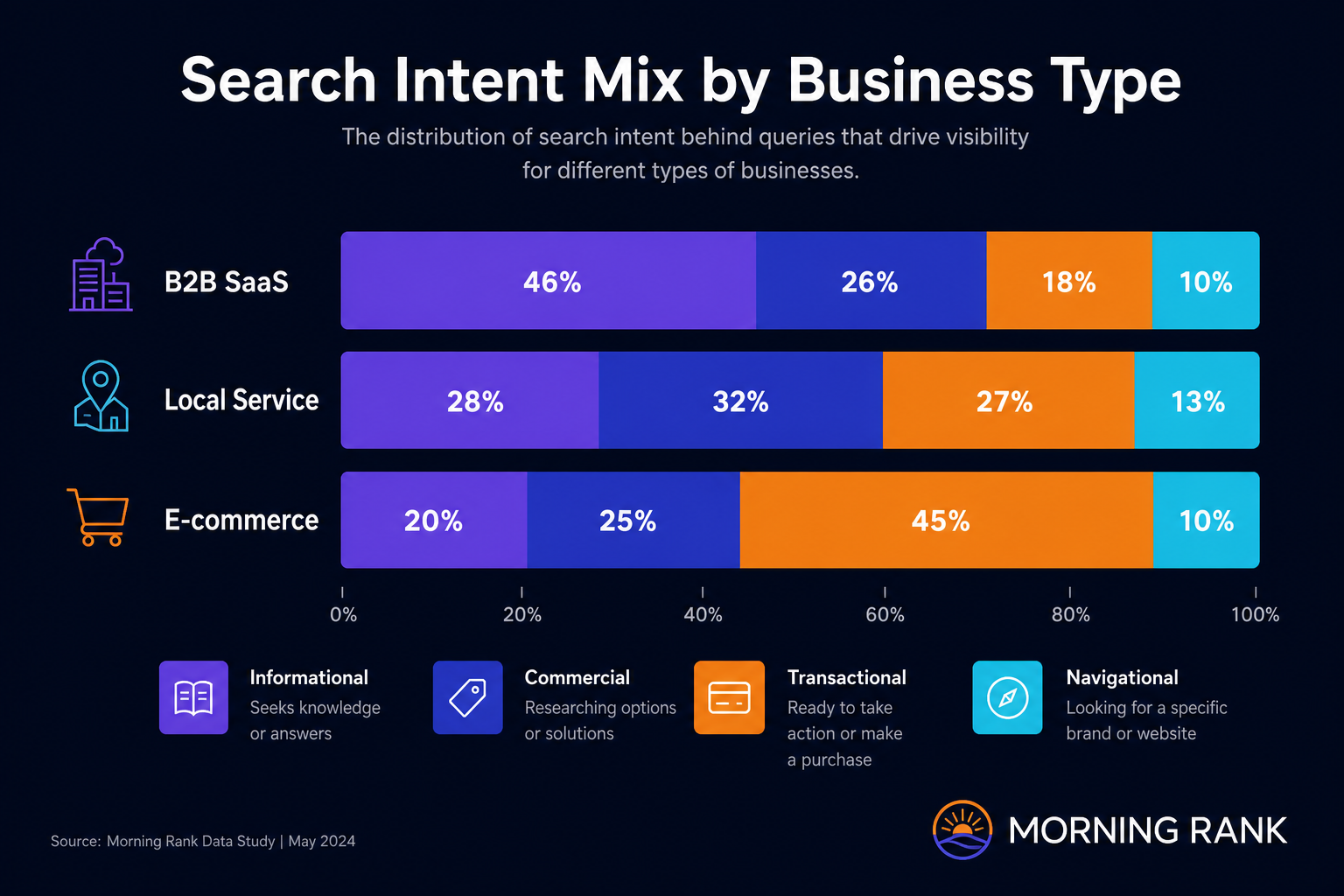
A B2B SaaS client should expect 70% informational, 20% commercial, 10% transactional in their target set. A local service business flips that ratio toward transactional. E-commerce sits in between but skews commercial. If your keyword list doesn't match the intent profile of the business, you're either over-investing in top-of-funnel or starving the funnel - both produce bad ROI.
Step 3: Build clusters, not lists
Group semantically related keywords into clusters that map to a single page. Ahrefs' Parent Topic feature is fast for this; Semrush's Keyword Manager works too. The output is a content map, not a spreadsheet.

The pillar should target the broad, high-volume head term. The spokes target the long-tail variants and questions. Internal links flow up to the pillar and across between thematically related spokes. This architecture is what generative engines reward - and it's what Morning Rank's AI Insights surfaces gaps in by default.
Step 4: Validate against the actual SERP
Volume lies. SERP intent doesn't. Open the top 10 for every target keyword and confirm the format Google is rewarding - listicles, in-depth guides, calculators, comparison pages, video carousels, AI Overviews. If you can't beat the format, change the keyword. We see agencies waste an entire quarter writing 2,500-word guides for keywords where the top 10 is all calculators and product pages - they never had a chance to rank.
What to record during SERP validation
- Dominant content format (guide, listicle, calculator, product page, video).
- AI Overview present? If yes, which 3-5 sources are cited.
- Map Pack present? (Disqualifies most non-local businesses.)
- Average word count of the top 5 organic results.
- Schema types in use (FAQ, HowTo, Product, etc.).
- Domain Rating range of the ranking sites - is this reachable for your client?
Step 5: Score by opportunity, not just difficulty
Difficulty scores are a useful starting point but a terrible decision input. Our weighted formula:
- Search volume × business relevance score (1-5)
- ÷ keyword difficulty score
- × SERP feature opportunity multiplier (AI Overview eligible: ×1.4, FAQ-eligible: ×1.2, video carousel: ×1.1)
- = prioritization score
It's not perfect - but it forces the conversation away from "high volume, easy" into "right fit, winnable, with surface upside." The relevance score is the part most SEOs skip and the part that matters most. A keyword with 50 searches/month and a 5/5 relevance score will out-earn a keyword with 5,000 searches/month and a 2/5 relevance score every time.
Step 6: Hand off to the content team without losing context
Every cluster brief should include: target keyword, related keywords, search intent, top 5 SERPs, content gap, internal link plan, target word count, schema requirements, and the angle that will earn an AI Overview citation. We auto-generate this brief inside Morning Rank's AI Insights - but a Google Doc template works just as well at smaller scale. The point is consistency: every brief follows the same structure so the writer never has to guess what's expected.
Step 7: Re-evaluate quarterly, not annually
The SERP shifts every quarter now. AI Overview triggering is volatile - keywords that didn't trigger one in January often do by April, and vice versa. We re-pull SERP features for the full target set every 90 days inside Morning Rank, and we recommend every agency build that cadence into their retainer scope. Otherwise, half the strategy is operating on stale assumptions by month four.
Once your clusters are live, the next question is reporting. We cover that in White-Label SEO Reports That Win Clients. The cluster strategy is also the foundation for everything in our AI search strategy guide.
"A repeatable keyword workflow makes strategy easier to explain, review, and improve each quarter."
About the author
Tyler Morgan
Head of SEO, Morning Rank
Tyler writes about agency SEO strategy, rankings, AI search, and competitor research at Morning Rank.
Want this kind of insight every week?
MorningRank delivers daily keyword rank tracking, AI SEO recommendations, GA4 integration, and white label client reporting.