White-Label SEO Reports That Win (and Keep) Clients
What separates an SEO report that gets opened from one that gets ignored. The structure, cadence, white-label setup, and storytelling we recommend for agencies in 2026.
An effective agency report does more than show ranking growth. It helps the client understand what changed, why it matters, and what happens next. The clearest reports share four practical traits, and none depend on adding more charts.
1. Lead with the answer to 'what did you do?'
Most reports lead with metrics. Clients want a one-screen executive summary: what you did, what changed, what's next. Three sentences. No charts above the fold.
The format that works:
- What we did: 1 sentence summarizing the work.
- What changed: 1 sentence with the headline result.
- What's next: 1 sentence on the next 30 days.
If the CMO opens the report on their phone, walks into a leadership meeting, and can answer "how's SEO going?" without scrolling - you've won. That's the bar.
2. Tie every metric to a business outcome
Rankings are a means, not an end. Replace "we ranked #4 for X" with "we ranked #4 for X, which drove 220 sessions and an estimated 14 leads at your historical conversion rate." Translate every metric into pipeline language. Clients don't pay for rankings; they pay for revenue. Reports that translate the metric chain win renewals.
If you don't have conversion data, ask for it on day one. Get the client's average lead-to-customer rate and average customer value. Even rough numbers turn "+12 keywords ranking page 1" into "~$28k in incremental pipeline."
3. Use white-label, not 'powered by'
If the client sees your tool's logo, they wonder what they're paying you for. Real white-label means: your domain (reports.youragency.com), your brand colors, your logo, your voice, your sender address on the email. Morning Rank reports ship white-label by default - no upgrade required, custom domain included on every plan, including starter.
Good white-label reporting keeps the tool in the background. The agency relationship and strategy stay visible.
4. Send weekly micro-updates, not just monthly PDFs
A 1-paragraph email every Monday - "here's what moved this week and why" - beats a 40-page PDF every 30 days. Clients perceive responsiveness, surprises (positive or negative) get framed by you instead of by Slack, and renewal rates measurably climb.
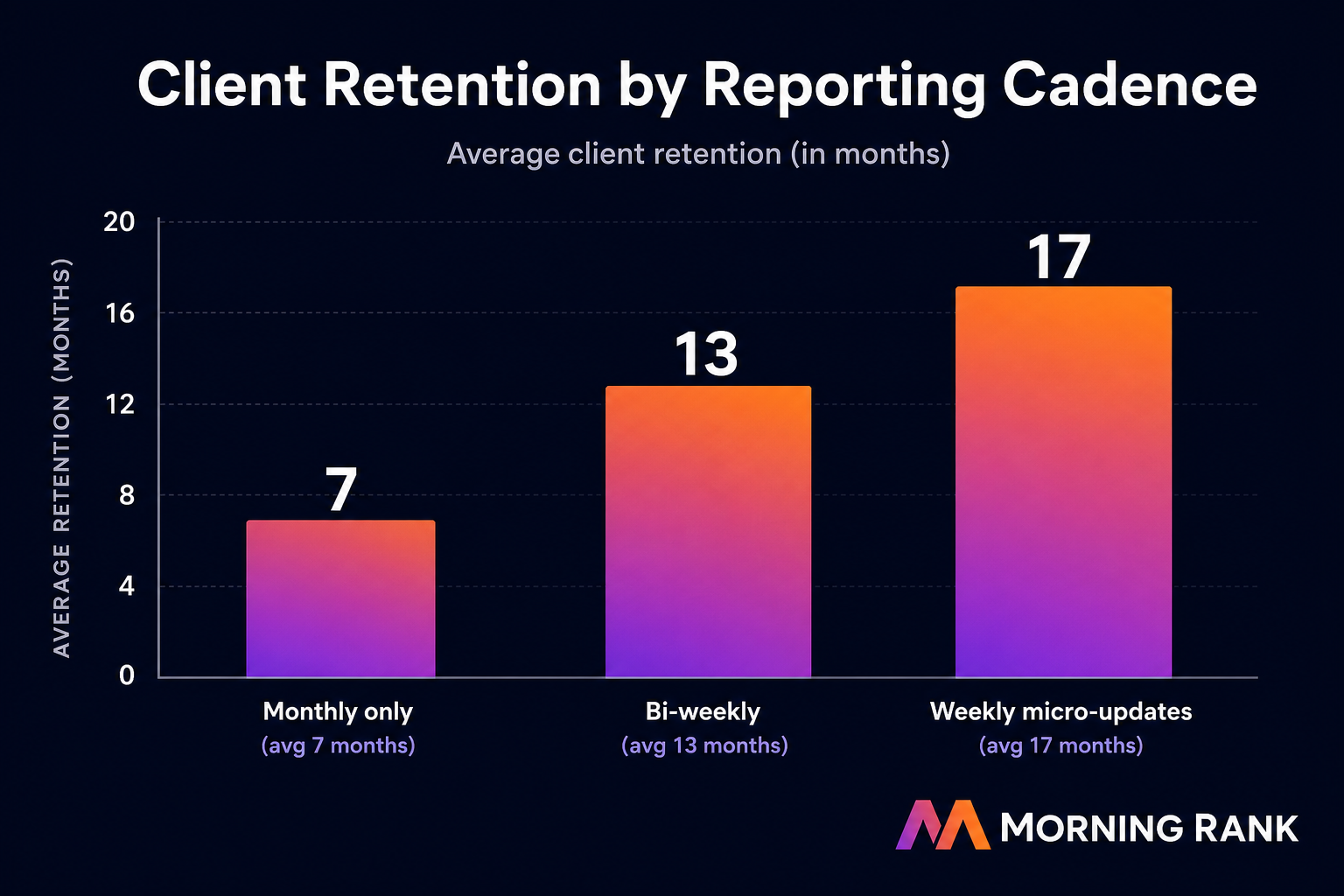
A brief weekly update can keep clients informed between monthly reports. The right cadence depends on the account, but frequent communication reduces surprises and makes progress easier to follow.
What to put in a 2026 SEO report
- Executive summary: 3 sentences, plain English, top of page 1.
- Wins: 2-3 specific ranking, traffic, or conversion gains tied directly to actions you took.
- Risks: anything dropping, plus the diagnosis and the next step (never a risk without a plan).
- AI Overview presence: which target keywords cite the client's site, which cite competitors, and the gap analysis.
- Map Pack share (for local clients): grid heatmap showing visibility by zip.
- Backlink growth: see Modern Backlink Strategy for what to track and how to frame it.
- Content velocity: what shipped, with links and target keywords.
- Next 30 days: 3 specific deliverables with owners and dates.
What to leave out
Just as important as what to include: what to remove. Reports get ignored when they look like dumps. Cut these:
- Vanity metrics with no decision attached (impressions without context, raw keyword counts).
- Screenshots from third-party tools that aren't your brand.
- "Industry trends" sections that don't reference the client's actual business.
- Acronym soup. If a non-marketer can't read it, rewrite it.
The reporting cadence we recommend
- Weekly: 1-paragraph email Monday morning, 5 bullets max. Sent from your domain.
- Monthly: 1-page executive summary + linked dashboard. PDF optional, dashboard is default.
- Quarterly: 30-minute strategy call + a strategic memo (not a metrics dump).
Most agencies do the opposite - they over-invest in monthly polish and skip the quarterly strategy conversation. The quarterly conversation is what gets you renewed. The weekly email is what stops the client from hearing about something on Slack before they hear it from you.
How Morning Rank operationalizes this
Every Morning Rank account ships with: white-label PDF and dashboard reports, a 1-click "weekly client email" template that pulls live data, scheduled report sending under your sender domain, and a client portal at reports.youragency.com (or your custom subdomain). The point is that the cadence we recommend should take 5 minutes per client per week - not 5 hours. If your reporting workflow is taking longer than that, the platform is wrong.
"A report should support a conversation. If the client cannot understand it, simplify it."
About the author
Tyler Morgan
Head of SEO, Morning Rank
Tyler writes about agency SEO strategy, rankings, AI search, and competitor research at Morning Rank.
Want this kind of insight every week?
MorningRank delivers daily keyword rank tracking, AI SEO recommendations, GA4 integration, and white label client reporting.