Modern Backlink Strategy: What Works in 2026
Forget guest post farms and PBNs. Here's the backlink strategy that actually moves rankings in 2026 - digital PR, original research, partner integrations, and what to track.

Google's link spam updates have systematically killed every cheap link tactic over the past three years. SpamBrain now neutralizes the vast majority of paid placements before they pass equity, and the March 2024 + November 2025 spam updates wiped out the remaining low-quality networks. What's left actually requires earning links - which is good news, because the brands doing it well have less competition than ever.
This backlink strategy focuses on durable tactics for organizations ranging from local services to enterprise SaaS. It is not glamorous or fast, but it is designed to compound.
1. Original research is the highest-ROI tactic
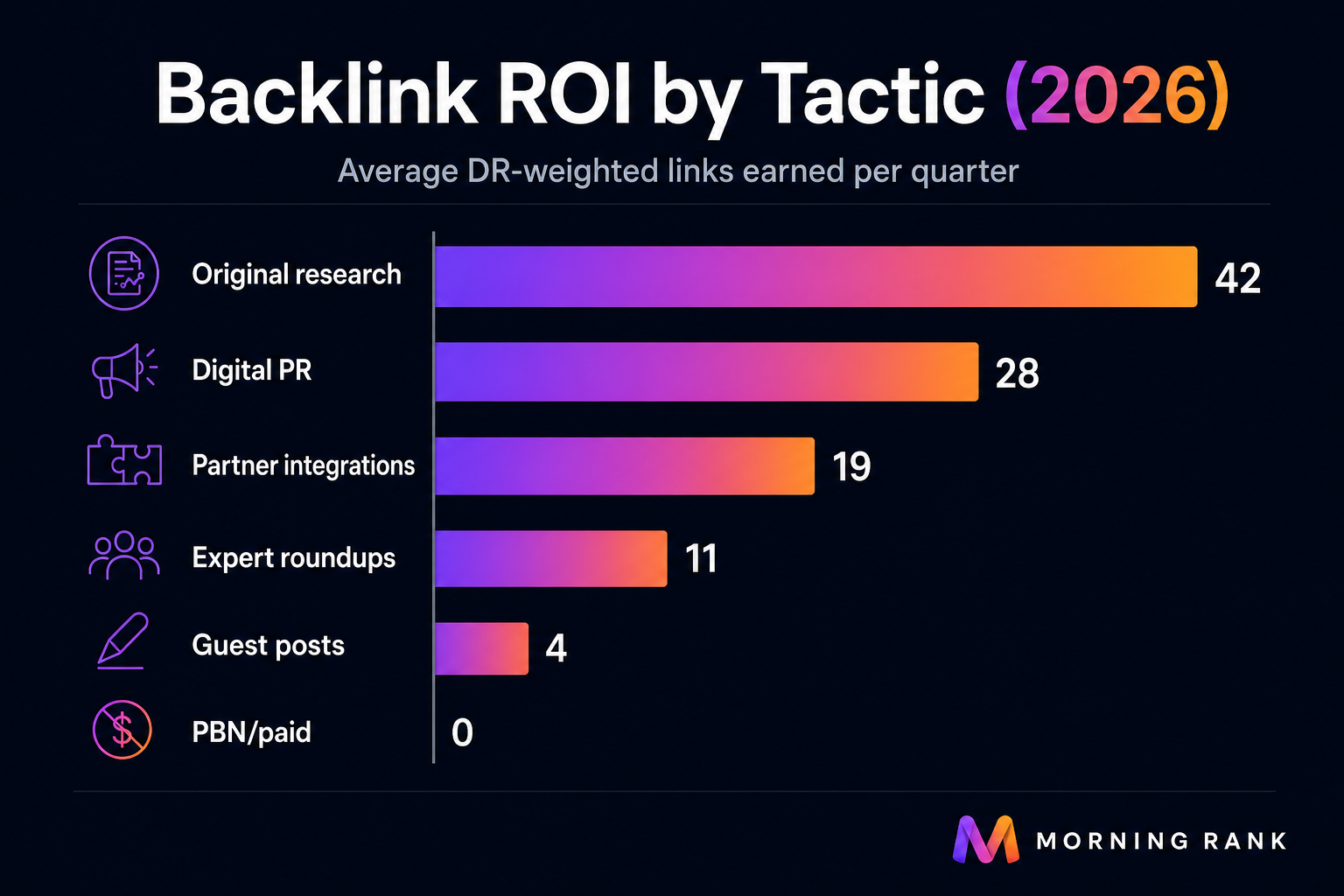
Publishing one well-designed industry study per year produces more durable links than three years of outreach. The math is straightforward: a single piece of original data becomes the citation that journalists, bloggers, and AI engines reach for whenever the topic comes up. The links keep arriving for years, and the brand mention pattern compounds with AI Overviews.
What kinds of original research actually earn links
- Survey 200+ professionals in your niche, publish the data with named methodology.
- Analyze proprietary data your platform has - rankings, ad spend, conversion rates, churn rates.
- Build a public benchmark or index that journalists can cite (the "State of X" report format).
- Run an experiment with reproducible methodology and share the data file publicly.
Backlinko's annual content study is the canonical example - it's earned 30k+ referring domains by being the citation everyone uses. Semrush's annual reports, Ahrefs' studies, and Moz's industry research all follow the same playbook for the same reason: it works.
2. Digital PR over guest posting
A single mention in TechCrunch, The Verge, or a major trade publication outweighs 50 guest posts on DR-30 blogs. The links are stronger, the brand lift is real, and the page often becomes a citation source for AI Overviews. The workflow:
- Build a 100-journalist list in your niche using Muck Rack or Prowly. Note their beats, recent stories, and preferred pitch format.
- Pitch only 1-2 stories per month, but make them genuinely newsworthy - original data, a contrarian take grounded in data, or a timely angle on a breaking story.
- Use HARO/Connectively for opportunistic placements. Respond within 30 minutes, lead with credentials, and keep the response under 200 words.
- Repurpose every press hit. One TechCrunch mention becomes a LinkedIn post, a newsletter, and three derivative pitches to adjacent journalists.
3. Partner integrations and co-marketing
Integrate with adjacent tools, get featured on their integrations page, and you've earned a permanent contextual link from a high-authority domain. We've watched a single Zapier-style integration page bring in DR 70+ links every month for years. The links are durable because the relationship is - partners have an active reason to keep the page up.
How to build the partner link layer
- List your top 10 adjacent tools - anything your customers use alongside yours.
- Build a real integration where it makes sense; build a co-marketing offer (joint webinar, joint study, customer story) where it doesn't.
- Negotiate the integrations page placement up front. Most tools will agree if you bring real distribution.
- Cross-promote: a webinar with one partner produces 3-5 derivative links if the recording is repurposed correctly.
4. The links you should never build
Cheap link tactics aren't just ineffective in 2026 - they're a real risk. Google's manual action volume on link schemes is up materially since the 2025 algorithm updates.
- Paid "guest post" networks. Google detects them programmatically. The vendor's first 200 customers got results; the next 5,000 got nuked.
- PBNs (private blog networks). They collapse the moment one site in the network gets penalized, and the modern detection is good.
- Forum signature spam, blog comment spam, Web 2.0 farms.
- Reciprocal link schemes at scale. "Link to me, I'll link to you" is fine in moderation; spreadsheet-driven trades are a manual action waiting to happen.
- Auto-generated citation schemes (the directory blasts that promise 500 listings for $99).
5. Track velocity, anchor distribution, and toxicity - not just count
Sudden spikes in referring domains can trigger manual review. Monitor weekly net new and lost links, anchor distribution (you want a healthy mix of branded, naked URL, and topical - not 80% commercial-money anchors), and DR-bucket diversity. Morning Rank's backlink module alerts on toxic-pattern spikes in real time, but Ahrefs and Semrush backlink tools work too at smaller scale. The point is the monitoring is non-negotiable.
What to put in your monthly link report
- Net new referring domains (week-over-week and month-over-month).
- Lost referring domains, with diagnosis (404, removed, replaced).
- Anchor text distribution by category.
- DR-bucket distribution of new links (DR 0-30, 30-60, 60+).
- Topical relevance score of new linking domains.
- Toxic / spam-pattern alerts.
6. The pace that compounds
Stop trying to build 1,000 mediocre links. The agencies that crush competitors with 10x the link count are usually building 30-60 great ones a year - original research, digital PR placements, durable partner integrations - and letting the topical authority compound. The quality bar is the strategy.
Pair this with strong client reporting (see White-Label SEO Reports That Win Clients) so backlink wins land with the people writing the checks. And anchor it inside the broader strategy in our AI search strategy guide - links remain the single strongest input to E-E-A-T at the domain level, and E-E-A-T is the entry ticket to AI Overview citation.
"Prioritize a smaller number of relevant, durable links over a large volume of weak placements."
About the author
Tyler Morgan
Head of SEO, Morning Rank
Tyler writes about agency SEO strategy, rankings, AI search, and competitor research at Morning Rank.
Want this kind of insight every week?
MorningRank delivers daily keyword rank tracking, AI SEO recommendations, GA4 integration, and white label client reporting.