
Mastering GEO Workflows: A Blueprint for Agency Efficiency in 2026
Generative Engine Optimization (GEO) workflows for agencies in 2026 are structured processes designed to efficiently create, optimize, and distribute content…
 Sofia Chen
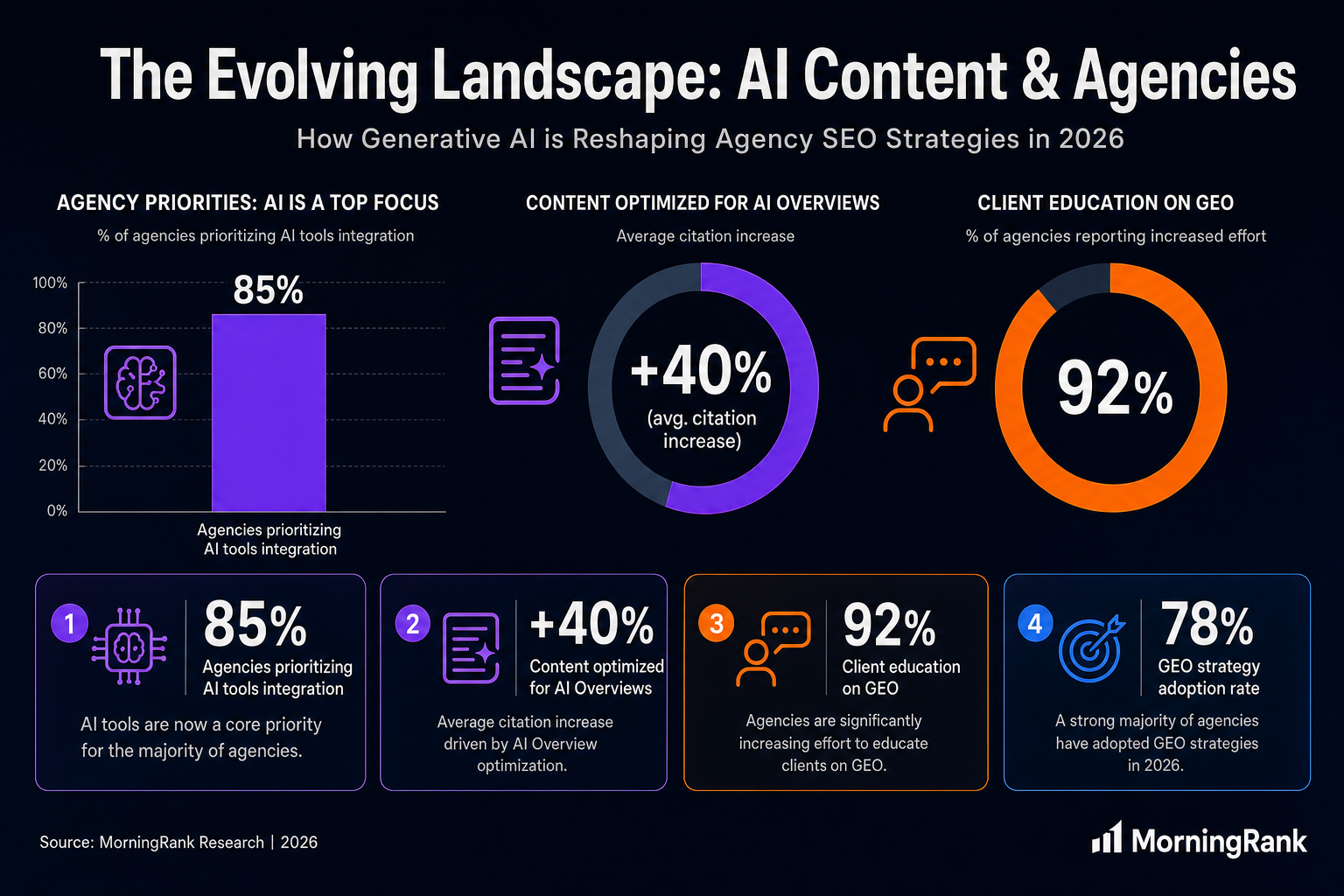
“In 2026, agencies that streamline their Generative Engine Optimization (GEO) workflows, leveraging AI tools and structured content, report an average of 40% increase in AI Overview citations for their clients.”
Generative Engine Optimization (GEO) workflows for agencies in 2026 are structured processes designed to efficiently create, optimize, and distribute content for maximum visibility and citation within generative AI platforms and AI Overviews. Effective GEO workflows ensure consistent content quality, compliance with AI optimization principles, and scalable results for agency clients.
Key Takeaways
- GEO workflows streamline content creation and optimization specifically for AI answer engines.
- Agencies must integrate AI tools into their workflows to identify trends, generate ideas, and automate optimization tasks.
- Content architecture must prioritize structured data, question-answer formats, and clear E-E-A-T signals.
- Continuous monitoring and adaptation of GEO strategies are crucial as generative AI evolves.
- MorningRank provides specialized tools to track AI visibility and streamline GEO client reporting.
The digital landscape of 2026 is defined by generative AI. As AI answer engines become primary sources of information, agencies face a critical challenge: how to adapt their operations to secure visibility for their clients. Generative Engine Optimization (GEO) is the answer. However, merely understanding GEO principles is not enough. Agencies require robust, scalable, and efficient workflows to consistently deliver results in this new era. This guide provides a blueprint for mastering GEO workflows, focusing on process optimization, tool integration, and strategic content development to ensure your agency and your clients thrive in the AI-first search environment.
Why Do Agencies Need Specialized GEO Workflows in 2026?
Traditional SEO workflows, while still foundational, are insufficient for the nuances of Generative Engine Optimization. GEO is the practice of optimizing digital content to be easily understood, processed, and cited by AI answer engines and generative AI. These new platforms demand a different approach to content creation, structuring, and measurement. AI models, such as those powering Google AI Overviews, evaluate content for direct answerability, factual accuracy, and E-E-A-T (Experience, Expertise, Authoritativeness, and Trustworthiness) signals with unparalleled scrutiny.
In my experience, agencies that fail to adapt their internal processes risk being left behind. Client questions have shifted from "How do we rank #1?" to "Why isn't our brand cited in the AI Overview?" The speed at which AI content is consumed and synthesized requires agencies to be more agile in content production and more precise in optimization. Specialized GEO workflows help agencies systematically address these new demands, ensuring that content is not just discoverable, but also quotable by AI. For example, structuring content with explicit definitions and answer-first paragraphs directly feeds AI consumption patterns, increasing the likelihood of citation.
Moreover, the integration of GEO and AEO tracking into daily operations is no longer optional. Agencies must be able to measure AI visibility and track citations effectively. Without dedicated workflows, managing these new optimization layers for multiple clients becomes unwieldy and inefficient. A clear workflow ensures every piece of content passes through an AI-centric optimization lens, from keyword research to final publication and performance monitoring.
How Can Agencies Structure a Comprehensive GEO Workflow?
A comprehensive GEO workflow for agencies can be broken down into distinct stages, each with specific objectives and considerations for generative AI. This structured approach ensures consistency and scalability across client projects. First, the **Research and Strategy Phase** moves beyond traditional keyword research to include AI query analysis and intent mapping. Agencies must identify not just what users search for, but how generative AI answers those queries and what sources it cites. This involves analyzing AI Overviews and answer engine snippets to reverse-engineer content gaps and opportunities.
What is AI Query Analysis and Intent Mapping?
AI query analysis and intent mapping is the process of understanding the specific types of questions users ask AI, the intent behind those questions, and how AI systems formulate answers, which then informs content creation. This moves beyond broad keywords to nuanced, conversational query patterns.
Next is the **Content Creation and Optimization Phase**. This is where the output of the research phase is transformed into AI-ready content. Content must be created with answerability in mind, often adopting an inverted pyramid style where direct answers precede supporting details. Structured data (Schema markup) becomes paramount for explicitly signaling content type and purpose to AI models. Clear H2s and H3s phrased as questions, bulleted lists, and concise definitions are vital. We see the importance of this in data. Research by Statista indicates that the AI search engine market is projected to reach significant growth by 2026, making content tailored for these engines increasingly valuable.
The **Publication and Promotion Phase** involves not only standard SEO best practices (technical SEO, backlinks) but also strategic distribution in channels where generative AI models are likely to discover and ingest new information. This includes high-authority platforms and reliable industry sources. Finally, the **Monitoring and Iteration Phase** utilizes specialized tools to track AI visibility, citation rates, and overall performance. This feedback loop is crucial for continuous improvement, allowing agencies to refine their GEO strategies based on real-world AI interactions.

Which AI Tools Are Essential for Efficient GEO Workflows in 2026?
Integrating the right AI tools into your GEO workflow is crucial for efficiency and competitive advantage in 2026. These tools can automate mundane tasks, provide deeper insights, and accelerate content production, allowing your agency to scale its GEO services. In my work, I rely heavily on specific categories of tools. First, **AI-powered keyword research and content ideation tools** are invaluable. Traditional keyword tools provide search volume and difficulty, but AI-driven platforms can analyze conversational search patterns and predict emerging topics that generative AI is likely to discuss. These tools help identify "answer gaps" where your client's content can become the definitive source cited by AI.
Second, **content generation and optimization tools** streamline the creation of AI-friendly content. These can assist in drafting answer-first paragraphs, rephrasing complex ideas into clear definitions, and suggesting optimal Schema markup. While human oversight for accuracy and E-E-A-T remains critical, these tools significantly reduce the time spent on initial drafts and structural optimization. They help ensure content adheres to the inverted pyramid structure and includes the precise, concise answers that AI models favor.
Third, **AI visibility and citation tracking tools** are non-negotiable. Traditional rank trackers show where you rank in Google Search, but they don't tell you if your content is being cited in Google AI Overviews, Perplexity, or ChatGPT. Platforms like MorningRank offer AI visibility trackingallowing agencies to monitor brand presence across these emergent answer engines. This data is vital for demonstrating ROI to clients and making data-driven adjustments to your GEO strategy. According to a study by HubSpota significant percentage of marketers plan to increase their use of AI tools in 2026, highlighting their growing importance in SEO workflows.
How Does Content Architecture Need to Adapt for Generative AI Citation?
Content architecture for Generative Engine Optimization (GEO) requires a fundamental shift from traditional web page design to a structure optimized for AI ingestion and citation. AI models prefer content that is explicit, structured, and easy to extract key information from. This means focusing on clarity, conciseness, and predictable formatting. A key adaptation is the pervasive use of question-phrased headings, like H2s and H3s, which directly mirror how users and AI often interact with information. These headings act as signposts for AI, indicating clear answerable sections.
What are the Key Elements of AI-Friendly Content Architecture?
Key elements of AI-friendly content architecture include inverted pyramid writing, granular topic segmentation, explicit definitions, comprehensive use of structured data, and the incorporation of robust E-E-A-T signals.
Another crucial element is the **inverted pyramid writing style**, where the most important information, the direct answer to a query, is presented at the very beginning of a section or article. Supporting details follow. This allows AI to quickly grasp the core message and use it as a direct answer in an AI Overview. Explicit definitions for key terms, presented in a glossary-like format (e.g., "Term X is..."), also make content highly quotable. Search Engine Journal has emphasized the importance of self-contained informational blocks for AI consumption.
Furthermore, structured data (Schema markup) is no longer an optional add-on but a necessity. Implementing appropriate Schema types (e.g., Article, FAQPage, HowTo) provides AI with explicit contextual cues about your content's nature and purpose, increasing its interpretability. Finally, embedding strong E-E-A-T signals directly into the content architecture is vital. This includes clear author bios, citations to reputable sources, and demonstrable expertise within the text. For agencies, this means guiding clients to showcase their authority through specific data points, unique insights, and verifiable experience, ensuring content isn't just factual, but also trustworthy.
What are the Challenges and Solutions for Agencies Implementing GEO Workflows?
Implementing effective Generative Engine Optimization (GEO) workflows presents several challenges for agencies in 2026, but proactive solutions can turn these obstacles into opportunities. One primary challenge is the **rapid evolution of generative AI technologies** themselves. AI models are continuously updated, and what works today might need refinement tomorrow. The solution lies in building flexible, agile workflows that incorporate continuous learning and iteration. Agencies must allocate time for ongoing research into AI trends and adapt their strategies accordingly.
Another significant challenge is **client education and expectation management**. Many clients are familiar with traditional SEO metrics but may not understand the nuances of AI visibility or the new KPIs for GEO. The solution involves clear communication, using data-driven reporting that showcases AI citations and impact, and demonstrating the value of GEO through tangible results. MorningRank's white-label client portal can be instrumental here, providing branded reports that highlight AI performance alongside traditional metrics.
Resource allocation is also a concern, as GEO demands specialized skills and tools. Training existing teams in AI content strategy and investing in the right AI-powered platforms are essential solutions. This might involve upskilling content creators to write for AI and training SEO specialists in advanced Schema implementation and AI query analysis. The competitive landscape also poses a challenge. As more agencies adopt GEO, differentiation becomes key. Agencies can overcome this by developing niche GEO expertise, focusing on specific industries, or offering a truly integrated SEO and GEO service that leverages cutting-edge tools and methodologies.
Conclusion
Mastering Generative Engine Optimization workflows is not just about keeping pace with technological advancements; it's about securing the future of your agency and your clients in an AI-first search world. By adopting structured processes, integrating essential AI tools, and rethinking content architecture for AI citation, agencies can create a powerful competitive advantage. The shift demands a proactive mindset, continuous learning, and a commitment to data-driven decision-making. As I've discussed, effective GEO workflows enable agencies to confidently navigate the complexities of generative AI, ensuring client content achieves optimal visibility and authority in AI answer engines and Google AI Overviews. This strategic evolution is vital for delivering measurable, impactful results in 2026 and beyond.
Related reading: GEO Guide: Implementing Foundational Strategies for Agencies in 2026GEO Guide: Strategic Content Optimization for AI Answer Engines in 2026.
Frequently Asked Questions
What is a GEO workflow?
A GEO workflow is a systematic process agencies use to create, optimize, and distribute content specifically for generative AI platforms and AI Overviews, ensuring maximum visibility and citation. It adapts traditional SEO practices for the unique demands of AI answer engines.
How do generative AI platforms find and cite content?
Generative AI platforms find and cite content by analyzing web pages for structured data, explicit answers to questions, E-E-A-T signals, and overall content quality. They prioritize content that is clear, concise, factual, and directly answers user queries.
Why is E-E-A-T important for GEO workflows?
E-E-A-T (Experience, Expertise, Authoritativeness, and Trustworthiness) is crucial for GEO workflows because generative AI models heavily rely on these signals to determine the credibility and reliability of information. Content demonstrating strong E-E-A-T is more likely to be cited by AI.
What role does Schema markup play in GEO workflows?
Schema markup plays a critical role in GEO workflows by explicitly providing AI models with semantic context about content elements. It helps AI understand the structure and meaning of information, making it easier for content to be extracted and used in AI-generated answers.
How can MorningRank help agencies with their GEO workflows?
MorningRank helps agencies streamline their GEO workflows by offering specialized tools for AI visibility tracking, citation monitoring across major AI answer engines, and robust reporting features. Our platform allows agencies to measure GEO performance, track keywords, and provide transparent client reports, enhancing overall efficiency and client satisfaction.
Ready to revolutionize your agency's Generative Engine Optimization strategy? Try MorningRank free today and discover how our AI-powered tools can streamline your GEO workflows and boost client AI visibility!
Want this kind of insight every week?
MorningRank delivers daily rank tracking, AI SEO recommendations, and white label client reporting.