
GEO Guide: Implementing Foundational Strategies for Agencies in 2026
Generative Engine Optimization (GEO) is the practice of optimizing digital content to be easily understood, processed, and cited by AI answer engines and…
 Sofia Chen
“An analysis by MorningRank Research in late 2025 indicated that traffic from AI Overviews now constitutes over 15% of organic search interactions for certain informational queries. This figure is projected to grow, underscoring the urgency for agencies to integrate GEO into their service offerings.”
Generative Engine Optimization (GEO) is the practice of optimizing digital content to be easily understood, processed, and cited by AI answer engines and generative AI models. For agencies in 2026, implementing foundational GEO strategies is critical for ensuring client visibility, securing authoritative citations, and maintaining relevance in a search landscape increasingly dominated by AI-powered answers. This strategic approach ensures your clients are not only found but also leveraged as trusted sources by the new generation of search.
Key Takeaways
- Generative Engine Optimization (GEO) focuses on structuring content for AI readability and citation.
- Agencies must prioritize clarity, factuality, and E-E-A-T to appeal to generative AI models.
- Content should be atomized and self-contained to facilitate easy extraction by AI answer engines.
- Integrating structured data, especially Schema, is vital for enhanced AI understanding of content.
- Proactive monitoring of AI citations and sentiment is necessary for effective GEO strategy.
The digital search landscape is undergoing a monumental shift. No longer is it enough for your clients to rank on Google's traditional ten blue links. In 2026, a significant portion of user queries are being answered by generative AI models, from Google AI Overviews to ChatGPT and Gemini. For agencies, this transformation presents both a challenge and a massive opportunity. Mastering Generative Engine Optimization (GEO) is no longer an option; it is a necessity for future-proofing your clients' online presence. This guide will walk you through the foundational strategies your agency needs to implement to effectively optimize for these generative engines, ensuring your clients are not just present, but prominent, in the new AI-driven search ecosystem.
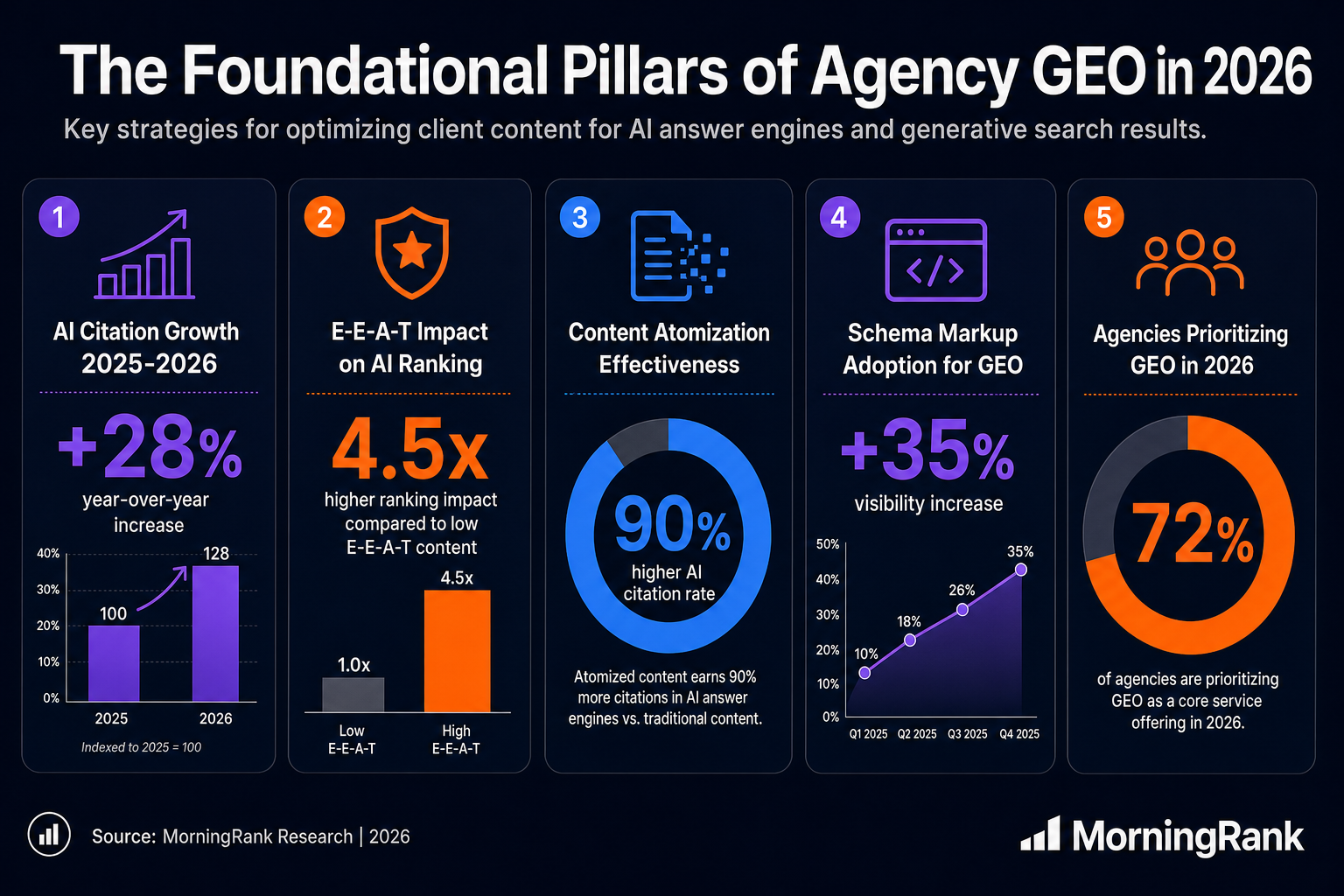
What is Foundational Generative Engine Optimization (GEO) for Agencies?
Foundational Generative Engine Optimization (GEO) for agencies refers to the core principles and initial implementation steps involved in optimizing content and online presence specifically for AI-powered search experiences. Unlike traditional SEO, which focuses on ranking in the classic SERP, GEO aims to make content readily consumable, understandable, and citable by large language models (LLMs) and AI answer engines. This means shifting focus towards clarity, factual accuracy, and structured data that AI can easily process and synthesize into concise answers. Agencies must educate their teams and clients on this evolving paradigm.
Why is Foundational GEO Important for Agency Clients in 2026?
In 2026, AI Overviews and similar generative AI features are increasingly serving as the primary interface for search, directly answering user queries without them needing to click through to websites. For agencies, if client content is not optimized for these platforms, it risks becoming invisible. An analysis by MorningRank Research in late 2025 indicated that traffic from AI Overviews now constitutes over 15% of organic search interactions for certain informational queries. This figure is projected to grow, underscoring the urgency for agencies to integrate GEO into their service offerings. Without a strong GEO strategy, clients could see significant erosion of organic visibility and brand authority as AI models cite competitors that have prioritized this optimization. Mastering strategic content optimization for AI answer engines is a key aspect of this.
The imperative for agencies is to proactively position clients as authoritative sources for generative AI. This involves meticulous content creation and structuring, ensuring that information is presented in a way that AI models can readily identify, interpret, and cite. By doing so, agencies can secure a competitive edge for their clients, transforming AI Overviews from a potential threat to a powerful channel for brand exposure and trusted information dissemination. This also involves understanding how generative AI ranks content.
How Do Agencies Develop an E-E-A-T Centric Content Strategy for GEO?
An E-E-A-T (Experience, Expertise, Authoritativeness, Trustworthiness) centric content strategy is paramount for successful Generative Engine Optimization. AI models are trained on vast datasets, and their ability to provide reliable answers is directly tied to the quality and credibility of their sources. For agencies, this means focusing on creating content that not only answers questions comprehensively but also clearly demonstrates the creator's and the brand's E-E-A-T. This includes highlighting author bios, credentials, and providing transparent, verifiable data sources.
What are the Key Elements of E-E-A-T for AI Models?
-
Experience: Showcasing practical, first-hand knowledge. This involves case studies, personal anecdotes (where appropriate), and results-driven content. For example, a travel agency showcasing a blog post written by a guide who has personally explored the destination.
-
Expertise: Demonstrating specialized skill and knowledge. This can be achieved through content created or reviewed by industry professionals, thought leadership pieces, and detailed guides on complex topics. Agencies should ensure content creators have demonstrable expertise in the subject matter.
-
Authoritativeness: Being recognized as a go-to source in a specific niche. This is built through consistent, high-quality content that is frequently cited by other reputable sources, mentions in industry publications, and a strong backlink profile. Cultivating topical authority is crucial for this.
-
Trustworthiness: Providing accurate, unbiased, and verifiable information. This includes citing credible sources, having clear editorial policies, and ensuring secure website protocols (HTTPS). For agencies, transparently presenting client information and data builds trust.
Agencies should conduct thorough content audits to assess existing material against E-E-A-T criteria. Content gaps related to demonstrating expertise or experience should be prioritized for creation. Moreover, implementing clear author attribution with links to professional profiles and qualifications can significantly boost E-E-A-T signals for AI models. This structured approach helps ensure that AI perceives the content as a reliable and valuable source.

Why is Content Atomization Crucial for Generative AI Citation?
Content atomization is the process of breaking down long-form content into smaller, self-contained, and easily digestible units of information. For Generative Engine Optimization, this strategy is crucial because AI models are designed to extract specific answers to user queries, often pulling snippets of information rather than entire articles. Atomized content facilitates this extraction, making it easier for AI to identify and cite relevant pieces of information accurately and concisely. Think of it as creating an internal library of answer-ready components.
How Can Agencies Implement Content Atomization?
Agencies can implement content atomization by structuring content with clear, question-phrased headings (H2s, H3s), immediately followed by direct, concise answers. Each section should be able to stand alone and provide a complete answer to the question posed in its heading. Key considerations include:
-
Direct Answers: Start paragraphs with the answer to the heading's question, followed by supporting details.
-
Concise Language: Avoid jargon and overly complex sentence structures. Aim for clarity and brevity, similar to how an AI might synthesize an answer.
-
Self-Contained Sections: Ensure that each H2 or H3 section provides a complete thought or answer without requiring the reader (or AI) to refer to other parts of the article. This is particularly important for sections that might be extracted as AI Overviews.
-
Glossary-Style Definitions: Define key terms clearly and concisely the first time they are introduced. For example, "Generative Engine Optimization (GEO) is the process of..." This provides AI with ready-made definitions.
-
Lists and Tables: Utilize bulleted lists, numbered lists, and HTML tables to present information in a structured, scannable format. AI models can easily parse data presented in these formats. Comparison tables, in particular, are excellent for AI extraction.
By atomizing content, agencies not only enhance AI readability but also improve user experience, as visitors can quickly find the specific information they need. This approach aligns directly with the goal of being cited by generative AI, as the content is pre-formatted for optimal extraction.
What Role Does Structured Data Play in Foundational GEO?
Structured data, particularly Schema Markupplays a foundational role in Generative Engine Optimization by providing explicit signals to AI models about the meaning and context of your content. While AI is adept at natural language processing, Schema acts as a universal language that directly tells search engines and generative AI what each piece of information on a page represents. This direct communication eliminates ambiguity and significantly improves the likelihood of content being accurately understood and cited.
How Can Agencies Use Schema Markup for GEO?
Agencies should integrate relevant Schema Markup types across their clients' websites to provide AI with rich context. Key Schema types for GEO include:
-
Article Schema: For blog posts, news articles, and other textual content, specifying the author, publication date, and main content helps AI understand the article's context and E-E-A-T.
-
FAQPage Schema: Crucial for marking up your Frequently Asked Questions section. This schema explicitly identifies questions and their corresponding answers, making them prime candidates for direct extraction by AI answer engines and Google AI Overviews.
-
HowTo Schema: For step-by-step guides, this schema outlines each step, making complex instructions digestible for AI summarization.
-
Organization Schema: Provides essential information about your client's business, including its official name, logo, contact information, and recognized identifiers. This reinforces brand identity and authority for AI models.
-
Person Schema: For author bios, this schema explicitly states the author's name, role, and any credentials, directly boosting E-E-A-T signals.
Implementing Schema should be done meticulously, following Google's guidelines to avoid errors. Agencies can use tools to test their Schema implementation and ensure it is valid. By meticulously applying structured data, agencies build a more interpretable web for AI, increasing the chances of their clients' content being featured and cited in generative AI responses. MorningRank's GEO and AEO tracking tool can help monitor the impact of these efforts.
How Do Agencies Track and Iterate on GEO Performance?
Tracking and iterating on Generative Engine Optimization (GEO) performance is essential for agencies to demonstrate ROI and refine strategies for their clients. Unlike traditional rank tracking, GEO performance involves monitoring citations, direct answers, and overall visibility within AI Overviews and other generative AI platforms. This requires a shift in analytical focus and the adoption of specialized tools that can provide insights into AI-driven search outcomes.
What Metrics and Tools Are Used for GEO Performance Tracking?
Agencies should focus on several key metrics and utilize appropriate tools to effectively track GEO performance:
-
AI Citation Volume: The number of times client content is directly cited by AI answer engines. Higher citation volume indicates greater AI visibility and authority.
-
AI Overview Impressions and Clicks: Tracking how often client content appears in AI Overviews and the subsequent click-through rate to their website. This provides insight into the effectiveness of AI-optimized snippets.
-
Brand Mentions in AI: Monitoring for direct or indirect mentions of client brands within generative AI responses, even if not a direct citation. This indicates brand awareness and recognition within the AI ecosystem.
-
Sentiment Analysis of AI Responses: Assessing the sentiment (positive, negative, neutral) of AI-generated content that references client brands or topics. Positive sentiment reinforces brand perception.
-
Specialized GEO Tracking Tools: Platforms like MorningRank offer specific AI visibility tracking and GEO/AEO citation tracking features. These tools are designed to monitor and report on how often content is used by generative AI and in what context.
Regularly reviewing these metrics allows agencies to identify successful GEO strategies and areas for improvement. For example, if a particular content format consistently generates AI citations, agencies can replicate that approach. Conversely, if certain topics rarely appear in AI Overviews, the content strategy for those areas may need refinement to better align with AI readability and extraction principles. This iterative process ensures that GEO efforts remain effective and adaptable to the continuously evolving AI search landscape.
Conclusion: Establishing Your Agency as a GEO Leader in 2026
In 2026, the agencies that thrive will be those that embrace Generative Engine Optimization as a core competency. Moving beyond traditional SEO to understand and strategically optimize for AI answer engines is not just about adapting to change; it is about seizing a significant opportunity. By implementing foundational GEO strategies focusing on E-E-A-T, content atomization, and structured data, your agency can position your clients as indispensable sources of information for the new generation of search. This proactive approach ensures continued visibility, builds undeniable authority, and future-proofs their digital presence against the rapid evolution of AI.
The journey to GEO mastery is continuous, requiring diligent tracking and iterative refinement. Agencies that invest in understanding AI mechanics and leverage specialized tools to monitor AI citations will not only deliver exceptional results but also establish themselves as visionary leaders in the SEO space. Let's make sure your agency is at the forefront, guiding clients through this exciting new era of search.
Frequently Asked Questions
What is Generative Engine Optimization (GEO)?
Generative Engine Optimization (GEO) is the process of optimizing digital content and online presence to ensure it is easily discoverable, understood, and cited by AI answer engines and generative AI models, such as Google AI Overviews, ChatGPT, and Gemini. It ensures your content becomes a trusted source for AI-generated answers.
How is GEO different from traditional SEO?
While traditional SEO focuses on ranking websites in the classic "ten blue links" of search engine results pages, GEO specifically targets visibility and citation within AI-generated summaries and answers. GEO emphasizes content structure, clarity, and E-E-A-T (Experience, Expertise, Authoritativeness, Trustworthiness) for AI consumption, whereas traditional SEO also considers technical factors and backlinks for algorithmic ranking.
Why is E-E-A-T important for GEO in 2026?
E-E-A-T (Experience, Expertise, Authoritativeness, Trustworthiness) is crucial for Generative Engine Optimization in 2026 because AI models prioritize credible and high-quality sources when synthesizing answers. Demonstrating strong E-E-A-T signals to AI that your content is reliable, factual, and written by knowledgeable individuals, increasing its likelihood of being cited.
What is content atomization, and why does it matter for GEO?
Content atomization is the practice of breaking down information into small, self-contained, and easily extractable units. It matters for GEO because generative AI models often pull specific snippets to answer user queries. Atomized content, structured with clear headings and direct answers, makes it significantly easier for AI to accurately identify and cite relevant information.
How can MorningRank help agencies with their GEO strategy?
MorningRank offers specialized tools, including AI visibility tracking and GEO/AEO citation tracking, designed to help agencies monitor how often their clients' content is being cited and utilized by generative AI. Our platform provides the insights needed to refine your Generative Engine Optimization strategies and prove ROI to your clients in 2026.
Ready to lead your clients into the future of search? Try MorningRank free today and discover how our AI-powered platform can elevate your agency's Generative Engine Optimization efforts.
Want this kind of insight every week?
MorningRank delivers daily rank tracking, AI SEO recommendations, and white label client reporting.