SERP Features Explained: Featured Snippets, Local Pack, and AI Overview
SERP features like Featured Snippets, Local Pack, and AI Overview change how clicks are distributed in Google. Learn how to track and win each one.
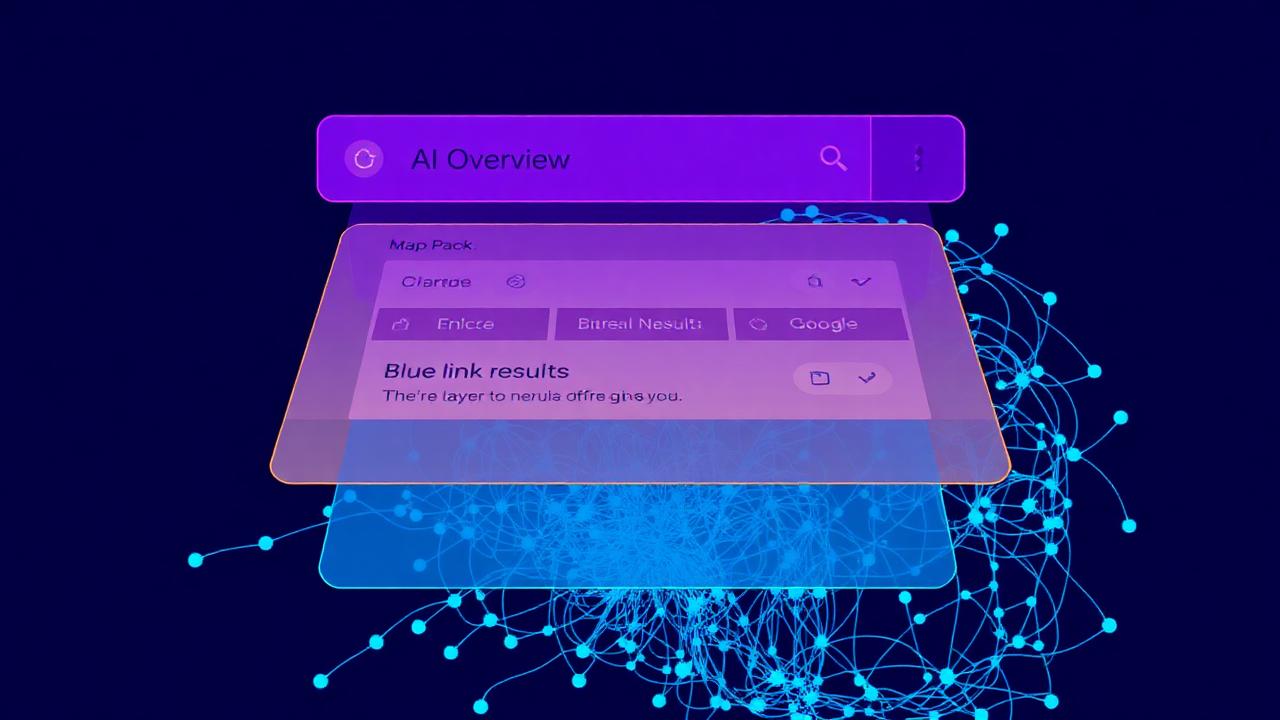
Open Google today and search for a generic head term in any category. Count how many distinct content blocks you see before the first 10 blue links. On most queries the answer is between four and seven: an AI Overview, a featured snippet, a local pack, a People Also Ask box, a video carousel, an image pack, sometimes a shopping module. The 10 blue links are no longer the SERP. They are one element of it.
If your SEO strategy still treats every keyword as a single position number, you are competing for a shrinking surface. The agencies and brands that win in 2026 understand each SERP feature as its own ranking layer with its own optimization rules. This is the working reference I hand every new strategist on the team.
Why SERP features matter more than ever
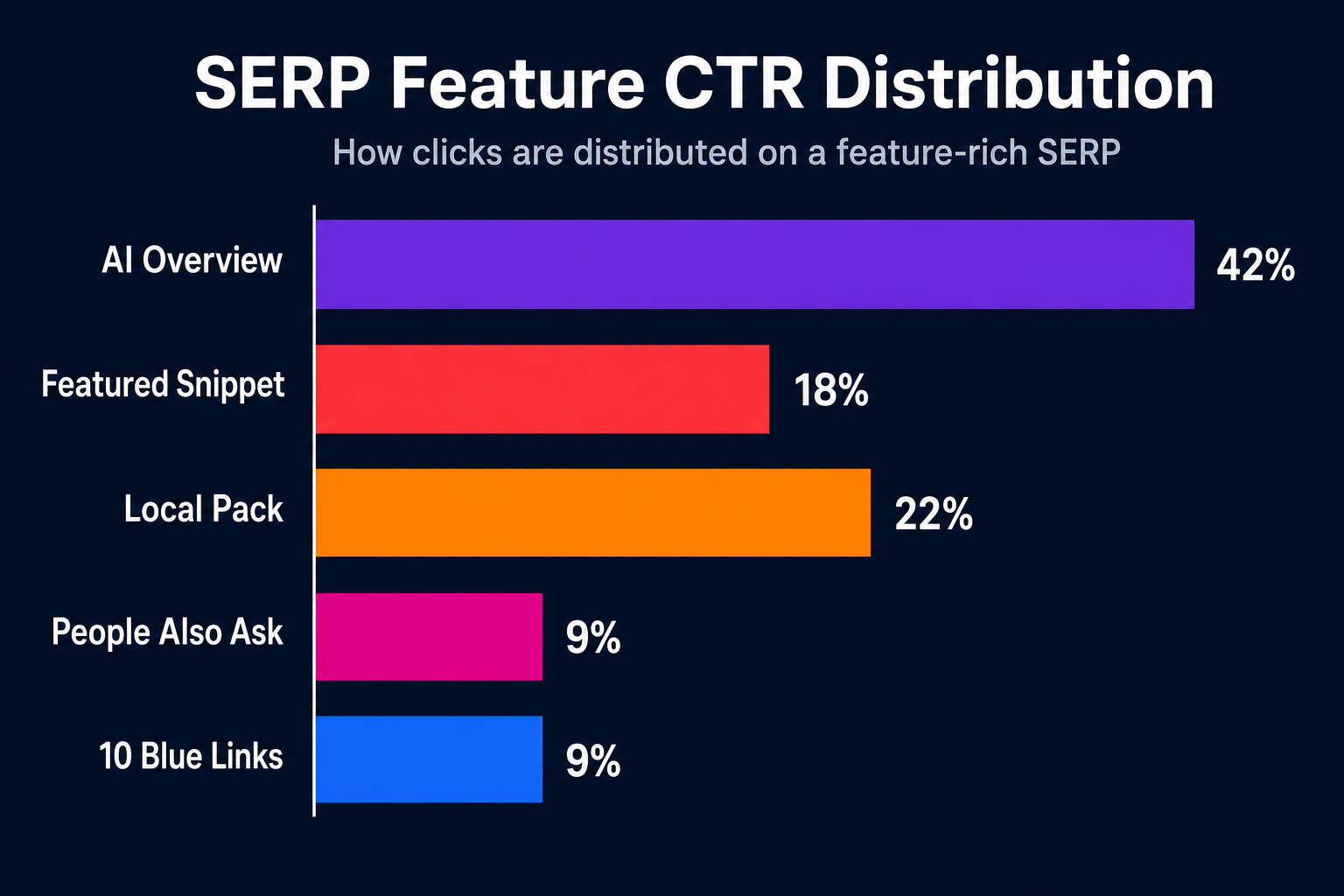
Click-through rate is no longer a function of position alone. Advanced Web Ranking's 2026 CTR study shows that on queries with an AI Overview present, the CTR of position 1 organic drops by roughly 35% compared to queries with no Overview. On queries with a local pack, position 1 organic loses roughly 25% of its CTR to the three pack listings above it. Position is still real. It is just not enough.
Tracking which SERP features each of your keywords triggers is now the prerequisite for prioritization. A keyword at position 4 with no SERP features above it can drive more clicks than a keyword at position 1 with an AI Overview, a local pack, and a video carousel stacked above it.
Featured Snippet
The featured snippet is the boxed answer pulled from a single page, usually shown above position 1. It still drives meaningful CTR on informational queries where AI Overview is not present.
How to win it
- Answer the literal question in the title in 40 to 60 words, ideally in the first paragraph.
- Use a clear H2 question style heading immediately above the answer paragraph.
- Use ordered or unordered lists when the query is procedural ("how to", "steps to").
- Use a clean comparison table when the query is comparative ("X vs Y").
- Add definitional structured data where applicable.
Local Pack
The local pack is the boxed set of three local business listings with a map. It runs on a separate algorithm dominated by Google Business Profile signals and has its own ranking layer that you should track distinctly from organic.
How to win it
- Verified Google Business Profile with the exact business name (no keyword stuffing).
- Most specific primary category plus relevant secondary categories.
- Steady review velocity with response rate above 95% within 24 hours.
- Consistent NAP across the 30 to 40 high-trust citations Google actually checks.
- Local link layer: chambers of commerce, local news, industry associations.
If you want the full local stack including grid tracking and reporting, our multi-location tracking guide covers it end to end.
AI Overview
AI Overviews are the generative answer block at the top of roughly 47% of informational queries. They cite 3 to 5 sources, and being one of those citations is now the most valuable real estate on the SERP.
How to win citation
- Answer first formatting: the literal answer to the title's question lives in sentence one.
- Original data, screenshots, methodology, or a proprietary framework that cannot be paraphrased away.
- Strong author byline with credentials, sameAs schema, and a real Author page.
- Article, FAQ, HowTo, and Author schema applied where relevant.
- Topical depth: a hub-and-spoke cluster of supporting pages, not a single asset.
The deeper pattern analysis is in our AI search strategy guide.
People Also Ask
PAA boxes expand into related questions and pull answers from individual pages. Winning a PAA slot is one of the cheapest visibility wins available because the optimization is mostly about format.
How to win it
- Build an FAQ section on every relevant page with 5 to 8 questions in customer language.
- Use FAQPage schema markup.
- Phrase the H3 heading as the literal question, then answer it in 40 to 60 words below.
- Mine PAA itself for question ideas: every PAA expansion exposes more PAA questions.
Shopping Results
Shopping results show product cards with image, price, and rating, pulled from Google Merchant Center and from organic product pages with strong product schema.
How to win it
- Set up a Merchant Center feed with all required attributes filled.
- Add Product schema (offer, price, availability, aggregateRating, review) to every product page.
- Maintain accurate inventory and pricing in the feed. Mismatches with the page get the listing dropped.
- Optimize product titles using the buyer's actual phrasing, not internal SKU language.
Video Carousel
Video carousels surface YouTube videos in a horizontal strip on roughly 30% of how-to and review queries.
How to win it
- Optimize the YouTube title with the exact target query.
- Add chapters with timestamped descriptive labels.
- Use a high-contrast custom thumbnail with on-frame text.
- Embed the video on a relevant page on your site to add a second discovery surface.
Sitelinks
Sitelinks are the indented links that appear under your top organic listing for branded and authoritative queries. You do not directly control them; you influence them with site architecture.
How to win them
- Clean, shallow site architecture with descriptive top-level URLs.
- Strong internal linking with descriptive anchor text from the homepage to key category pages.
- Clear page titles and metas on the pages you want surfaced.
- Brand authority. Sitelinks reward dominant entities; they do not appear for new domains.
Image Pack
Image packs surface a row of images on visual queries. They drive real traffic on product, recipe, design, and how-to terms.
How to win it
- Use original photography. Google Vision detects stock and discounts it.
- Descriptive file names (red-leather-handbag.jpg, not IMG_4823.jpg).
- Descriptive alt text written for screen readers, not stuffed for keywords.
- Image schema and proper sitemap inclusion.
- Compress images aggressively. Page speed is part of the image ranking signal.
How tracking SERP features changes prioritization
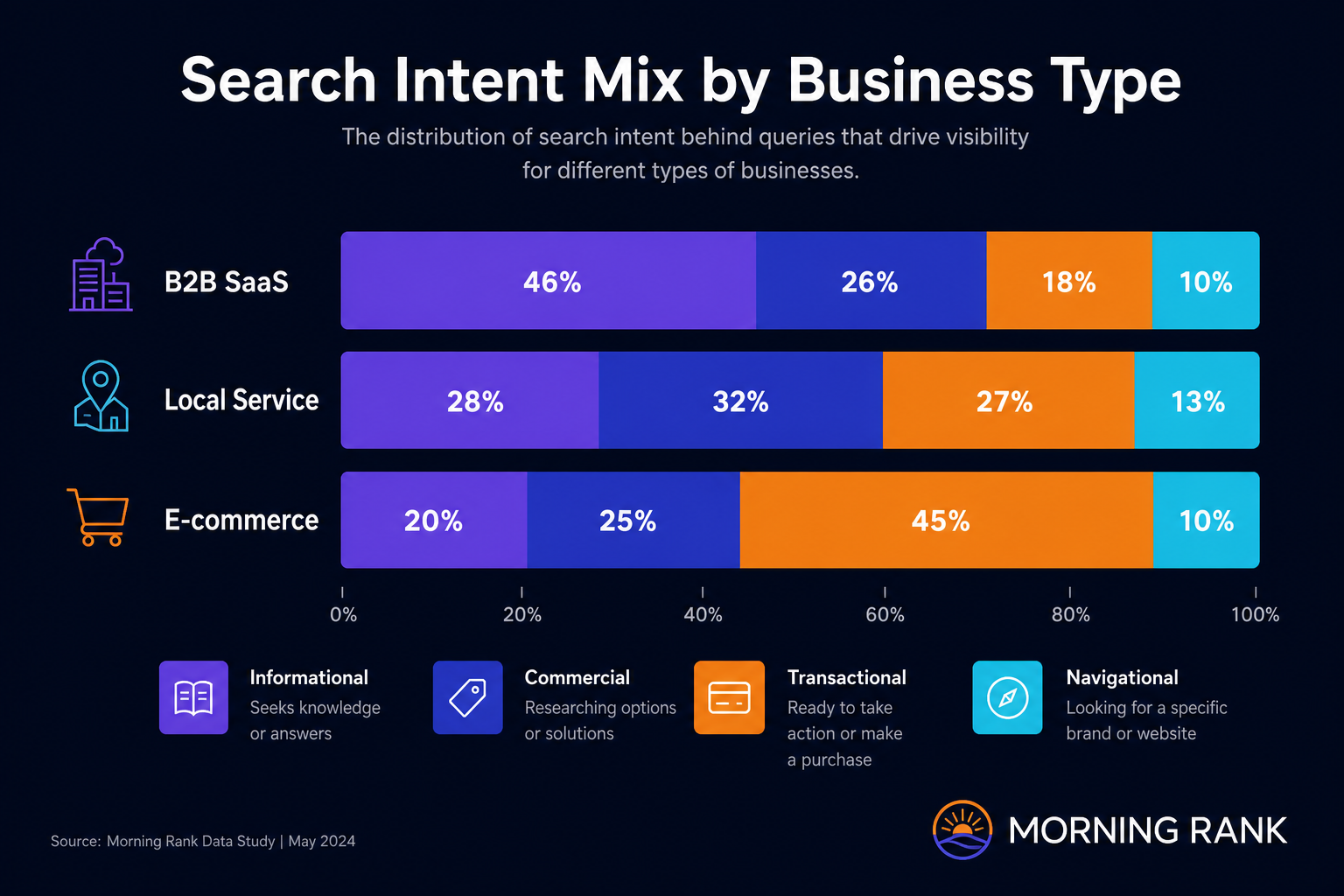
Once you know which features each keyword triggers, prioritization stops being a difficulty score exercise. Two keywords with identical volume and difficulty can have wildly different opportunity profiles. The one with no AI Overview, no local pack, and a clean SERP is worth far more clicks at the same position than the one with three feature boxes stacked above the organic results.
MorningRank tracks the full SERP feature set per keyword every day, displayed with icons next to each tracked term. You can filter the keyword list by which features are present, which features you currently win, and which features your competitors win. The filtering view is the part most strategists use daily because it answers the prioritization question without a spreadsheet. Full module details are on the features page.
A prioritization framework
When auditing a new client's keyword list, I sort by SERP feature opportunity in this order:
- Tier 1: keywords with AI Overview present where the client is not cited and 1 to 2 competitors are. Highest leverage and the gap is winnable.
- Tier 2: keywords with local pack present (for local businesses) where the client is outside the 3-pack. Direct revenue impact, fast feedback loop.
- Tier 3: keywords with PAA or featured snippet opportunity and the client is on page 1 but not in the snippet. Cheap wins.
- Tier 4: keywords with image pack, video carousel, or shopping opportunity that match the business model.
- Tier 5: clean SERPs (no major features) where the client is on page 2. Standard organic optimization.
This framework moves the conversation off difficulty and onto opportunity. Clients understand it intuitively because the language matches what they actually see when they search.
Closing thought
Modern SEO is not about ranking for keywords. It is about appearing in the specific surfaces that distribute clicks for those keywords. Track the feature set, prioritize by feature opportunity, and optimize each layer with its own playbook. The agencies that internalize this stop arguing with clients about position numbers and start showing up in the boxes that own the SERP.
"Track AI citations, local pack presence, and featured snippets alongside traditional organic position."
About the author
Tyler Morgan
Head of SEO, Morning Rank
Tyler writes about agency SEO strategy, rankings, AI search, and competitor research at Morning Rank.
Want this kind of insight every week?
MorningRank delivers daily keyword rank tracking, AI SEO recommendations, GA4 integration, and white label client reporting.