
Understanding Google Algorithm Update Types and Their Implications for 2026 SEO
Google algorithm updates are continuous modifications to the search engine's ranking systems, designed to improve the quality and relevance of search results.
 Christina Blair
“In the fluid landscape of Google algorithm updates, the agencies that thrive are those committed to continuous learning and the relentless pursuit of user-centric excellence, consistently outperforming competitors by adapting faster and smarter.”
Google algorithm updates are continuous modifications to the search engine's ranking systems, designed to improve the quality and relevance of search results. To effectively adapt your SEO strategy in 2026, it is essential to understand the various types of updates Google rolls out, from broad core updates to more niche, targeted adjustments. This knowledge allows agencies and local businesses to proactively build resilient websites that align with Google's evolving standards.
Key Takeaways
- Google algorithm updates are categorized into major core updates, spam updates, and focused updates, each with distinct goals and impacts.
- Core updates focus on overall search quality and relevance, often requiring broad content and E-E-A-T improvements.
- Spam updates target manipulative practices, emphasizing the importance of ethical, white-hat SEO techniques.
- Focused updates, like those for local search or product reviews, demand specialized optimization efforts.
- Proactive SEO, emphasizing quality content and technical excellence, is the best defense against negative update impacts.
Google's algorithms are not static, they are a constantly evolving system. As a local search specialist, I've observed firsthand how these changes can significantly impact a business's online visibility. From broad core updates that reshape the entire search landscape to targeted adjustments focusing on specific search verticals, staying informed and adaptable is paramount. This guide will demystify the different types of Google algorithm updatesexplain their implications for SEO in 2026, and provide actionable strategies for your agency or local business to not just survive, but thrive amidst these changes.
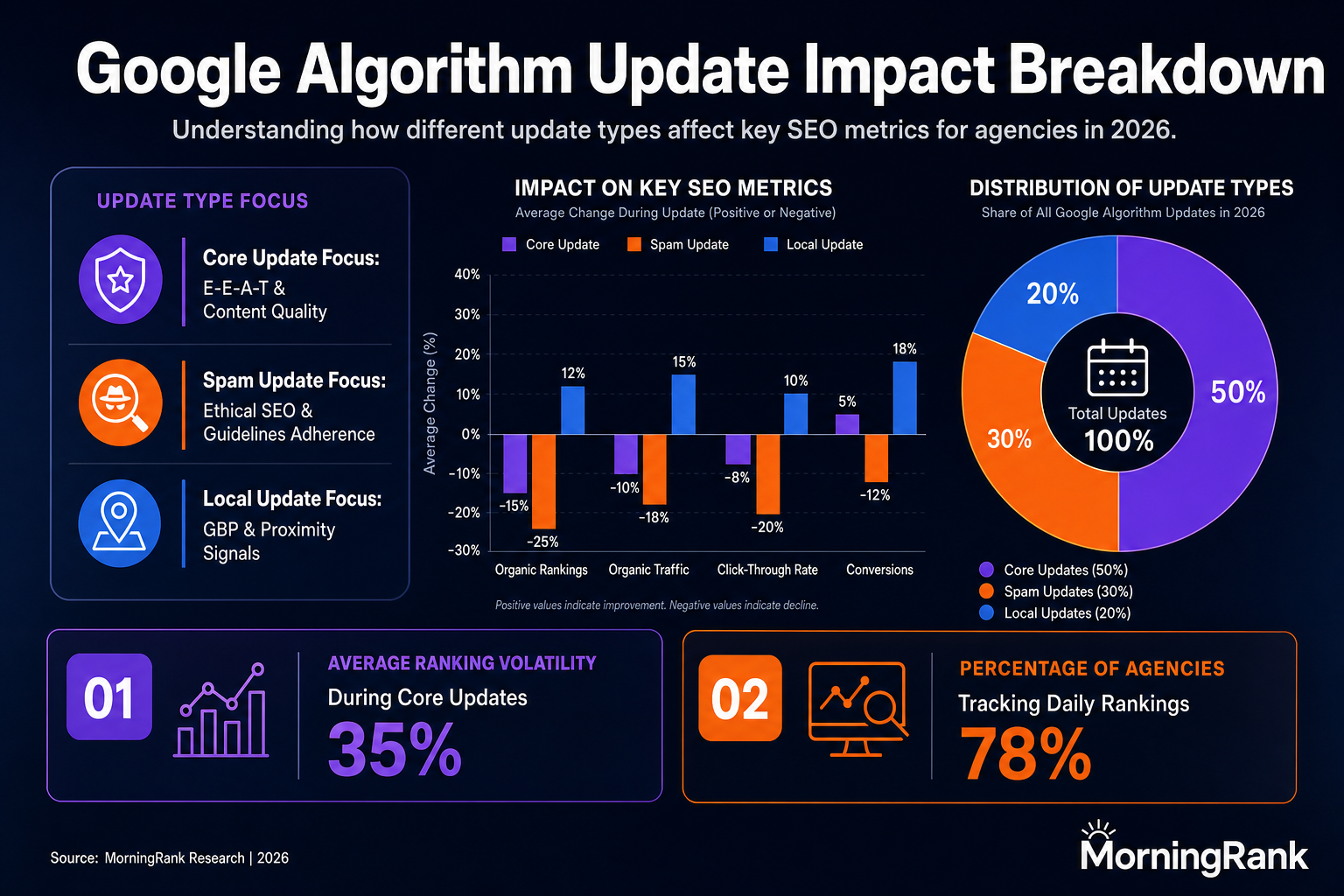
What Are the Primary Google Algorithm Update Types in 2026?
Google implements several types of algorithm updates, each serving a distinct purpose in refining search results. Understanding these classifications helps SEO professionals predict potential impacts and formulate appropriate responses.
Core Updates: General Quality Improvements
A Google core update is a broad change to Google's overall search ranking algorithms, designed to improve the quality and relevance of search results. These updates are not aimed at specific niches but rather at how Google assesses content across the web. They often involve recalibrating how Google understands and evaluates factors like E-E-A-T (Experience, Expertise, Authoritativeness, and Trustworthiness), content quality, and overall user experience.
When a core update rolls out, you might see significant ranking fluctuations across various industries. Sites that see declines often lack perceived E-E-A-T or have content that Google deems less helpful or authoritative. For example, a site with thin content or a poor reputation might experience a drop. Conversely, sites with well-researched, original, and expert-driven content often see gains. In my experience, focusing on creating truly valuable content, backed by demonstrable expertise, is the best long-term strategy for navigating core updates.
Spam Updates: Combating Low-Quality Content
Google spam updates are targeted algorithm adjustments specifically designed to identify and demote content that violates Google's Webmaster Guidelines, often through manipulative tactics. These updates aim to remove spammy, low-quality, or unoriginal content from search results, ensuring a cleaner and more relevant search experience for users.
Typical targets of spam updates include automatically generated content, cloaking, scraped content, doorway pages, and keyword stuffing. Google is continuously improving its ability to detect these tactics. For instance, the "Helpful Content System" launched in previous years has been continuously refined to identify content primarily created for search engines rather than people. A 2024 analysis by Backlinko indicated that content quality remains a top-tier ranking factordirectly influencing a site's susceptibility to spam update impacts.
Agencies and local businesses must adhere strictly to white-hat SEO practices. Prioritize creating original, high-quality content that genuinely helps users. Avoid any attempt to manipulate rankings, as the long-term consequences, including manual penalties, can be severe. Monitoring your site's technical health with an automated SEO site audit tool can help catch potential issues before they escalate.
Focused Updates: Niche-Specific Adjustments
Google focused updates are algorithmic changes that target specific aspects of search or particular content types, such as local search, product reviews, or news. These updates aim to refine the ranking of content within a specialized vertical, providing more accurate and useful results for niche queries.
Examples include product review updates, which prioritize in-depth, unbiased reviews over summary content, and local search updates, which often fine-tune factors related to proximity, relevance, and prominence for local businesses. For instance, a local business relying heavily on a single keyword phrase might struggle during a local search update if their Google Business Profile isn't fully optimized or if their location data is inconsistent. Our post, Mastering Local Google Business Profile Optimization in 2026, delves into specific strategies for local SEO.
How Do Google Algorithm Updates Impact Local SEO in 2026?
Google algorithm updates have a profound and often immediate impact on local SEO, influencing how businesses appear in the local pack, Google Maps, and localized organic search results. Local search is particularly sensitive to updates that refine geographical relevance, user intent, and the trustworthiness of local business information.
Local Search Specific Updates
Google frequently deploys updates specifically designed to improve local search results. These often involve adjusting the weight of factors like proximity of the searcher to the business, the relevance of the business to the search query, and the prominence of the business based on reviews, links, and citations. For example, a "Local Search Update" might prioritize businesses with a more complete and accurate Google Business Profile, positive recent reviews, or a stronger local citation profile. Businesses that have inconsistent NAP (Name, Address, Phone) information across directories are particularly vulnerable during these updates.
In my experience, consistency and completeness are critical for local SEO. Ensure your Google Business Profile is fully optimized, accurately categorize your business, and regularly solicit reviews. Tools like MorningRank's Local SEO Rank Tracking by City and Location allow agencies to monitor performance at a hyper-local level, quickly identifying shifts after an update. A study published by BrightLocal in 2025 noted that Google Business Profile signals account for approximately 36% of local pack ranking factorsemphasizing its importance.
E-E-A-T and Its Role in Local Rankings
E-E-A-T, which stands for Experience, Expertise, Authoritativeness, and Trustworthiness, is increasingly important for local businesses. Google wants to ensure that the businesses it recommends are legitimate, reputable, and provide a good customer experience. For local businesses, E-E-A-T is demonstrated through:
- Experience: Testimonials, case studies, and user-generated content showcasing real customer interactions.
- Expertise: Content on your website that demonstrates industry knowledge, relevant certifications, or skilled team members.
- Authoritativeness: Backlinks from authoritative local sites, mentions in local news, and positive media coverage.
- Trustworthiness: Consistent positive reviews, transparent business practices, secure website (HTTPS), and clear contact information.
Updates reinforcing E-E-A-T can disproportionately affect local businesses that lack a strong online reputation or whose websites do not clearly convey their legitimacy. Regularly updating your website with high-quality, informative content relevant to your services and location, alongside proactive optimizing local SEO citationswill strengthen your local E-E-A-T signals.

How Can Agencies Proactively Adapt to Google Algorithm Updates?
For agencies managing multiple clients, adapting to Google algorithm updates requires a proactive, strategic approach. Waiting for an update to hit before reacting is a recipe for client churn. Instead, focus on building resilient SEO foundations and continuous improvement.
Prioritize Foundational SEO Principles
Google consistently emphasizes that its updates reward sites that offer a great user experience and high-quality content. Therefore, the best defense against negative algorithm impacts is a strong offense rooted in foundational SEO principles. This includes:
- Technical SEO Excellence: Ensure fast loading speeds, mobile-friendliness, secure HTTPS, and a clear site architecture. Address crawl errors and optimize for Core Web Vitals. MorningRank's automated SEO site audit tool can help agencies keep client sites technically sound.
- Exceptional Content Quality: Create content that is original, helpful, in-depth, and demonstrates clear E-E-A-T. Avoid duplication, keyword stuffing, and thin content.
- Strong User Experience (UX): Design intuitive navigation, clear calls to action, and minimize intrusive elements. A positive user experience encourages longer dwell times and lower bounce rates, signals Google values.
- Ethical Link Building: Focus on earning high-quality, relevant backlinks naturally, rather than pursuing manipulative link schemes.
By consistently prioritizing these fundamentals, agencies can future-proof their clients' SEO strategies against the whims of algorithmic shifts. Our guide on Mastering Google Algorithm Update Best Practices for 2026 provides further insights.
Implement Continuous Monitoring and Analysis
Proactive adaptation also involves vigilant monitoring and data-driven analysis. After all, you can't adapt to what you don't measure. Agencies should have systems in place to track key SEO metrics continuously.
- Daily Rank Tracking: Use a reliable keyword rank tracking tool to monitor daily position changes for target keywords. Sudden drops or spikes can indicate an algorithmic shift.
- Traffic and Conversion Analysis: Regularly check Google Analytics 4 for changes in organic traffic, bounce rates, and conversion rates. Cross-reference these with known update dates.
- Google Search Console: Monitor Search Console for crawl errors, indexing issues, and manual actions. This provides direct communication from Google about your site's health.
- Competitor Analysis: Keep an eye on how competitors are performing. If they gain or lose rankings around an update, it can offer clues about what Google is prioritizing.
When an update occurs, analyze the affected pages or keyword clusters to identify common characteristics. Did pages with low E-E-A-T drop? Were pages with poor mobile experience impacted? This analysis informs your adaptation strategy. For example, if product review pages are impacted, it signals a need to enhance the depth and originality of review content.
What Tools Support Algorithm Update Adaptation?
Leveraging the right tools is essential for effective adaptation to Google algorithm updates. Modern SEO platforms provide the data and insights necessary to monitor, diagnose, and strategize efficiently.
Comprehensive Rank Tracking Platforms
A robust rank tracker is your first line of defense. It allows you to see the immediate impact of an update on your clients' keyword rankings. Look for tools that offer:
- Daily Updates: Near real-time data to catch fluctuations quickly.
- Local Tracking: The ability to track rankings by city, zip code, or even specific addresses for local businesses.
- SERP Feature Monitoring: Tracking positions in local packs, featured snippets, People Also Ask boxes, and other rich results, as these are often impacted by updates.
- Historical Data: Long-term trend analysis to understand performance over time and correlate with known update dates.
MorningRank's always-fresh rank tracking provides agencies with the granular, up-to-the-minute data needed to identify the exact keywords and locations affected by algorithm changes, enabling rapid response and client communication.
Technical SEO Audit Software
Technical issues can be exacerbated by algorithm updates, making an audit tool indispensable. These tools crawl your website, identify issues like broken links, slow pages, duplicate content, and indexing problems, and often provide actionable recommendations. Resolving these issues improves overall site health, which is a consistent factor Google rewards.
For agencies, a tool with prioritized health scoring, like MorningRank's automated SEO site audit toolis particularly valuable. It helps streamline the diagnostic process for multiple client sites, allowing you to focus on the most critical issues first. This proactive approach ensures your clients' websites are technically sound and less vulnerable to negative impacts from algorithm adjustments.
Conclusion: Embracing Continuous Adaptation in 2026
Google algorithm updates are not a threat to be feared, but a constant reality to be embraced. By understanding the different types of updates, their implications for local SEO, and implementing proactive strategies, agencies and local businesses can maintain and even improve their search visibility in 2026. The key lies in prioritizing foundational SEO principles, focusing on providing genuine value to users, and leveraging advanced tools for continuous monitoring and analysis. As I've often said, "In the fluid landscape of Google algorithm updates, the agencies that thrive are those committed to continuous learning and the relentless pursuit of user-centric excellence, consistently outperforming competitors by adapting faster and smarter." This proactive mindset, combined with ethical SEO practiceswill build long-term resilience and sustained success for your clients.
Related reading: Mastering Google Algorithm Update Fundamentals for Sustained SEO in 2026.
Frequently Asked Questions
What is a Google algorithm update?
A Google algorithm update is a significant modification to Google's automated systems that determine how web pages are ranked in search results. These updates aim to enhance the quality, relevance, and user experience of search by rewarding helpful content and demoting low-quality or manipulative practices.
How often does Google release algorithm updates?
Google releases algorithm updates continuously, with minor adjustments happening daily. Major updates, such as core updates, spam updates, or focused updates, are announced periodically, often several times a year, and can lead to more noticeable shifts in search rankings. The pace of Google algorithm updates has only accelerated in recent years.
What is the difference between a core update and a spam update?
A core update is a broad, global change to Google's ranking algorithms designed to improve overall search quality and relevance across the board. A spam update, however, is a targeted algorithmic adjustment specifically aimed at identifying and demoting content that violates Google's Webmaster Guidelines, often through manipulative or low-quality practices.
How can I tell if my site was impacted by a Google algorithm update?
Monitor your organic traffic and keyword rankings for significant, sudden drops or increases that correlate with a known update date. Tools like Google Search Console and keyword rank trackers can help identify these fluctuations. Analyzing the type of content or pages affected can provide clues about the nature of the update.
What should I do if my local business rankings drop after an update?
If your local business rankings drop, first analyze which keywords and local packs were affected. Review your Google Business Profile for completeness and accuracy, check for new negative reviews, assess your website for E-E-A-T signals, and ensure technical SEO health. Focus on user experience and content quality across your digital properties.
How can MorningRank help agencies manage Google algorithm updates?
MorningRank helps agencies manage Google algorithm updates through its comprehensive suite of tools, including always-fresh keyword rank tracking, local SEO monitoring by city and location, automated technical SEO audits, and competitor analysis. These features provide the data and insights necessary to quickly detect impacts, diagnose issues, and adapt client strategies effectively.
What is the best way to prepare for future Google algorithm updates?
The best way to prepare for future Google algorithm updates is to continuously prioritize foundational SEO principles: create high-quality, user-centric content, ensure excellent technical SEO, build strong E-E-A-T signals, and maintain a robust backlink profile. Proactive, ethical SEO practices build long-term resilience against algorithmic shifts.
Ready to empower your agency with the tools needed to navigate Google algorithm updates confidently? Try MorningRank free today and discover how our AI-powered platform can help you detect impacts, optimize strategies, and deliver consistent results for your clients.
Want this kind of insight every week?
MorningRank delivers daily rank tracking, AI SEO recommendations, and white label client reporting.