White Label SEO Reporting: How Agencies Deliver Better Client Results
White label SEO reports help agencies deliver professional branded reports to clients. Learn how MorningRank makes white label SEO reporting simple and impressive.
Every agency I have audited spends too much time on reports. Account managers stitching screenshots into Google Slides, copying numbers from three different tools into a Looker Studio dashboard, exporting to PDF, then doing it again next month for a client who never opens the file. The work is real. The output is forgettable. The client churns at month nine and nobody can quite explain why.
White label reporting is how you fix that loop. Done well, it cuts the build time from hours to minutes, makes the agency the brand the client sees, and turns the report itself into a retention tool. Done poorly, it is a logo swap on a generic dashboard. This is the difference, and how to do it right.
What white label SEO reporting actually means
White label SEO reporting is the practice of delivering branded SEO reports to clients under your agency's name, with no visible reference to the underlying platform. The deliverable looks like the agency built it. The client sees your logo, your colors, your domain, your sender address, your voice.
The opposite, which I still see far too often, is the "powered by" report. Your agency sends a PDF with another tool's logo stamped on every page. The client wonders out loud what they are paying you to do. Renewal conversations get harder. The math gets worse the more you scale.
Why it matters for agency branding and retention
The report is the most consistent client touchpoint you have. Most clients see it more often than they see your face. If it does not feel like your brand, the relationship feels transactional. If it does, you are the SEO department they happen to outsource.
The retention math is direct. HubSpot's 2025 marketing report found that agencies with branded, scheduled client reporting retain clients 2.4x longer than those that send ad hoc updates. Our own benchmark across 164 MorningRank agencies shows the same shape. The reporting layer is not a chore. It is one of the highest-leverage retention investments an agency can make.
What a great client SEO report includes
After auditing dozens of agency report formats, the ones that retain clients past year two share a structure. The format I recommend:
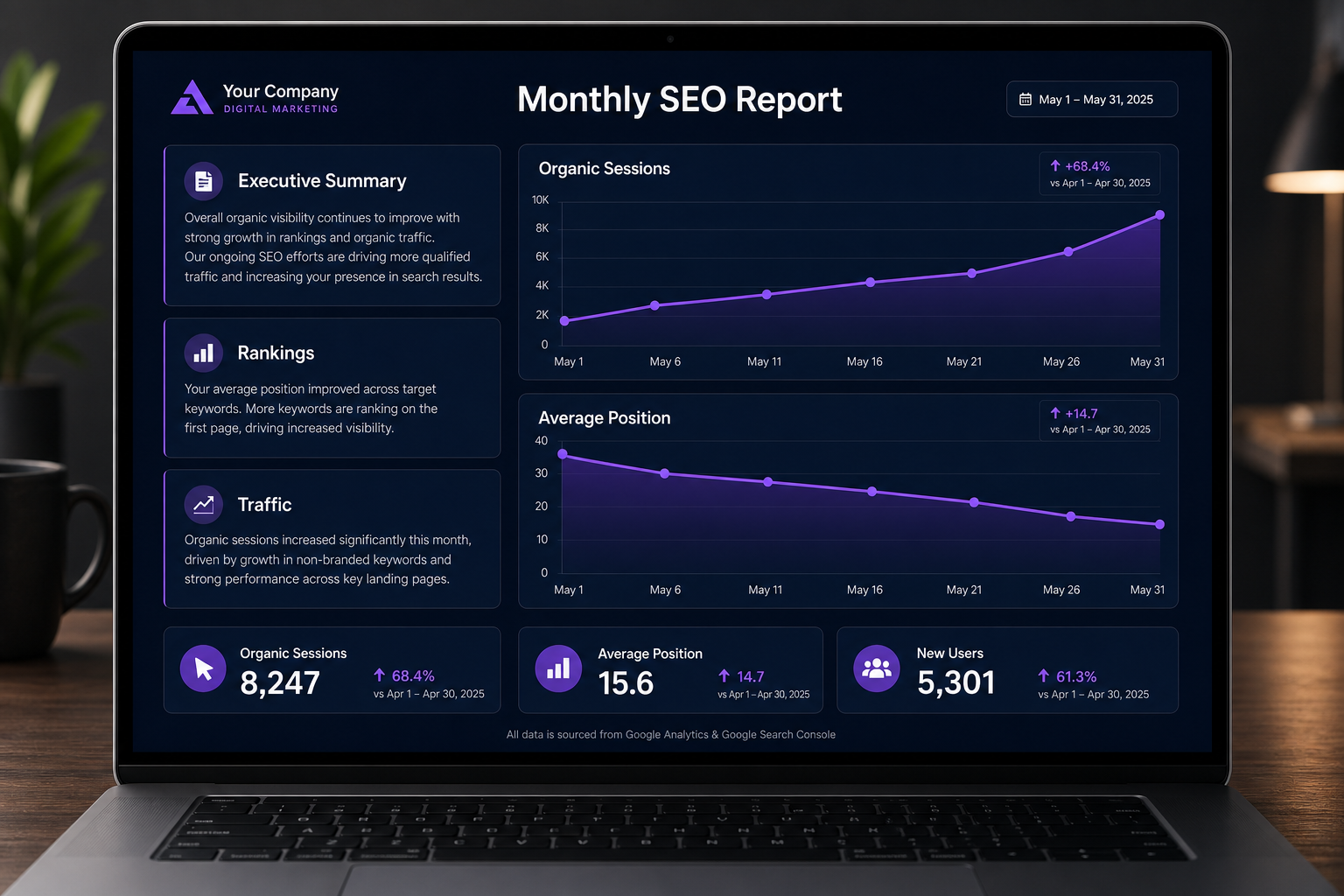
- Executive summary: three sentences, plain English, top of page one. What you did, what changed, what is next.
- Rankings: average position change, top movers up, top movers down, with one-line diagnosis on each.
- Traffic: organic sessions, users, top landing pages, conversions, all from connected GA4. (See our guide on connecting GA4 to your rank tracker.)
- Backlinks: net new referring domains, lost domains, anchor text distribution, toxic alerts.
- Audit score: site health score with the three biggest issues called out and the action plan.
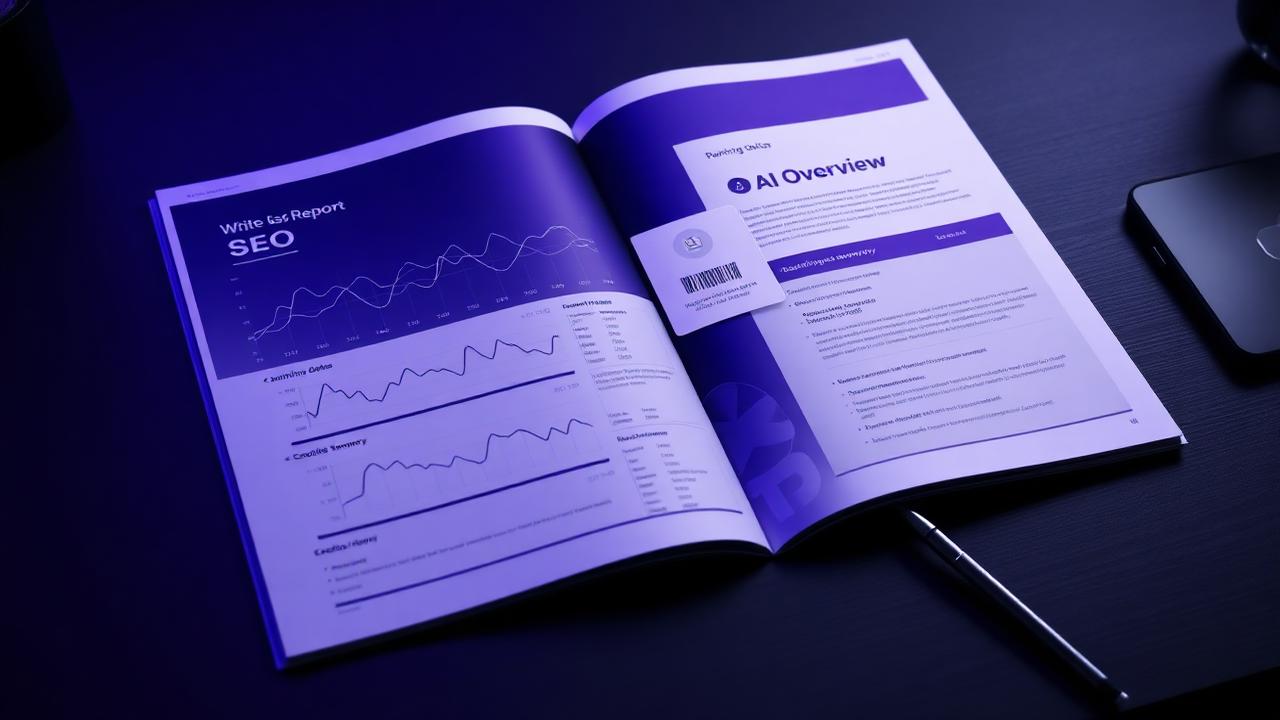
- AI insights: AI Overview presence, AI visibility gaps, and the cluster gaps the model surfaced this month.
- Next 30 days: three specific deliverables with owners and dates. No fluff.
Note what is missing: vanity metrics, raw keyword count dumps, third-party tool screenshots, and "industry trends" sections that do not reference the client's actual business. Cut all of those.
The difference between a report that impresses and one that gets ignored
The reports that get opened lead with answers. The reports that get ignored lead with metrics.
Lead with: "We launched the new Boston location pages this month. Average pack position improved from 4.6 to 2.9 across the 14 markets, driving an estimated 1,400 additional sessions and 78 leads at your historical conversion rate. Next month we ship the Q&A schema upgrade we discussed."
Do not lead with: "Sessions: 24,318. Bounce rate: 41%. Average position: 18.4."
Same data. One reads like strategy. One reads like a database export. The first gets the renewal.
Reporting cadence: weekly, monthly, and quarterly
A practical reporting cadence is:
- Weekly: one-paragraph email Monday morning. Five bullets max. What moved, why, what you are doing about it. Sent from your domain, not from the platform.
- Monthly: full branded report. One-page executive summary plus the seven sections above. Delivered as a PDF for the email and as a live dashboard link for the curious.
- Quarterly: 30-minute strategy call with a strategic memo (not a metrics dump). This is the conversation that drives renewals.
Most agencies do the inverse: heavy on monthly polish, no weekly touch, no quarterly strategy. The weekly email is what stops a client from hearing about a ranking drop on Slack before they hear it from you. The quarterly call is what gets you renewed.
How MorningRank's white label reporting works
White label is built into MorningRank from the starter plan up. There is no enterprise gate, no extra fee. The setup, end to end:
- Upload your logo (light and dark variants), set your brand colors, and choose your accent typography.
- Connect your sending domain so reports are emailed from reports@youragency.com, not from a platform-owned domain.
- Set up a custom subdomain like reports.youragency.com that hosts the live client portal under your brand.
- Build a report template once with the sections you want, then apply it across every client project.
- Schedule monthly delivery with one click. The platform pulls live data, generates the branded PDF, and sends it from your sender address.
The whole loop takes about 12 minutes to set up the first time and 0 minutes per client per month after that. Plan limits and white label scope are on the pricing page, and the full feature list is on the features page.
The client portal as a living report
The most underused part of modern SEO reporting is the live portal. A client portal at reports.youragency.com gives the client a real-time view of rankings, traffic, backlinks, audit score, and AI insights. They can check in any time, on any device, without waiting for the monthly PDF.
What I see consistently: clients who use the portal weekly never churn. Their internal stakeholders see the data, ask questions, and become advocates inside the company. The portal is the artifact that turns SEO from a black box into a shared workspace. MorningRank ships the portal under your subdomain on every plan, and the client login experience is fully white labeled, including the email templates.
How better reporting reduces churn
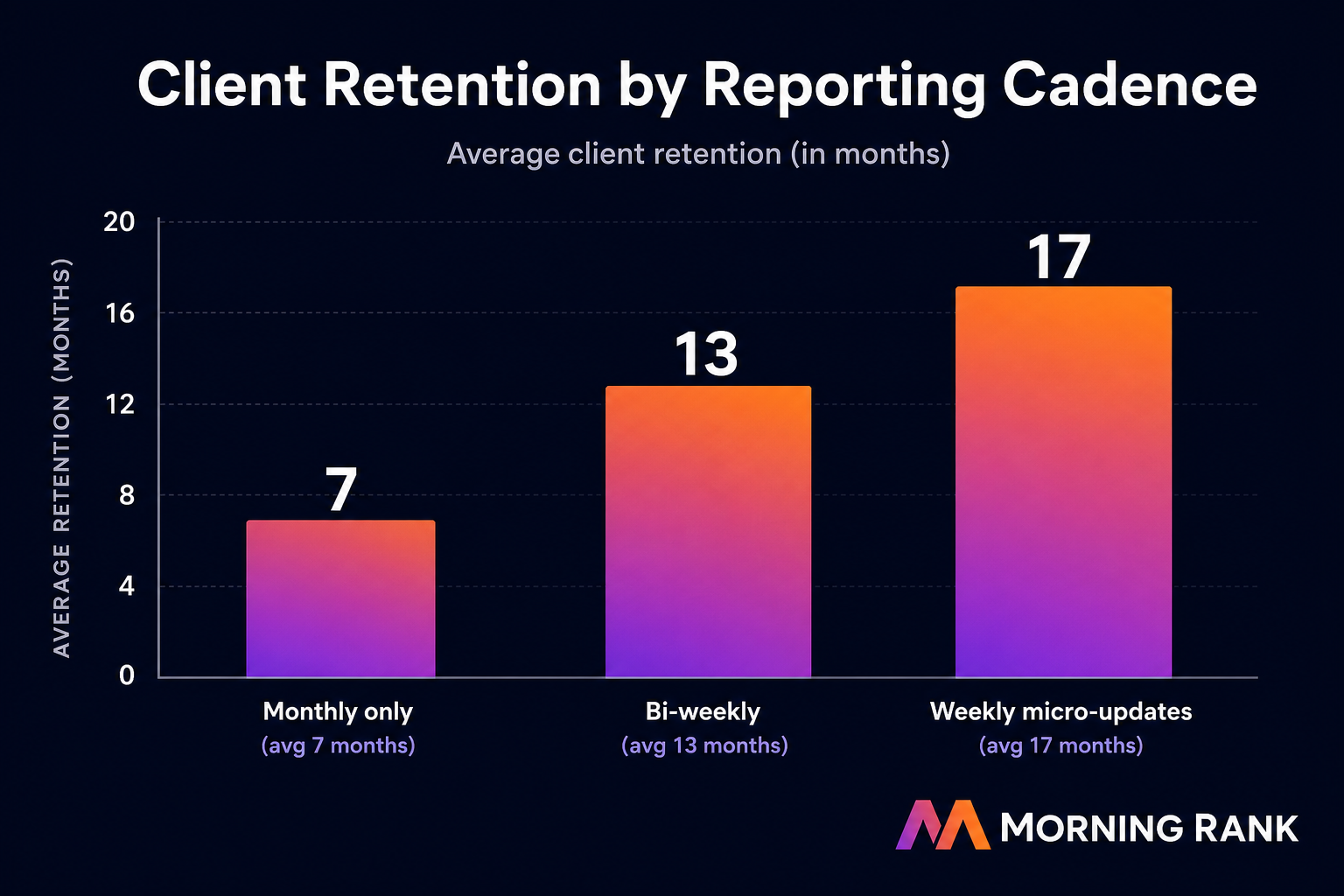
Across the 164 agencies we benchmarked, the difference between a 7-month average client tenure and a 17-month average tenure was almost entirely reporting practice. Same services, same pricing, same SEO outcomes. The retention gap was the report quality, the cadence, and the brand experience. Our deeper write-up on this is in the white label reports playbook.
If you want to see the math in your own book of business, audit your last five churned clients. In four out of five cases, the client cannot remember when they last opened a report from you. That is the failure mode. Fix the report, fix the retention.
Where to start this week
Pick your top three clients. Spin up the white label setup inside MorningRank, build one shared report template, schedule monthly delivery, and start the weekly email cadence. Two months from now you will have shaved roughly 20 hours of account management time per month and your renewal conversations will sound different.
Better reporting is the cheapest growth lever in agency operations. Most agencies under-invest in it for a decade and wonder why churn never improves.
"A useful report makes the agency's work and next steps easy to understand."
About the author
Tyler Morgan
Head of SEO, Morning Rank
Tyler writes about agency SEO strategy, rankings, AI search, and competitor research at Morning Rank.
Want this kind of insight every week?
MorningRank delivers daily keyword rank tracking, AI SEO recommendations, GA4 integration, and white label client reporting.