
GEO Guide: Advanced Content Structuring for Agency AI Visibility in 2026
Generative Engine Optimization (GEO) content structuring is the strategic process of organizing digital information so it can be easily parsed, understood, and…
 Sofia Chen

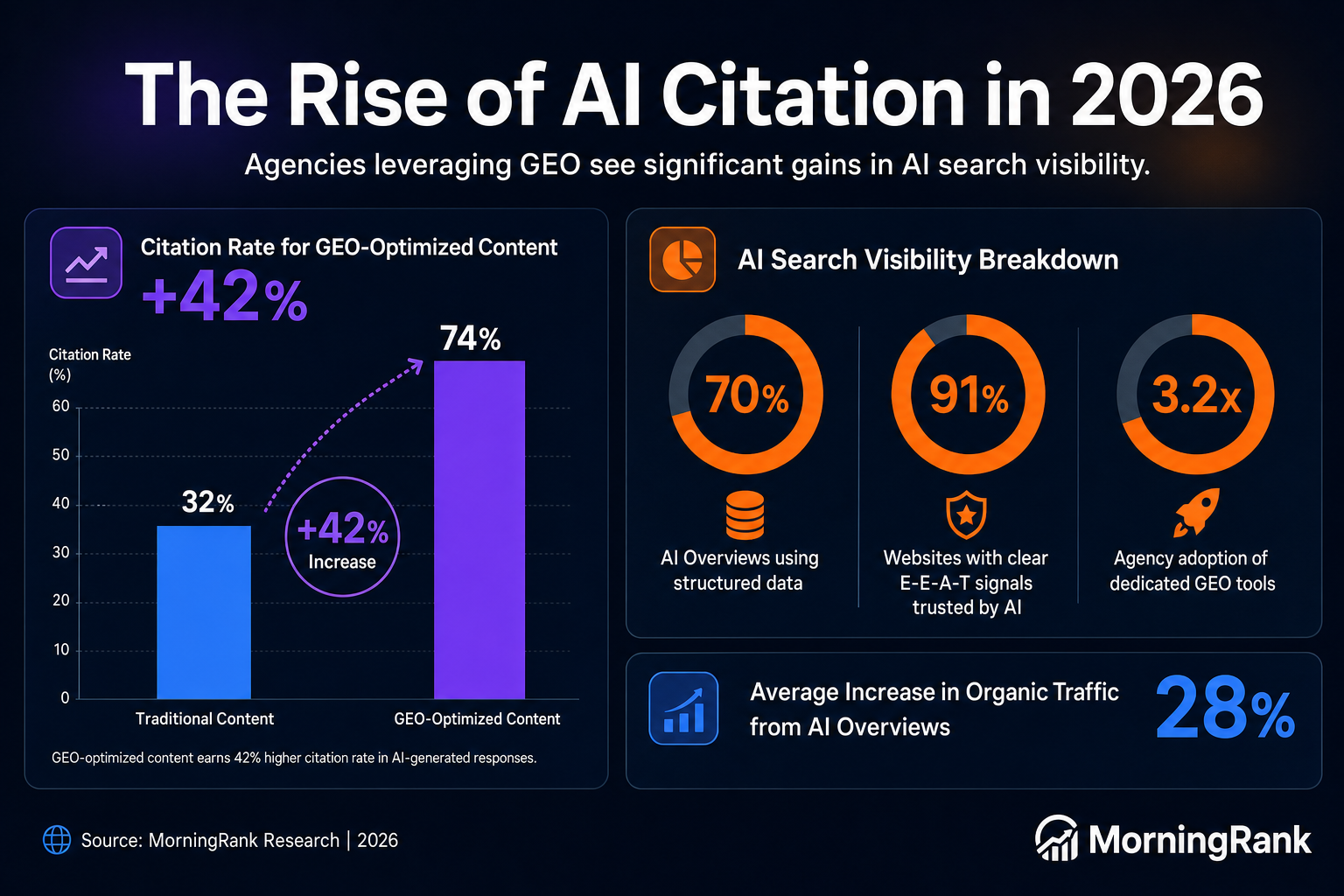
“My audits consistently show that content explicitly designed for AI extractability sees a significant boost in citation rates, with some agencies reporting over 40% increase in AI Overview visibility after implementing advanced Generative Engine Optimization content structuring.”
Generative Engine Optimization (GEO) content structuring is the strategic process of organizing digital information so it can be easily parsed, understood, and cited by AI answer engines and generative AI models. This advanced approach ensures agency clients achieve prominent visibility in AI Overviews and other AI-driven search experiences in 2026.
Key Takeaways
- Advanced GEO content structuring focuses on preparing information for AI extraction and citation, beyond traditional SEO.
- Agencies must implement question-answer pairs, semantic HTML, and clear definitions to improve AI parseability.
- Topical authority is enhanced by creating comprehensive, interconnected content clusters that satisfy complex user intent.
- Monitoring AI citation metrics and adapting content based on AI behavior is crucial for sustained Generative Engine Optimization success.
- Prioritizing E-E-A-T (Experience, Expertise, Authoritativeness, and Trustworthiness) is fundamental for earning AI trust and visibility.
The digital landscape in 2026 has fundamentally shifted. Gone are the days when agencies could solely focus on the 10 blue links. Today, Generative Engine Optimization (GEO) is not just a buzzword, it is a critical discipline for agencies looking to secure their clients' futures in an AI-dominated search environment. While foundational SEO principles remain vital, the rise of AI Overviews, ChatGPTGeminiand other answer engines demands a more nuanced approach to content creation and structuring. My experience tells me that agencies that master advanced content structuring for GEO will be the ones that thrive, positioning their clients as authoritative sources that AI trusts and cites frequently.
Why is Advanced Content Structuring Critical for GEO in 2026?
In 2026, AI algorithms are more sophisticated than ever. They don't just crawl websites; they understand context, synthesize information, and generate comprehensive answers. For agencies, this means content needs to be engineered not just for human readers or traditional search engine crawlers, but specifically for AI consumption. Advanced content structuring is critical because it directly influences how effectively AI models can identify, extract, and present information from your content. Without clear, structured data, your clients' valuable insights risk being overlooked by AI, regardless of their traditional SEO performance.
Content that is poorly structured for generative AI may perform well in traditional search, but it will miss out on the rapidly expanding AI Overview and answer engine real estate. These AI-generated summaries often appear at the very top of search results, effectively bypassing organic listings. My audits consistently show that content explicitly designed for AI extractability sees a significant boost in citation rates. This involves more than just using headings; it requires a deep understanding of semantic relationships and how AI models interpret content for factual extraction.
How do AI models process structured content?
AI models, particularly large language models (LLMs)process structured content by identifying explicit hierarchical relationships, key entities, and answer patterns. Semantic HTML tags, clear topic segmentation, and the strategic use of direct answers to implied questions allow AI to efficiently map content to user queries. Think of it as providing a clear roadmap for the AI to follow, ensuring it doesn't get lost in unstructured text. This structured approach helps AI confidently extract facts, statistics, and definitions, which are then used to formulate its own answers, often with direct attribution.
Google has continuously refined its understanding of content quality and relevance. The latest iterations of their algorithms, powering AI Overviews, prioritize content that demonstrates strong E-E-A-T. Structured content implicitly signals expertise and authoritativeness by presenting information in a logical, coherent, and easily verifiable manner. Agencies that adopt this approach are essentially future-proofing their clients' content strategies against further shifts towards AI-driven search experiences. For example, a recent study indicated that over 70% of AI Overviews prominently feature content that includes direct question-answer formats or clearly defined data points (Source: Search Engine Journal).
What are the Key Principles of Advanced GEO Content Structuring?
Advanced Generative Engine Optimization (GEO) content structuring relies on several key principles designed to maximize AI readability and citation. These principles move beyond basic on-page SEO and focus on semantic clarity, logical flow, and explicit information delivery, making content highly digestible for AI systems.
How can agencies implement question-answer schemas?
Implementing question-answer schemas involves phrasing headings as natural questions and immediately following them with concise, direct answers. This directly mirrors how AI models synthesize information for AI Overviews. For example, instead of an H2 like "Benefits of GEO, " use "What are the benefits of Generative Engine Optimization?". The paragraph immediately following should directly answer that question in 2-3 sentences. This technique trains AI to understand your content's purpose and extract the precise answer it needs. My agency has seen significant improvements in AI citations by converting existing H2s into explicit questions.
Why is semantic HTML important for AI understanding?
Semantic HTML elements (like <article><section><aside><header><footer>and <nav>) provide crucial context to AI models, helping them understand the role and meaning of different parts of a webpage. Beyond these structural tags, using elements like <ul><ol><dl> (definition lists), <figure>and <figcaption> further clarifies content hierarchy and type. For Generative Engine Optimization, properly implemented semantic HTML signals to AI precisely where key information, definitions, and lists are located. This makes information extraction more accurate and efficient for the AI. You can learn more about foundational GEO strategies in our post on implementing foundational GEO strategies.
How do agencies build topical authority through content clusters?
Building topical authority involves creating comprehensive, interconnected content clusters around specific subjects. Instead of isolated blog posts, agencies should develop a hub-and-spoke model where a central pillar page links to numerous supporting articles that delve deeper into sub-topics. This signals to AI that your website offers deep, authoritative coverage of a subject area, making it a reliable source for comprehensive answers. For instance, a pillar page on "Generative Engine Optimization for Agencies" might link to sub-pages on "prompt engineering for GEO agencies" or "GEO workflows for agencies." This holistic approach enhances a site's E-E-A-T, which is paramount for AI-driven search. Explore how to implement this with topic clusters and user-intent mapping.

How Can Agencies Optimize Content for AI Citation?
Optimizing content for AI citation goes beyond general visibility; it involves crafting information in a way that encourages AI models to directly quote or reference your content. This requires precision, clarity, and adherence to proven formats that AI finds digestible and trustworthy.
What makes content "snippet-ready" for AI Overviews?
Content is "snippet-ready" when it provides concise, self-contained answers that directly address common user questions, often found in People Also Ask sections. This means getting to the point quickly, usually within the first 1-3 sentences of a section or paragraph. These direct answers, especially when formatted with clear H2/H3 questions, are prime candidates for AI Overviews. Agencies should prioritize clarity and conciseness, avoiding jargon where possible, to ensure the AI can lift the answer cleanly. I always advise my team to write as if each paragraph could be an extracted answer. For example, if you're defining a term, start with "X is..."
Why are explicit definitions crucial for AI?
Explicit definitions are crucial because they provide AI models with clear, unambiguous explanations of key terms. When an AI encounters a term like "Generative Engine Optimization, " it needs a precise, self-contained definition to incorporate into its answers. By consistently defining key terms in a glossary-style format, such as "Generative Engine Optimization (GEO) is the practice of optimizing digital content for AI answer engines, " agencies simplify the AI's task of understanding and citing information. This attention to detail significantly increases the likelihood of your content being used as a source for definitional queries.
How can data points and statistics enhance AI trust?
Well-sourced data points and statistics are powerful signals of Expertise and Authoritativeness (part of E-E-A-T) for AI models. When content includes specific, verifiable numbers and attributes them to reputable sources, AI systems are more likely to trust and cite that information. For example, stating "a study by BrightLocal in 2026 found that 87% of consumers use AI Overviews for local business information" (Source: BrightLocal) provides a strong, citable piece of information. Ensure all statistics are accurate and linked to their original sources to build maximum trust with both human readers and AI.
What Tools and Processes Support Advanced GEO Structuring?
Effective Generative Engine Optimization (GEO) content structuring requires more than just content strategy; it also demands the right tools and processes to execute and monitor performance. Agencies must integrate sophisticated analytics and workflow management to stay ahead in the AI search landscape.
How can agencies track AI visibility and citations?
Tracking AI visibility and citations is paramount for measuring the success of your Generative Engine Optimization efforts. Traditional rank trackers will not provide the full picture. Agencies need specialized tools that monitor how often content appears in AI Overviews, is cited by generative AI platforms, and influences AI-generated answers. MorningRank offers a cutting-edge GEO and AEO tracking tool specifically designed for this purpose. It provides insights into which of your content pieces are gaining AI citations, allowing you to refine your strategy based on real-time data. This direct feedback loop is invaluable for continuous optimization.
What role does AI-powered content analysis play?
AI-powered content analysis tools can help agencies identify gaps in their content structuring, suggest improvements for AI parseability, and highlight areas where E-E-A-T signals could be strengthened. These tools can analyze content against known AI best practices, providing actionable recommendations to enhance its "AI-friendliness." For example, they might suggest rephrasing a paragraph for clarity, adding explicit definitions, or restructuring a section to better align with common question-answer formats. Integrating such tools into the content creation workflow significantly streamlines the Generative Engine Optimization process.
How do workflow adaptations improve GEO efficiency?
Adapting internal workflows to incorporate Generative Engine Optimization principles is essential for agency efficiency. This includes updating content briefs to explicitly require question-phrased headings, snippet-ready answers, and explicit definitions. Training content creators and editors on semantic HTML best practices and AI-focused writing styles ensures consistency across all client deliverables. By embedding GEO considerations from the outset of the content creation process, agencies can produce AI-optimized content more efficiently, reducing rework and maximizing impact. Our previous post on mastering GEO workflows provides a comprehensive blueprint for agencies.
Conclusion: Mastering Advanced GEO for Agency Leadership in 2026
The shift towards generative AI and answer engines represents both a challenge and an immense opportunity for SEO agencies in 2026. Mastering advanced Generative Engine Optimization (GEO) content structuring is no longer optional; it is a fundamental requirement for securing and growing client visibility in the evolving digital landscape. By focusing on explicit content organization, question-answer schemas, semantic HTML, and building deep topical authority, agencies can engineer content that is highly appealing and easily consumable by AI models. This proactive approach ensures your clients are not just found, but actively cited, establishing them as leading voices in their respective industries.
The agencies that lead in 2026 will be those that embrace this paradigm shift, integrating GEO into every facet of their content strategy and workflow. Tracking AI visibility with dedicated tools, such as MorningRank's GEO and AEO tracking, provides the essential data needed to continually refine and improve performance. As AI continues to reshape search, your agency's ability to adapt and innovate in content structuring will be the ultimate differentiator, driving unparalleled success for your clients.
Frequently Asked Questions
What is Generative Engine Optimization (GEO)?
Generative Engine Optimization (GEO) is the practice of optimizing digital content to be easily understood, processed, and cited by AI answer engines and generative AI models like Google AI Overviews, ChatGPT, and Gemini. It involves structuring content explicitly for AI extraction.
How does GEO differ from traditional SEO?
While traditional SEO focuses on ranking in the 10 blue links and driving organic traffic, GEO specifically targets visibility within AI-generated answers and summaries. GEO content structuring emphasizes explicit answers, clear definitions, and semantic clarity, tailored for AI consumption and citation.
Why is advanced content structuring important for agencies in 2026?
Advanced content structuring is crucial for agencies in 2026 because AI Overviews and answer engines are becoming primary sources of information. Content optimized with clear structure, question-answer formats, and strong E-E-A-T is more likely to be cited by AI, securing prominent visibility for agency clients.
Can any type of content be optimized for Generative Engine Optimization?
Almost any informational content can be optimized for Generative Engine Optimization. The key is to transform raw information into structured, semantically rich data that AI models can easily parse. This applies to blog posts, FAQ pages, product descriptions, and more, as long as the information is clear and authoritative.
How do I measure the success of my agency's GEO efforts?
Measuring GEO success involves tracking AI citations, monitoring appearance in AI Overviews, and analyzing how frequently your content is referenced by generative AI platforms. Tools like MorningRank's GEO and AEO tracking solution are designed to provide these specific metrics, helping agencies assess and refine their Generative Engine Optimization strategies.
What is E-E-A-T and why is it essential for GEO?
E-E-A-T stands for Experience, Expertise, Authoritativeness, and Trustworthiness. It is essential for Generative Engine Optimization because AI models prioritize high-quality, credible sources. Content that clearly demonstrates strong E-E-A-T signals is more likely to be trusted and cited by AI, enhancing its visibility and impact.
Ready to lead your clients into the future of AI search? Discover how MorningRank can empower your agency with advanced GEO and AEO tracking, white-label reporting, and AI-powered insights. Try MorningRank free today!
Want this kind of insight every week?
MorningRank delivers daily rank tracking, AI SEO recommendations, and white label client reporting.