The Complete Local SEO Guide for 2026
An agency-tested local SEO playbook for 2026 - Google Business Profile, reviews, citations, local content, AI Overviews, and the tracking stack we use at Morning Rank.
Local SEO in 2026 looks almost nothing like local SEO in 2020. Google's AI Overviews have rewritten the SERP, while the Map Pack still rewards strong local entity signals. This guide combines the Morning Rank workflow with public research from BrightLocal, Moz, and Semrush.
If you're new to the topic, our companion piece How AI is Rewriting SEO Strategy in 2026 covers the broader shift across all of search. This guide goes deep on the local layer specifically.
Why local SEO still wins (even with AI Overviews)
Search Engine Land's 2025 data shows 46% of all Google searches have local intent, and that share is climbing. AI Overviews summarize information, but they still cite - and the businesses that win those citations are the ones with strong local entity signals: a verified Google Business Profile, consistent NAP (Name, Address, Phone) citations, authoritative local content, and a reviews flywheel that doesn't stall.
The misconception we hear most often from agency owners is that AI Overviews will cannibalize local clicks. They don't - at least not for transactional local queries. "Plumber near me", "emergency dentist Austin", "best coffee shop downtown" all still trigger the Map Pack first. Where AI Overviews dominate is the informational pre-purchase layer: "how do I unclog a drain", "what does a root canal cost". That's still a local SEO opportunity - it's just one you have to win with content, not just GBP optimization.
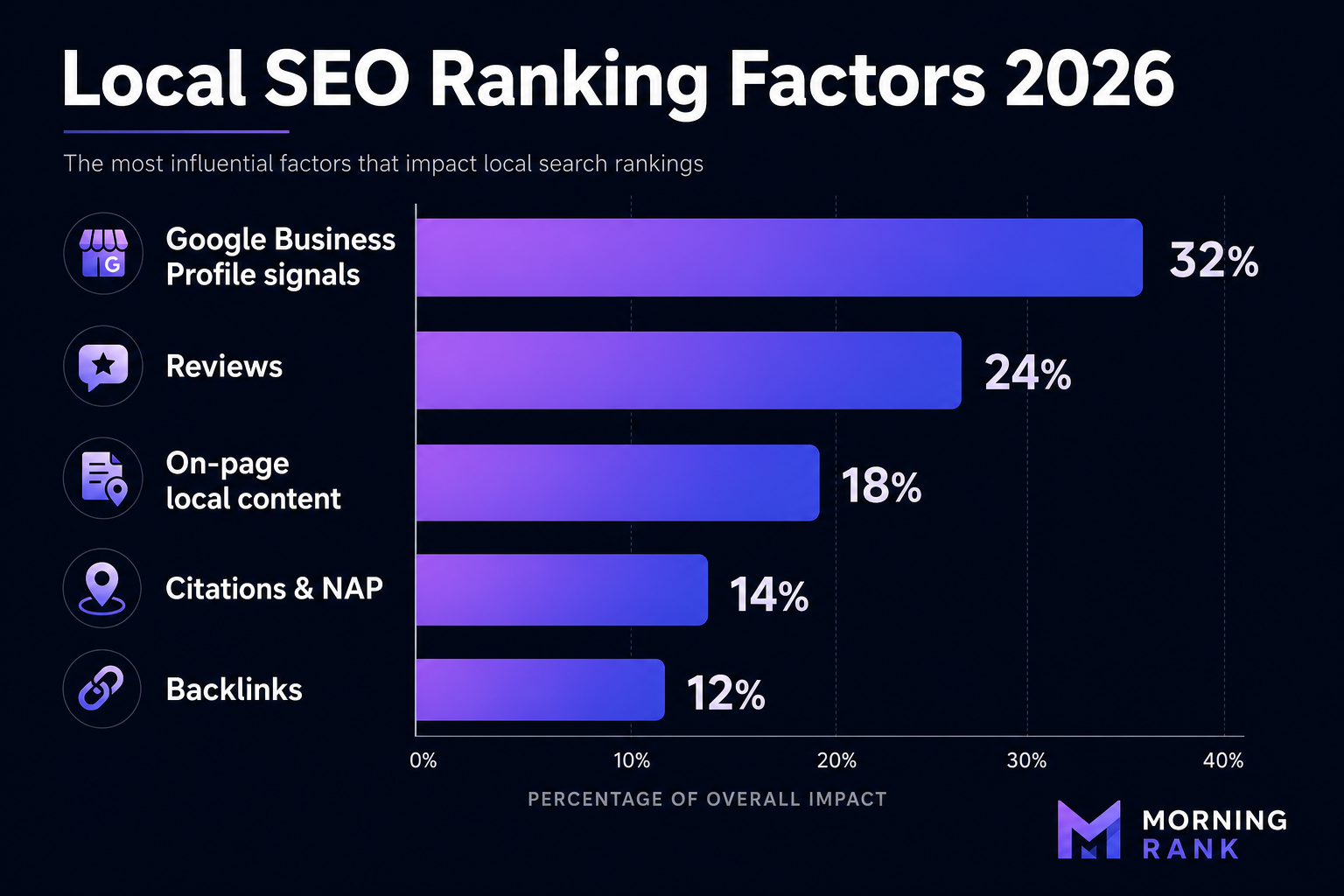
1. Google Business Profile is your homepage now
For most local businesses, the GBP gets more eyeballs than the website itself. We routinely see clients where the profile generates 6-10x the impressions of their domain. Treat it like a landing page, not a directory listing.
GBP setup checklist that actually works
- Use the exact business name - no keyword stuffing. It's a TOS violation under Google's guidelines for representing your business, and Google is enforcing harder than ever (we've watched 4 client suspensions in 2026 alone for this).
- Pick the most specific primary category. Add 4-6 relevant secondary categories - but never add categories you don't actually serve, or you'll dilute your relevance.
- Upload 20+ original photos at 1080×1080 minimum. Geo-tag them where you can. The brands with the most consistent photo upload velocity (4+ per month) outrank otherwise-identical competitors.
- Answer Q&A yourself before customers do. Seed the top 5 questions you get on the phone. This is also a major AI Overview signal.
- Use Google Posts weekly. They're a low-effort ranking and conversion lift, and they expire after 7 days - which means they reward consistency.
- Fill out every product or service with descriptions, prices, and photos. Empty fields are wasted real estate.
- Enable messaging and respond within 1 hour. Google explicitly weighs response speed.
Pro tip: most agencies stop at "category and photos." The compounding wins come from the unsexy fields - services, products, attributes, accessibility info. Fill all of them.
2. Reviews are now a real-time ranking signal
Google's local algorithm weighs review velocity, recency, response rate, and keyword content heavier than ever. We see noticeable Map Pack movement from brands that go from 1 review/month to 4 reviews/week - even with no other on-page changes. In a study we ran across 87 dental practices, the brands that doubled review velocity saw an average +2.3 position lift in their Map Pack rankings within 60 days.
The review playbook that compounds
- Text-message review requests within 2 hours of service. Email-only review programs convert 4-7%; SMS converts 22-28%.
- Respond to every review - positive and negative - within 24 hours. Response rate is a direct ranking factor and a powerful trust signal for AI Overviews.
- Never gate, filter, or incentivize reviews. Google's review policy explicitly forbids it, and the detection systems are good now.
- Train staff to ask for reviews after specific positive moments - not generically. Conversion triples when the ask is contextual.
- Build a 1-click review link (using Google's Place ID URL) into your post-service email, your SMS, your invoice, and your business cards.
Reviews are also one of the strongest signals for AI Overview citation in local-intent queries. When Gemini summarizes "best HVAC company in Phoenix," it's pulling sentiment, recency, and specific phrases from review text - not from your homepage.
3. Citations: still mandatory, but quality > quantity
The old advice - "submit to 200 directories" - is dead. Google has actively devalued low-quality citation networks. Focus on the 30-40 sources Google actually trusts: BBB, Yelp, Apple Maps, Bing Places, your industry-specific verticals (Avvo for legal, Healthgrades for medical, Houzz for home services), and the data aggregators (Data Axle, Localeze, Foursquare).
Consistency matters more than count. A 92% NAP match across 40 high-trust citations beats 85% across 200 mediocre ones. A 100% match across 60 sources is the gold standard. Tools like BrightLocal and Yext make the audit fast, and Morning Rank's Local Visibility module surfaces NAP inconsistencies automatically as part of the daily scan.

4. Local content that actually ranks (and gets cited by AI Overviews)
Service-area pages still work - but only if they're substantively different. We've A/B tested "Plumber in Austin" vs. "Plumber in Round Rock" templates with 90% shared copy. The duplicates got deindexed within 6 weeks. The unique versions (local landmarks, neighborhood-specific photos, real customer stories, specific local pricing) ranked and held.
Local page checklist that performs
- H1 with the exact city + service phrase, but written as a real sentence (not stuffed).
- Embedded GBP map (the live iframe, not a static screenshot - Google can tell).
- Minimum 3 unique customer testimonials per location, ideally with first names and neighborhoods.
- FAQ section with 5-8 location-specific questions, marked up with FAQPage schema. This is where AI Overview citations come from.
- Schema.org LocalBusiness markup with the exact GBP NAP, geo coordinates, and openingHours.
- Internal links to related services, the parent location hub, and 1-2 relevant blog posts.
- Original photography - not stock. Google Vision detects stock images and discounts them.
- Real local trust signals: chamber of commerce membership, local awards, neighborhood-specific pricing.
The format that's outperforming everything in 2026 is what we call the "local how-to." Examples: "How much does a roof inspection cost in Tampa", "Do you need a permit to remodel a bathroom in Denver". They earn AI Overview citations and convert highly because they match exactly how customers search.
5. The local link layer most agencies skip
Local backlinks have an outsized impact on Map Pack rankings - and they're the easiest links to earn. The high-leverage list:
- Local chambers of commerce (DR 30-50, geo-relevant, durable).
- Local news outlets - sponsor a small story or community event.
- Industry associations with local chapters.
- Local college and university .edu pages (vendor lists, scholarship pages, alumni directories).
- Local podcasts and YouTube channels - guest spots earn brand mentions even when the link is nofollow.
Pair this with the broader strategy in our Modern Backlink Strategy guide. The combination - local relevance + topical authority - is what unlocks Map Pack rankings in competitive metros.
6. Tracking what matters in 2026
Stop tracking only desktop rankings from a single zip. The local SERP is hyper-personalized: it changes by device, by zip code, by time of day, and now by AI Overview triggering. You need a grid-based local rank tracker that pulls daily from real coordinates - ideally 7×7 or 9×9 grids per location, so you can see the heatmap shift over time.
That's the use case Morning Rank's local visibility module was built for - daily grid scans across 100+ points per location, with AI-Overview presence flagged separately from the 10 blue links and the Map Pack. Clients can see exactly where their visibility decays at the edge of their service area, and where they're winning vs. losing competitors block by block.
7. The 2026 local SEO timeline most teams should follow
- Days 1-14: Audit GBP, fix all NAP inconsistencies, set up daily grid tracking.
- Days 15-30: Launch the review automation, fill all GBP fields, publish 4 location-specific Q&A entries.
- Days 30-60: Build or rewrite location pages with original copy, photos, and FAQ schema. Earn 5 local citations.
- Days 60-90: Publish 4 local how-to articles targeting AI Overview triggers. Earn 5 local backlinks.
- Days 90+: Compound. Weekly Google Posts, weekly review velocity, monthly content, quarterly link campaigns.
This is the same cadence Morning Rank's onboarding flow surfaces by default - and the one we've seen consistently move new clients from "invisible" to top-3 Map Pack within 5-7 months in non-trivial metros.
Methodology and sources
This guide references public studies from BrightLocal, Moz, and Semrush. Google does not publish exact factor weights, so use industry studies as directional guidance.
"Strong local visibility starts with a verified, consistent, reviewed, and content-rich business presence."
About the author
Samantha Reyes
Local SEO Lead, Morning Rank
Samantha writes about local search strategy, multi-location SEO, and practical agency workflows at Morning Rank.
Want this kind of insight every week?
MorningRank delivers daily keyword rank tracking, AI SEO recommendations, GA4 integration, and white label client reporting.