
Optimized Keyword Rank Tracking for Agency SEO in 2026
Keyword rank tracking strategies in 2026 involve a sophisticated approach that moves beyond basic position monitoring, encompassing hyper-local variations…
 Daniel Park
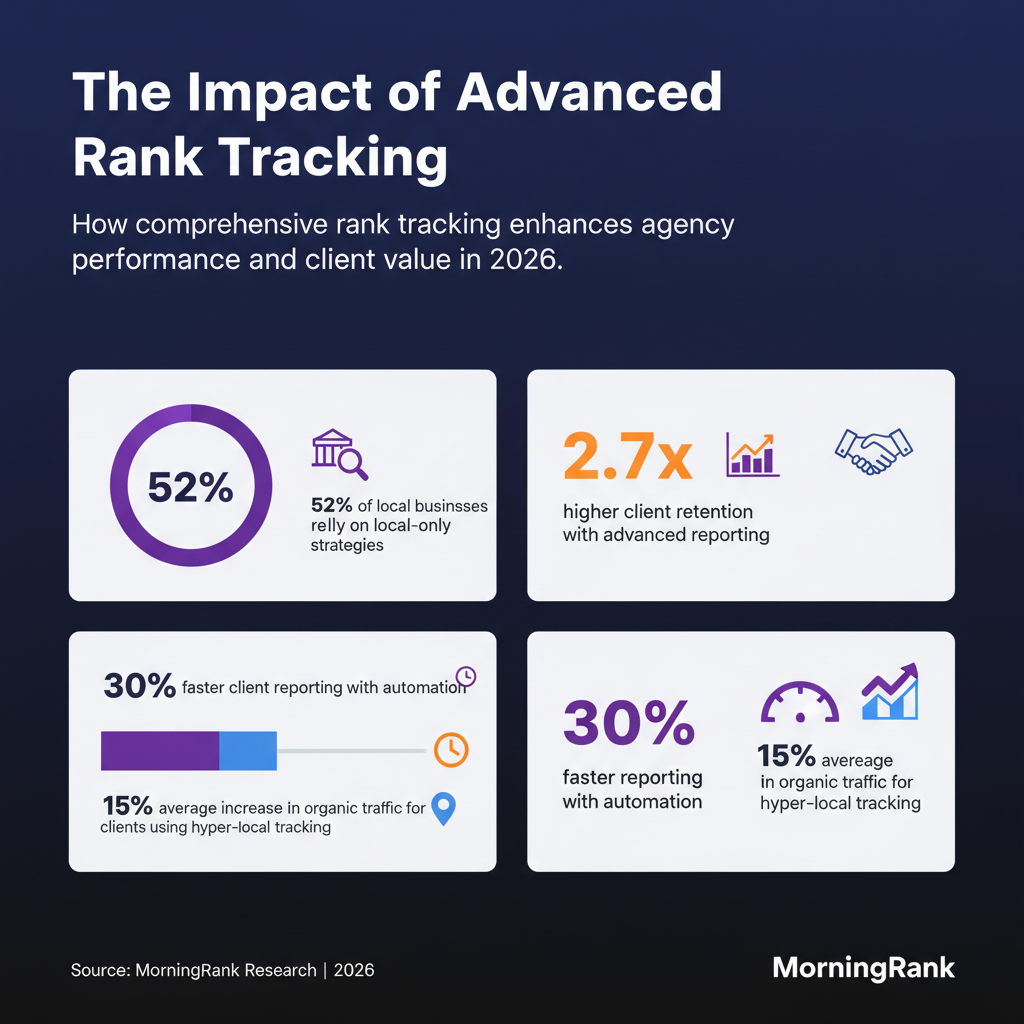
“In my experience, embracing hyper-local rank tracking for service area businesses can lead to a 15% average increase in organic traffic, directly impacting lead generation and client ROI.”
Keyword rank tracking strategies in 2026 involve a sophisticated approach that moves beyond basic position monitoring, encompassing hyper-local variations, SERP feature analysisand AI visibility tracking. Implementing these advanced strategies enables SEO agencies to provide more accurate reporting, identify growth opportunities, and deliver measurable client success in a dynamic search landscape.
Key Takeaways
- Adopt hyper-local rank tracking to capture granular performance data for service area businesses.
- Monitor SERP feature visibility, not just organic rankings, to understand true search presence.
- Integrate AI visibility tracking to measure brand mentions and citations in generative AI platforms.
- Utilize competitive keyword tracking to identify opportunities and benchmark client performance against rivals.
- Automate reporting and leverage white-label client portals to enhance client communication and save agency time.
In today's rapidly evolving search landscape, a basic understanding of "where a keyword ranks" is no longer sufficient. For SEO agencies, keyword rank tracking strategies must be precise, comprehensive, and forward-thinking to deliver real value to clients. The challenge intensifies with Google's continuous algorithm updates, the rise of AI Overviews, and the increasing importance of local search. As a Technical SEO Lead at MorningRank, I've audited countless client sites and observed firsthand how granular rank tracking transforms campaign effectiveness and client retention.
This post will delve into advanced keyword rank tracking strategies for agencies in 2026. We will explore how to go beyond traditional tracking methods to gain deeper insights, monitor critical SERP features, and even track visibility in generative AI platforms. By understanding and implementing these strategies, your agency can provide unparalleled transparency and demonstrate tangible ROI to your clients.
What is Hyper-Local Rank Tracking and Why Does it Matter?
Hyper-local rank tracking is the process of monitoring a website's search engine rankings for specific keywords in extremely granular geographic areas, often down to individual zip codes, neighborhoods, or even specific street addresses. This differs significantly from broader city-level tracking, providing unparalleled precision for local businesses and service area businesses (SABs).
In my experience, many agencies still rely on city-level tracking, which can be misleading for clients with highly localized customer bases. For instance, a plumber serving a 5-mile radius in a large metropolitan area needs to know their visibility within that specific radius, not just across the entire city. BrightLocal's 2023 Local SEO Industry Survey found that 52% of businesses are local-onlyhighlighting the critical need for this granular data. Without hyper-local data, an agency might report strong city-wide rankings for a client, while their actual visibility in their immediate service area could be poor, leading to missed leads.
How Does Hyper-Local Rank Tracking Work?
Implementing hyper-local rank tracking involves using specialized tools that can simulate searches from numerous specific geographic points. These tools adjust the search location parameters to mimic a user searching from that exact spot, giving you true local SERP results. This allows agencies to:
- Identify areas where a client is underperforming locally.
- Tailor content and Google Business Profile (GBP) optimizations for specific neighborhoods.
- Demonstrate concrete improvements in local visibility to clients.
For service area businesses, this is particularly important for optimizing Google Business Profile listings and localized landing pages. MorningRank, for example, offers local SEO rank tracking by city and locationallowing agencies to pinpoint performance in precise geographic zones. This level of detail helps create highly effective local SEO campaigns.
How Can Competitor Keyword Tracking Enhance Your Agency's Strategy?
Competitor keyword tracking involves systematically monitoring the search engine performance of your clients' key rivals, identifying their ranking keywords, content gaps, and overall SEO strategies. This strategic analysis provides invaluable insights, allowing agencies to react proactively to market shifts and uncover hidden opportunities.
Understanding what your competitors are doing well, and where they are falling short, is a fundamental aspect of robust SEO. By tracking competitor rankings for target keywords, agencies can benchmark their clients' performance and identify areas for improvement. Are competitors ranking for keywords your client isn't targeting? Are they dominating specific SERP features? These questions can only be answered with consistent competitor monitoring.
What Insights Can You Gain from Competitor Keyword Tracking?
Through dedicated competitor keyword tracking, agencies can:
- Uncover Keyword Gaps: Discover valuable keywords that competitors rank for but your client doesn't, providing new content or optimization opportunities. A comprehensive competitor keyword tracking and gap analysis tool can automate this process, saving significant agency time.
- Benchmark Performance: Understand a client's relative position in the market. Knowing that a top competitor ranks #1 for 70% of shared keywords provides a clear target for improvement.
- Analyze Content Strategies: See what content types (blogs, product pages, local guides) are performing best for competitors and use these insights to refine your clients' content plans.
- Monitor New Entrants: Quickly identify new competitors entering the market and assess their immediate impact on search results.
- Identify SERP Feature Dominance: Determine if competitors are capturing more featured snippets, local packs, or other valuable SERP features.
In my experience, a significant portion of successful SEO strategies emerges from competitor analysis. Agencies that consistently track competitor performance are better equipped to adapt their strategies, refine their clients' keyword portfolios, and ultimately drive superior results. This proactive approach helps agencies not only maintain but also grow their clients' market share. For a deeper dive into competitor analysis, you can read our blog post on Competitor Keyword Tracking & Gap Analysis Tool for 2026.

Why is SERP Feature Tracking Essential for Agencies in 2026?
SERP feature tracking is the monitoring of specialized search engine results page (SERP) elements, such as Featured Snippets, Local Packs, People Also Ask boxes, images, videos, and shopping results. In 2026, relying solely on organic "blue link" rankings is an incomplete view of search visibility, as SERP features often capture significant user attention and clicks.
Google's SERPs are no longer just a list of ten links. They are dynamic, visually rich environments where various features compete for attention. Capturing a Featured Snippet, for instance, can provide a more prominent position and higher click-through rate than a traditional organic #1 ranking. The increasing prevalence of these features means agencies must track their clients' performance across all relevant SERP elements to accurately assess their true search presence.
How Do SERP Features Impact Search Visibility?
Different SERP features serve distinct user intents and offer unique visibility opportunities:
- Featured Snippets: These concise answers appearing at the top of the SERP directly answer a user's query, often coming from a low-ranking page. They are a prime target for AEO (Answer Engine Optimization).
- Local Packs: Essential for local businesses, these map-based results display businesses relevant to local queries. Visibility here is critical for driving foot traffic and local inquiries.
- People Also Ask (PAA): These boxes expand to show related questions and answers, offering opportunities to rank for long-tail queries and extend topical authority.
- Video Carousels: For certain queries, video results dominate, making video optimization and tracking crucial.
- Image Packs: Visual queries often trigger image packs, important for product-based businesses or visual content creators.
In my professional opinion, ignoring SERP features is akin to ignoring half of your client's potential search visibility. Advanced SERP feature tracking tools allow agencies to monitor which features their clients are appearing in, identify opportunities to target new features, and track changes in their feature eligibility. For local businesses, focusing on Local Pack prominence is particularly important, as discussed in our post on Local Pack Prominence in 2026.
What is AI Visibility Tracking and How Can Agencies Leverage it in 2026?
AI visibility tracking is the process of monitoring how frequently and prominently a brand or piece of content is cited, mentioned, or directly used by generative AI platforms like Google AI Overviews, ChatGPT, Gemini, and Perplexity. In 2026, as AI answer engines become increasingly integrated into search experiences, tracking this new form of visibility is paramount for agencies.
The rise of AI Overviews within Google Search and the growing adoption of standalone AI chatbots means that a significant portion of information retrieval is now mediated by AI. If a client's content is not being summarized or cited by these AI systems, they risk losing a substantial segment of their potential audience. Agencies must adapt their keyword rank tracking strategies to include this new dimension of search.
Why is AI Visibility Tracking Crucial for Agencies?
Tracking AI visibility allows agencies to:
- Measure Brand Citations: Understand how frequently client brands or specific pieces of content are referenced by AI summaries.
- Optimize for AI Overviews: Tailor content to be easily digestible and extractable by AI models, increasing the likelihood of being featured in Google AI Overviews. Our guide on Optimizing Your Content for Google AI Overviews in 2026 provides more detail.
- Demonstrate Value in New Search Paradigms: Show clients their performance in a new, rapidly growing search channel, providing a competitive edge.
- Identify New Search Opportunities: Discover new question-answer patterns and emerging topics favored by AI models.
In 2026, a truly comprehensive rank tracking solution must incorporate AI visibility tracking. This capability enables agencies to report on performance not just in traditional SERPs, but across the entire spectrum of AI-driven search. Without it, your clients may be missing critical opportunities for exposure and authority in the evolving digital landscape. Services like MorningRank's GEO and AEO tracking tool are specifically designed to help agencies master AI citations.
Leveraging White-Label Reporting for Agency Success in 2026
White-label SEO reporting involves delivering client performance reports under your agency's brand, rather than the brand of the SEO software used to generate them. This practice is crucial for agencies to maintain brand consistency, build client trust, and streamline communication of keyword rank tracking results and overall campaign performance.
For agencies, client reporting isn't just about data; it's about presentation and perceived value. Generic reports bearing a third-party logo can undermine an agency's professionalism and dilute its brand identity. White-label reporting ensures that every document, chart, and data point your client receives reinforces your agency's expertise and brand presence. This creates a seamless, professional experience that strengthens client relationships.
What are the Benefits of White-Label Reporting for Agencies?
Implementing white-label reporting for keyword rank tracking results offers several distinct advantages:
- Enhanced Brand Authority: Consistent branding across all client communications, including detailed rank tracking reports, elevates your agency's professional image.
- Improved Client Trust: Clients are more likely to trust reports that clearly come from their agency partner, fostering stronger, long-term relationships.
- Streamlined Communication: Automated, branded reports simplify the process of communicating complex SEO performance data, including detailed keyword movements and SERP feature wins. Platforms with automated PDF reports make this incredibly efficient.
- Time Savings for Agencies: Utilizing a white-label client portal dramatically reduces the administrative burden of preparing custom reports for each client. For example, a white-label client portal for agencies centralizes all data and allows clients to access their dashboards securely under your brand.
- Competitive Differentiation: Agencies that offer a polished, branded reporting experience stand out from competitors who might use less sophisticated or generic reporting methods.
In my experience, agencies that prioritize transparent, branded reporting see higher client retention rates and stronger testimonial potential. The ability to present detailed keyword rank tracking data within an intuitive, agency-branded portal makes complex information easily accessible and understandable for clients, cementing your position as a trusted advisor. For best practices in client communication, refer to our guide on Client Reporting Best Practices for Agencies in 2026.
Conclusion: Elevate Your Agency's Keyword Rank Tracking in 2026
The landscape of SEO in 2026 demands more than just basic rank tracking. Agencies seeking to excel must embrace advanced keyword rank tracking strategies that include hyper-local precision, comprehensive SERP feature monitoring, and essential AI visibility tracking. These sophisticated approaches ensure that your clients receive the most accurate and actionable insights, reflecting their true performance across all relevant search environments, from traditional organic results to the burgeoning world of AI Overviews.
By implementing these strategies, agencies can move beyond simply reporting numbers to becoming strategic partners who understand and navigate the complexities of modern search. This not only reinforces your value proposition but also contributes directly to your clients' business growth and your agency's reputation. Investing in tools that support these advanced tracking capabilities is no longer optional; it's a necessity for continued success in a competitive and rapidly evolving industry.
For agencies ready to elevate their keyword rank tracking and client reporting, MorningRank offers an AI-first platform designed to meet these exact needs. From hyper-local tracking to AI visibility and white-label client portals, MorningRank empowers agencies to deliver unparalleled insights and build stronger client relationships.
Frequently Asked Questions
What is keyword rank tracking?
Keyword rank tracking is the process of monitoring a website's position in search engine results pages (SERPs) for specific keywords over time. This data helps SEO professionals understand the effectiveness of their optimization efforts and identify opportunities for improvement in their keyword rank tracking strategies.
How often should an agency track keyword rankings?
For most competitive niches, agencies should track keyword rankings daily to capture fluctuations and algorithm impacts accurately. Daily tracking provides the most granular data for quick adjustments and detailed trend analysis, which is crucial for effective keyword rank tracking strategies.
Why is hyper-local keyword rank tracking important for local businesses?
Hyper-local keyword rank tracking is crucial for local businesses because it provides precise insights into their visibility within very specific geographic areas, often down to neighborhoods or zip codes. This allows for highly targeted local SEO adjustments and effective keyword rank tracking strategies in specific service territories.
Can I track SERP features like Featured Snippets with keyword rank tracking?
Yes, advanced keyword rank tracking tools typically allow you to monitor SERP features like Featured Snippets, Local Packs, and People Also Ask boxes. Tracking these features provides a more complete picture of your search visibility beyond traditional organic links, making it a critical part of comprehensive keyword rank tracking strategies.
Why should agencies use white-label reporting for keyword rank tracking?
Agencies should use white-label reporting to deliver keyword rank tracking results under their own brand, enhancing professionalism and client trust. This practice reinforces the agency's brand identity and streamlines communication, making client reports more impactful and supporting transparent keyword rank tracking strategies.
How does AI visibility tracking differ from traditional rank tracking?
AI visibility tracking specifically monitors how often and effectively your content is cited, summarized, or mentioned by generative AI platforms, such as Google AI Overviews and chatbots. This differs from traditional keyword rank tracking, which focuses on organic positions in standard SERPs, adding a new dimension to keyword rank tracking strategies.
Where can I get a reliable tool for agency-grade keyword rank tracking?
You can get a reliable, agency-grade keyword rank tracking tool by exploring platforms designed for comprehensive SEO management, such as MorningRank. MorningRank offers advanced features like hyper-local tracking, AI visibility monitoring, and white-label reporting to empower agencies with robust keyword rank tracking strategies.
Ready to elevate your agency's SEO performance with advanced keyword rank tracking? Try MorningRank free today at https://morningrank.com.
Want this kind of insight every week?
MorningRank delivers daily rank tracking, AI SEO recommendations, and white label client reporting.