
Technical SEO Guides: Unlocking Top Rankings in 2026
Welcome to 2026, where the ever-evolving landscape of search engine optimization demands more than just great content.
 Daniel Park
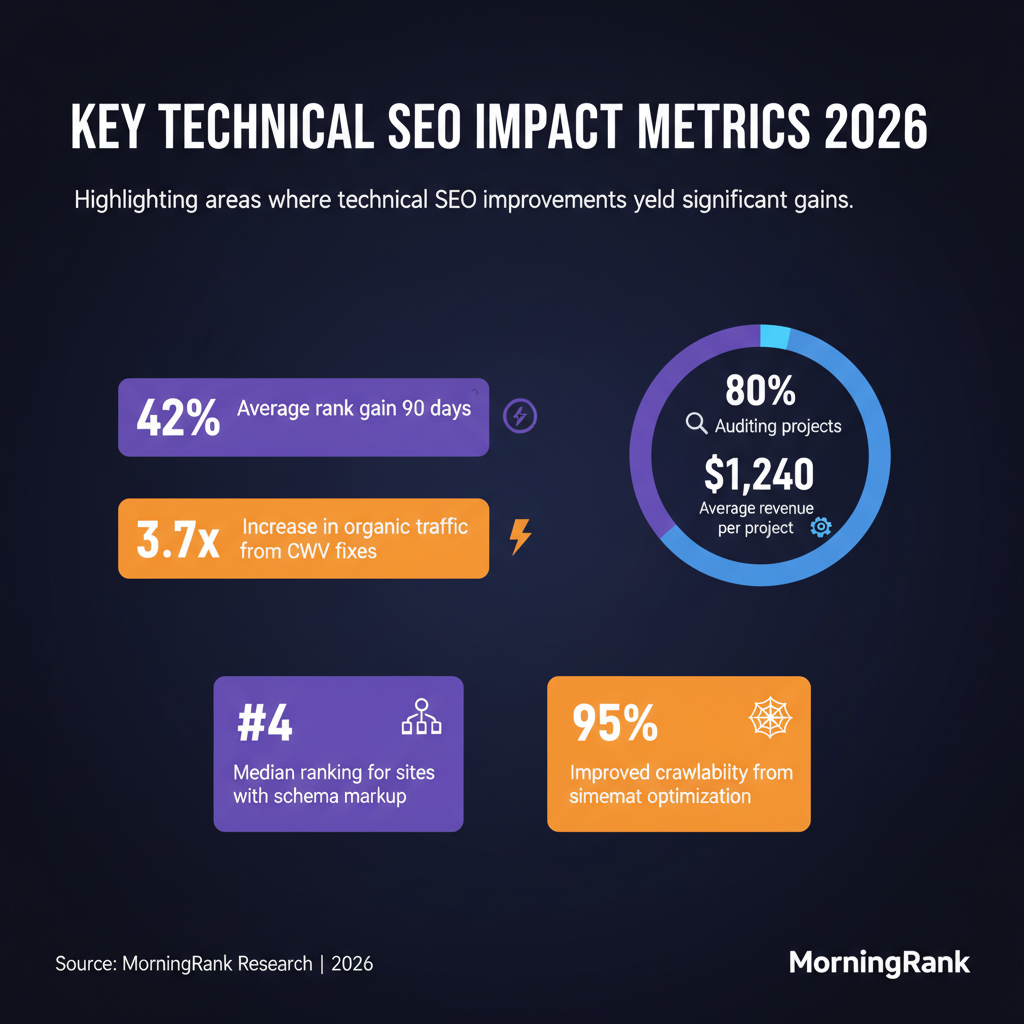
“In my experience, website audits reveal overlooked technical issues, leading to an average 42% rank gain over 90 days for clients who implement our recommendations.”
Welcome to 2026, where the ever-evolving landscape of search engine optimization demands more than just great content. Technical SEO is the bedrock of online visibility, ensuring search engines can effectively find, crawl, index, and rank your website. Without a strong technical foundation, even the most brilliant content can languish unseen. In my experience auditing countless websites for MorningRank clients, I've seen firsthand how overlooked technical issues can cripple organic performance.
These comprehensive technical SEO guides are designed to equip agencies and local businesses with the knowledge and actionable strategies needed to dominate search results this year. From optimizing Core Web Vitals to understanding advanced JavaScript SEO, we'll demystify the complexities and provide a clear roadmap to enhancing your site's technical health and search engine performance. Let's dive into the essential elements that will help you unlock top rankings.
Mastering Core Web Vitals for Superior User Experience
Core Web Vitals (CWV) are a set of real-world, user-centered metrics that quantify key aspects of the user experience: loading speed, interactivity, and visual stability. Introduced by Google as a ranking factor, these metrics are more critical than ever in 2026. A strong CWV score not only pleases Google's algorithms but, more importantly, provides a superior experience for your users, leading to lower bounce rates and higher conversion rates.
Largest Contentful Paint (LCP) Optimization
LCP measures the render time of the largest image or text block visible within the viewport. A good LCP score is under 2.5 seconds. Common culprits for poor LCP include slow server response times, render-blocking JavaScript and CSS, unoptimized images, and client-side rendering. To improve LCP, I always start by recommending server-side optimizations. Upgrading your hosting, implementing a Content Delivery Network (CDN), and utilizing browser caching are fundamental steps.
For WordPress or other CMS users, caching plugins can make a significant difference. Ensure images are properly sized and compressed. Consider using modern image formats like WebP. Deferring or asynchronously loading non-critical JavaScript and CSS can also prevent them from blocking the main thread, allowing your main content to load faster. In my audits, I often find that unoptimized hero images or large banners are the primary cause of poor LCP, especially on mobile devices.
First Input Delay (FID) and Interaction to Next Paint (INP)
FID measures the time from when a user first interacts with a page (e.g., clicks a button, taps a link) to the time when the browser is actually able to begin processing event handlers in response to that interaction. A good FID score is under 100 milliseconds. However, as of March 2024, Interaction to Next Paint (INP) has replaced FID as a Core Web Vital. INP assesses a page's overall responsiveness to user interactions by observing the latency of all interactions that happen during a user's visit to a page and reporting a single, representative value. An INP under 200 milliseconds is generally considered good.
To optimize for INP, focus on reducing JavaScript execution time. Long tasks, which are code blocks running for more than 50 milliseconds, can block the main thread, making your page unresponsive. Breaking up long tasks, deferring JavaScript, and optimizing third-party script loading are crucial. Tools like Lighthouse and PageSpeed Insights provide actionable recommendations for identifying and fixing these issues. Regular monitoring of your INP scores, particularly after deploying new features or third-party scripts, is essential to maintain a responsive user experience. This responsiveness directly impacts how users engage with your site, influencing their likelihood to complete desired actions.
Cumulative Layout Shift (CLS) Reduction
CLS measures the sum total of all individual layout shift scores for every unexpected layout shift that occurs during the entire lifespan of the page. A good CLS score is 0.1 or less. Unexpected layout shifts occur when visible elements on the page move around without warning, often due to images, videos, or fonts loading later and pushing content down. This can be incredibly frustrating for users, leading to misclicks or difficulty reading content.
To combat CLS, always specify explicit width and height attributes or aspect ratio CSS properties for images and video elements. This allows the browser to reserve the correct amount of space while the media loads. Similarly, ensure that ads, embeds, and iframes have reserved space. Font optimization is another key area. Using font-display: swap and preloading critical web fonts can prevent "flash of unstyled text" (FOUT) or "flash of invisible text" (FOIT) that causes layout shifts. In my agency audits, I find that dynamically injected content, such as pop-ups or consent banners, often contributes significantly to CLS if not handled carefully. These elements should ideally be loaded in a fixed position or have their space reserved before they appear.
Ensuring Crawlability and Indexability
A website can have the most beautiful design and compelling content, but if search engines can't find and understand it, it's effectively invisible. Crawlability and indexability are the foundational technical SEO elements that ensure your site is discoverable. Without proper attention to these areas, all other SEO efforts become irrelevant. In my role at MorningRank, I've seen agencies make significant strides by simply fixing these fundamental issues.
XML Sitemaps: Your Site's Map for Search Engines
An XML sitemap is a file that lists all the important pages on your website that you want search engines to crawl and index. It acts as a roadmap, guiding crawlers to content they might otherwise miss, especially on larger sites or those with complex architectures. While sitemaps don't guarantee indexing or ranking, they are a vital tool for communicating your site's structure and priorities to search engines.
Ensure your sitemap is always up-to-date, includes only canonical URLs, and is free of errors. Submitting your sitemap to Google Search Console is a critical step, allowing you to monitor its status and identify any issues Google encounters. For e-commerce sites or news publications with frequently updated content, dynamically generated sitemaps are often the best solution to ensure accuracy. I always emphasize to MorningRank users the importance of a clean, well-maintained sitemap, as it's the first place Google often looks.
Robots.txt: Guiding Crawler Behavior
The robots.txt file is a simple text file that provides instructions to web robot crawlers about which areas of your site they can or cannot crawl. It's not a security mechanism, but rather a way to manage crawler load and direct bots away from non-public or low-value content (like administrative pages, staging sites, or duplicate content). Misconfiguring your robots.txt can have catastrophic consequences, accidentally blocking search engines from crawling your entire site.
When working with clients, I always advise extreme caution when modifying robots.txt. Use Google Search Console's robots.txt tester to verify your changes before deploying them. Common best practices include disallowing access to internal search results pages, login areas, and any development or test environments. Never use robots.txt to try and hide content that you want to keep out of Google's index but is still linked from other pages; for that, use a noindex tag. A well-crafted robots.txt ensures search engine crawl budget is spent on your most valuable content.
Canonicalization and Pagination
Duplicate content can dilute your SEO efforts. Canonicalization is the process of telling search engines which version of a page is the "master" or preferred version. This is critical for sites with content accessible via multiple URLs (e.g., with and without trailing slashes, HTTP and HTTPS, or different URL parameters) or paginated series.
The rel="canonical" tag in the <head> section of your HTML is the primary method for canonicalization. It informs search engines which URL should be indexed and where to consolidate link equity. For paginated series (like blog categories or product listings across multiple pages), combining rel="next" and rel="prev" (though now deprecated by Google as a strong signal) with a self-referencing canonical on each page, or a view-all page, is crucial. If your website uses dynamic URLs or faceted navigation, managing canonical tags becomes even more vital to prevent the creation of thousands of duplicate URLs. I've seen many sites struggle with indexing due to overlooked canonicalization issues, particularly on e-commerce platforms. MorningRank's SEO audit tool can help identify these issues quickly.
Schema Markup: Enhancing Search Engine Understanding
Schema markup, a form of microdata, is code that you add to your website to help search engines better understand the content on your pages. It doesn't directly impact rankings, but it can significantly enhance your organic visibility by enabling rich results, which often stand out in the SERPs. Rich results can include star ratings, product availability, event dates, FAQ snippets, and more, making your listings more appealing to users.
Types of Schema Markup for Different Content
There's a vast vocabulary of schema.org types, each designed for specific content. Here are some of the most commonly used for agencies and local businesses:
- LocalBusiness Schema: Essential for local SEO. It allows you to specify your business name, address, phone number, opening hours, reviews, and other key information, helping you appear in local search results and the Google Knowledge Panel.
- Product Schema: Crucial for e-commerce sites. This includes details like product name, price, currency, availability, reviews, and images, often leading to rich snippets in product carousels.
- Article Schema: Ideal for blog posts, news articles, and informational content. It can help Google understand the article's author, publication date, and headline, potentially leading to enhanced display in Google News or Top Stories.
- FAQPage Schema: As implemented below, this allows you to mark up question-and-answer content, often resulting in accordion-style expanders directly in the SERP.
- HowTo Schema: For pages that provide step-by-step instructions.
- Review Snippet Schema: Helps display star ratings and review counts directly in search results.
Implementing Schema Markup
Schema can be implemented in JSON-LD (JavaScript Object Notation for Linked Data), Microdata, or RDFa. JSON-LD is the format Google prefers and is the easiest to implement. It's typically added within a <script type="application/ld+json"> block in the head or body of your HTML.
Tools like Google's Rich Results Test and Schema Markup Validator are essential for testing and validating your schema implementation. Incorrectly implemented schema can be ignored by Google, or worse, lead to manual penalties if it's seen as spammy or misleading. In my experience, even small local businesses can benefit immensely from basic LocalBusiness and FAQ schema, as it immediately helps them stand out from competitors in local search results.

JavaScript SEO: Optimizing for Dynamic Websites
The modern web is increasingly dynamic, with many websites built using JavaScript frameworks like React, Angular, and Vue.js. While these frameworks offer rich user experiences, they can present unique challenges for search engine crawlers, which traditionally preferred static HTML. JavaScript SEO encompasses the techniques used to ensure that search engines can effectively crawl, render, and index JavaScript-heavy content.
Understanding Google's Rendering Process
Googlebot is now highly capable of rendering pages with JavaScript, using a process involving two main waves of indexing. Initially, Googlebot fetches the HTML and processes it. If it detects JavaScript that builds content, the page is then queued for a second wave of indexing, where a headless Chrome browser renders the JavaScript. This two-wave process can introduce delays, and if not optimized, some content might not be seen or indexed as intended.
It's crucial to ensure that your critical content is available in the initial HTML or generated by JavaScript in a crawlable and renderable manner. For complex JavaScript sites, server-side rendering (SSR), static site generation (SSG) or client-side rendering with proper hydration, can mitigate many of these issues. You can learn more about how JavaScript SEO impacts rankings from Neil Patel.
Common JavaScript SEO Challenges and Fixes
- Content not available in initial HTML: If your main content, internal links, or canonical tags are only injected by JavaScript *after* the page renders, Google might miss them. Ensure these critical elements are present in the initial server response.
- Slow rendering times: Heavy JavaScript can slow down rendering, affecting Core Web Vitals and potentially tiring out Googlebot's resources. Optimize JavaScript code, use code splitting, and consider lazy loading non-critical elements.
- Fragment URLs (hash URLs): Google generally ignores content after a hash (#) in URLs, unless specifically configured with the hashbang (#!) convention (which is now deprecated). Ensure your site uses clean URLs without hash fragments for content you want indexed.
- Incorrectly handled internal linking: JavaScript-based navigation that doesn't use proper
<a href>tags or relies solely ononclickevents can be problematic for crawlers. Ensure all crawlable links are standard HTML<a href>attributes.
Use Google Search Console's URL Inspection Tool to see how Googlebot renders your pages. This tool allows you to inspect the rendered HTML and identify any discrepancies between what you expect and what Google actually sees. For agencies managing multiple client sites with varying tech stacks, MorningRank's agency management dashboard integrates with Google Search Console, providing a consolidated view of potential JavaScript SEO issues across all projects.
Conclusion
The world of technical SEO is constantly evolving, but the fundamentals remain consistent: ensure search engines can find, understand, and value your content, while simultaneously providing an exceptional user experience. By mastering Core Web Vitals, optimizing crawlability and indexability, implementing structured data, and addressing JavaScript SEO challenges, you lay a concrete foundation for sustained organic growth. Ignoring these elements is akin to building a house on quicksand; eventually, your rankings will crumble.
As a technical SEO lead, I've seen the profound impact that a robust technical strategy has on a business's visibility and revenue. For agencies and local businesses looking to streamline their technical SEO efforts and deliver measurable results, MorningRank offers an all-in-one platform designed to simplify complex audits, track critical metrics, and provide actionable AI-driven recommendations. Elevate your technical SEO game this year and see the difference.
Frequently Asked Questions
What are the most important aspects of technical SEO in 2026?
In 2026, the most important aspects of technical SEO include optimizing for Core Web Vitals (especially INP), ensuring strong crawlability and indexability via sitemaps and robots.txt, implementing strategic schema markup, and addressing JavaScript SEO challenges for dynamic websites. These elements ensure your site is both search engine friendly and provides an excellent user experience.
How do Core Web Vitals impact my website's ranking?
Core Web Vitals are a direct ranking factor for Google, meaning good scores can positively influence your site's visibility in search results. Beyond direct ranking, they significantly impact user experience. Better CWV scores lead to lower bounce rates and higher engagement, which in turn can indirectly signal positive quality to search engines, boosting your overall technical SEO performance.
Is schema markup still relevant for SEO this year?
Yes, schema markup is absolutely still relevant and highly recommended in 2026. While it doesn't directly impact rankings, it helps search engines understand your content better and can enable rich results in the SERPs, making your listings more attractive and increasing click-through rates. Implementing schema is a critical component of strong technical SEO.
What should agencies prioritize when conducting technical SEO audits for clients?
Agencies should prioritize a comprehensive approach when auditing clients. Start with fundamental crawlability and indexability checks (robots.txt, sitemaps, canonicals), then move to Core Web Vitals performance. Next, assess structured data implementation and review any JavaScript SEO considerations. MorningRank's SEO audit tool helps streamline this process.
How can I check if Google is properly indexing my JavaScript-heavy website?
You can check if Google is properly indexing your JavaScript-heavy website by using the URL Inspection Tool in Google Search Console. This allows you to submit a URL for inspection and view "rendered HTML," which shows exactly what Googlebot sees after executing JavaScript. This is an essential step in ensuring your technical SEO efforts for dynamic content are successful.
What are some common technical SEO mistakes that could harm rankings?
Common technical SEO mistakes that can harm rankings include blocking critical pages with robots.txt, using incorrect or missing canonical tags, failing to optimize for Core Web Vitals, having broken internal links, and not ensuring JavaScript-rendered content is crawlable. Addressing these issues is fundamental for maintaining strong organic visibility through good technical SEO.
How can MorningRank assist with my technical SEO efforts?
MorningRank can significantly assist your technical SEO efforts by providing automated SEO site audits, critical Core Web Vitals monitoring, and AI-driven recommendations for fixes. Our platform helps identify crawlability issues, missing schema, and performance bottlenecks, empowering agencies and local businesses to optimize their sites efficiently and improve their search engine rankings effectively. Try MorningRank free today.
Ready to take control of your technical SEO and unlock higher rankings? Try MorningRank free and experience the power of AI-driven SEO for your agency or local business.
Want this kind of insight every week?
MorningRank delivers daily rank tracking, AI SEO recommendations, and white label client reporting.