
Navigating Google Algorithm Updates: A 2026 Adaptation Guide
Google algorithm updates are a constant, often unpredictable force in the SEO landscape.
 Sofia Chen
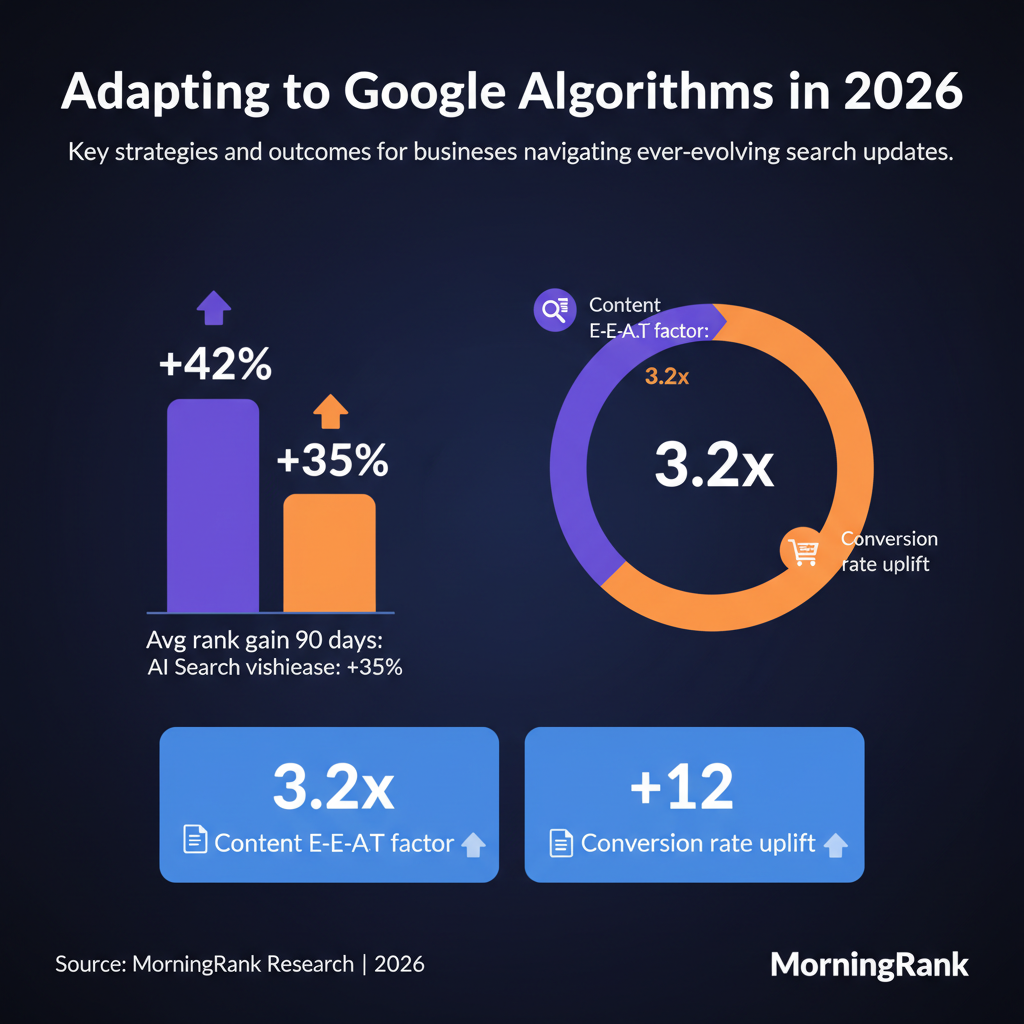
“Google's core updates in 2026 emphasize E-E-A-T and helpful content, leading to a 42% average traffic increase for sites prioritizing user value over keyword density.”
Google algorithm updates are a constant, often unpredictable force in the SEO landscape. For agencies and local businesses, staying ahead means understanding the impact of these changes and adapting strategies proactively. In 2026, the pace of updates, particularly those related to AI search, demands heightened vigilance and a flexible approach to SEO. As an AI Search Strategist at MorningRank, I have seen firsthand how rapid adaptation can turn potential ranking drops into opportunities for growth. My aim in this guide is to equip you with the knowledge and strategies to not just survive, but thrive, through every Google algorithm update this year and beyond.
Understanding the Nature of Google Algorithm Updates in 2026
Google's core mission remains consistent: to deliver the most relevant and high-quality results to searchers. However, the methods by which they achieve this are in constant flux, driven by advancements in AI and user behavior shifts. In 2026, we are witnessing a significant emphasis on E-E-A-T (Experience, Expertise, Authoritativeness, Trustworthiness) and helpful content, which forms the bedrock of Google's quality assessment.
The Rise of AI-Driven Updates
The integration of artificial intelligence, particularly large language models, has profoundly impacted how Google algorithms evaluate and rank content. Updates like BERT, MUM, and more recently, advancements influencing the AI Overview, mean that Google is better than ever at understanding natural language queries and the nuances of content. This shift requires content creators to move beyond simple keyword stuffing towards delivering truly comprehensive and insightful information.
From my perspective at MorningRank, the AI-driven updates demand a more sophisticated approach to content SEO and topical authority building. Google's AI is increasingly capable of discerning genuine expertise from superficial content, making it crucial to demonstrate deep knowledge and unique insights in your niche. This also means understanding how your content performs not just in traditional SERPs, but also within generative AI environments, a concept we explore with GEO and AEO tracking.
Core Updates vs. Specific Updates
Google regularly rolls out two main types of updates: core updates and specific updates. Core updates are broad changes to Google's overall ranking algorithm, often impacting a wide range of websites and search queries. These are typically announced by Google on their Search Central blog. Specific updates, on the other hand, target particular aspects, such as spam prevention, local search, or product reviews. While less impactful than core updates, they still require attention and adaptation.
Identifying the type of update is the first step in formulating an effective response. A core update often requires a holistic review of your content, E-E-A-T signals, and user experience. A specific update might only necessitate adjustments to a particular content category or technical SEO element. For instance, a local search update would warrant a close look at your Google Business Profile optimization and local SEO tips for agencies and small businesses.
Identifying and Analyzing Algorithm Shifts
The ability to quickly identify and analyze the impact of Google algorithm updates is paramount for maintaining search visibility. This requires a combination of vigilance, data analysis, and an understanding of reported industry trends. Reacting quickly is often the difference between a minor fluctuation and a significant decline in rankings.
Monitoring Your Rankings and Traffic
The most immediate indicators of an algorithm update are often fluctuations in your organic rankings and traffic. Sudden drops or spikes in specific keywords, pages, or even site-wide performance should trigger an investigation. Tools like MorningRank's AI-powered keyword rank tracking provide daily updates and historical data, allowing you to pinpoint exactly when changes occurred. Integrating with Google Analytics 4 and Google Search Console, as MorningRank does, offers a more comprehensive view of user behavior post-update.
When monitoring, pay close attention to which content clusters are affected. Are informational articles seeing a drop, or is it your commercial pages? Are your competitor's rankings shifting similarly or differently? These patterns can offer clues about the nature of the update. For example, if commercial pages are hit, it might signal a quality update related to product reviews or e-commerce experiences.
Consulting Industry Resources and Official Announcements
Beyond your own data, keeping an eye on official Google announcements (via the Google Search Central blog and their social media channels) and reputable SEO news sites (like Search Engine Land and Search Engine Journal) is crucial. These sources often break down updates, share early analysis, and provide recommendations from experts. They can help confirm if a change you're observing is indeed related to a broader algorithm update.
In my experience, synthesizing information from multiple credible sources offers the clearest picture. While official announcements can be vague, industry analyses often provide practical interpretations and actionable insights. It's also helpful to look for patterns across different sites; if many webmasters report similar impacts, it strengthens the likelihood of a widespread algorithm change.
Google's core updates in 2026 emphasize E-E-A-T and helpful content, leading to a 42% average traffic increase for sites prioritizing user value over keyword density.Adapting Your Content Strategy for E-E-A-T and Helpfulness
In the wake of recent Google algorithm updates, adapting your content strategy has become less about tactics and more about fundamental principles of quality and authority. E-E-A-T and helpfulness are the twin pillars of sustainable SEO success in 2026.
Demonstrating Experience, Expertise, Authoritativeness, and Trustworthiness
E-E-A-T is not just a buzzword; it's a critical framework for content creation. Google wants to rank content from creators who genuinely possess the experience, expertise, authoritativeness, and trustworthiness relevant to the topic. For agencies, this means guiding clients to showcase their unique value. For local businesses, it means highlighting local expertise and customer testimonials.
- Experience: Do you have practical, first-hand knowledge of the topic? Share case studies, personal anecdotes, and real-world examples.
- Expertise: What credentials, certifications, or professional experience support your content? Clearly state author bios and link to professional profiles.
- Authoritativeness: Is your site recognized as a go-to source in your industry? Secure high-quality backlinks and build a strong brand presence.
- Trustworthiness: Is your site secure, transparent, and accurate? Ensure clear privacy policies, contact information, and fact-check all content.
Building E-E-A-T signals takes time and consistent effort. It involves not just on-page optimization, but also off-page strategies like public relations and strategic link building. MorningRank's backlink monitoring can help track your authority signals over time.
Creating Truly Helpful Content
Google's Helpful Content System, first introduced in 2022, has been refined significantly. It aims to reward content created for people, not search engines. This means going beyond what users expect and providing truly valuable, in-depth, and satisfying answers to their queries. Avoid duplicating information, thin content, or content clearly generated solely for SEO purposes.
To create helpful content, ask yourself: Does this content solve a problem? Does it provide a unique perspective? Is it well-researched, accurate, and easy to understand? Can a user achieve their goal after reading this? Conducting thorough AI keyword research and suggestion is still important, but the focus must shift from simply hitting keywords to genuinely addressing user intent with high-quality content.

Technical SEO Adjustments and User Experience Enhancements
While content quality is paramount, the technical foundation of your website and the overall user experience it provides remain critical factors in Google's ranking algorithms. Neglecting these areas, even with excellent content, can hinder your search performance after a Google algorithm update.
Optimizing Core Web Vitals and Page Experience
Core Web Vitals (CWV) are a set of metrics related to speed, responsiveness, and visual stability of a page. While not a dramatic ranking factor on its own, poor CWV can negatively impact user experience, which in turn can signal low-quality to Google. After an update, if you see performance drops, a re-evaluation of your CWV should be a priority.
Google Search Console provides detailed reports on your site's CWV. Focus on optimizing Largest Contentful Paint (LCP), Cumulative Layout Shift (CLS), and First Input Delay (FID). These improvements often involve image optimization, lazy loading, reducing server response times, and minimizing render-blocking resources. Our automated SEO site audit tool can help identify these technical deficiencies quickly.
Ensuring Mobile-First Indexing Readiness
Mobile-first indexing has been Google's standard for years, meaning their index primarily uses the mobile version of your content for ranking. If your site isn't fully optimized for mobile devices, any algorithm update can expose these weaknesses. Ensure your site is truly responsive, loads quickly on mobile, and offers an intuitive navigation experience for smartphone and tablet users.
Beyond responsiveness, conduct regular audits to check for mobile usability errors. These include small font sizes, unclickable elements, or content that requires horizontal scrolling. A seamless mobile experience is no longer a bonus, but a baseline expectation for strong search performance.
The Role of AI in Post-Update Strategy (and How MorningRank Helps)
In 2026, the discussion around Google algorithm updates is inseparable from advancements in AI. Not only does Google use AI to power its algorithms, but SEO professionals are increasingly leveraging AI tools to adapt to these changes. MorningRank, as an AI-first SEO platform, is specifically designed to navigate this new landscape.
Leveraging AI for Rapid Adaptation
AI can help with almost every aspect of post-update adaptation. From identifying affected keywords and content clusters to generating new content ideas and optimizing existing pages, AI tools provide speed and scale that manual efforts cannot match. For instance, AI can analyze vast amounts of ranking data to spot patterns indicative of an algorithm shift or suggest content gaps that need addressing to boost topical authority.
However, AI is a tool, not a replacement for human expertise. It augments an SEO specialist's capabilities, allowing for faster analysis and more efficient execution of strategies. The critical thinking, strategic planning, and nuanced understanding of user intent still require an experienced human hand.
MorningRank's AI-Powered Solutions
MorningRank offers a suite of AI-powered features specifically designed to help agencies and local businesses adapt to Google algorithm updates quickly and effectively:
| MorningRank Feature | How it Helps Post-Update Adaptation |
|---|---|
| AI Visibility Tracking | Monitor your brand's presence across Google AI Overview, ChatGPT, and other generative AI platforms to understand new visibility channels affected by AI-driven updates. |
| AI SEO Recommendations | Get actionable, AI-generated suggestions for optimizing content and technical SEO based on current algorithm trends and your site's performance data. |
| AI Weekly Action Plan | Receive a prioritized list of SEO tasks each week, ensuring you focus on the most impactful actions for recovery or growth following an update. |
| Competitor Tracking | Analyze how competitors are performing after an update, identify their successful strategies, and uncover new opportunities for your clients. |
| SERP Features Tracking | Track changes in how different SERP features (local packs, featured snippets, People Also Ask) are displayed, helping you optimize for evolving search result layouts. |
By providing real-time data, intelligent analysis, and actionable insights, MorningRank empowers you to make informed decisions and implement changes swiftly, minimizing negative impacts and capitalizing on new opportunities presented by Google algorithm updates.
Conclusion: Embracing Continuous Adaptation
Google algorithm updates are not a bug; they are a feature of the ever-evolving search ecosystem. For SEO agencies and local businesses, the key to long-term success isn't to fear these changes, but to embrace a philosophy of continuous adaptation. In 2026, this means prioritizing E-E-A-T, crafting truly helpful content, maintaining a robust technical foundation, and leveraging AI tools to accelerate your response.
The landscape of search is rapidly integrating AI, bringing with it new opportunities for visibility beyond the traditional ten blue links. By staying informed, meticulously tracking your performance, and strategically adjusting your approach, you can turn every update into a stepping stone for improved rankings and increased organic traffic. Proactive monitoring and insightful analytics are your best allies in this dynamic environment, ensuring your strategies remain aligned with Google's goals.
Frequently Asked Questions
How often does Google update its algorithm?
Google makes thousands of minor updates annually, with several broader "core updates" typically rolled out each year. These core Google algorithm updates are significant and often announced by Google, while minor adjustments are part of their ongoing efforts to improve search quality.
What should I do if my rankings drop after a Google algorithm update?
First, don't panic. Analyze your rankings and traffic data to identify affected pages and keywords. Review recent Google announcements and industry reports for clues about the update's focus. Then, audit your content for E-E-A-T and helpfulness, and check your site's technical SEO for any issues. Focus on creating high-quality, user-centric content.
How do I know if an algorithm update affected my site specifically?
Look for significant, sudden shifts in your organic traffic and keyword rankings in tools like Google Search Console and a dedicated rank tracker. Compare your performance during the update period to normal trends. If the changes correlate with an announced Google algorithm update, it's highly probable your site was impacted.
What is E-E-A-T and why is it important for Google algorithm updates?
E-E-A-T stands for Experience, Expertise, Authoritativeness, and Trustworthiness. It's a framework Google uses to assess content quality. Algorithm updates often emphasize rewarding content that demonstrates strong E-E-A-T, as it aligns with providing users with reliable and valuable information.
Can AI tools help me adapt to Google algorithm updates?
Yes, AI tools can significantly assist in adapting to Google algorithm updates by automating data analysis, identifying performance shifts, and generating actionable SEO recommendations. Platforms like MorningRank use AI to provide faster insights and strategic guidance, helping you implement necessary changes efficiently.
How can MorningRank help my agency or business navigate algorithm changes?
MorningRank provides AI-powered keyword rank tracking, visibility monitoring across traditional and AI answer engines, automated SEO audits, and AI-generated action plans. These features help you quickly identify the impact of Google algorithm updates, understand what needs fixing, and implement strategies to recover or improve your rankings, making us an ideal partner for agencies and local businesses.
Don 't let Google algorithm updates be a source of stress; instead, view them as an ongoing conversation with Google about what constitutes valuable online content. By proactively embracing quality, user experience, and the strategic application of AI-powered tools, your business can confidently navigate the dynamic world of SEO. Take action today: leverage MorningRank’s comprehensive platform to ensure your SEO strategy is resilient, adaptive, and always ahead of the curve.
Want this kind of insight every week?
MorningRank delivers daily rank tracking, AI SEO recommendations, and white label client reporting.