
Agency GEO Strategy: Optimizing for AI Overviews in 2026
Generative Engine Optimization (GEO) involves strategically crafting and structuring content to be easily consumed, understood, and cited by generative AI…
 Sofia Chen
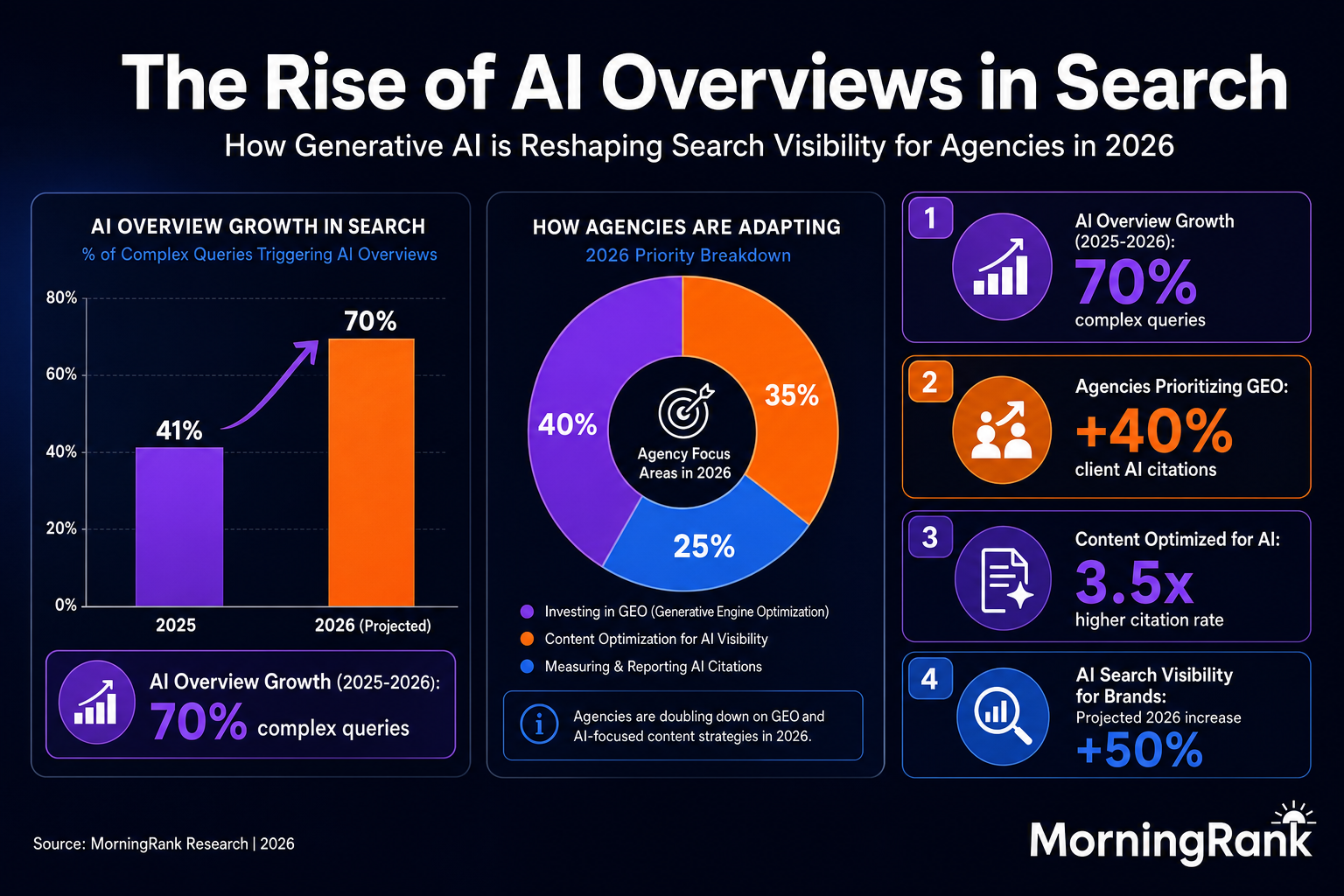
“Research from Search Engine Land in late 2025 indicated that AI Overviews appeared for over 70% of complex queries, a figure projected to grow in 2026, underscoring the immediate need for agencies to prioritize AIO optimization.”
Generative Engine Optimization (GEO) involves strategically crafting and structuring content to be easily consumed, understood, and cited by generative AI models, especially Google AI Overviews. For agencies, mastering GEO in 2026 is critical for securing top AI search visibility and ensuring clients' brands are prominently featured in the new search landscape.
Key Takeaways
- Generative Engine Optimization (GEO) focuses on structuring content for AI consumption, ensuring it is cited accurately by generative models.
- Agencies must adapt SEO workflows to include AI-first content creation, prioritizing clarity, conciseness, and E-E-A-T.
- Optimizing for Google AI Overviews requires direct answers, structured data, and high topical authority.
- Monitoring AI citation and visibility is crucial for proving GEO strategy effectiveness to clients.
- Adopting an AI-first content strategy now prepares agencies for the evolving search landscape.
The rise of generative AI in search, particularly Google AI Overviews (AIOs), has fundamentally reshaped the digital marketing landscape. As an AI Search Strategist at MorningRank, I've observed firsthand how agencies that proactively embrace Generative Engine Optimization (GEO) are outperforming those clinging to outdated SEO tactics. Your clients' brands need to be visible where users are getting their answers, and increasingly, that's directly from an AI model. This guide will walk you through the essential components of an effective GEO strategy for your agency in 2026, from content creation to performance measurement.
What is Generative Engine Optimization (GEO) for Agencies?
Generative Engine Optimization (GEO) is the practice of optimizing digital content specifically for generative AI models and AI-powered search experiences. Unlike traditional Search Engine Optimizationwhich primarily targets search engine algorithms for organic listings, GEO focuses on making content discoverable, digestible, and directly citable by AI Overviews, chatbots, and other AI answer engines. This means going beyond keywords to prioritize semantic clarity, factual accuracy, and structured information that AI can easily process and synthesize.
For agencies, a robust GEO strategy means ensuring client content not only ranks in traditional search results but also appears as the authoritative source within AI-generated summaries. In my experience, agencies that integrate GEO early gain a significant competitive edge, allowing them to deliver tangible results to clients as AI search becomes more prevalent. This shift requires a deep understanding of how AI consumes information and what signals it prioritizes for citation. It's about being the source, not just ranking in the top ten.
Why Are Google AI Overviews So Critical for Agency GEO Strategy?
Google AI Overviews (AIOs) represent a paradigm shift in how users receive information directly within Google Search, making them a cornerstone of any effective agency GEO strategy. Instead of a list of blue links, users now frequently see a concise, AI-generated summary at the top of the search results, often pulling information from multiple sources. This prominent placement means that if your client's content is not optimized to be cited by AIOs, they risk losing significant visibility and traffic to competitors who are.
Research from Search Engine Land in late 2025 indicated that AI Overviews appeared for over 70% of complex queries, a figure projected to grow in 2026. This underscores the immediate need for agencies to prioritize AIO optimization. For clients, being featured in an AI Overview signifies authority and trustworthiness, establishing their brand as a go-to source of information. Agencies must therefore develop content that answers user queries directly, concisely, and with verifiable E-E-A-T (Experience, Expertise, Authoritativeness, and Trustworthiness) signals to be chosen by the AI.

How Can Agencies Structure Content for AI Overview Optimization?
Structuring content effectively for AI Overview optimization involves a deliberate approach that prioritizes clarity, conciseness, and semantic richness. AI models excel at extracting direct answers from well-organized content. Start by adopting an "answer-first" writing style, where the most important information is presented upfront, followed by supporting details. Think of each content piece as potentially providing a direct answer to a user's question.
Key elements for structuring GEO-friendly content include:
- Clear, Question-Based Headings: Use H2 and H3 tags to pose direct questions that users might ask (e.g., "What is Generative Engine Optimization?", "How Does AI Overviews Work?"). This helps AI quickly identify relevant sections.
- Direct Answers in First Paragraphs: Ensure the first paragraph under each heading provides a succinct, self-contained answer to the question posed in the heading. Aim for 2-4 sentences, making it snippet-ready.
- Bullet Points and Numbered Lists: AI loves structured data. Break down complex information into digestible lists, which are easily parsable and ideal for AI summary generation.
- Glossary-Style Definitions: Define key terms and acronyms clearly the first time they appear, ideally in a "Term is..." format. This provides the AI with unambiguous definitions.
- Semantic Markup (Schema): Implement relevant Schema Markup for AI Search. While not a direct ranking factor for AIOs, it helps AI understand the context and relationships between entities on your page, making it easier to extract information.
- E-E-A-T Signals: Clearly demonstrate expertise and trustworthiness. Cite authoritative sources, include author bios with credentials, and ensure content is regularly updated for accuracy. Google's AI models are trained on quality signals, and strong E-E-A-T is paramount.
By implementing these structural best practices, agencies can significantly improve the chances of their client's content being chosen as a primary source for Google AI Overviews and other generative AI responses.
What Role Does Topical Authority Play in Agency GEO Strategies?
Topical authority is a foundational pillar of successful agency GEO strategies, especially in the context of AI Overviews. It's no longer enough to rank for individual keywords; AI models seek comprehensive, authoritative sources that cover a subject deeply and broadly. Topical authority means establishing your client's website as the go-to expert for an entire cluster of related topics, not just a few scattered keywords.
When an AI model is compiling an overview, it favors sources that have demonstrated consistent and thorough coverage of a subject. If a client's site has a strong internal linking structure connecting numerous pieces of content around a core topic, and each piece provides high-quality, E-E-A-T rich information, the AI is more likely to trust and cite that domain. This approach builds trust not only with search engines but also with generative AI, which prioritizes credible information. For more on this, explore our guide on Topic Clusters and User-Intent Mapping.
In my experience, agencies that invest in building genuine topical authority see their clients benefit from increased AI citations and improved overall AI search visibility. It's a long-term play that yields significant dividends as AI search continues to evolve. Without deep, interconnected content, AI models may struggle to ascertain the true expertise of a site on a given subject, opting for more comprehensively covered sources instead.
| Feature | Traditional SEO Focus | Generative Engine Optimization (GEO) Focus |
|---|---|---|
| Primary Goal | Rank in organic SERP listings | Be cited and sourced by AI Overviews and answer engines |
| Content Creation | Keyword-driven articles, blog posts | Direct answers, structured data, clear definitions, E-E-A-T signals |
| Measurement | Organic rankings, traffic, conversions | AI citation count, AI search visibility, source attribution |
| Key Challenge | Algorithm updates, competition for top 10 | AI comprehension, trust, and synthesis |
| User Experience | Website engagement, time on page | Clarity, conciseness, quick answer delivery |
How Do Agencies Measure Generative Engine Optimization Success?
Measuring Generative Engine Optimization success requires a shift from traditional SEO metrics to ones that reflect AI visibility and citation. While organic rankings and traffic remain important, agencies must now track how frequently and effectively their clients' content is being utilized by AI Overviews and other answer engines. In my experience, a multi-faceted approach to measurement provides the clearest picture of GEO performance.
Key metrics for GEO success include:
- AI Citation Rate: This measures how often a client's website or specific content is cited as a source within Google AI Overviews or other generative AI responses. This is perhaps the most direct indicator of GEO effectiveness.
- AI Search Visibility Share: A percentage indicating your client's share of voice within AI-generated answers for their target topics.
- Branded Entity Recognition: Tracking whether AI models correctly identify and reference client brands, products, or services.
- Traffic from AI Overviews: While AI Overviews aim to provide direct answers, they often include links to sources. Monitoring referral traffic originating from AIOs is crucial.
- Topical Authority Score: A qualitative or quantitative assessment of your client's domain authority and comprehensive coverage across their target topics, as perceived by AI.
Tools like MorningRank's AI visibility tracking and GEO and AEO tracking features are designed precisely for this purpose. They enable agencies to monitor client citations across major AI answer engines, providing the data needed to demonstrate ROI and refine GEO strategies. Without these specialized metrics, agencies are operating blind in the evolving AI search landscape.
Conclusion: Future-Proofing Agency SEO with GEO in 2026
The shift towards generative AI in search is not a trend, but a fundamental evolution of how users find and consume information. For agencies in 2026, embracing Generative Engine Optimization (GEO) is no longer optional; it's imperative for maintaining client visibility and demonstrating value. By prioritizing AI-first content creation, structuring information for optimal AI comprehension, and building robust topical authority, agencies can ensure their clients remain at the forefront of the AI search revolution.
As an AI Search Strategist, I see GEO as the critical link between traditional SEO and the future of search. It requires a proactive mindset, continuous adaptation, and the right tools to monitor performance effectively. Agencies that master GEO will not only secure more client wins but also position themselves as forward-thinking leaders in an increasingly AI-driven digital world. This is about future-proofing your agency's SEO services.
Related reading: Advanced GEO Techniques: Beyond the Basics for Agencies in 2026.
Frequently Asked Questions
What is Generative Engine Optimization (GEO)?
Generative Engine Optimization (GEO) is the process of optimizing content to be easily found, understood, and cited by generative AI models and AI-powered search experiences like Google AI Overviews. It ensures your content is the authoritative source for AI-generated answers.
How is GEO different from traditional SEO?
Traditional SEO focuses on ranking in organic search results, while GEO specifically targets visibility within AI-generated answers. GEO emphasizes direct answers, structured data, and E-E-A-T signals to cater to AI's content consumption patterns, whereas SEO primarily focuses on keywords and backlinks.
Why should agencies prioritize GEO in 2026?
Agencies should prioritize GEO in 2026 because Google AI Overviews are becoming a dominant feature in search results, often providing answers before users see organic links. Without GEO, clients risk losing significant AI search visibility and brand authority to competitors.
What are the key components of an effective GEO content strategy?
An effective GEO content strategy includes creating direct, concise answers to common questions, using clear headings, implementing structured data, demonstrating strong E-E-A-T, and building comprehensive topical authority. The goal is to make content easily digestible for AI models.
How can agencies measure GEO performance for clients?
Agencies can measure GEO performance by tracking AI citation rates, AI search visibility share, branded entity recognition, and referral traffic from AI Overviews. Specialized tools like MorningRank's GEO and AEO tracking features provide critical data to assess and report on these metrics.
Can GEO help my clients rank higher in Google AI Overviews?
Yes, an effective Generative Engine Optimization strategy significantly increases your clients' chances of being cited and featured prominently in Google AI Overviews. By providing clear, authoritative, and structured content, you help AI models identify your client's site as the best source for a query.
How can MorningRank support my agency's GEO efforts?
MorningRank offers specialized tools for AI visibility tracking and GEO/AEO citation tracking, enabling agencies to monitor their clients' performance within AI Overviews and other generative AI platforms. This helps you refine strategies, prove ROI, and secure your clients' position in the evolving AI search landscape.
Ready to empower your agency with cutting-edge Generative Engine Optimization capabilities? Discover how MorningRank can transform your clients' AI search visibility. Try MorningRank free today.
Want this kind of insight every week?
MorningRank delivers daily rank tracking, AI SEO recommendations, and white label client reporting.