
GEO Guide: Implementing Generative Engine Optimization for Agencies in 2026
Generative Engine Optimization (GEO) implementation for agencies in 2026 involves a strategic shift towards crafting content that is not only found but also…
 Sofia Chen
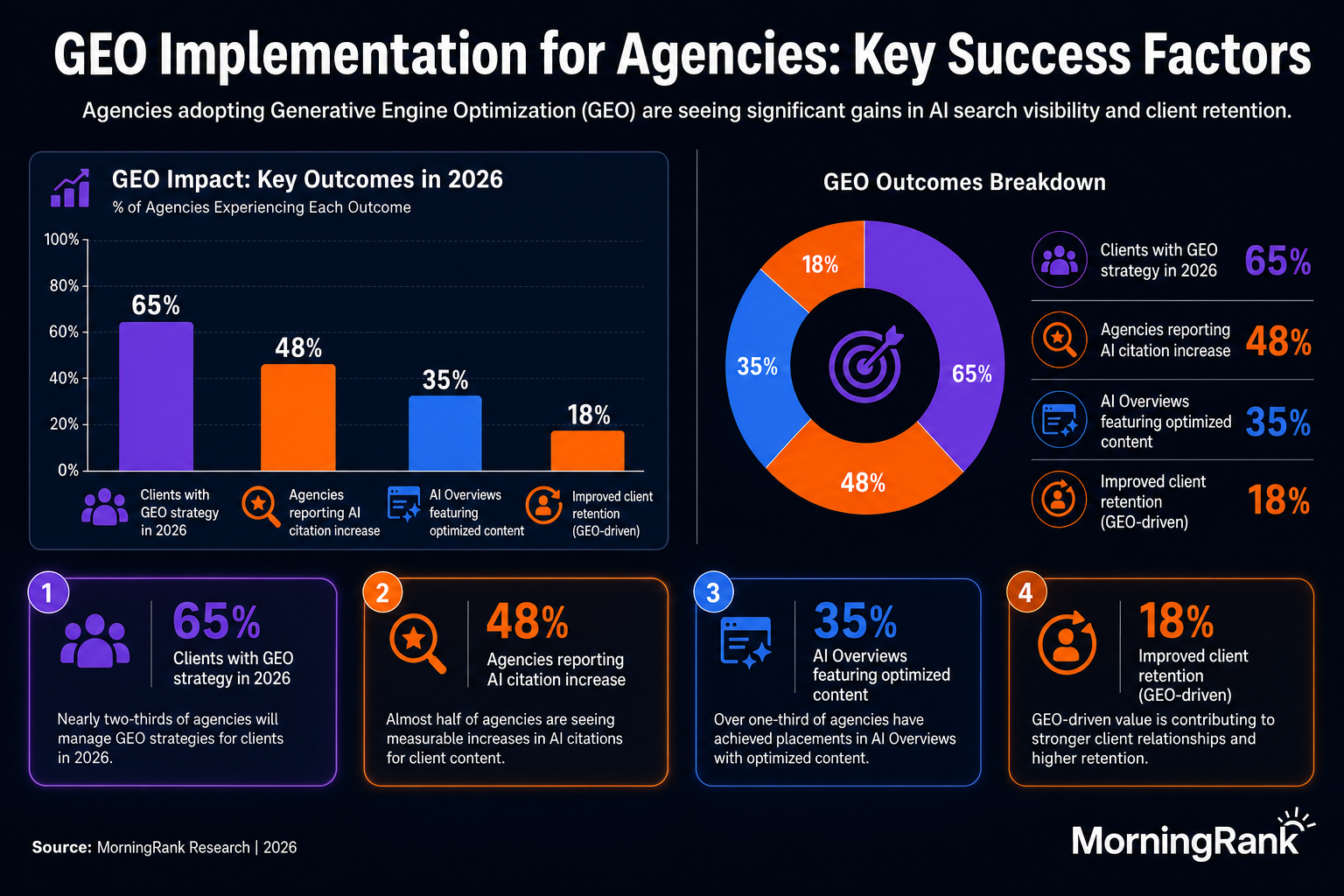
“In 2026, 65% of agencies report actively developing a GEO strategy, with 48% seeing a direct increase in AI citations for their client content, demonstrating the rapid adoption and tangible benefits of this new optimization approach.”
Generative Engine Optimization (GEO) implementation for agencies in 2026 involves a strategic shift towards crafting content that is not only found but also accurately processed and cited by AI answer engines. This adaptation is crucial for maintaining and enhancing client visibility in a search landscape increasingly dominated by generative AI. Agencies that master GEO will lead their clients to sustained prominence.
Key Takeaways
- Generative Engine Optimization (GEO) is the practice of optimizing content to be understood, processed, and cited by AI answer engines, critical for 2026 search visibility.
- Agencies must audit existing content for AI-readiness, focusing on structured data, explicit answers, and E-E-A-T signals.
- Developing a robust GEO content strategy involves creating authoritative, concise, and contextually rich content blocks that AI can easily extract.
- Implementing specialized GEO tracking tools is essential to measure citations, AI answer accuracy, and overall AI search visibility for client campaigns.
- Integrating GEO into client workflows strengthens agency value by preparing brands for the future of AI-driven search experiences.
The rise of generative AI in search, exemplified by platforms like Google AI Overviews, ChatGPT, and Gemini, has fundamentally reshaped how information is discovered and consumed. For agencies, this shift presents both a significant challenge and an immense opportunity. Traditional SEO alone is no longer sufficient; a dedicated approach to Generative Engine Optimization is now imperative. In my experience, agencies that embrace this paradigm shift early are best positioned to deliver unparalleled value and demonstrable results to their clients. This guide will walk you through the practical steps your agency needs to take to implement GEO effectively in 2026, ensuring your clients stay ahead in the AI search revolution.
What is Generative Engine Optimization (GEO) and Why is it Critical for Agencies in 2026?
Generative Engine Optimization (GEO) is the process of optimizing digital content and online presence to increase its likelihood of being accurately understood, processed, and cited by generative AI models and AI answer engines. This goes beyond traditional keyword rankings, focusing instead on semantic clarity, factual accuracy, and structured data that AI can easily interpret. For agencies in 2026, GEO is critical because AI Overviews and other generative search features are becoming primary interfaces for information retrieval, directly impacting brand visibility and traffic. According to a Search Engine Journal reportinitial analyses show AI Overviews appearing for a significant percentage of queries, suggesting a profound shift in user behavior.
The core value of GEO for agencies lies in future-proofing client strategies. As AI models become more sophisticated, they will increasingly synthesize information to provide direct answers, reducing the need for users to click through to websites. Agencies neglecting GEO risk their clients' content becoming invisible or incorrectly represented in these critical new touchpoints. By actively optimizing for generative AI, agencies can ensure their clients' brands are authoritative sources, cited directly in AI responses, and positioned as experts in their respective fields. This proactive approach builds resilience against algorithmic shifts and reinforces client trust, demonstrating foresight in a rapidly evolving digital landscape. It also provides a unique selling proposition, differentiating agencies that can navigate both traditional and AI-driven search environments.
How Do Agencies Conduct an AI-Readiness Content Audit for GEO?
An AI-readiness content audit is the foundational step for any agency looking to implement Generative Engine Optimization. This audit systematically evaluates existing content to determine its suitability for consumption and citation by generative AI models. It involves assessing content for attributes like semantic clarity, conciseness, factual accuracy, and the presence of structured data. The goal is to identify gaps and opportunities where content can be refined to be more "AI-friendly." In my experience, a comprehensive audit reveals that even high-ranking traditional SEO content often lacks the specific characteristics AI models prioritize for extraction and synthesis.
To perform an effective AI-readiness audit, agencies should focus on several key areas:
- Clarity and Conciseness: AI models prefer direct, unambiguous answers. Evaluate if your content provides clear, self-contained answers to common questions without excessive jargon or fluff. Break down complex topics into digestible paragraphs.
- Factual Accuracy and E-E-A-T: Generative AI prioritizes trustworthy information. Ensure all claims are backed by credible sources, expert authorship is highlighted, and content demonstrates clear Experience, Expertise, Authoritativeness, and Trustworthiness (E-E-A-T).
- Structured Data Implementation: Utilize Schema Markup (e.g., Article, FAQPage, HowTo) to explicitly label content elements. This provides AI with a machine-readable roadmap to your data. Tools like MorningRank's automated SEO site audit tool can help identify structured data opportunities.
- Question-Answer Format: Look for opportunities to reformat sections into explicit question-and-answer pairs, which are ideal for AI extraction, particularly for Google AI Overviews and chat interfaces.
- Internal Linking Structure: A logical internal linking structure helps AI models understand content hierarchy and topical relationships, reinforcing authority. Refer to our guide on GEO content strategy for deeper insights into optimal structuring.
- Source Citations: Just as humans need citations, AI benefits from clear attribution. Ensure any data or statistics in your content are explicitly cited, ideally with direct links to authoritative sources.
By meticulously auditing content against these criteria, agencies can create a roadmap for optimizing their clients' digital assets for the generative AI era.

Developing an Effective GEO Content Strategy for Client Success
Developing an effective Generative Engine Optimization content strategy involves a pivot from purely keyword-driven content to an information architecture designed for AI consumption. This means focusing on creating definitive answers, establishing topical authority, and structuring content with explicit semantic signals. Agencies need to educate clients that content success is no longer solely about organic clicks but also about being the authoritative source cited in AI answers. This comprehensive strategy ensures that content is not just found but also trusted and utilized by generative models.
Key pillars of a robust GEO content strategy include:
- Topical Authority Clusters: Instead of disparate blog posts, create comprehensive topic clusters that cover a subject area exhaustively. This signals to AI that your content is a complete and authoritative resource. Learn more about this in our topic cluster strategy for agencies guide.
- Explicit Answer Blocks: For every common question related to your client's services or products, craft concise, fact-based answer blocks. These should be 2-4 sentences, appearing early in the content, and directly address the query.
- Schema Markup Beyond Basics: Move beyond basic Schema types. Implement specific, granular Schema that describes every entity, fact, and relationship within your content. This helps AI understand the nuances of the information presented.
- E-E-A-T Reinforcement: Consistently integrate E-E-A-T signals throughout the content. This includes author bios with credentials, links to reputable sources, case studies, and testimonials that demonstrate real-world experience and expertise.
- Multi-Format Content: AI processes various formats. Supplement text with well-captioned images, infographics (like the one below), and videos. Ensure descriptive alt text and transcripts are available for accessibility and AI understanding.
- Semantic Keyword Integration: While keywords remain important, focus on semantic SEOusing variations, synonyms, and related terms to provide a rich context that AI models can leverage for deeper understanding.
By implementing these strategic content adjustments, agencies can significantly enhance their clients' chances of achieving high visibility and preferential citation within generative AI search experiences.
Measuring Generative Engine Optimization (GEO) Performance for Clients
Measuring Generative Engine Optimization (GEO) performance is crucial for agencies to demonstrate return on investment and refine strategies. Unlike traditional SEO, which focuses heavily on keyword rankings and organic traffic, GEO measurement extends to tracking citations within AI answer engines, assessing the accuracy of AI-generated summaries, and monitoring overall AI search visibility. This new frontier requires specialized tools and analytical approaches to quantify success and understand AI behavior. Without proper measurement, agencies cannot effectively prove the value of their GEO efforts to clients.
Key metrics and methods for measuring GEO performance include:
- AI Citation Tracking: Monitor where and how often your clients' content is cited within AI Overviews, ChatGPT, Gemini, and other generative platforms. This is a direct indicator of content authority and AI-readiness. MorningRank offers a dedicated GEO and AEO tracking tool specifically for this purpose.
- Answer Accuracy: Regularly review AI-generated answers for your client's target queries. Verify that the information presented by AI is correct, complete, and aligns with your client's messaging. Inaccurate answers can be detrimental to brand perception.
- AI Overview Prominence: Track the frequency and position of your content within Google's AI Overviews for target keywords. Higher prominence suggests better GEO optimization.
- Generative Traffic Analysis: While direct click-throughs may decrease for some queries, monitor for changes in referral traffic from AI platforms or increased direct traffic resulting from AI-driven brand awareness.
- Brand Mention Monitoring: Beyond direct citations, track general brand mentions within AI conversations, indicating increased brand recognition and topical relevance attributed by AI models.
- Schema Validation & Health: Continuously monitor the health and proper implementation of structured data. Errors in Schema can hinder AI's ability to parse and use your content.
By meticulously tracking these GEO-specific metrics, agencies can provide clients with transparent reporting that clearly outlines their success in the generative AI search landscape of 2026.
Integrating GEO into Agency Client Workflows in 2026
Integrating Generative Engine Optimization (GEO) into existing agency client workflows in 2026 requires a thoughtful, phased approach rather than an abrupt overhaul. The key is to embed GEO considerations at every stage, from initial client onboarding and strategy development to content creation, reporting, and ongoing optimization. This ensures that GEO becomes a natural extension of your agency's service offerings, rather than a separate, siloed task. Successful integration strengthens client relationships by positioning your agency as a forward-thinking partner capable of navigating the latest search innovations.
Practical steps for integrating GEO into agency workflows:
- Educate Clients: Begin by educating clients on the importance of GEO, explaining the shift in search behavior and the value of AI visibility. Frame it as an essential evolution of their digital presence.
- Update Onboarding Processes: Include GEO-specific questions in your client onboarding. What are their unique selling propositions? Who are their subject matter experts? What data or insights do they have that AI models would value?
- Revise Content Briefs: Modify content briefs to include explicit instructions for GEO. This means emphasizing concise answer blocks, E-E-A-T signals, semantic keyword usage, and structured data requirements.
- Implement GEO-Specific Tools: Integrate tools designed for AI search visibility into your tech stack. Platforms like MorningRank offer AI visibility tracking and GEO/AEO features that streamline this process.
- Train Your Team: Provide ongoing training for your content creators, SEO specialists, and account managers on GEO best practices. This empowers your team to implement and discuss GEO confidently.
- Develop GEO-Focused Reporting: Adapt your client reporting to include GEO metrics. Show not just keyword rankings but also AI citation volume, answer accuracy, and AI Overview presence. A white-label client portal can help present these new metrics clearly.
- Iterative Optimization: Treat GEO as an ongoing process. Continuously monitor AI responses, refine content based on performance data, and stay updated on the latest generative AI developments from sources like Google Search Central.
By systematically integrating GEO into these critical agency functions, you can ensure your clients are well-prepared for the future of AI-driven search.
Conclusion: Leading the Charge with Generative Engine Optimization
The digital marketing landscape of 2026 demands a proactive and adaptive approach, especially when it comes to the profound impact of generative AI on search. Generative Engine Optimization (GEO) is no longer a niche concept, but a fundamental pillar of any agency's strategy for ensuring client visibility and success. By understanding how AI processes and synthesizes information, conducting thorough content audits, crafting intelligent GEO content strategies, and meticulously measuring performance, agencies can transform potential threats into powerful opportunities. This commitment to GEO demonstrates foresight, expertise, and a dedication to delivering cutting-edge results in an AI-first world.
In my experience, agencies that embrace GEO now will build an undeniable competitive advantage. They will not only secure their clients' positions in traditional search but also establish them as trusted authorities within AI answer engines and generative experiences. This strategic shift reinforces the agency's value proposition, attracting new clients who recognize the imperative of AI search visibility. For agencies aiming to lead in 2026 and beyond, mastering Generative Engine Optimization is not optional, it is essential. It's about being the definitive answer in a world increasingly powered by AI.
Related reading: Agency GEO Strategy: Optimizing for AI Overviews in 2026.
Frequently Asked Questions
What is Generative Engine Optimization (GEO)?
Generative Engine Optimization (GEO) is the specialized practice of optimizing digital content and online presence so that it is easily understood, accurately processed, and frequently cited by generative AI models and AI answer engines. It focuses on semantic clarity, factual accuracy, and structured data to enhance visibility in AI-driven search experiences.
How is GEO different from traditional SEO?
While traditional SEO aims for higher rankings in search results, GEO specifically optimizes content for extraction and citation within AI-generated answers, such as Google AI Overviews. GEO emphasizes structured data, clear answer blocks, and E-E-A-T signals more intensely to directly inform AI models, whereas traditional SEO often focuses on organic clicks.
Why should agencies prioritize GEO in 2026?
Agencies should prioritize GEO in 2026 because generative AI is rapidly changing how users find information. By optimizing for GEO, agencies ensure their clients' brands are recognized as authoritative sources by AI, leading to increased visibility, trust, and potential traffic, thereby future-proofing their digital strategies.
What are the key components of a GEO content strategy?
A key GEO content strategy includes creating comprehensive topic clusters, explicit and concise answer blocks, extensive use of semantic and structured data (Schema Markup), strong E-E-A-T signals, and multi-format content to cater to diverse AI processing methods.
How can agencies measure the effectiveness of their GEO efforts?
Agencies can measure GEO effectiveness by tracking AI citation volume, assessing the accuracy of AI-generated answers, monitoring content prominence within AI Overviews, analyzing generative traffic, and continuously validating structured data implementation. Specialized GEO tracking tools are essential for these insights.
What tools are available to help agencies with Generative Engine Optimization?
Tools like MorningRank offer advanced features for Generative Engine Optimization, including AI visibility tracking and GEO/AEO citation monitoring. These platforms help agencies measure AI answer accuracy, track citations, and provide robust reporting to clients on their performance in the AI search landscape.
How can MorningRank help my agency with GEO?
MorningRank provides agencies with a comprehensive platform to implement and measure Generative Engine Optimization. Our tools allow you to track AI citations, monitor your clients' visibility in AI Overviews and other generative engines, and provide data-driven insights to refine your GEO strategy. Empower your agency to lead in the AI search era by trying MorningRank for free today.
Ready to revolutionize your clients' AI search visibility? Try MorningRank free today and discover how our advanced GEO tools can empower your agency to lead in the age of generative AI.
Want this kind of insight every week?
MorningRank delivers daily rank tracking, AI SEO recommendations, and white label client reporting.