
AEO Strategies: Optimizing Content for Answer Engines in 2026
Answer Engine Optimization (AEO) is a specialized SEO discipline focused on structuring and presenting content in a way that is easily consumable and citable…
 Sofia Chen
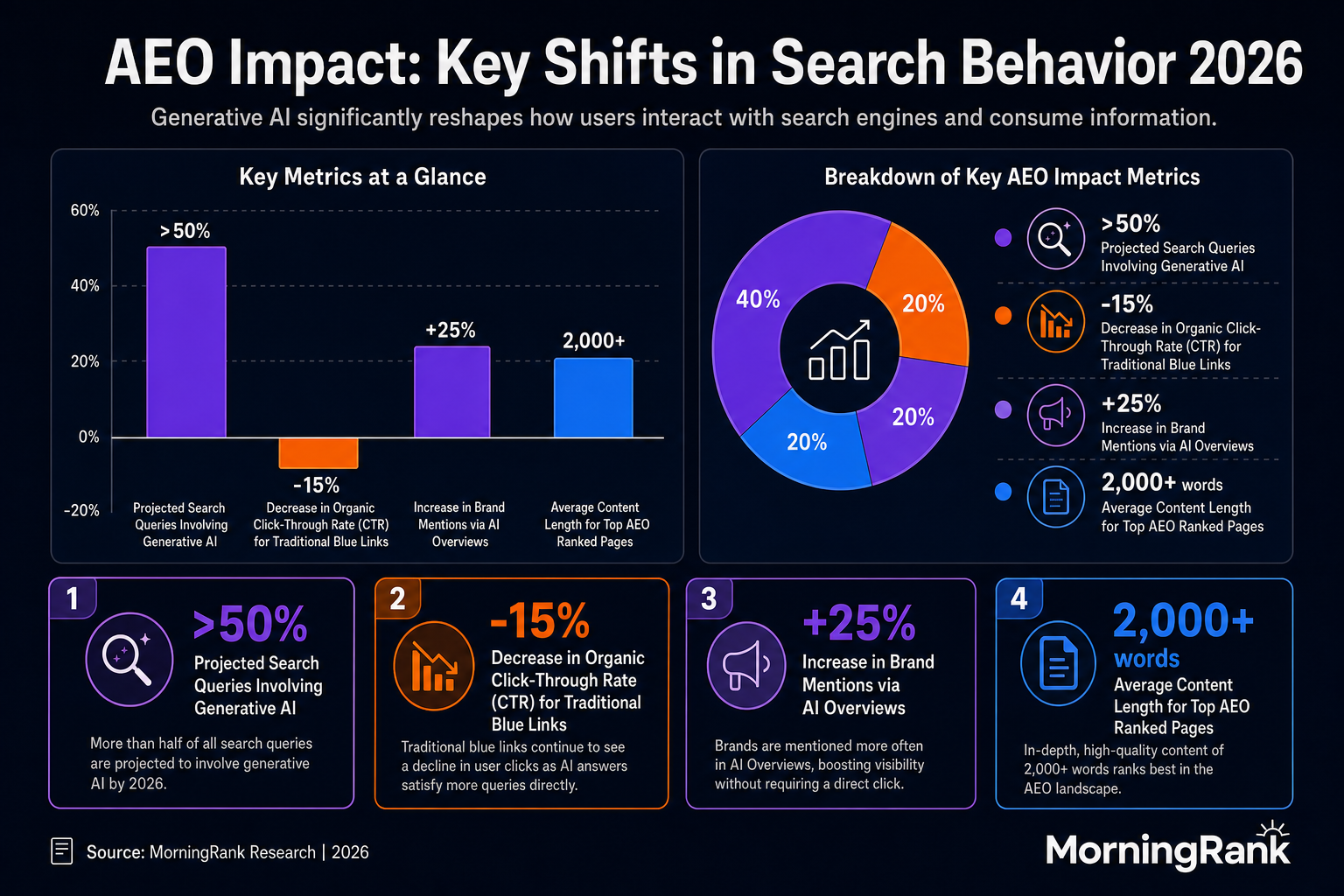
“Over 50% of search queries are expected to involve generative AI components by the end of 2026, highlighting the critical need for agencies to integrate AEO into their core service offerings and prioritize AI visibility.”
Answer Engine Optimization (AEO) is a specialized SEO discipline focused on structuring and presenting content in a way that is easily consumable and citable by AI answer engines and generative AI models. Effective AEO strategies ensure your content directly answers user queries, increasing visibility in AI Overviews and other AI-driven search experiences in 2026.
Key Takeaways
- AEO is distinct from traditional SEO, focusing on direct answers and AI-friendly content structures.
- Content must be clear, concise, and structured with explicit definitions and answer-first paragraphs.
- Schema Markup and structured data are crucial for AI models to understand and extract information.
- Building topical authority through comprehensive content clusters is vital for AEO success.
- Agencies must monitor AI visibility using specialized tools to track citations and performance.
The digital search landscape continues its rapid evolution in 2026. Traditional SEO, while still foundational, is no longer the sole pathway to visibility. The rise of AI answer engines like Google AI Overviews, ChatGPT, Gemini, and Perplexity has introduced a new paradigm: Answer Engine Optimization (AEO). As an AI Search Strategist at MorningRank, I've observed firsthand how agencies and local businesses that master AEO are securing a significant competitive edge. This post will detail robust AEO strategies and actionable playbooks your agency can implement to ensure your clients' content is not just found, but directly cited by the AI systems shaping the future of search.
What is Answer Engine Optimization (AEO) and Why Does it Matter in 2026?
Answer Engine Optimization (AEO) is the process of optimizing content specifically for AI answer engines, ensuring it is easily discoverable, understood, and cited by these platforms. Unlike traditional SEO, which primarily targets search engine ranking algorithms for web pages, AEO focuses on satisfying the information retrieval patterns of AI models. It emphasizes direct, concise answers, structured data, and clear semantic relationships within content.
In 2026, AEO matters more than ever because a significant portion of user queries are now answered directly by AI Overviews or generative AI tools without users ever clicking through to a website. Google's AI Overviews, for instance, often synthesize information from multiple sources to provide a direct answer at the top of the search results page. If your content is not optimized for AEO, it risks being overlooked by these powerful answer engines, even if it ranks well in traditional organic search. Agencies that embrace AEO can position their clients as authoritative sources within the AI search ecosystem, driving brand visibility and trust.
The shift towards AI-first search means that a proactive AEO strategy is no longer optional. It is a critical component of a comprehensive digital marketing plan. According to recent industry projections, over 50% of search queries are expected to involve generative AI components by the end of 2026 (Source: Search Engine Land). This statistic underscores the urgency for agencies to integrate AEO into their core service offerings. My experience shows that content designed with AEO in mind performs better not only in AI Overviews but also often sees improved rankings in traditional organic results due to its enhanced clarity and E-E-A-T signals.
AEO requires a nuanced approach, blending traditional SEO principles with new techniques tailored for AI. It involves understanding how AI models process information, prioritize sources, and construct answers. This often means focusing on semantic optimization, explicit definitions, and ensuring content is factually accurate and well-supported. By prioritizing AEO, agencies can secure their clients' relevance in the evolving search landscape and provide tangible value through increased AI visibility tracking.
How Can Structured Content Fuel Your AEO Strategy?
Structured content is foundational to a successful AEO strategy because it provides AI answer engines with clear, organized data that is easy to parse, understand, and extract. AI models thrive on explicit semantic relationships and well-defined information blocks. Implementing structured content involves using various HTML elements and Schema Markup to highlight key information, making it readily available for AI consumption.
One of the most effective ways to structure content for AEO is by adopting an inverted pyramid style, leading with the direct answer to a query. This ensures that the most critical information is immediately accessible to AI systems. Breaking down complex topics into smaller, digestible paragraphs with clear headings and subheadings also aids AI comprehension. Use <p> tags for paragraphs, <ul><li> for lists, and <h2>/<h3> for logical content hierarchy.
Beyond basic HTML, implementing Schema Markup is paramount. Schema.org vocabulary allows you to semantically describe your content, providing context to search engines and AI models. For instance, using FAQPage Schema can help AI engines understand and display your questions and answers directly in rich results or AI Overviews. Similarly, ArticleHowToand FactCheck Schema types can guide AI to the most relevant parts of your content. My team often leverages MorningRank's AI SEO Recommendations tool to identify optimal Schema implementation strategies for our clients.
Another crucial aspect of structured content for AEO is the explicit definition of key terms. The first time a critical term or acronym appears, define it clearly in a single, self-contained sentence, much like a glossary entry. This helps AI models establish a robust understanding of the vocabulary within your content, increasing the likelihood of accurate citation. By adopting these structured content practices, agencies can significantly improve their clients' chances of winning citations from AI answer engines.

Why is Topical Authority Essential for AEO Success?
Topical authority is essential for AEO success because AI answer engines prioritize information from sources that demonstrate deep, comprehensive knowledge across a specific subject area. Building topical authority signals to AI models that your content is trustworthy, authoritative, and reliable, making it a preferred source for answers and citations.
Topical authority goes beyond just ranking for individual keywords. It involves creating a web of interconnected content that covers a broad subject comprehensively, addressing all related sub-topics and user intents. This typically involves creating topic clusters where a pillar page links out to numerous supporting articles, each delving into a specific aspect of the broader topic. For example, a pillar page on "Answer Engine Optimization" might link to supporting content on "AEO content strategies, " "Schema Markup for AEO, " and "measuring AI visibility."
AI models, particularly those powering generative AI, analyze entire content ecosystems to assess expertise and authoritativeness. When your website consistently provides in-depth, well-researched, and accurate information across a topic, AI is more likely to trust and cite your content. This trust translates directly into enhanced AEO performance. As a search strategist, I emphasize that focusing on E-E-A-T (Experience, Expertise, Authoritativeness, and Trustworthiness) is a cornerstone of building this authority. Providing evidence of expertise, such as author bios, research citations, and data-backed claims, significantly boosts a site's standing with AI.
Moreover, robust internal linking within topic clusters helps AI models understand the relationships between your content pieces, reinforcing your site's overall authority on the subject. This comprehensive approach differentiates your content from superficial articles and positions your clients as leading experts in their fields, a critical factor for securing prime spots in AI Overviews and other answer engine results in 2026. For more insights on this, read our guide on Mastering Content SEO for Topical Authority.
How Can Agencies Measure and Track AI Visibility?
Agencies can measure and track AI visibility by employing specialized AEO and GEO tracking tools that monitor citations and mentions across various AI answer engines and generative AI platforms. Traditional SEO analytics often fall short in capturing these new metrics, necessitating a dedicated approach to understanding AI performance.
The first step is to identify where your clients' content is being cited. This involves actively monitoring platforms like Google AI Overviews, ChatGPT, Gemini, and Perplexity for mentions of your clients' brands, content, and key information. Manual tracking can be cumbersome and inefficient, especially for agencies managing multiple clients. This is where advanced tools become indispensable. MorningRank offers a dedicated AI visibility tracking feature that helps agencies monitor their clients' presence and citations across these diverse AI environments.
Key metrics for AI visibility include the number of times content is cited, the prominence of the citation (e.g., direct answer, supporting source), and the context in which it appears. Tracking these metrics over time allows agencies to assess the effectiveness of their AEO strategies and make data-driven adjustments. For example, if a client's content is frequently cited for a particular type of query, that indicates a strong alignment with AI intent and topical relevance.
Furthermore, agencies should track changes in AI-driven traffic referrals. While direct click-throughs from AI Overviews might be lower than traditional organic results, the value of brand mentions and implied authority can be significant. Understanding how users interact with AI-generated answers and subsequently engage with your clients' websites provides crucial insights. Regular reporting on these AI visibility metrics, integrated into existing client dashboards via a white-label client portaldemonstrates the tangible impact of AEO efforts and solidifies client trust in 2026.
Conclusion: Mastering AEO for 2026 Search Dominance
In 2026, mastering AEO strategies is no longer just an advantage, it's a necessity for agencies and local businesses aiming for search dominance. The landscape has undeniably shifted, with AI answer engines playing an increasingly prominent role in how users consume information. By prioritizing answer-first content, implementing robust structured data, building deep topical authority, and diligently tracking AI visibility, agencies can ensure their clients remain at the forefront of search innovation.
The future of search is conversational and AI-driven. Agencies that adapt quickly, adopting sophisticated AEO playbooks, will be the ones that consistently deliver measurable results and maintain client satisfaction. This means moving beyond a sole focus on traditional keyword rankings and embracing the nuanced requirements of generative AI. At MorningRank, we are committed to providing the tools and insights necessary for agencies to navigate this evolving environment successfully. Our platform helps you track not just traditional SEO metrics, but also your clients' crucial AI visibility, offering a comprehensive view of their digital presence in 2026.
Related reading: AEO Strategy Playbooks: Navigating AI Answer Engines in 2026.
Frequently Asked Questions
What is the primary difference between AEO and traditional SEO?
AEO, or Answer Engine Optimization, focuses on optimizing content to be directly understood and cited by AI answer engines like Google AI Overviews. Traditional SEO primarily aims for higher rankings in the organic search results of conventional search engines, driving clicks to web pages.
How important is structured data for AEO in 2026?
Structured data, particularly Schema Markup, is critically important for AEO in 2026. It provides explicit semantic context to AI models, helping them accurately parse, interpret, and extract information from your content for use in AI Overviews and other generative answers.
Can AEO help with traditional Google rankings as well?
Yes, AEO can positively impact traditional Google rankings. Content optimized for AEO tends to be highly organized, clear, and authoritative, which are strong signals for Google's core ranking algorithms, often leading to improved organic search performance.
What role does E-E-A-T play in AEO strategies?
E-E-A-T (Experience, Expertise, Authoritativeness, and Trustworthiness) plays a fundamental role in AEO strategies. AI answer engines prioritize content from highly authoritative and trustworthy sources, making strong E-E-A-T signals crucial for securing citations and visibility in AI-driven search results.
How can I track my clients' AEO performance effectively?
You can track your clients' AEO performance effectively using specialized AI visibility tracking tools, such as MorningRank's, that monitor citations and mentions across various AI answer engines and generative AI platforms. This provides insights into how AI models are consuming and utilizing your content.
Is AEO a replacement for traditional SEO?
No, AEO is not a replacement for traditional SEO; rather, it is a complementary and essential extension of it in 2026. A comprehensive digital strategy integrates both AEO and traditional SEO to achieve maximum visibility across the entire search ecosystem, including both conventional search results and AI-generated answers.
Where can agencies find tools to implement and track AEO strategies?
Agencies can find advanced tools to implement and track AEO strategies, including AI visibility and citation tracking, within platforms like MorningRankwhich provides comprehensive solutions tailored for the evolving AI search landscape of 2026.
Ready to empower your agency with cutting-edge AEO capabilities and dominate the AI search landscape? Try MorningRank free today and discover how our platform can transform your clients' AI search visibility.
Want this kind of insight every week?
MorningRank delivers daily rank tracking, AI SEO recommendations, and white label client reporting.