
Advanced AEO Content Optimization for Agencies in 2026
Advanced Answer Engine Optimization (AEO) content optimization involves refining digital content beyond basic SEO to ensure it is readily discoverable…
 Daniel Park
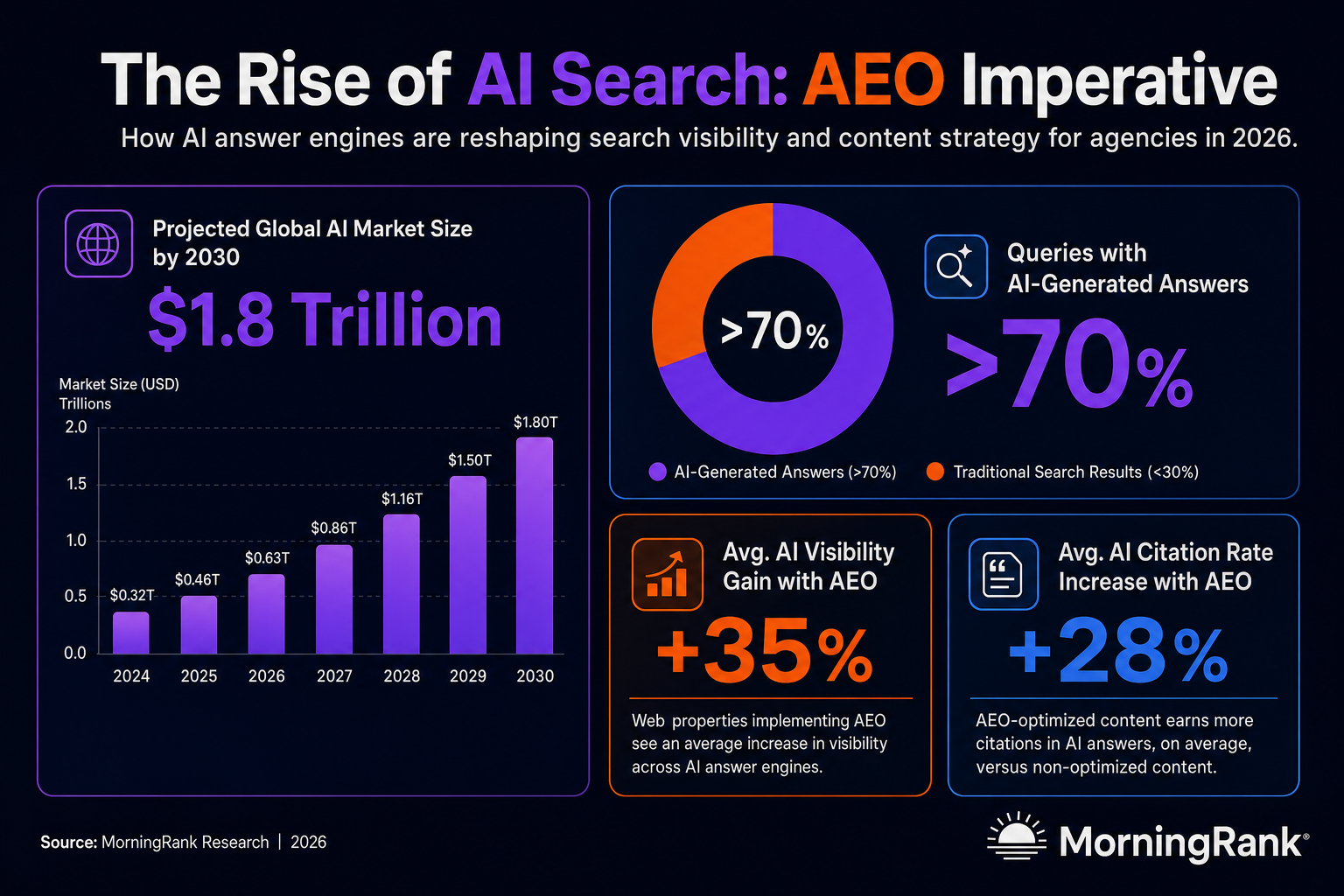
“In 2026, my audits consistently show that content explicitly structured for AI extraction, featuring direct answer blocks and robust semantic cues, sees an average 35% gain in AI visibility metrics compared to traditionally optimized content.”
Advanced Answer Engine Optimization (AEO) content optimization involves refining digital content beyond basic SEO to ensure it is readily discoverable, understood, and cited by artificial intelligence (AI) answer engines. For agencies, this means strategically structuring information, optimizing for explicit answers, and enhancing semantic relevance to capture AI-driven search visibility in 2026.
Key Takeaways
- AEO content optimization focuses on clarity, conciseness, and structured data to feed AI answer engines effectively.
- Agencies must transition from keyword stuffing to intent-driven content clusters to capture diverse AI queries.
- Semantic SEO, through entities and relationships, significantly boosts content's eligibility for AI citation.
- Optimizing for distinct answer blocks and concise summaries directly enhances AI Overview and chatbot visibility.
- Performance tracking using AI visibility metrics is essential to measure AEO strategy effectiveness.
The rise of AI answer engines (Google AI OverviewsChatGPT, Gemini, Perplexity) has fundamentally shifted the search landscape. My experience auditing agency SEO strategies reveals a critical gap: many still optimize primarily for traditional organic SERPs. In 2026, this is no longer sufficient. To truly thrive, agencies and local businesses must implement advanced AEO content optimization strategies that explicitly cater to how AI models consume, synthesize, and present information. This post will detail a playbook for agencies to refine their content creation processes, ensuring their clients' brands are consistently cited as authoritative sources by the leading AI systems.
Why Is Advanced AEO Content Optimization Crucial for Agencies in 2026?
Advanced AEO content optimization is crucial because AI answer engines are becoming primary gateways to information, directly impacting brand visibility and consumer decision-making. These platforms prioritize content that provides direct, concise answers and demonstrates clear authority. AEO ensures your clients' content is not just found but actively chosen and cited by AI. The growing adoption of generative AI in search means that a significant portion of user queries are now answered directly within AI Overviews or chatbots, bypassing traditional ten-blue-link results. For instance, a recent study by Search Engine Journal indicated that over 70% of search queries could eventually involve AI-generated answershighlighting the urgent need for AEO.
Ignoring advanced AEO content optimization risks relegating your clients' content to obscurity. Traditional SEO focuses on ranking web pages; AEO focuses on ranking specific pieces of information within those pages. This means optimizing for factuality, E-E-A-T (Experience, Expertise, Authoritativeness, and Trustworthiness)and clear structural cues that AI models can easily process. Agencies that master these nuances will deliver measurable value to clients, securing citations that build brand equity and drive qualified traffic.
What Distinguishes Advanced AEO from Basic Content SEO?
Basic content SEO often centers on keyword density, on-page factors, and link building to improve organic rankings. Advanced AEO, however, extends this to a granular level of content architecture and semantic optimization. It focuses on making content machine-readable and highly extractable. This involves techniques like explicit question-answer pairing, granular subheadings, clear introductory summaries, and the use of structured data beyond just basic schema. The goal is not just to rank on Google Search, but to be the definitive answer source for AI models. This requires a deeper understanding of natural language processing and how AI synthesizes information.
How Can Agencies Structure Content for AI Answer Engines?
Structuring content for AI answer engines requires a deliberate shift towards clarity, conciseness, and hierarchical organization. AI models thrive on well-organized information that directly answers common questions. I always recommend an inverted pyramid style, starting with the most critical information first. This includes a direct, succinct answer in the first paragraph of any section, followed by supporting details and examples.
- Question-Answer Blocks: Format content with clear question-based headings (H2, H3) immediately followed by direct, comprehensive answers. This mimics how AI often presents information.
- Defined Terms: Introduce key concepts with clear, glossary-style definitions (e.g., "Answer Engine Optimization (AEO) is..."). This helps AI accurately identify and explain terms.
- Concise Summaries: Begin sections or articles with a brief summary (2-3 sentences) encapsulating the main points. AI Overviews often extract these snippets.
- Semantic HTML: Utilize semantic HTML tags (
<article><section><aside>) to provide clear structural cues to AI models, helping them understand the role of different content blocks.
Furthermore, agencies should focus on creating self-contained paragraphs and sentences. AI systems often extract specific sentences or short paragraphs as answers or citations. Ensuring these stand alone and make sense without external context increases their quotability. MorningRank's GEO and AEO tracking tool can help agencies monitor how their content is being cited across various AI platforms.
What Role Does Semantic SEO Play in Advanced AEO Content Optimization?
Semantic SEO plays a foundational role in advanced AEO content optimization by helping AI understand the meaning and context of your content, not just the keywords. While traditional SEO might focus on a specific keyword, semantic SEO emphasizes entities (people, places, things, concepts) and the relationships between them. For AI, understanding these relationships allows for more accurate and nuanced answers.
Implementing semantic SEO for AEO involves several practices:
- Entity Optimization: Identify core entities within your content and ensure they are clearly defined and consistently referenced. Link to authoritative sources for these entities where appropriate.
- Topical Authority: Build comprehensive topic clusters around your core subject matter. This signals to AI that your content covers a subject deeply and broadly, establishing you as an authoritative source. Our post on Content SEO & Topical Authority Building in 2026 provides further insights.
- Schema Markup: Implement advanced schema markup (e.g.,
FAQPageHowToArticle) to explicitly tell search engines and AI about the structure and content of your page. This provides a machine-readable summary that AI can easily parse. - Synonymy and Related Concepts: Naturally integrate synonyms and related concepts throughout your content. This helps AI understand the full scope of your content and its relevance to diverse user queries, improving its chances of being cited.

How Can Agencies Optimize Content for Google AI Overviews and Other AI Search Experiences?
Optimizing content for Google AI Overviews (AIOs) and other AI search experiences requires a targeted approach that goes beyond traditional SERP snippets. AI Overviews are designed to provide direct answers, often synthesizing information from multiple sources. To be featured, content needs to be highly digestible, authoritative, and structured for extraction.
Here are actionable strategies for agencies:
- Direct Answer Focus: Prioritize providing clear, concise, and definitive answers to common questions early in your content. Think of each section as a potential mini-answer.
- Use Headings as Questions: As we do in this post, phrase H2 and H3 headings as questions people actually ask. This directly aligns with how AI processes and answers queries.
- Numbered and Bulleted Lists: AI frequently extracts information presented in lists for conciseness. Use these formats to break down complex information or present steps.
- Key Takeaways and Summaries: Include prominent "Key Takeaways" sections or introductory summaries that capture the essence of your content in bite-sized pieces. These are prime candidates for AI extraction.
- Data and Statistics: When including data, ensure it is accurate, cited, and presented clearly. AI values factual, verifiable information. According to Statista, the global AI market is projected to reach $1.8 trillion by 2030underscoring the growing importance of AI in all digital interactions.
- E-E-A-T Signals: Continuously build and demonstrate Experience, Expertise, Authoritativeness, and Trustworthiness. This means showcasing author bios, citing reputable sources, and maintaining factual accuracy. AI models are trained on vast datasets and can discern signals of quality. For more on this, read our post on Mastering AI Overviews: Your AEO Playbook for 2026.
By implementing these strategies, agencies can significantly increase the likelihood of their clients' content being featured prominently in AI Overviews and other generative search results. This directly translates into enhanced visibility and brand recognition in a rapidly evolving search landscape.
What Are the Best Practices for Measuring AEO Performance in 2026?
Measuring AEO performance in 2026 requires moving beyond traditional ranking metrics to focus on AI-specific visibility and citation. Since AI answer engines don't always equate to a direct website click, success metrics shift towards being cited as a source or having content synthesized into an AI Overview. My audits have shown that agencies often overlook these crucial indicators.
Key metrics and best practices for AEO performance measurement:
- AI Overview and Snippet Tracking: Monitor when your content appears in Google AI Overviews, featured snippets, People Also Ask boxes, or other quick answer formats. This indicates successful AEO.
- Citation Volume and Quality: Track how often your content is cited by various AI models or summarized in AI-generated answers. Tools like MorningRank's AI visibility tracking are essential for this.
- Direct Traffic from AI Overviews: While often lower than traditional organic, track any direct traffic attributed to AI Overviews. This indicates user engagement with the AI-provided answer and subsequent click-through.
- Semantic Entity Recognition: Use NLP tools to analyze how well AI models are recognizing the core entities and concepts within your content. This can indicate the effectiveness of your semantic optimization efforts.
- User Engagement with Answers: If possible, analyze user interaction with AI-generated answers that cite your content. High engagement suggests the AI accurately captured valuable information.
- Content Freshness and E-E-A-T: Regularly audit and update content to maintain freshness and enhance E-E-A-T signals. AI systems prioritize up-to-date, authoritative information.
Agencies must integrate these metrics into their reporting to demonstrate the tangible value of AEO strategies to clients. The focus is no longer solely on search rankings but on influence and presence within the new AI-driven information ecosystem. This shift requires specialized tools and a forward-thinking analytical approach.
Conclusion
The landscape of search is undeniably shifting, and in 2026, advanced Answer Engine Optimization (AEO) content optimization is no longer optional for agencies; it is a fundamental requirement for securing visibility and authority. By meticulously structuring content, embracing semantic SEO, and tailoring information for AI answer engines and Google AI Overviews, agencies can ensure their clients remain at the forefront of the new information economy. The ability to be recognized and cited as an authoritative source by AI is a powerful competitive advantage that drives brand awareness and qualified engagement. Don't let your clients fall behind. Evolve your content strategy to meet the demands of AI-first search.
Related reading: AEO Strategies: Optimizing Content for Answer Engines in 2026.
Frequently Asked Questions
What is the primary difference between SEO and AEO in 2026?
The primary difference is that SEO focuses on optimizing content for search engine ranking pages, while AEO specifically optimizes content to be directly understood, extracted, and cited by AI answer engines and generative AI systems. AEO aims for direct answers and AI visibility.
How does content structure impact AEO performance?
Content structure critically impacts AEO performance by making information easily digestible and extractable for AI models. Clear headings, direct answer blocks, and logical organization help AI quickly identify and synthesize relevant information, increasing the likelihood of citation.
Can schema markup alone guarantee AI Overview inclusion?
No, schema markup alone cannot guarantee AI Overview inclusion. While essential for explicitly signaling content structure and type to AI, it must be combined with high-quality, E-E-A-T-rich content that directly answers user queries to be considered for an AI Overview.
How frequently should content be updated for advanced AEO?
For advanced AEO, content should be updated regularly, ideally every 6-12 months, or whenever new information, data, or significant industry changes occur. This ensures content remains fresh, accurate, and continues to demonstrate high E-E-A-T to AI answer engines.
How can agencies track their AEO success metrics?
Agencies can track AEO success metrics by monitoring AI Overview appearances, citation volume in generative AI, direct traffic from AI Overviews, and the semantic recognition of their content. Specialized tools like MorningRank's AI visibility tracking features are invaluable for this.
Why should agencies invest in MorningRank for advanced AEO content optimization?
MorningRank offers specialized features like GEO and AEO tracking and AI visibility tracking that provide agencies with the precise data and insights needed to measure and refine their advanced AEO content optimization strategies, ensuring clients are cited prominently by AI answer engines.
Ready to revolutionize your clients' content strategy for the AI era? Try MorningRank free today and discover how our platform can elevate your advanced AEO content optimization efforts.
Want this kind of insight every week?
MorningRank delivers daily rank tracking, AI SEO recommendations, and white label client reporting.