
Mastering AI Overviews: Your AEO Playbook for 2026
To master AI Overviews in 2026, agencies must implement a dedicated Answer Engine Optimization (AEO) playbook focused on structured content, clear answers, and…
 Daniel Park
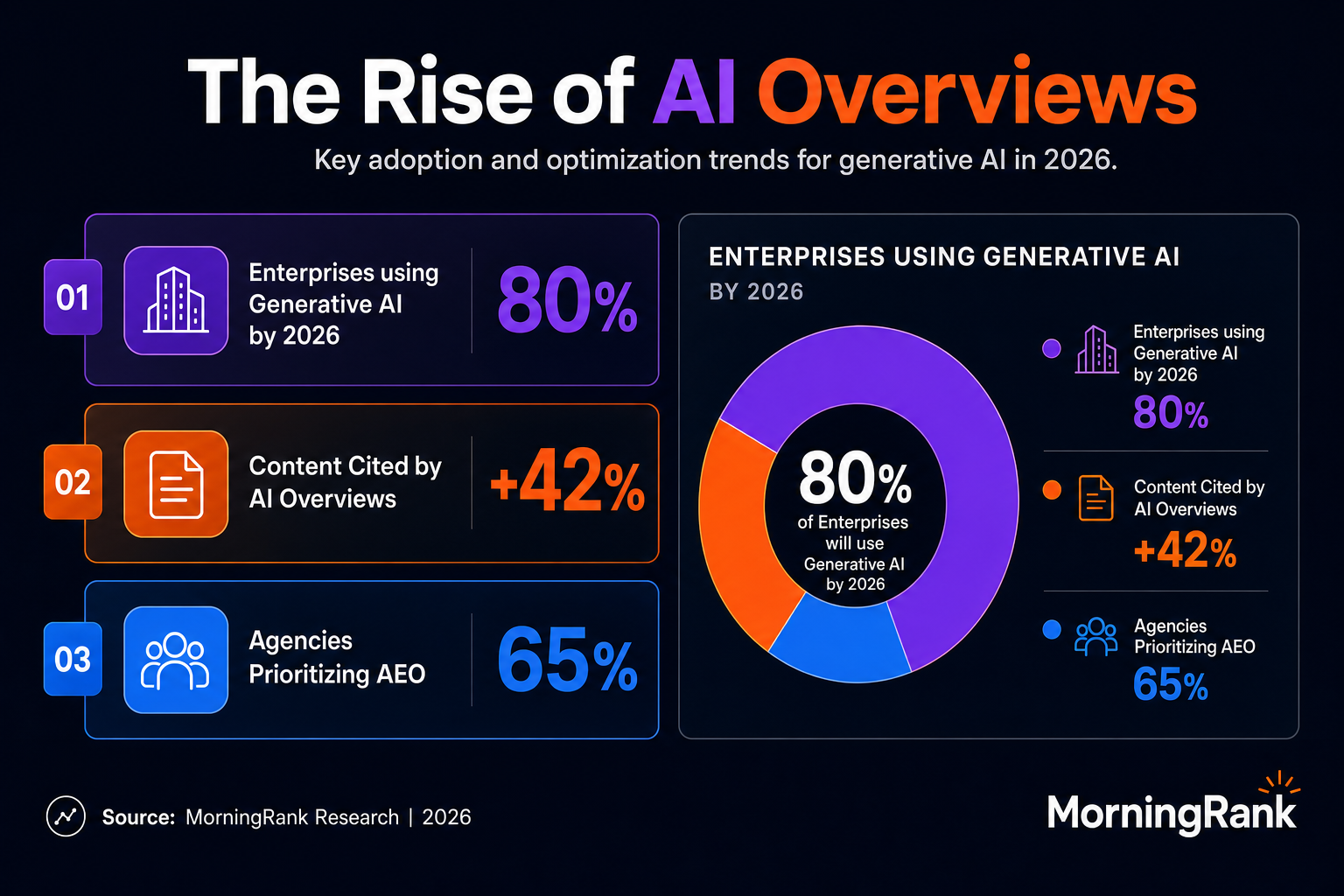
“In 2026, over 80% of enterprises will have deployed generative AI, making proactive Answer Engine Optimization (AEO) essential for any agency aiming to maintain client visibility and trust in AI Overviews.”
To master AI Overviews in 2026, agencies must implement a dedicated Answer Engine Optimization (AEO) playbook focused on structured content, clear answers, and E-E-A-T signals. This approach ensures content is easily digestible and cited by generative AI for maximum visibility.
Key Takeaways
- Answer Engine Optimization (AEO) is crucial for visibility in AI Overviews and other generative AI experiences in 2026.
- Content must be structured for AI, prioritizing direct answers, clear definitions, and logical flow.
- E-E-A-T (Experience, Expertise, Authoritativeness, and Trustworthiness) remains a cornerstone for AI citation.
- Schema markup and internal linking help AI understand content hierarchy and relationships.
- Tracking AI visibility requires specialized tools to measure citations and generative mentions.
The search landscape has fundamentally shifted. In 2026, it is no longer enough to rank highly in traditional ten-blue-link search results; your content must also be ready to be consumed and cited by AI. Generative AI, spearheaded by Google AI Overviews, is becoming the new front door for a significant portion of user queries. As an agency or local business, ignoring this shift means ceding valuable visibility to competitors who are actively optimizing for Answer Engine Optimization (AEO). This comprehensive playbook will guide you through the strategies and tactics required to ensure your content is not just found, but actively leveraged by AI for optimal presence in 2026.
What is Answer Engine Optimization (AEO) for AI Overviews?
Answer Engine Optimization (AEO) is the process of optimizing web content specifically for generative AI platforms, such as Google AI Overviews, ChatGPT, Gemini, and Perplexity, to ensure it is readily understood, extracted, and cited by these AI models. Unlike traditional SEO, which focuses on ranking in SERPs, AEO prioritizes being the source for direct answers and summarized information. The goal is to make your content the most authoritative, clear, and comprehensive resource for AI to reference.
Google AI Overviews (AIOs) represent a significant evolution in search. Instead of a list of links, users often receive a concise, AI-generated summary directly at the top of the search results page. These summaries frequently cite their sources, offering a new pathway for traffic and brand exposure. For agencies, understanding how to engineer content for these AI summarization features is paramount to client success. It's about thinking like an AI: how does it process information, identify key facts, and attribute knowledge?
In my experience, many businesses are still playing catch-up. They have excellent content, but it isn't structured in a way that AI can easily parse. A proper AEO strategy involves not just content creation, but also specific formatting, semantic structuring, and a deep understanding of AI's information retrieval mechanisms. It is a proactive approach to maintain relevance in an increasingly AI-driven search ecosystem. Moreover, the growth of generative AI is undeniable; Gartner predicts that by 2026, over 80% of enterprises will have deployed generative AI APIs or applications, or will be using generative AI-enabled applications in production (Source: Gartner). This underscores the urgency for agencies to master AEO.
How Does Content Structure Impact AI Citation?
Content structure is the backbone of effective Answer Engine Optimization. Generative AI models are trained on vast datasets, but they process information most efficiently when it is logically organized and semantically clear. Long, rambling paragraphs or poorly defined sections make it difficult for AI to identify the core message or extract quotable snippets. Think of your content as a knowledge graph for the AI.
Key structural elements include:
-
Direct Answer First: Begin each section, and ideally your entire article, with a concise, direct answer to the question posed by the heading or implied by the content. This allows AI to quickly identify and extract the most relevant information.
-
Clear Headings (H2, H3): Use descriptive, question-based headings that naturally incorporate keywords. These act as signposts for both human readers and AI, delineating distinct topics and subtopics. Avoid vague or overly creative headings that obscure the content's purpose.
-
Bullet Points and Numbered Lists: Whenever possible, break down complex information into digestible lists. AI models find structured data in lists much easier to process and summarize. This also improves readability for users.
-
Short Paragraphs: Keep paragraphs focused on a single idea, typically 3-4 sentences maximum. Shorter paragraphs are easier for AI to understand contextually and extract individual facts without pulling in extraneous information.
Implementing topic cluster strategies significantly aids AEO. By creating comprehensive content hubs around a central topic, you establish deep topical authority, signaling to AI that your site is a definitive source. This holistic approach makes it more likely for your content to be cited across multiple related queries. AI rewards clarity and organization, ensuring your message is not lost in translation.

Why is E-E-A-T Critical for AI Overviews and Answer Engines?
E-E-A-T (Experience, Expertise, Authoritativeness, and Trustworthiness) is not just a Google ranking factor; it is a foundational principle for AI Overviews and all generative answer engines. AI models prioritize credible, verifiable information from reliable sources. If your content lacks demonstrable E-E-A-T, AI is less likely to cite it, regardless of how well it is structured.
Establishing strong E-E-A-T signals requires a multi-faceted approach:
-
Author Biographies: Ensure content creators have clear, credible author bios that highlight their relevant experience and expertise. Link these bios to their professional profiles (LinkedIn, academic institutions, etc.) to enhance authoritativeness.
-
Citations and References: Just as in academic writing, citing external, authoritative sources for statistics, claims, and data points builds trust. Internally, link to other high-E-E-A-T content on your site. This demonstrates thorough research and factual backing.
-
Website Reputation: A strong backlink profile from reputable sites, positive user reviews, and mentions in industry publications all contribute to overall site authority and trustworthiness. These external signals validate your content's credibility to AI.
-
Original Research and Data: Publishing unique studies, surveys, or data points positions you as an expert and an original source of information, making your content highly valuable for AI to cite. In a study by Semrush, 68% of searchers are more likely to trust content that includes original research (Source: Semrush).
Google's Quality Rater Guidelines, which heavily emphasize E-E-A-T, are essentially the instruction manual for how human evaluators assess content quality. These guidelines indirectly influence AI models, as the highest-quality, most trusted content is precisely what AI is designed to surface and summarize. Agencies need to audit their clients' content through an E-E-A-T lens, ensuring every piece of information is backed by demonstrable credibility. For a deeper dive into these guidelines, refer to our article on Navigating Google's Quality Rater Guidelines Updates for 2026.
What Role Does Technical SEO Play in AEO for AI Overviews?
Technical SEO often operates behind the scenes, yet its role in AEO is more critical than ever. AI models rely on a clean, accessible, and semantically rich website to understand and process content effectively. If AI struggles to crawl, index, or comprehend your site's structure, your chances of being cited in AI Overviews diminish significantly. This isn't just about Googlebot; it's about any AI agent parsing your site for information.
Key technical AEO considerations include:
-
Schema Markup: Implementing structured data (Schema Markup) such as Article, FAQPage, HowTo, or Product schema helps explicitly define the type of content and key entities on your page. This provides AI with a clear, machine-readable understanding of your content's context and purpose.
-
Crawlability and Indexability: Ensure your site has no crawling or indexing issues that would prevent AI from accessing your valuable content. This means optimizing robots.txt, sitemaps, and checking for crawl errors. A robust automated SEO audit tool can quickly identify and flag these issues.
-
Page Speed and Core Web Vitals: While primarily a user experience factor, fast-loading pages indicate a well-maintained site, which can indirectly signal quality to AI. Google has confirmed Core Web Vitals are a ranking factor, and a fast site is easier for AI to process at scale (Source: Google Search Central).
-
Internal Linking: A logical and comprehensive internal linking structure helps AI understand the relationships between different pieces of content on your site, establishing topical authority and guiding AI to the most relevant information. It connects your knowledge base.
Poor technical SEO creates unnecessary barriers for AI. In my audits, I've often found that even brilliant content fails to achieve AEO visibility due to fundamental technical flaws. Addressing these underlying issues is a prerequisite for any successful AEO strategy in 2026.
How Can Agencies Measure and Adapt Their AEO Strategy?
Measuring AEO performance requires a new set of metrics beyond traditional keyword rankings. Agencies need to track how often their clients' content is appearing in AI Overviews, how frequently it is cited by generative AI, and the impact this has on traffic and conversions. This necessitates specialized tools and a shift in reporting focus.
Key measurement and adaptation strategies:
-
AI Visibility Tracking: Utilize platforms that can monitor mentions and citations across various AI answer engines and AI Overviews. This provides direct insight into your AEO success. MorningRank's AI visibility tracking tool is specifically designed for this purpose.
-
Traffic Analysis: Monitor referral traffic specifically from AI Overviews or generative AI snippets. This can often appear as direct traffic or be attributed to organic search, requiring careful segmentation in analytics platforms like GA4.
-
User Behavior Metrics: Analyze user engagement metrics for pages that appear in AI Overviews. Are users clicking through to your site? How long do they stay? High engagement signals content relevance and quality, which AI may prioritize further.
-
Content Audits: Regularly audit existing content to ensure it aligns with AEO best practices. Look for opportunities to add direct answers, improve structure, enhance E-E-A-T signals, and update outdated information. This iterative process is crucial for sustained performance.
-
Competitive Analysis: Identify which competitors are being cited by AI and analyze their content strategy. What are they doing differently? This can uncover new opportunities and best practices for your own AEO playbook.
Adapting your AEO strategy is an ongoing process. The AI landscape is evolving rapidly, and what works today may need refinement tomorrow. Continuous monitoring and a willingness to iterate based on performance data are hallmarks of a successful agency in 2026. This dynamic approach ensures your clients remain at the forefront of AI-driven search.
Conclusion
Mastering AI Overviews through a robust AEO playbook is no longer optional; it is a fundamental requirement for SEO success in 2026. Agencies must evolve their content strategies, prioritize structured data and E-E-A-T, and embrace new measurement methodologies to thrive in this AI-first search environment. By focusing on creating easily digestible, authoritative, and technically sound content, you can position your clients as the definitive sources for generative AI. The future of search is conversational and AI-driven, and those who adapt now will reap significant rewards in terms of visibility and trust.
Related reading: AEO Strategy: Answer Engine Optimization Playbooks for 2026.
Frequently Asked Questions
What is Answer Engine Optimization (AEO)?
Answer Engine Optimization (AEO) is the practice of optimizing content to be understood, extracted, and cited by generative AI models and AI Overviews. It ensures your content provides direct, clear answers that AI can readily use to respond to user queries.
How is AEO different from traditional SEO?
While traditional SEO focuses on ranking in organic search results, AEO specifically targets visibility within AI-generated summaries and responses. It emphasizes content structure, direct answers, and E-E-A-T signals that make content AI-friendly, rather than just keyword-optimized for algorithms.
What are Google AI Overviews?
Google AI Overviews are AI-generated summaries that appear at the top of Google search results for certain queries. They provide concise answers to user questions, often citing sources, and are a primary target for AEO strategies in 2026.
How can I make my content more 'AI-friendly' for AEO?
To make your content AI-friendly, focus on clear headings, direct answers in the first paragraph of sections, bullet points, numbered lists, and comprehensive E-E-A-T signals. Implementing relevant schema markup also greatly assists AI in understanding your content.
Does E-E-A-T matter for Answer Engine Optimization?
Yes, E-E-A-T (Experience, Expertise, Authoritativeness, and Trustworthiness) is critically important for Answer Engine Optimization. AI models prioritize content from credible, authoritative sources, making strong E-E-A-T signals essential for your content to be cited and trusted by AI.
What tools can help track AI Overview visibility?
Tracking AI Overview visibility requires specialized tools that can monitor citations and mentions across various AI answer engines. Platforms like MorningRank offer dedicated AI visibility tracking features to help agencies measure their AEO performance.
Ready to ensure your clients' content dominates the AI-driven search landscape? Explore MorningRank's advanced AEO tracking features and tools by starting your free trial today at https://morningrank.com.
Want this kind of insight every week?
MorningRank delivers daily rank tracking, AI SEO recommendations, and white label client reporting.