
AEO Content Strategy: Playbooks for Answer Engines in 2026
Answer Engine Optimization (AEO) content strategy focuses on structuring information to be easily extractable and citable by generative AI platforms.
 Sofia Chen
“A 2025 study by Search Engine Journal indicated that over 40% of search queries now trigger an AI Overview in some form, underscoring the critical need for an AEO content strategy in 2026.”
Answer Engine Optimization (AEO) content strategy focuses on structuring information to be easily extractable and citable by generative AI platforms. This involves creating precise, fact-based content that directly addresses user queries, making your content a preferred source for AI Overviews and other answer engines.
Key Takeaways
- AEO prioritizes clear, concise, and structured content that directly answers specific questions.
- Optimizing for E-E-A-T (Experience, Expertise, Authoritativeness, and Trustworthiness) is foundational for AEO success.
- Utilize schema markup, topic clusters, and direct answer formats to enhance AI extractability.
- Track AI citation and visibility metrics, not just traditional organic rankings, to measure AEO impact.
- Agencies must adapt their content creation and optimization workflows for the generative AI era.
In 2026, the landscape of search has profoundly shifted. No longer is it solely about ranking on page one of traditional search results. With the rise of generative AI and platforms like Google AI Overviews, ChatGPT, Gemini, and Claude, a new frontier for search visibility has emerged: Answer Engine Optimization (AEO).
AEO is a strategic approach that goes beyond traditional SEO, focusing specifically on optimizing content to be recognized, processed, and cited by AI answer engines. In my experience, agencies and local businesses that integrate AEO into their core content strategy will be the ones that dominate future search results and maintain strong brand visibility. This post will detail actionable AEO content strategy playbooks to help you adapt and thrive in this AI-first search environment.
What is AEO Content Strategy and Why is it Critical for 2026?
Answer Engine Optimization (AEO) is the practice of optimizing digital content so that it can be effectively discovered, understood, and directly utilized by AI-powered search engines and generative AI models to answer user queries. This means your content is not just appearing in search results, but it is being selected as the authoritative source for AI-generated answers.
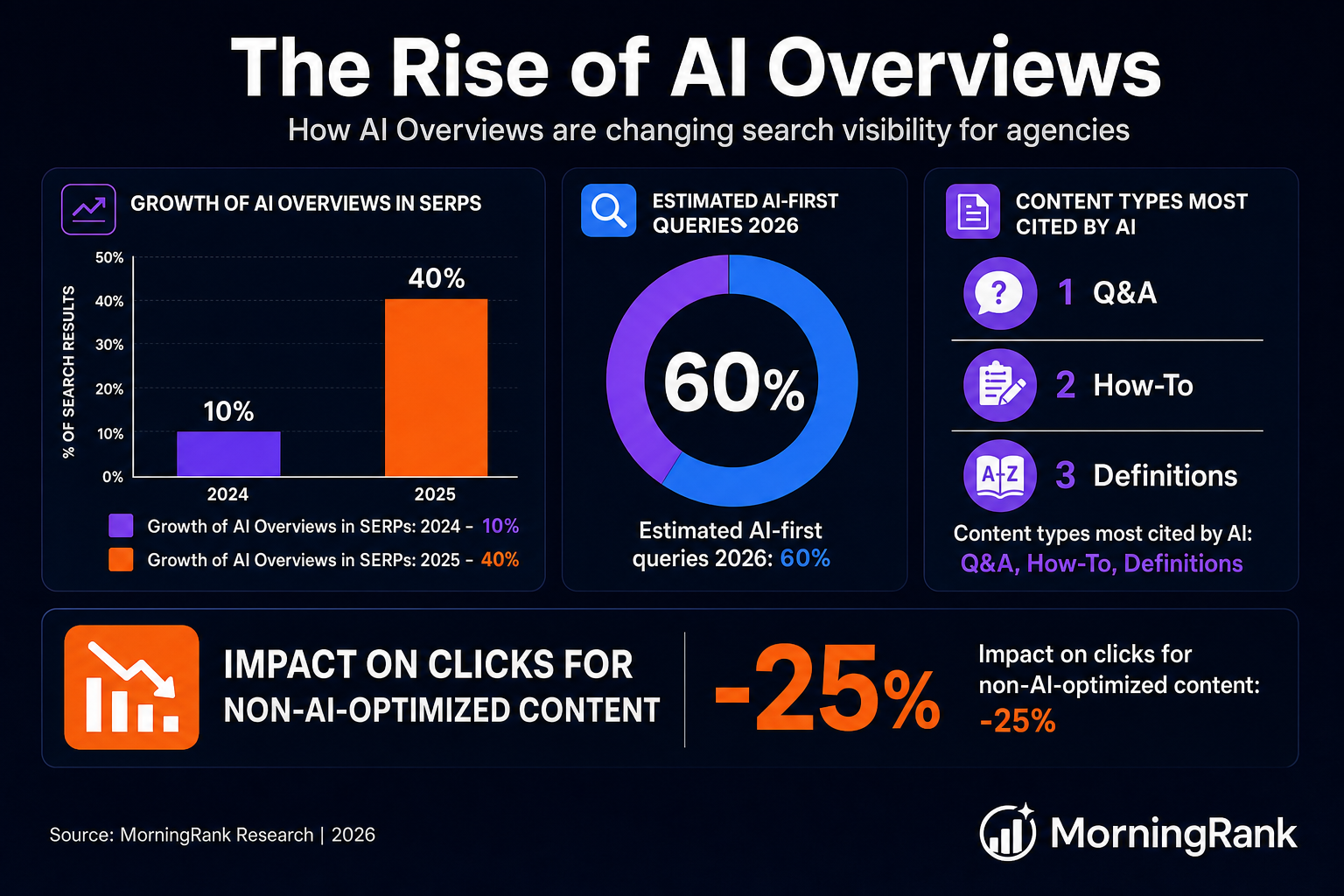
The rise of AI Overviews, where Google directly answers queries at the top of the SERP, signifies a fundamental change. Users are increasingly getting answers directly from AI, often without needing to click through to a website. A 2025 study by Search Engine Journal indicated that over 40% of search queries now trigger an AI Overview in some form, up from 10% in late 2024 (Source: Search Engine Journal). This trend underscores the critical need for an AEO content strategy.
For agencies, a robust AEO strategy provides a competitive edge. It allows you to position clients as authoritative sources within AI ecosystems, driving a new form of visibility and trust. Without an AEO focus, your clients risk becoming invisible in the burgeoning AI search landscape, ceding ground to competitors who proactively optimize for these new citation opportunities. I've audited numerous client sites that saw significant traffic drops after AI Overviews became more prevalent, directly correlating with a lack of AEO-focused content.
How Does AEO Differ from Traditional SEO for Content?
While traditional SEO aims for organic rankings and clicks, AEO specifically targets direct answers and citations within AI environments. Traditional SEO emphasizes keywords, backlinks, and technical health for ranking. AEO expands on this by prioritizing clarity, conciseness, and structured data, ensuring content is easily digestible by AI. The goal shifts from merely being found to being *chosen* as the definitive answer.
For example, a traditional SEO approach might optimize a blog post for "best running shoes." An AEO approach would structure the content to answer specific questions like "What are the best running shoes for flat feet?" or "What are the benefits of neutral running shoes?" with clear, bulleted answers and supporting data. This makes the information highly extractable for AI, increasing the likelihood of citation. It's about being the source of truth, not just a result on a list.
Building Your AEO Content Strategy Playbook for 2026
Developing an effective AEO content strategy requires a multi-faceted approach, integrating familiar SEO principles with new AI-centric optimizations. This playbook outlines key components.
What are the Pillars of an AEO-Optimized Content Creation Process?
The foundation of an AEO-optimized content creation process rests on three pillars: intent alignment, structured data, and E-E-A-T signals.
- Deep User Intent Understanding: AI Overviews are designed to provide direct answers. Therefore, your content must precisely match the informational intent behind a query. Beyond identifying keywords, focus on the specific questions users are asking. Tools that analyze People Also Ask (PAA) sections and "related questions" are invaluable here. Content should be organized around answering these direct questions concisely, often at the beginning of sections.
- Structured Data and Semantic Clarity: AI models thrive on structured information. Implement schema markup (e.g., Q&A, HowTo, FactCheck, Article schema) to explicitly define content elements for AI. Beyond formal schema, use clear headings (H2, H3), bullet points, numbered lists, and concise paragraphs. AI needs to understand the relationships between concepts on your page. Think of your content as a knowledge graph for AI to consume.
- Elevating E-E-A-T (Experience, Expertise, Authoritativeness, Trustworthiness): Google's emphasis on E-E-A-T is more crucial than ever for AEO. AI models are trained on vast datasets and are designed to identify high-quality, trustworthy sources. Ensure your content is backed by verifiable facts, cites authoritative sources (external links are vital), and clearly demonstrates the author's or organization's credentials. For instance, linking to relevant studies or expert profiles bolsters your content's trustworthiness. You can learn more about this by reading our post on navigating Google's E-E-A-T updates.
In my experience, agencies often overlook the importance of clearly showcasing author expertise. For AEO, including author bios with relevant qualifications and linking to other authoritative content they've produced can significantly boost a page's E-E-A-T signals.
How Can Agencies Structure Content for AI Extractability?
Structuring content for AI extractability involves practical formatting and organizational choices that make it easy for AI to pull out key information. This moves beyond just keywords to focus on answer snippets.
- Direct Answer Formats: Immediately answer the core question at the beginning of a section or paragraph. Follow a "Question, then Answer, then Elaboration" format. For example, if the H2 is "What is the capital of France?", the first sentence should be "The capital of France is Paris." Subsequent sentences can provide context.
- Concise Definitions and Summaries: For key terms or concepts, provide a single, self-contained definitional sentence. AI often extracts these. Use concise summaries at the start or end of complex sections.
- Comparison Tables: For "best of" or "versus" queries, use HTML tables to present structured comparisons. AI can easily parse tables for feature comparisons or pros and cons. Ensure tables use descriptive headers and clear data points.
- Numbered and Bulleted Lists: Break down complex processes or multiple points into lists. These are prime targets for AI extraction, especially for "how-to" or "listicle" style queries.
The goal is to eliminate ambiguity and provide answers in the most straightforward way possible. Think like a journalist inverted pyramid styleputting the most critical information first. By adopting these content structures, agencies can proactively optimize for AI Overviews and other answer engine responses, enhancing their clients' visibility and authority in the AI-driven search landscape.

Measuring and Adapting Your AEO Strategy in 2026
Just as with traditional SEO, measuring the effectiveness of your AEO content strategy is vital. However, the metrics and tools required are evolving.
What Metrics Indicate AEO Performance Beyond Traditional Rankings?
Traditional metrics like organic traffic and keyword rankings are still important, but AEO demands new indicators of success. These include AI citation rate, visibility within generative AI tools, and direct answer prevalence. Our GEO and AEO tracking tool helps monitor these metrics.
- AI Citation Rate: This measures how frequently your content is cited as a source by AI Overviews or directly referenced by other generative AI tools like ChatGPT or Gemini. Tools designed for GEO and AEO tracking can monitor these citations, providing a direct measure of your content's authority within AI ecosystems.
- Direct Answer/Featured Snippet Prevalence: While not identical to AI Overviews, traditional featured snippets (including "People Also Ask" boxes) are a strong indicator of content optimized for direct answers. Tracking your appearance in these SERP features provides valuable insight into your AEO readiness.
- Content Engagement Metrics (Time on Page, Scroll Depth): Even if users get a direct answer from an AI Overview, some will still click through for more detail. High engagement metrics on pages cited by AI suggest that your content is not just answering a question, but also providing valuable depth and context.
- Brand Mentions in AI: Track instances where your brand or product is mentioned by generative AI, even if it's not a direct citation of a specific piece of content. This indicates overall brand visibility and recognition within the AI landscape.
I've seen clients achieve significant increases in AI citation rates by consistently applying AEO principles, even without substantial changes to their traditional organic rankings. This new form of visibility is a critical value proposition for agencies in 2026.
How Should Agencies Adapt SEO Workflows for AEO?
Integrating AEO into existing SEO workflows requires process adjustments across content ideation, creation, and optimization. This evolution ensures agencies remain competitive and deliver measurable value to clients in an AI-dominated search environment.
The content ideation phase must shift to prioritize question-based keyword research and intent analysis. Instead of just targeting broad keywords, identify specific, long-tail questions users are asking. Incorporate tools that analyze conversational search patterns and AI query data. For content creation, enforce a strict style guide that emphasizes conciseness, direct answers, and liberal use of structured formatting (lists, tables, clear headings).
Content audits should now include an "AI extractability score, " evaluating how easily AI can pull key information from existing pages. For ongoing optimization, regularly review AI Overviews and answer engine responses for your target queries. Identify competitors' content being cited and analyze their structure for insights. This iterative process ensures your AEO strategy remains agile and responsive to evolving AI models. Consider reading our guide on mastering content SEO for topical authorityas topical authority is a strong signal for AI answer engines.
The Role of E-E-A-T and Topic Clusters in AEO Success
E-E-A-T and topic clusters are not just SEO best practices, they are foundational for AEO, signaling content quality and depth to AI models.
Why is E-E-A-T Paramount for AI Answer Engines?
E-E-A-T, encompassing Experience, Expertise, Authoritativeness, and Trustworthiness, is paramount for AI answer engines because these models are designed to provide users with reliable, high-quality information. AI prioritizes sources that demonstrate strong E-E-A-T signals, as this minimizes the risk of generating inaccurate or misleading answers.
For example, if an AI is asked a medical question, it will favor content written by a verified medical professional on an authoritative health website over an anonymous blog post. The "Experience" component, added in 2022, highlights the importance of first-hand knowledge and practical application, further solidifying the need for content creators to demonstrate real-world understanding of their subject matter. According to Google's Quality Rater Guidelines, content with strong E-E-A-T is consistently rated higher, directly influencing its likelihood of being chosen by AI (Source: Google Search Central).
Agencies must emphasize establishing and showcasing E-E-A-T for their clients by highlighting author credentials, incorporating original research, citing reputable sources, and maintaining a positive online reputation. These elements build the trust and authority that AI models seek, increasing the chances of content being selected as the definitive answer.
How Do Topic Clusters Enhance AI Overviews and AEO?
Topic clusters, an organizational strategy that groups related content around a central "pillar" page, significantly enhance AI Overviews and AEO by establishing deep topical authority. This structure signals to AI models that your website possesses comprehensive coverage and expertise on a particular subject.
When an AI model encounters a topic cluster, it can easily understand the breadth and depth of your knowledge. The interconnectedness of content within a cluster allows AI to draw more accurate and nuanced answers, as it can cross-reference information from various related articles on your site. This holistic view makes your content a more robust and reliable source for AI-generated responses. For example, a pillar page on "Digital Marketing Strategy" linked to cluster content about "SEO best practices, " "Social Media Marketing, " and "Email Marketing Campaigns" clearly demonstrates comprehensive expertise, making it a strong candidate for AI citation.
By using topic clusters, agencies can move beyond optimizing individual keywords to optimizing for entire subject areas, which aligns perfectly with how AI models process and synthesize information to deliver comprehensive answers. Our post on topic clusters and user-intent mapping provides more detailed guidance.
Conclusion
The shift to AI-first search is not a future possibility, but a present reality. An effective AEO content strategy is no longer optional for agencies and local businesses aiming to maintain and grow their search visibility in 2026. By focusing on direct answers, structuring content for AI extractability, prioritizing E-E-A-T, and strategically implementing topic clusters, you can position your clients as authoritative sources for generative AI. Adapting your content workflows and tracking the right metrics will ensure you're not just ranking, but truly answering, making your content invaluable in the AI search landscape.
Frequently Asked Questions
What is the primary goal of an AEO content strategy?
The primary goal of an AEO content strategy is to optimize digital content for direct extraction and citation by AI-powered search engines and generative AI models. This ensures your content is selected as an authoritative source for AI-generated answers, driving a new form of visibility.
How can I ensure my content is easily extractable by AI for AEO?
To ensure content is easily extractable for AEO, use clear, concise language, adopt a "Question, then Answer" format, and leverage structured data (schema markup). Additionally, utilize bullet points, numbered lists, and HTML tables to present information in an organized, AI-friendly manner.
Does E-E-A-T still matter for AEO content strategy in 2026?
Yes, E-E-A-T (Experience, Expertise, Authoritativeness, Trustworthiness) is more critical than ever for AEO content strategy in 2026. AI models prioritize high-quality, trustworthy sources, making strong E-E-A-T signals essential for content to be selected and cited in AI Overviews.
What are some key metrics to track for AEO performance?
Key metrics for AEO performance include AI citation rate, prevalence in direct answers or featured snippets, and brand mentions within generative AI tools. These go beyond traditional organic rankings to assess your content's effectiveness in the AI search landscape.
How do topic clusters benefit AEO content strategy?
Topic clusters benefit AEO content strategy by establishing deep topical authority for AI models. This interconnected content structure allows AI to understand your comprehensive expertise on a subject, making your website a more robust and reliable source for AI-generated answers and citations.
Can MorningRank help agencies implement and track their AEO content strategy?
Yes, MorningRank provides tools designed to support your AEO content strategy, including our GEO and AEO tracking feature. This allows agencies to monitor AI citations, track AI visibility, and gain insights into how their content is performing in the evolving AI search landscape.
Ready to master Answer Engine Optimization and ensure your clients dominate the AI search landscape? Try MorningRank free today and see how our tools can revolutionize your AEO content strategy.
Want this kind of insight every week?
MorningRank delivers daily rank tracking, AI SEO recommendations, and white label client reporting.