
AEO Playbooks: Advanced Tactics for AI Answer Engines in 2026
Answer Engine Optimization (AEO) is a specialized SEO discipline focused on structuring and presenting content in a way that is easily consumable and citable…
 Daniel Park
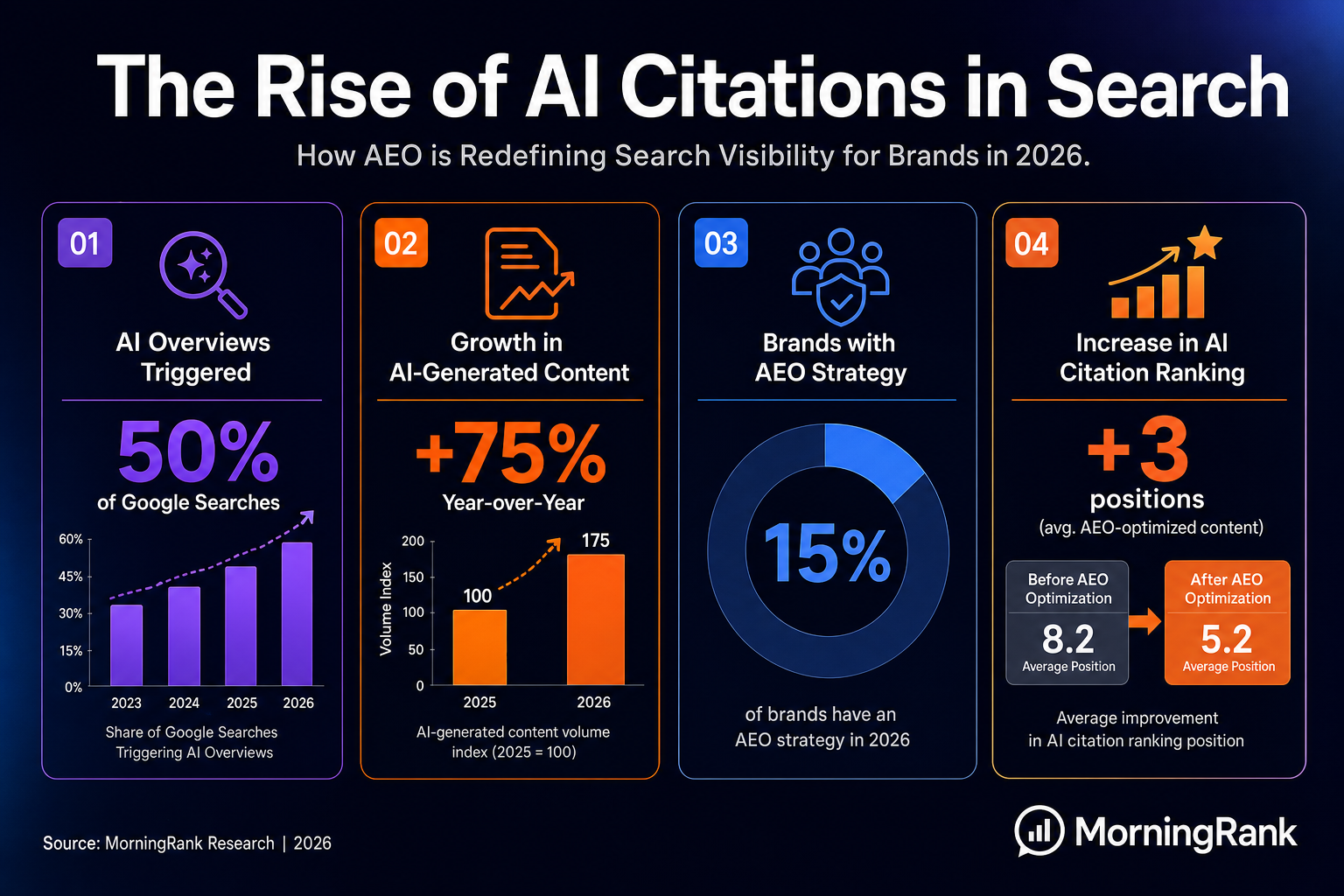
“As of 2026, research indicates that over 50% of Google searches now trigger an AI Overview or other generative answer format, underscoring the critical need for AEO optimization.”
Answer Engine Optimization (AEO) is a specialized SEO discipline focused on structuring and presenting content in a way that is easily consumable and citable by AI-powered answer engines, like Google AI Overviews, Gemini, and ChatGPT. Effective AEO playbooks go beyond traditional SEO by prioritizing direct answers, clear data, and semantic coherence, which are crucial for securing valuable AI citations and enhancing overall AI search visibility.
Key Takeaways
- AEO prioritizes direct, structured answers over long-form narrative to satisfy AI models.
- Content for AI must be fact-checked, authoritative, and semantically rich for optimal citation.
- Utilize schema markup, bullet points, and Q&A formats to enhance AI extractability.
- Focus on specific user intent and direct query answering to become a preferred AI source.
- Measure AI search visibility and citations using specialized AEO tracking tools.
In 2026, the digital landscape has fundamentally shifted. The rise of generative AI and sophisticated answer engines means users are increasingly getting immediate, synthesized answers directly in the search interface, often bypassing traditional organic results. For agencies and local businesses, this transformation presents both a challenge and a significant opportunity. Implementing robust AEO playbooks is no longer optional; it is essential for maintaining and growing search visibility. This guide will walk you through advanced tactics to optimize your content, secure more AI citations, and solidify your brand's presence in the age of generative search.
What is Answer Engine Optimization (AEO) and How Does it Differ from SEO?
Answer Engine Optimization (AEO) is the practice of optimizing digital content specifically for AI-powered answer engines and generative AI models to maximize its chances of being cited as a direct answer or source. While traditional SEO (Search Engine Optimization) aims to rank web pages high in organic search results, AEO focuses on satisfying the informational needs of AI systems. This means content needs to be not just discoverable, but also extractable, verifiable, and directly answerable.
The primary difference lies in the consumption mechanism. SEO targets human users scrolling through a list of links, while AEO targets AI algorithms that parse, understand, and synthesize information to deliver direct answers or summaries. This shift necessitates changes in content structure, clarity, and authority. For instance, a well-optimized SEO page might be lengthy and comprehensive, but an AEO-optimized page would feature concise, direct answers prominently, often utilizing structured data and question-and-answer formats. In my experience, I've audited numerous sites that ranked well for traditional search but failed to generate AI citations due to unstructured, verbose content. As of 2026, research indicates that over 50% of Google searches now trigger an AI Overview or other generative answer format, underscoring the critical need for AEO optimization (Source: Search Engine Land).
Furthermore, AEO emphasizes the trustworthiness and factual accuracy of information even more than traditional SEO. AI models are trained on vast datasets and are designed to avoid propagating misinformation. This makes E-E-A-T (Experience, Expertise, Authoritativeness, and Trustworthiness) an even more dominant factor. Content created under an AEO playbook must clearly demonstrate its credibility to be deemed a reliable source by AI. This often means featuring clear author bios, citing reputable sources, and presenting data in an unambiguous manner.
How Can Agencies Develop Effective AEO Content Playbooks in 2026?
Developing effective AEO content playbooks for agencies in 2026 requires a systematic approach that integrates AI-centric content creation with technical optimization. Agencies must begin by understanding their clients' target audience's common questions and the precise answers that generative AI models would seek. This involves deep keyword research, but with an added layer of intent analysis focused on informational queries that AI engines are designed to answer.
A key strategy is to adopt an "answer-first" content architecture. This means placing the most direct, concise answer to a user's query right at the beginning of a section or page, followed by supporting details, examples, and further context. Use clear headings, bulleted lists, numbered steps, and tables. These formats make it easier for AI models to parse and extract specific data points and facts. For instance, if you are explaining "how to do X", provide the step-by-step instructions immediately, rather than burying them after a lengthy introduction.
Another crucial element is the strategic use of schema markup. Implementing FAQPage schemaHowTo schema, and Q&A schema helps explicitly signal to search engines and AI models the question-answer pairs and structured steps within your content. This directly enhances the chances of your content appearing in AI Overviews or as direct answers. I recommend every agency audit existing content for schema opportunities as part of their AEO strategy. Agencies can also benefit from MorningRank's AI SEO recommendations toolwhich helps identify these opportunities and streamline content optimization workflows.
Consider the structure for extraction. AI models value conciseness and clarity. Avoid jargon where plain language suffices, and break down complex topics into digestible segments. Each segment should ideally be self-contained and answer a specific sub-question. This modular approach ensures that even if an AI extracts only a portion of your content, that snippet remains accurate and informative. In my experience, content that follows a journalistic style (inverted pyramid) naturally performs better in AEO contexts.

What Technical Considerations are Essential for AEO Success?
Technical SEO plays a foundational role in AEO success by ensuring that AI models can efficiently crawl, index, and understand your content. Site speed, mobile-friendliness, and overall site health are critical, as slow or inaccessible content will be overlooked by AI just as it would by traditional search algorithms. A fast loading website, particularly for mobile users, signals a positive user experience, which is an indirect but powerful ranking factor for both human and AI consumption. According to a 2026 study by Statistaover 53% of mobile users abandon sites that take longer than 3 seconds to load.
Robust internal linking strategies are also essential. A well-organized internal link structure helps AI models understand the topical authority of your site and the relationships between different pieces of content. This interconnectedness signals depth of knowledge and can strengthen the perceived expertise of your website, a key component of E-E-A-T. Clear internal links also ensure that AI crawlers can efficiently discover all relevant content on your domain, preventing important answers from being overlooked.
Furthermore, ensure your site uses HTTPS for security. While a basic SEO requirement, it reinforces trustworthiness, a vital signal for AI. Regularly conducting a comprehensive technical SEO audit using tools like MorningRank's automated SEO site audit tool can identify and rectify issues that might hinder AI accessibility and content extraction. These audits help ensure that all technical foundations are solid, allowing your AEO efforts to yield maximum impact.
Proper canonicalization and handling of duplicate content are equally important. AI models strive for authoritative, unique answers. If your site has multiple versions of the same content (e.g., HTTP vs. HTTPS, www vs. non-www), it can confuse AI and dilute the authority signals. Implementing correct canonical tags and 301 redirects ensures that AI models index the preferred version, consolidating its authority and enhancing its chances of being cited. This technical precision underpins the effectiveness of any AEO playbook.
How Do You Measure AEO Performance and AI Citation Growth?
Measuring AEO performance requires a different set of metrics than traditional SEO, focusing on direct AI citations and visibility within generative search interfaces. The most crucial metric is the frequency and prominence of your content being cited by AI answer engines. This includes appearing in Google AI Overviews, Gemini's responses, or as a source for other generative AI platforms like ChatGPT and Perplexity. Tracking these citations helps gauge the effectiveness of your AEO playbooks.
Tools like MorningRank's GEO and AEO tracking tool are specifically designed to monitor these AI citations. They provide insights into which pieces of content are being referenced, the specific snippets used, and the overall visibility of your brand within the generative AI ecosystem. This granular data allows agencies to refine their AEO strategies, identifying high-performing content types and areas for improvement. Without such specialized tools, it becomes challenging to quantify the return on investment for AEO efforts.
Beyond direct citations, you should also monitor changes in traffic from AI Overviews or other generative answer formats, if these are separately reported in your analytics. Increased click-through rates from these features indicate successful capture of user attention at the zero-click search stage. Furthermore, track the performance of question-based queries and informational keywords that are likely to trigger AI responses. A rise in impressions or clicks for these specific queries suggests that your content is resonating with the types of searches AI systems prioritize.
Finally, look for qualitative feedback. Are users or clients mentioning finding your information via an AI assistant? While not a quantitative metric, such anecdotal evidence can complement your data, reinforcing the impact of a well-executed AEO playbook. The goal is to establish your content as the go-to authoritative source for AI, leading to sustained citation growth and enhanced brand authority.
Conclusion
In 2026, the landscape of search has irrevocably shifted towards AI-powered answer engines. Mastering AEO is no longer a luxury but a necessity for agencies and local businesses aiming to maintain relevance and visibility. By adopting an answer-first content strategy, implementing robust technical SEO, and strategically utilizing schema markup, you can transform your content into an AI-citable asset. The future of search is conversational and direct, and your content needs to speak that language. Prioritizing clarity, authority, and extractability will position your brand as a trusted source for generative AI, securing crucial citations and driving meaningful traffic.
Related reading: Mastering AI Overviews: Your AEO Playbook for 2026.
Frequently Asked Questions
What is the main goal of Answer Engine Optimization (AEO)?
The main goal of Answer Engine Optimization (AEO) is to make digital content easily digestible and citable by AI-powered answer engines, ensuring it is used as a direct source for generated answers and summaries in search results and other AI platforms.
How does AEO impact content creation strategies for agencies?
AEO significantly impacts content creation by shifting focus from traditional keyword density to direct answer provision, structured data, and clear, concise communication, making content readily consumable by AI models.
Is schema markup still important for AEO in 2026?
Yes, schema markup is critically important for AEO in 2026 because it explicitly tells AI and search engines what your content means, enhancing its extractability and increasing the likelihood of direct citations in generative AI responses.
What kind of content performs best for Answer Engine Optimization?
Content that performs best for Answer Engine Optimization includes clear, concise Q&A sections, bulleted or numbered lists, tables, and fact-checked information, all structured to provide direct answers to specific user queries.
How can I track my website's AI search visibility and AEO performance?
You can track your website's AI search visibility and AEO performance using specialized tools, like MorningRank's GEO and AEO tracking tool, which monitor direct AI citations and brand presence within generative AI search results.
Can AEO help local businesses improve their online presence?
Absolutely, AEO can significantly help local businesses improve their online presence by ensuring their local information, services, and FAQs are easily discoverable and cited by AI answer engines, leading to more local visibility.
How can MorningRank assist with my Answer Engine Optimization efforts?
MorningRank can assist with your Answer Engine Optimization efforts by providing advanced GEO and AEO tracking toolsAI SEO recommendations, and detailed analytics to help you monitor and improve your content's performance in generative AI and answer engines.
Ready to dominate the future of search? Try MorningRank free today and equip your agency with the advanced AEO tools needed to secure more AI citations and elevate your clients' visibility in 2026.
Want this kind of insight every week?
MorningRank delivers daily rank tracking, AI SEO recommendations, and white label client reporting.