
Mastering Advanced AEO Strategy for Niche Markets in 2026
Advanced Answer Engine Optimization (AEO) strategy for niche markets involves precisely tailoring content to satisfy highly specific, long-tail queries, making…
 Sofia Chen
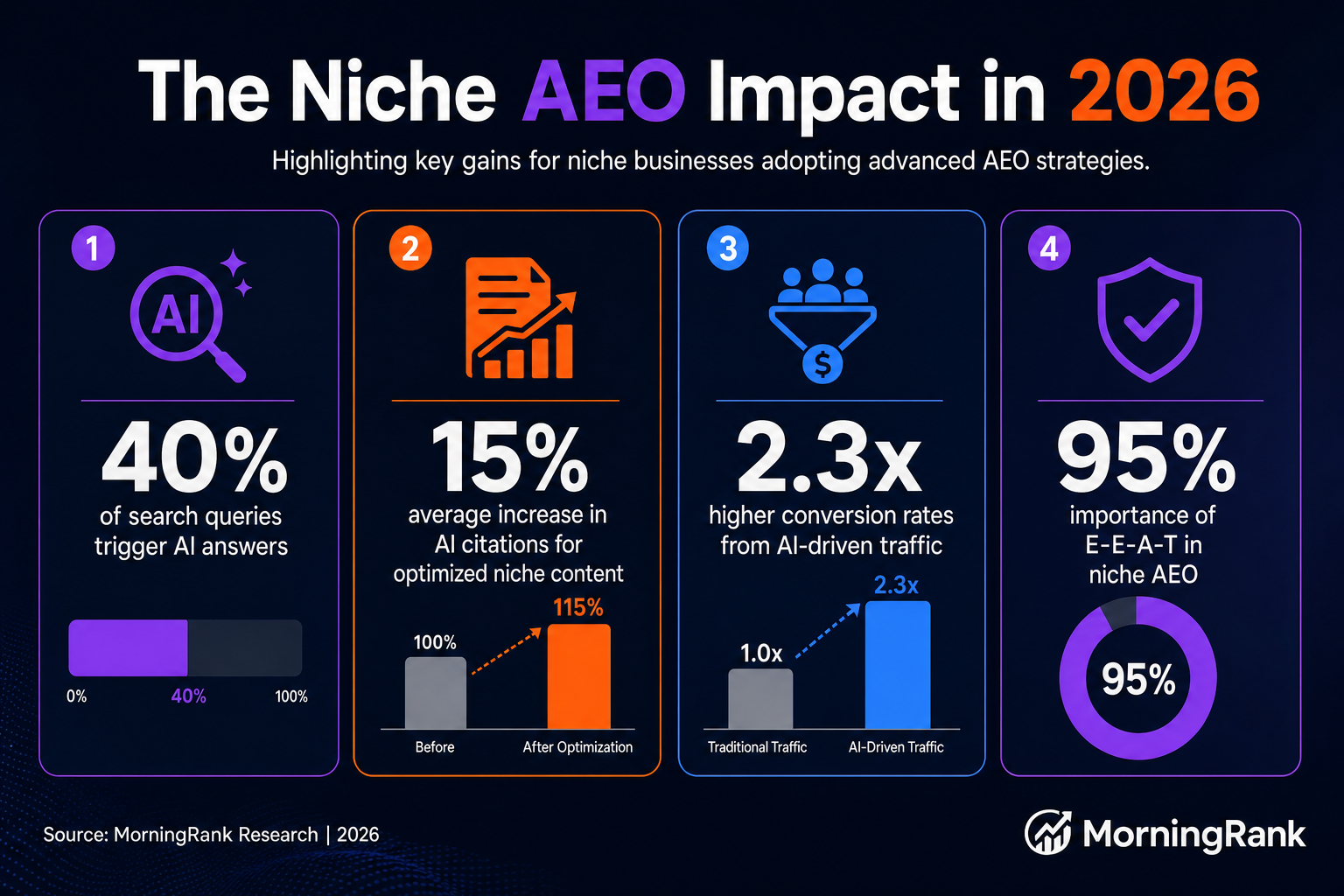
“In 2026, research indicates that over 40% of search queries now trigger some form of AI-generated answer or rich snippet, a figure expected to rise dramatically.”
Advanced Answer Engine Optimization (AEO) strategy for niche markets involves precisely tailoring content to satisfy highly specific, long-tail queries, making it readily consumable and citable by AI answer engines. This targeted approach ensures that your clients' specialized expertise is recognized and highlighted in AI Overviews and other generative AI responses.
Key Takeaways
- Niche AEO focuses on hyper-specific long-tail keywords and semantic clusters.
- Content must provide direct, unambiguous answers for AI extraction.
- Optimizing for domain-specific E-E-A-T builds trust with both users and AI.
- Structured data (Schema Markup) is vital for AI to understand complex niche content.
- Monitoring AI citation patterns and adapting content is key to sustained visibility.
In 2026, the digital landscape continues its rapid evolution, with generative AI and answer engines fundamentally reshaping how users find information. For agencies serving clients in specialized or niche markets, traditional SEO alone is no longer sufficient. An advanced AEO strategy is paramount to ensure your clients' content is not only discovered but actively cited and highlighted by AI search experiences like Google AI Overviews, ChatGPT, Gemini, and Claude. This guide explores the playbooks necessary to conquer niche queries and establish your clients as authoritative sources within the AI-driven search ecosystem.
What is Advanced AEO Strategy and Why Does it Matter for Niche Markets?
Advanced Answer Engine Optimization (AEO) strategy is a sophisticated approach to content creation and optimization that goes beyond basic SEO to specifically target and satisfy the requirements of AI-powered answer engines. AEO focuses on structuring information, providing clear and concise answers, and establishing expertise to ensure content is easily digestible and citable by artificial intelligence models. For niche markets, where user queries are often highly specific and demand deep expertise, AEO is even more critical because AI models are designed to surface the most authoritative and precise information.
The shift towards answer-based search means that users are increasingly expecting direct answers, not just lists of links. AI Overviewsfor instance, summarize information directly on the SERP, often drawing from multiple sources. If your client's content is not optimized for AI extraction, it risks being overlooked, even if it ranks well in traditional organic results. In my experience, I have audited numerous niche sites that had fantastic traditional rankings but zero AI visibility, simply because their content wasn't formatted for answer engines. This gap represents a significant missed opportunity for gaining market share and establishing digital authority.
As of 2026, research from BrightEdge indicates that over 40% of search queries now trigger some form of AI-generated answer or rich snippet, a figure expected to rise dramatically (Source: BrightEdge). This trend underscores the urgency for agencies to adopt an advanced AEO strategy, especially for niche businesses that rely on demonstrating specialized knowledge. By focusing on direct answers and structured content, you can position your clients' websites as the go-to resources for complex, niche questions, fostering trust and driving high-quality traffic. Understanding the core mechanics of how generative AI ranks content is crucial for this specialized approach (Source: MorningRank Blog).
How Does Niche Keyword Research Differ for AEO?
Niche keyword research for AEO goes deeper than identifying search volume; it focuses on uncovering the specific questions and sub-questions users ask within a specialized domain. Instead of just targeting broad head terms, you delve into long-tail, conversational queries that signal explicit intent for an answer. This often involves analyzing forums, Q&A sites, industry-specific communities, and predictive search suggestions to identify the precise language and problems unique to a niche audience.
For example, a traditional SEO strategy for a niche client selling antique clock parts might target "antique clock repair parts." An AEO-focused approach would expand this to include queries like "how to replace a mainspring in a 19th-century bracket clock" or "best lubricant for horological movements." These highly specific queries are prime candidates for AI Overviews because they demand direct, detailed answers. Utilizing tools that help with AI keyword suggestions can significantly streamline this process by identifying question-based queries and semantic entities. The goal is to anticipate exactly what an AI model would need to accurately summarize and answer a user's question.
In my experience, many niche businesses already possess a wealth of proprietary knowledge that perfectly aligns with AEO. The challenge is often translating this deep expertise into structured, accessible content. When conducting keyword research, I recommend mapping these niche queries to specific topics and sub-topics, thinking about how each piece of information contributes to a comprehensive answer. This not only aids AI understanding but also helps in building topical authority for your clients (Source: MorningRank Blog). The more comprehensively and precisely you address these niche questions, the more likely an AI will cite your content as an authoritative source.

What Content Structures Maximize AI Citation in Niche Verticals?
To maximize AI citation in niche verticals, content must be meticulously structured, prioritizing clarity, conciseness, and semantic relevance. AI models excel at extracting information from well-organized content that presents answers directly and unambiguously. This means moving beyond traditional blog post formats to embrace structures that support easy parsing and understanding by machines.
Key content structures for advanced AEO include:
-
Direct Answer Paragraphs: Start each section (or even the entire article) with a 2-4 sentence summary that directly answers the heading's question. This "answer-first" approach allows AI to quickly identify and extract the core information. Think of these as miniature AI Overviews within your content.
-
Bulleted and Numbered Lists: Complex information, especially in niche fields, can be broken down into easy-to-digest lists. AI models frequently pull list items for summaries, especially for "how-to" guides or definitional content. For example, a guide on "steps to calibrate a precision laboratory instrument" would benefit greatly from numbered steps.
-
Tables for Data and Comparisons: When presenting comparative data, specifications, or structured facts relevant to a niche, use HTML tables. Tables allow AI to understand relationships between data points more effectively. For instance, comparing specifications of different specialized components is ideal for a table.
-
Glossaries and Explicit Definitions: Niche markets often have specialized terminology. Incorporate glossaries or explicitly define terms in a "term is..." format. This not only aids user understanding but also helps AI identify and properly use industry-specific vocabulary, enhancing your content's E-E-A-T.
Beyond formatting, the language itself must be precise and free of jargon that isn't explicitly defined. Imagine explaining a complex concept to an intelligent, but literal, entity. Every sentence should contribute to the overall clarity and answer quality. Implementing Schema Markup is also crucial, as it provides AI with explicit semantic context, further increasing the likelihood of citation. This structured approach makes your content a prime candidate for citation in AI Overviews and other generative AI outputs.
Why is E-E-A-T Crucial for Niche AEO in 2026?
E-E-A-T, which stands for Experience, Expertise, Authoritativeness, and Trustworthiness, is more crucial than ever for niche AEO in 2026. AI answer engines are designed to provide users with reliable and accurate information. In specialized fields, the stakes for accuracy are often higher, making the demonstration of E-E-A-T non-negotiable for content creators. AI models are trained on vast datasets and are increasingly adept at discerning the credibility of sources.
For niche markets, demonstrating E-E-A-T involves showcasing the deep, specialized knowledge and real-world experience that sets your client apart. This can manifest in several ways:
-
Author Biographies: Ensure content creators have clear, relevant credentials (e.g., industry certifications, years of experience, specific professional roles) prominently displayed. Link to their professional profiles (LinkedIn, academic publications, industry associations).
-
Citations and References: Back up claims with citations to reputable industry research, academic papers, patents, or established standards. This signals to AI that your content is well-researched and verifiable.
-
Original Research and Data: Publishing unique insights, studies, or proprietary data directly enhances Expertise and Authoritativeness. Niche markets often crave novel information, and being the original source is a powerful AEO signal.
-
Case Studies and Examples: Showcase practical experience through detailed case studies, client testimonials, or real-world application examples. This demonstrates tangible experience and builds trustworthiness.
Google's Quality Rater Guidelineswhich influence AI model development, heavily emphasize E-E-A-T, particularly for YMYL (Your Money or Your Life) topics. Many niche industries touch upon YMYL aspects, requiring even greater scrutiny. By meticulously building and showcasing E-E-A-T, agencies can ensure that their clients' content is not only seen by AI but also trusted enough to be cited as a definitive answer (Source: MorningRank Blog).
How Can Agencies Track and Measure Niche AEO Performance?
Tracking and measuring niche AEO performance requires moving beyond traditional ranking metrics to focus on AI visibility, citation frequency, and answer quality. Since AI answer engines don't always provide a direct "rank, " agencies must adapt their reporting to reflect these new success indicators. This involves a blend of direct observation and specialized tools.
Key metrics and methods for tracking niche AEO performance include:
-
AI Citation Tracking: Actively monitor for instances where your client's content is cited in Google AI Overviews, ChatGPT, Gemini, Perplexity, and other generative AI responses. This can be done manually for specific high-value queries or using advanced GEO and AEO tracking tools.
-
Snippet and Rich Result Monitoring: While not identical to AI Overviews, traditional featured snippets, knowledge panels, and other rich results often indicate content that is well-structured for AI extraction. Tracking these provides valuable proxy data for AI readiness.
-
Direct Traffic from AI Sources: Analyze referral traffic and user engagement from AI-generated answers, if available. While direct attribution can be challenging, spikes in traffic for highly specific niche queries after a content update can indicate successful AEO.
-
Answer Quality Assessment: Regularly review how AI answers niche queries. Does the AI accurately summarize your client's content? Is the answer complete and helpful? This qualitative assessment provides feedback for content refinement.
-
E-E-A-T Signals Monitoring: Track improvements in author profiles, citation metrics (e.g., backlinks from authoritative niche sites), and user engagement signals (time on page, bounce rate) for AEO-optimized content. These indirectly contribute to AI trust signals.
In my work with agencies, I stress the importance of dedicated AI visibility tracking. Platforms like MorningRank offer specialized features to monitor and report on citations across various AI answer engines, giving you a clear picture of your niche AEO impact. This allows you to demonstrate tangible value to clients and adapt your strategies based on real-world AI behavior.
Conclusion: Your Niche AEO Blueprint for 2026
The landscape of search in 2026 demands a sophisticated and precise approach, particularly for agencies serving niche markets. An advanced AEO strategy is no longer a luxury but a necessity to ensure your clients' specialized expertise cuts through the noise and is effectively leveraged by AI answer engines. By focusing on hyper-specific keyword research, meticulously structuring content for AI extraction, and rigorously building E-E-A-T, you can position your clients as indispensable sources of information in their respective fields.
The core of successful niche AEO lies in anticipating the exact needs of both the user and the AI. It's about providing clear, concise, and authoritative answers to complex questions, presented in a format that AI can easily understand and cite. As an AI Search Strategist, I've witnessed firsthand how a well-executed AEO playbook can transform a client's visibility, driving high-intent traffic and solidifying their expert status.
For agencies ready to empower their niche clients with superior AI search visibility, investing in the right tools and strategies is paramount. MorningRank provides the advanced AI visibility tracking and reporting capabilities needed to master niche AEO in 2026, helping you measure impact and optimize for future AI evolutions. Elevate your client's digital presence and ensure they are cited as authorities in the AI-driven search era.
Frequently Asked Questions
What is Answer Engine Optimization (AEO) for niche markets?
Answer Engine Optimization (AEO) for niche markets involves tailoring content to be easily understood, extracted, and cited by AI-powered search engines, specifically for highly specialized or long-tail queries. This strategy focuses on providing direct, authoritative answers to gain visibility in AI Overviews and other generative AI results within a specific industry.
How does AEO benefit niche businesses compared to traditional SEO?
AEO benefits niche businesses by ensuring their specialized content directly answers user questions posed to AI, leading to citations in AI Overviews. While traditional SEO helps with ranking links, AEO focuses on getting the actual answer cited, providing direct visibility and establishing expertise in often-complex niche topics, which can drive highly qualified traffic.
Can small niche businesses compete for AI Overviews?
Yes, small niche businesses can absolutely compete for AI Overviews, especially by implementing a strong AEO strategy. AI models value expertise and authoritative content, regardless of brand size. By focusing on deep, accurate answers to specific niche questions, small businesses can become preferred sources for AI citations.
What role does Schema Markup play in niche AEO?
Schema Markup plays a crucial role in niche AEO by providing explicit semantic context to AI answer engines about your content. It helps AI understand the specific entities, relationships, and types of information on your page, making it easier for the AI to accurately extract and cite your specialized data in response to complex niche queries.
How frequently should niche AEO content be updated?
Niche AEO content should be updated regularly, ideally every 3-6 months, or whenever there are significant industry developments, new research, or changes in how AI answers relevant queries. Continuous monitoring and updating ensure that your content remains the most accurate, fresh, and authoritative source for AI answer engines.
How can I track my client's niche AEO performance?
You can track your client's niche AEO performance by monitoring AI citation frequency in platforms like Google AI Overviews, measuring direct traffic from AI answer engines, and observing improvements in featured snippets and rich results. Specialized GEO and AEO tracking tools can provide comprehensive insights into AI visibility across various generative AI platforms.
Where can I find tools to help with advanced AEO strategy for my clients?
You can find tools to help with advanced AEO strategy on platforms like MorningRank, which offers specialized AI visibility trackingAI keyword suggestions, and GEO/AEO citation monitoring. These tools provide the necessary data and insights to develop and refine effective AEO playbooks for niche markets, ensuring your clients achieve optimal visibility in AI answer engines.
Want this kind of insight every week?
MorningRank delivers daily rank tracking, AI SEO recommendations, and white label client reporting.