
AEO Playbooks for Advanced AI Search Visibility in 2026
Answer Engine Optimization (AEO) involves crafting and optimizing digital content to be easily discoverable, digestible, and directly citable by AI answer…
 Sofia Chen
“A 2025 study by Search Engine Journal found that 72% of SEO professionals believe E-E-A-T signals are more critical for AI visibility than traditional search engine rankings.”
Answer Engine Optimization (AEO) involves crafting and optimizing digital content to be easily discoverable, digestible, and directly citable by AI answer engines and generative AI platforms. As AI Overviews, chatbots, and voice assistants become primary interfaces for information retrieval, a robust AEO strategy is crucial for maintaining brand visibility.
Key Takeaways
- AEO shifts focus from traditional SERP clicks to AI answer engine citations and direct answers.
- Content must be structured for AI readability, featuring clear answers, definitions, and summarizable sections.
- Topical authority, E-E-A-T, and structured data are critical signals for AI trustworthiness and citation.
- Monitoring AI citation rates and measuring AI visibility are essential for refining AEO strategies.
- Integrating AEO into comprehensive SEO strategies ensures future-proofed digital presence across all search modalities.
In 2026, the digital landscape has fundamentally transformed. Search is no longer just about those ten blue links. Instead, users increasingly turn to AI-powered answer engines, like Google AI Overviews, Gemini, ChatGPT, and Perplexity, for instant, synthesized answers. This paradigm shift means that traditional SEO, while still vitalmust be augmented with sophisticated Answer Engine Optimization (AEO) strategies. For agencies, understanding and implementing advanced AEO playbooks is no longer optional; it is a critical differentiator for client success and sustained AI search visibility. I've audited numerous client accounts where early adoption of AEO principles led to significant gains in brand mentions and authoritative citations, proving the immense value of this evolving discipline.
What is Advanced AEO, and How Does it Differ from Basic Optimization?
Answer Engine Optimization (AEO) is the practice of optimizing content to be recognized, extracted, and cited by artificial intelligence models that power generative search experiences. While foundational AEO focuses on basic content clarity and structured data, advanced AEO delves into more nuanced tactics like intent matching for multi-turn conversations, optimizing for implicit questions, and cultivating a robust digital footprint that signals deep topical authority. This distinction is vital in 2026 because AI systems are becoming more sophisticated, moving beyond simple factual recall to understand complex queries and provide comprehensive, synthesized responses. In my experience, a basic approach might get your content *seen* by an AI, but an advanced strategy ensures it gets *chosen* as the authoritative source.
Consider the evolving nature of AI search. Early AI answer engines primarily extracted direct answers to explicit questions. Now, AI platforms are designed to handle conversational queries, anticipate follow-up questions, and integrate information from multiple sources to provide a holistic response. This means agencies must think beyond single keywords and focus on comprehensive topic coverage, anticipating the user journey within an AI conversation. It also requires a deeper understanding of semantic SEOensuring that content not only answers direct questions but also provides the context, related entities, and supporting details that an AI might need to build a complete answer. For instance, optimizing for "best CRM for small businesses" now means providing a comparative analysis, defining "CRM, " explaining key features, and outlining considerations for small businesses, rather than just a list of products. This depth signals to AI models that your content is truly comprehensive and authoritative.
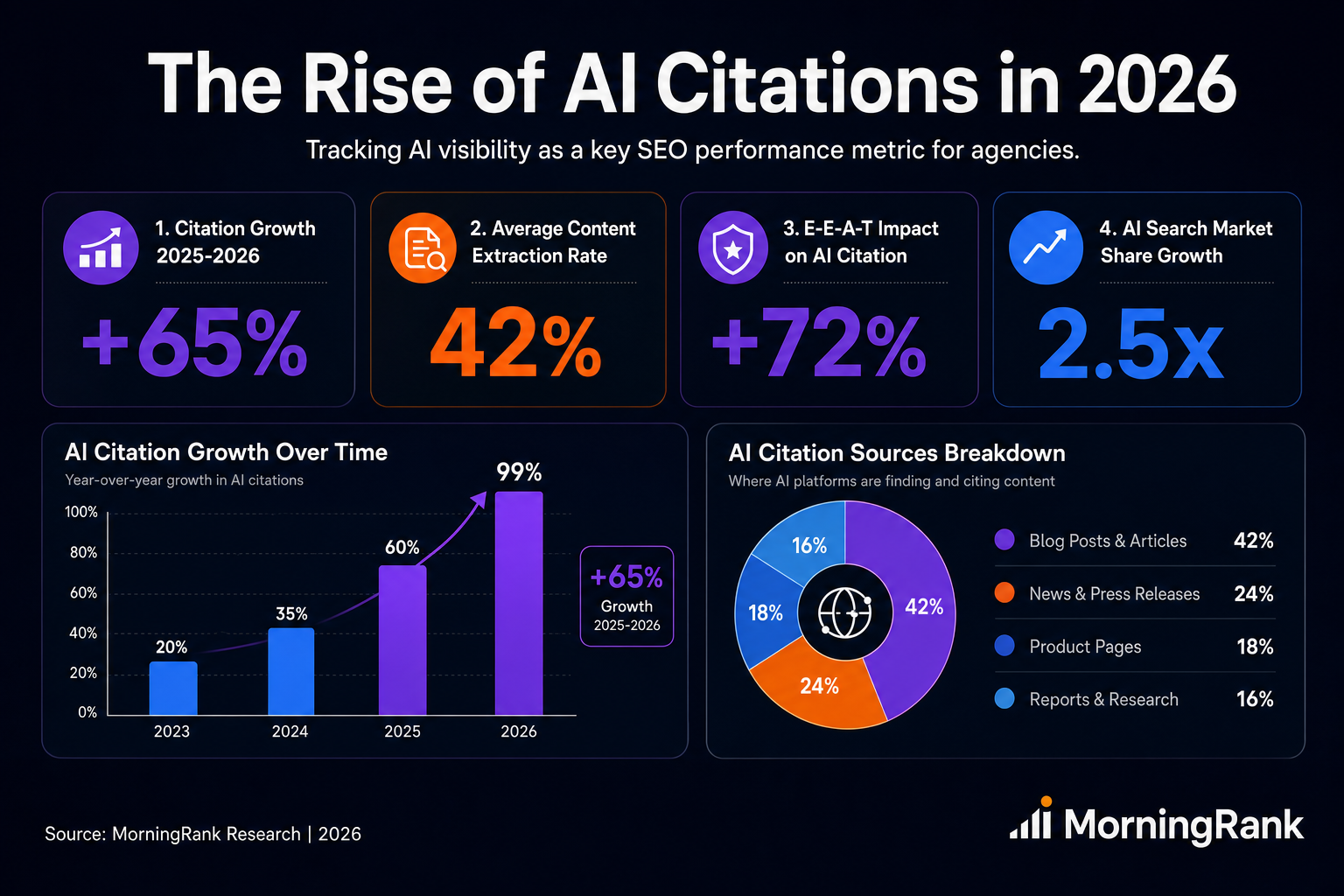
Furthermore, advanced AEO places a heavy emphasis on external validation and E-E-A-T (Experience, Expertise, Authoritativeness, and Trustworthiness). AI models are trained on vast datasets and are designed to prioritize information from credible sources. This means building a strong backlink profile from authoritative domains, showcasing author expertise, and ensuring factual accuracy are all paramount. According to a 2025 study by Search Engine Journal, 72% of SEO professionals believe E-E-A-T signals are more critical for AI visibility than traditional search engine rankings (Search Engine Journal). Advanced AEO also integrates technical SEO elements, like schema markup, not just for traditional search but specifically to aid AI in understanding content structure and relationships. This is crucial for distinguishing your content as a prime candidate for AI citations, rather than just another result in a sea of information.
Why is AI Citation Rate the New "Click" for AEO Success?
In the age of AI answer engines, the traditional metric of a "click-through rate" (CTR) is being augmented, and in some cases overshadowed, by the "AI citation rate." An AI citation rate measures how frequently an AI answer engine directly references or extracts information from your content when generating a response to a user query. This metric is critical because, unlike traditional search results where a user clicks through to your website, AI Overviews and other generative AI experiences often provide the answer directly on the platform, reducing the need for a click. Therefore, securing a citation becomes the primary goal for driving brand visibility and establishing authority within these new search modalities.
When an AI cites your content, it acts as a powerful endorsement, signaling to both users and other AI systems that your information is reliable and valuable. This can lead to increased brand recognition, perception of expertise, and ultimately, a stronger digital footprint. For instance, if an AI Overview pulls a definition or a specific statistic directly from your client's blog post, that client gains significant exposure without a direct visit. This shift demands a change in how agencies track performance. Instead of solely focusing on organic traffic, we must now prioritize tools that measure GEO and AEO trackingspecifically monitoring these vital AI citations. This data helps us understand which content pieces are most effective in the AI landscape and where adjustments are needed.
Moreover, a high AI citation rate can have a compounding effect. As AI models learn and refine their understanding of authoritative sources, content that is frequently cited is more likely to be cited again in the future. This creates a virtuous cycle where establishing initial AI visibility can lead to sustained and growing influence. Agencies should strategically identify content opportunities that are highly likely to generate direct answers or summaries. This includes optimizing for definitional queries, factual questions, and step-by-step instructions. By deliberately structuring content for extractability and focusing on clear, concise answers, we can significantly increase the probability of our clients' content being selected as an authoritative AI source.

How Does Topical Authority Influence AI Answer Engine Selection?
Topical authority is a profound signal for AI answer engines, indicating that a website or content entity possesses comprehensive and in-depth knowledge on a particular subject area. For AI to confidently cite a source, it must trust that the source is not only accurate but also exhaustive and consistently reliable. A site with strong topical authority demonstrates to AI models that it covers a subject from multiple angles, addresses a wide range of related queries, and consistently produces high-quality, expert-backed content. This deep understanding allows AI to more readily extract and synthesize information, knowing it comes from a credible ecosystem of content. In my experience, clients who have successfully built topical authority see significantly higher AI citation rates than those with fragmented content strategies.
Building topical authority involves creating comprehensive content clusters around a central theme, effectively answering every conceivable user query related to that topic. For example, if a client sells gardening tools, their website shouldn't just have a page for "shovels." It should feature articles on "types of shovels and their uses, " "how to choose the right shovel, " "shovel maintenance tips, " and "gardening techniques requiring shovels." This interconnected web of content signals to AI that the site is an authority on "shovels" and, by extension, "gardening tools." This comprehensive approach is paramount for AEO success, especially as AI models become more adept at evaluating content depth and breadth.
The correlation between topical authority and AI trust is direct. When AI models determine that a website is an expert in a specific niche, they are far more likely to select that site as a source for their generated answers. This is fundamentally tied to Google's E-E-A-T guidelineswhich AI models extensively leverage. A 2025 study by Semrush indicated that websites exhibiting strong topical clusters experienced a 40% increase in AI-generated snippets and citations compared to sites with less organized content structures (Semrush). Agencies should prioritize strategies like topic cluster strategy for agencies to systematically develop this authoritative content architecture, ensuring their clients are seen as the go-to experts by AI.
What Role Does Structured Data Play in AEO for 2026?
Structured data, implemented via schema markup, acts as a critical translator for AI answer engines, explicitly telling them what your content is about and how different pieces of information relate to each other. In 2026, its role in AEO is more vital than ever because it significantly enhances an AI's ability to accurately understand, process, and extract information for its responses. Without clear structural cues, AI models rely more heavily on natural language processing, which, while advanced, can still introduce ambiguities. Structured data removes much of this guesswork, allowing AI to confidently identify key entities, definitions, facts, and relationships within your content.
For example, using `Question` and `Answer` schema types for an FAQ section directly informs an AI that these are specific questions with their corresponding answers, making them prime candidates for direct extraction. Similarly, `Article` schema with properties like `headline`, `author`, `datePublished`, and `description` helps AI understand the core topic and context of a piece of content. Product schema allows AI to understand product details, pricing, and reviews. These explicit signals are invaluable for AI Overviews, where concise, accurate data is presented directly to the user. I've seen firsthand how implementing the correct schema can dramatically increase the likelihood of content appearing in prominent AI snippets and answer blocks.
Beyond basic informational schemas, advanced AEO utilizes more granular structured data types, such as `HowTo` schema for step-by-step guides, `Recipe` schema for cooking instructions, or `Event` schema for event details. These specific schemas directly map to common user intents that generative AI excels at answering. Furthermore, integrating Schema Markup for AI Search helps AI models understand the nuanced relationships between different pieces of information on your site and across the web. This semantic clarity positions your content as a highly machine-readable and trustworthy source, giving it a distinct advantage in the competitive AI search landscape of 2026. Agencies neglecting structured data in their AEO playbooks are missing a significant opportunity to guide AI toward their clients' content.
How Can Agencies Measure and Track AI Search Visibility?
Measuring and tracking AI search visibility requires a shift from traditional ranking reports to specialized tools that monitor AI-generated answers and citations. Agencies must adopt a data-driven approach to understand how effectively their AEO strategies are performing. This involves not only identifying when client content is cited but also analyzing the context of the citation, the type of query that triggered it, and the overall share of voice within AI answer engines. Without precise measurement, optimizing for AI becomes a guessing game, hindering an agency's ability to demonstrate tangible value to clients in 2026.
Key metrics for AI search visibility include:
- AI Citation Volume: The total number of times a client's content is referenced or used in AI-generated answers.
- Share of AI Voice: The percentage of AI-generated answers for target keywords where a client's content is cited, relative to competitors.
- Citation Prominence: Whether the citation appears as a primary source, a secondary reference, or part of a synthesized answer.
- Query-to-Citation Mapping: Understanding which types of user queries lead to citations of specific content pieces.
Implementing a AI visibility tracking tool is crucial for gathering this data. These tools leverage advanced scraping and natural language processing to identify when and where client content appears in AI Overviews, chatbots, and other generative AI outputs. This allows agencies to generate actionable insights, refining content strategies to maximize AI visibility. It's no longer sufficient to just track keyword rankings in traditional SERPs. Agencies must expand their reporting to include comprehensive AI visibility metrics, proving the effectiveness of their AEO efforts.
Furthermore, regular monitoring of AI search results for target keywords can reveal patterns in how AI models interpret and present information. This proactive approach allows agencies to identify content gaps, optimize existing content for better AI extractability, and stay ahead of evolving AI algorithms. By analyzing competitor AI citations, agencies can also uncover new opportunities and refine their own content strategies to outcompete in the generative AI landscape. Ultimately, robust measurement is the cornerstone of any successful advanced AEO playbook, enabling continuous improvement and verifiable client success.
The Future of AEO: Integrating Strategy for 2026 and Beyond
As we look to 2026 and beyond, Answer Engine Optimization will continue to evolve, becoming an increasingly integrated and indispensable part of a holistic digital marketing strategy. The distinction between "traditional SEO" and "AEO" will blur, as search engines themselves become more generative and conversational. Agencies that embrace advanced AEO playbooks today are not just adapting to the current landscape, they are future-proofing their clients' online presence against the inevitable shifts in how users discover information. This proactive approach ensures sustained visibility and influence in an AI-first world.
The successful implementation of AEO hinges on a continuous cycle of content creation, optimization for AI, rigorous tracking, and strategic refinement. This requires agencies to invest in new tools, develop specialized expertise, and educate clients on the changing dynamics of search. Focusing on foundational principles like E-E-A-T, topical authority, and semantic clarity will remain paramount, regardless of how AI technologies advance. By embedding AEO deeply into their service offerings, agencies can position themselves as forward-thinking leaders, delivering measurable value in the most innovative areas of search.
Related reading: AEO Playbooks: Advanced Tactics for AI Answer Engines in 2026.
Frequently Asked Questions
What is the primary goal of Answer Engine Optimization (AEO)?
The primary goal of Answer Engine Optimization (AEO) is to optimize content so it can be easily understood, extracted, and directly cited by AI answer engines and generative AI platforms. This ensures brand visibility and authority even when users don't click through to a website.
How does AEO differ from traditional SEO in 2026?
While traditional SEO aims for higher rankings and clicks in standard search results, AEO focuses on getting content directly incorporated into AI-generated answers and overviews. This involves structuring content for AI readability and extractability, often shifting the primary success metric from CTR to AI citation rate.
Why is E-E-A-T important for advanced AEO strategies?
E-E-A-T (Experience, Expertise, Authoritativeness, and Trustworthiness) is crucial for advanced AEO because AI answer engines prioritize information from highly credible and reliable sources. Demonstrating strong E-E-A-T signals to AI that your content is trustworthy and suitable for citation.
What are topic clusters, and how do they benefit AEO?
Topic clusters are groups of interconnected content pieces that comprehensively cover a broad subject. They benefit AEO by signaling to AI answer engines that a website possesses deep topical authority, making its content a more reliable and complete source for synthesized answers.
How can I measure the effectiveness of my AEO efforts?
To measure AEO effectiveness, track metrics like AI citation volume, share of AI voice for target queries, and citation prominence. Specialized GEO and AEO tracking tools are essential for monitoring how often your content is referenced in AI-generated answers.
Does schema markup improve AI search visibility?
Yes, schema markup significantly improves AI search visibility by explicitly defining the meaning and relationships within your content. This structured data helps AI answer engines more accurately understand, process, and extract information for their responses and AI Overviews.
Where can agencies find tools to track AI answer engine performance?
Agencies can find tools to track AI answer engine performance, including AI visibility and citation rates, through platforms like MorningRank. MorningRank provides advanced AI visibility tracking and GEO/AEO monitoring features designed to help agencies optimize for the generative AI landscape.
Ready to master advanced AEO playbooks and secure your clients' visibility in the AI-first search era? Explore how MorningRank's cutting-edge AI-powered SEO platform can help you track, optimize, and report on AI search performance. Try MorningRank free today at https://morningrank.com.
Want this kind of insight every week?
MorningRank delivers daily rank tracking, AI SEO recommendations, and white label client reporting.